Jan 1, 2026 Written by 

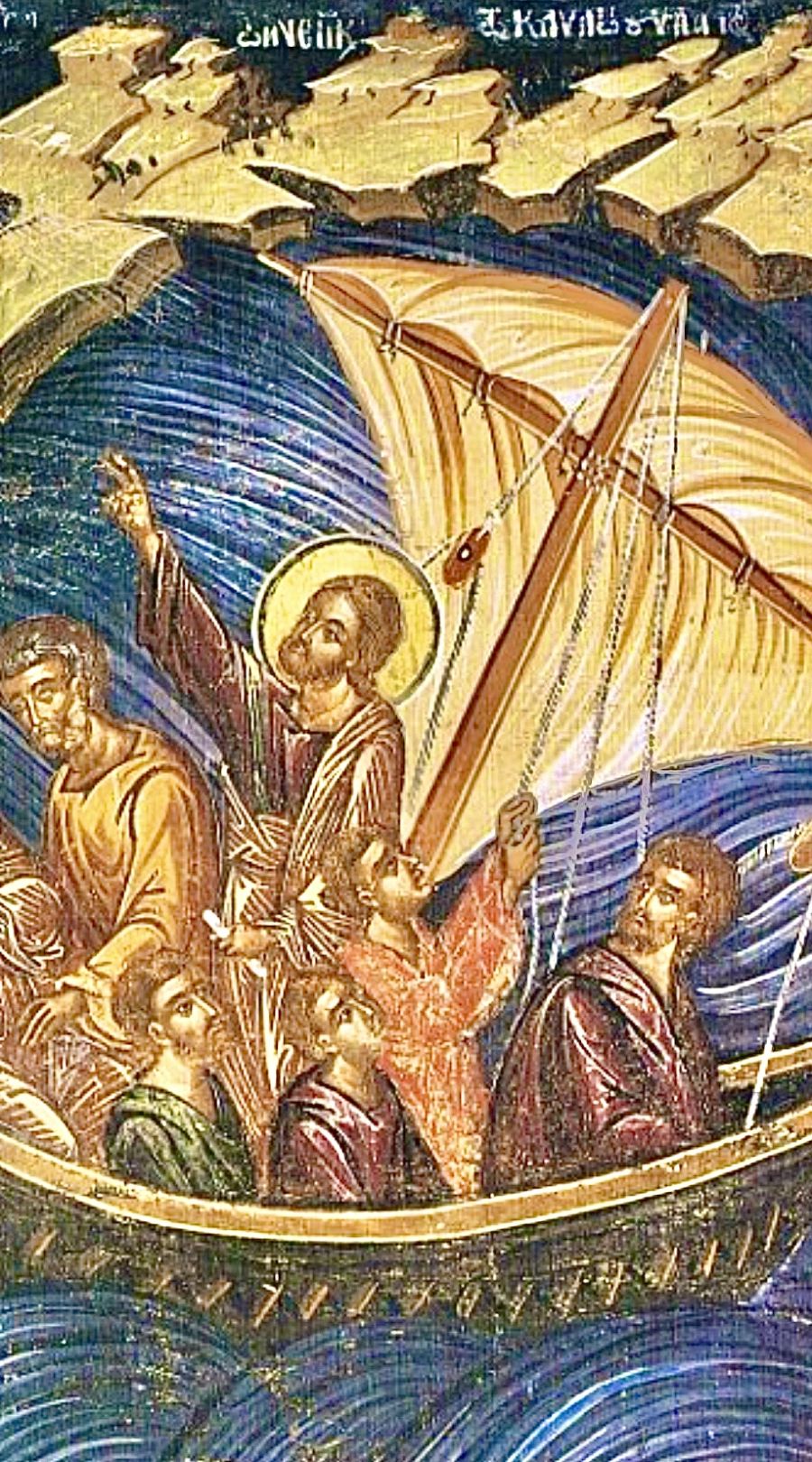
On troubled waters, with a headwind

(Mk 6:45-52)


Roman communities of the time of Mk [the year of the four Caesars] were on the high seas and the disciples seemed to be alone: the Master had now reached safe Land (vv.46-47).

In the dark, though they wanted to move forward, the tiny fraternities were confused by the ongoing civil war, marginalised by the ideology of power, battered by headwinds.

Using paraphrases from the book of Exodus and Isaiah [new Exodus], Mk seeks to help his communities understand the Mystery of the Person of Jesus.

In particular, the presence of the Father in Him, and that 'Someone within something': in the events of their life experience, also torn by internal polemics.

In such growth, there arises the essential awareness of the 'God-with-us'.

Only the Risen One overcomes the fear of upheavals, but does so without rushing in.

And He even wants to go beyond the storms in which the disciples seem to get wrapped up and lost (v.48).

He is devoid of established patterns that would frame Him forever: it would be like making Him evasive and making Him perish. Indeed - like the disciples of Emmaus - they do not recognise Him (vv.49-50).

But if we were all to welcome Him in the «little boat» (v.51), amazed within ourselves [cf. Greek text] we would realise that there is another Kingdom, where each element is in His power.


The invisible Friend guides and fulfils infallibly, and brings us to «shore» (v.53) - a ‘final condition’ that the force of the waves cannot affect, even when we have the feeling of being swept away by the floatings.

Precisely in the condition of tossed pilgrims, in approaching his Person we would experience a strange and 'different stability': the persistence against the current.

A crossing towards the freedom that 'comes'... from clinging to 'Jesus within' alone. In the chaos of securities, with no guarantees - because the Lord does not take us out of eddies and oscillating situations, to die in norms, or expected conformisms.

Ours is a discordant permanence, fluctuating; and actuating, but in reversals.

The fatigue of questioning ourselves and the suffering that the adventure of Faith hold, will also fade amidst the troubles of the rough seas.

It is enough to disengage oneself from fixed ideas of stability, even religious stability, and to listen to life as it is, embracing it, even in its throng of bumps, bitterness, dashed hopes of harmony, sorrows - engaging with this torrent of new emergencies, and encountering one's own profound nature.

The best vaccine against the anxieties of adventuring together with Christ on the changing waves of the unexpected will be precisely not to avoid worries upstream - rather, to go towards them and welcome them; to recognise oneself, to let them happen.

Even in the time of global crisis, the apprehensions that seem to want to devastate us again, come to us as preparatory energies for other joys that wish to break through - for new cosmic attunements; for amazement starting with ourselves. And guidance of the beyond.


Our little boat is in an upside down, inverted, unequal stability; uncertain, unseemly - yet energetic, prickly, capable of reinventing itself.

It may even be overstretched, but from disarray.


Weekday Liturgy, January 9

198 Last modified on Friday, 09 January 2026 11:59
don Giuseppe Nespeca

Giuseppe Nespeca è architetto e sacerdote. Cultore della Sacra scrittura è autore della raccolta "Due Fuochi due Vie - Religione e Fede, Vangeli e Tao"; coautore del libro "Dialogo e Solstizio".

And quite often we too, beaten by the trials of life, have cried out to the Lord: “Why do you remain silent and do nothing for me?”. Especially when it seems we are sinking, because love or the project in which we had laid great hopes disappears (Pope Francis)
E tante volte anche noi, assaliti dalle prove della vita, abbiamo gridato al Signore: “Perché resti in silenzio e non fai nulla per me?”. Soprattutto quando ci sembra di affondare, perché l’amore o il progetto nel quale avevamo riposto grandi speranze svanisce (Papa Francesco)
The Kingdom of God grows here on earth, in the history of humanity, by virtue of an initial sowing, that is, of a foundation, which comes from God, and of a mysterious work of God himself, which continues to cultivate the Church down the centuries. The scythe of sacrifice is also present in God's action with regard to the Kingdom: the development of the Kingdom cannot be achieved without suffering (John Paul II)
Il Regno di Dio cresce qui sulla terra, nella storia dell’umanità, in virtù di una semina iniziale, cioè di una fondazione, che viene da Dio, e di un misterioso operare di Dio stesso, che continua a coltivare la Chiesa lungo i secoli. Nell’azione di Dio in ordine al Regno è presente anche la falce del sacrificio: lo sviluppo del Regno non si realizza senza sofferenza (Giovanni Paolo II)
For those who first heard Jesus, as for us, the symbol of light evokes the desire for truth and the thirst for the fullness of knowledge which are imprinted deep within every human being. When the light fades or vanishes altogether, we no longer see things as they really are. In the heart of the night we can feel frightened and insecure, and we impatiently await the coming of the light of dawn. Dear young people, it is up to you to be the watchmen of the morning (cf. Is 21:11-12) who announce the coming of the sun who is the Risen Christ! (John Paul II)
Per quanti da principio ascoltarono Gesù, come anche per noi, il simbolo della luce evoca il desiderio di verità e la sete di giungere alla pienezza della conoscenza, impressi nell'intimo di ogni essere umano. Quando la luce va scemando o scompare del tutto, non si riesce più a distinguere la realtà circostante. Nel cuore della notte ci si può sentire intimoriti ed insicuri, e si attende allora con impazienza l'arrivo della luce dell'aurora. Cari giovani, tocca a voi essere le sentinelle del mattino (cfr Is 21, 11-12) che annunciano l'avvento del sole che è Cristo risorto! (Giovanni Paolo II)
Christ compares himself to the sower and explains that the seed is the word (cf. Mk 4: 14); those who hear it, accept it and bear fruit (cf. Mk 4: 20) take part in the Kingdom of God, that is, they live under his lordship. They remain in the world, but are no longer of the world. They bear within them a seed of eternity a principle of transformation [Pope Benedict]
Cristo si paragona al seminatore e spiega che il seme è la Parola (cfr Mc 4,14): coloro che l’ascoltano, l’accolgono e portano frutto (cfr Mc 4,20) fanno parte del Regno di Dio, cioè vivono sotto la sua signoria; rimangono nel mondo, ma non sono più del mondo; portano in sé un germe di eternità, un principio di trasformazione [Papa Benedetto]
In one of his most celebrated sermons, Saint Bernard of Clairvaux “recreates”, as it were, the scene where God and humanity wait for Mary to say “yes”. Turning to her he begs: “[…] Arise, run, open up! Arise with faith, run with your devotion, open up with your consent!” [Pope Benedict]

Due Fuochi due Vie - Vol. 1 Due Fuochi due Vie - Vol. 2 Due Fuochi due Vie - Vol. 3 Due Fuochi due Vie - Vol. 4 Due Fuochi due Vie - Vol. 5 Dialogo e Solstizio I fiammiferi di Maria

duevie.art

don Giuseppe Nespeca

Tel. 333-1329741


Disclaimer

Questo blog non rappresenta una testata giornalistica in quanto viene aggiornato senza alcuna periodicità. Non può pertanto considerarsi un prodotto editoriale ai sensi della legge N°62 del 07/03/2001.
Le immagini sono tratte da internet, ma se il loro uso violasse diritti d'autore, lo si comunichi all'autore del blog che provvederà alla loro pronta rimozione.
L'autore dichiara di non essere responsabile dei commenti lasciati nei post. Eventuali commenti dei lettori, lesivi dell'immagine o dell'onorabilità di persone terze, il cui contenuto fosse ritenuto non idoneo alla pubblicazione verranno insindacabilmente rimossi.






