


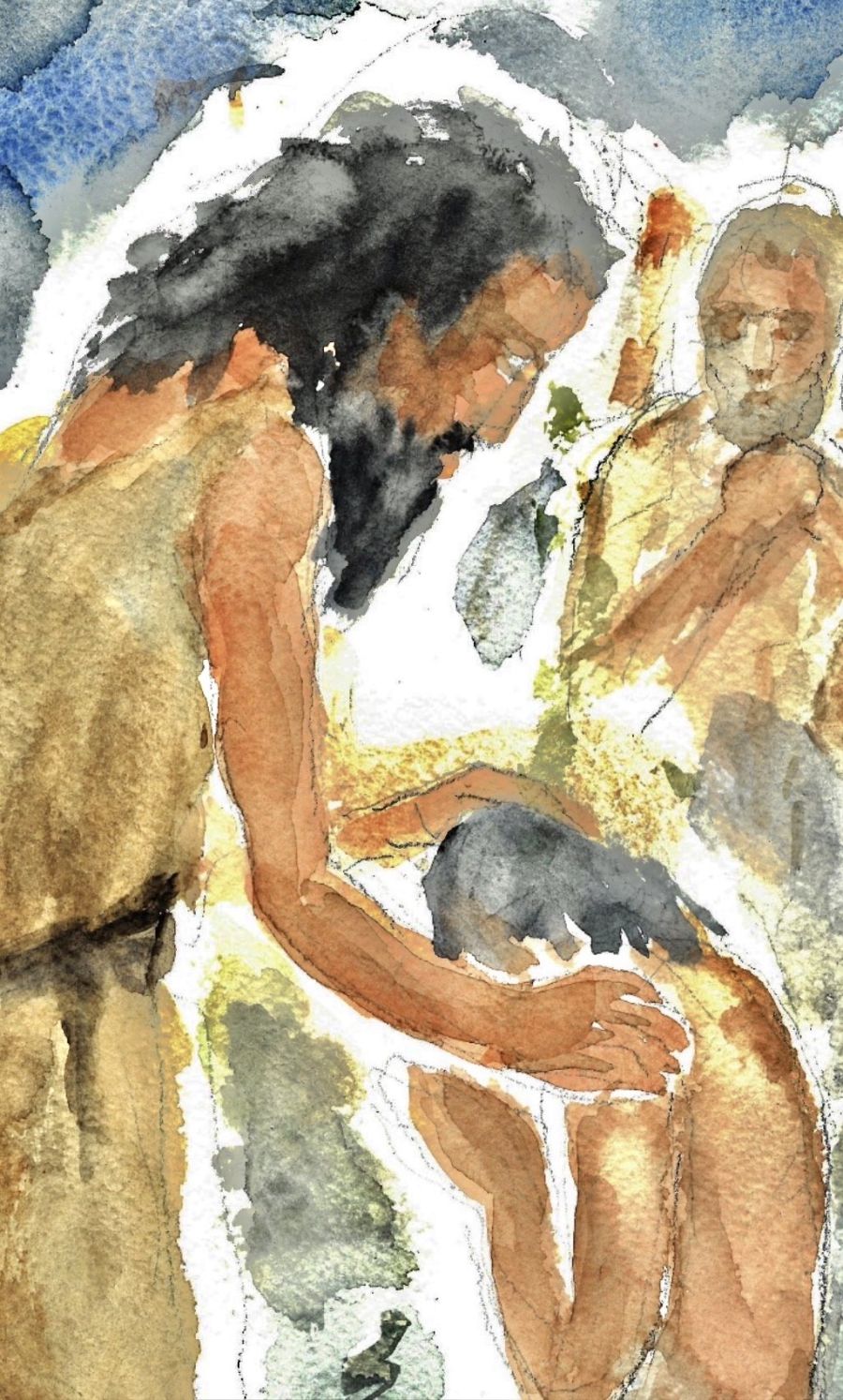
(Is 11:1-10; Mt 3:1-12)
The Son of God who Comes «will not judge according to appearances and will not make decisions by hearsay» (Is. 11:3).
Thus the Church who bears witness to him.
But how is it possible in the society of the outside, not to be conditioned by dominant opinions?
Not by trying to reproduce the world around.
But attempting the principle of a renewal that can only be introduced from the Source of the Sense of self and the cosmos - then it will also flow out, and it will happen constantly.
Not... immediately with blush, plump lips, swollen cheekbones, leveling of furrows; nor with an overambitious "U-conversion".
Not a defibrating regression to external religion; rather, by settling inside, in that Force of the Logos in the heart.
So, in the Gospels the Greek term «metanoia» doesn’t indicate a return to the God of normalized worship; rather, a change of mentality.
The life of Faith is precisely marked by the reversal of the hierarchy of values, which is reflected in real choices.
New Testament Conversion is a reappropriation of himself, not as in devotions, but with a coup de main.
A leap forward which makes fruitful, green and happy the recovery of the whole Church that draws from its own Source.
A reconquest of the same Core that drags the whole reality.
God in the soul not only improves, but rises in Vital Fullness. He acts by refounding, and chisels our true Path.
First of all He flies over the established cliques. It would be useless to insist on environments and characters refractory to the novelty of the Spirit.
Thus, the Word-event goes to land on a visionary of the present and the future.
At less than twenty years old, John should have presented himself to the practitioners of the rite and the Law to be examined according to the purist norms of the Torah, in order to then officiate the cults at the Temple in Jerusalem.
But despite being of a priestly lineage, he rejected that formal, insensitive and corrupt environment - which he knew well.
In short, the choice and the figure of the Baptist is a Reminder for us: to the authentic Church it’s not enough to iron wrinkles.
Botulinum and creams do not scratch reality, but disturb the Essence.
The Prophet felt young and alive precisely because he had not wanted to resemble, match at all costs, be identifiable, repeat opinions - nor did he limit himself to a remediation of the situation.
He didn't want to die out. He wanted to stare his gaze not on the big signs, but at his own (and others’) attitudes.
For us too, the "destiny" that belongs to us lurks in that daily impetus to want to do something creative and personal, unpublished and drawn only from the Core of our waves, rippling, many faces.
Advent [the Coming] thus proposes to us that Call of the Roots which opens the way - so that we may achieve something that is not habitual, but belongs to us.
We will be «shoots that sprout» not slumped, on the contrary that «rise to banner for the multitudes» because kidnapped and placed on this Ray of unusual «knowledge of the Lord that will fill the earth».
Counter-exodus of John the Baptist, counter-exodus of Jesus
Retracing the crossing of the Jordan.
Epistrèphein: Conversion is, in the ancient mindset, 'turning around', 'going back' (Hebrew Shùb) [because the people have strayed from God, from the Temple, from the Fathers].
In the Second Testament, the term is only Metanoein:
For the Baptist, conversion [already in the sphere of «metanoein»] does not have a specifically religious, liturgical or doctrinal meaning, but rather an existential one: it means, for example, putting an end to social injustices.
But according to Jesus' new preaching, Conversion has a broader and more central meaning. Christ proposes a new vision of God himself, of his Heart - and therefore of authentic man and society.
While the «brood of vipers' continues to inject its venom... here instead is the «Beautiful Fruit», complete and full, of this new tree (v. 10).
The CEI '74 translation proposed “good fruits” [which has another meaning, linked to morality, simplistic]. Now it is “good fruit”, which is perhaps halfway there.
«Beautiful Fruit» is Love; the product of the Fire of the Spirit [Gal 5:22: love, joy, peace, magnanimity, benevolence, goodness, faithfulness, gentleness, self-control].
This Fire is no longer an external element. No longer an extrinsic power. It comes from within.
Like the Action of the new Waters, now Joyful, which are assimilated not for the purpose of cleansing and purifying, but for growth.
A Flame yes, that burns away all evil - without, of course, making a «clean sweep».
Not spiritual life: Life in the Spirit!
A completely different specific weight, a completely different Breath.
Counter-exodus of the Baptist: sometimes we stopped there.
Counter-exodus of Jesus: Life in the Spirit.
[2nd Advent Sunday (year A), December 7, 2025]








