Oct 23, 2026 Written by 

End of strategic positions

(Lk 14:1.7-14)


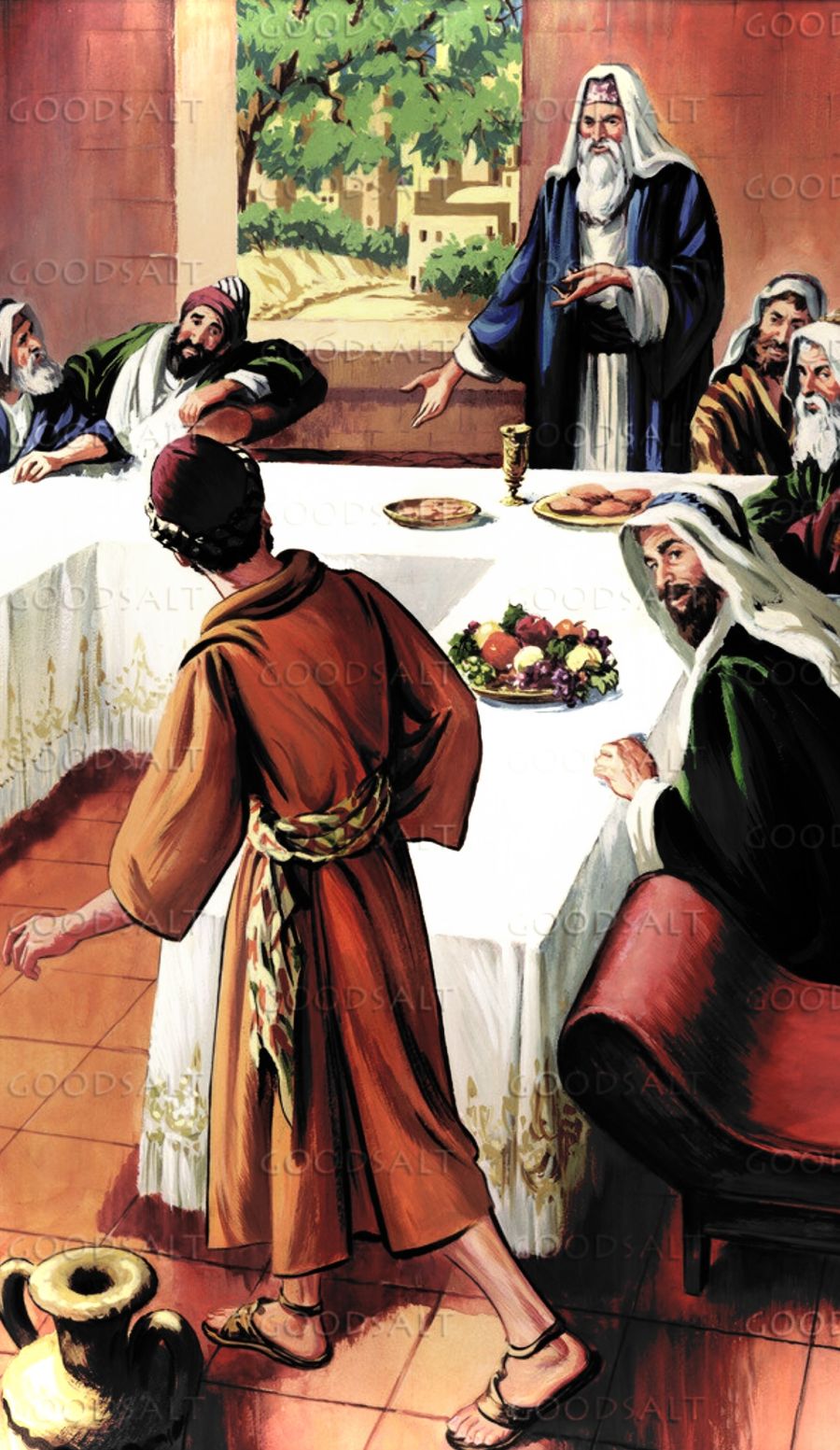
The Bible often presents Salvation under the image of a banquet in which God himself participates alongside man.

At the table of a "righteous" one did not sit immediately arriving: you had to stick to a strict label - because of class hierarchies absolutely to be respected.

At the center the persons of regard, then the owner; then all the others, but in order: according to social position, religious function, possessed wealth.

Clumsiness and complacency of vanity, the Lord evaluates them. Smoke volutes, strident especially in the case of the Eucharistic Banquet [v.1: «eating bread»; v.8: «wedding feast»].

And the way in which Jesus speaks at the Table is surprising: He imposes himself, reproaches, suggests.

Finally He begins to blame the one who "invited" him [vv.12-14: «this is not how you have to choose the guests...»]. The effect is lashing.

Yet his is not a lesson in etiquette, nor an exhortation to common sense; much less of opportunism.

During the breaking of the Bread, Christ is not an occasional guest, but the amphitryon, the master of the House [here already worried about the possible failure of his proposal].


The banquet of Lk 14 is precisely setting for the sacred Banquet in which everyone is simple summoned - by vocation (not by merit).

In fact, the recurring term is what some texts palely translate with "invited" while the Greek ‘kalèo’ means ‘[I] call': the «called».

Here it is necessary that notables and bystanders who willingly participate to show off immediately repent.

Not only must they stay away from grabbing, but they must also keep away from pathetic rush to occupy strategic positions.


With the image of the Eucharistic Banquet, Lk presents the world of relationships as God imagined it - reign where the Creator has «called» all his sons.

"Norm" between family members is not appropriation, nor some catwalk that inflates (only some) of self-respect.

Broken Bread regulates behavior in the sense of Gratuitousness.

It is Food of life not degrading, but humanizing: mutual recognition, dialogue, love, shared knowledge...

Food for a non-fierce life - despite the criteria of the ancient world may tend to infiltrate again.

Desire to accumulate and get noticed leads out of the logic of the unconditional invitation.

Arrogant pace of the primactors who sit on the throne to overcome and stand out - to be served first, better and with more abundance than the others - will soon be unmasked and overturned (vv.9-11).


With the drafting of the Gospel of Lk [mid-80’s] we are already in a time where disagreements explode over issues of precedence!

Problem perhaps unchanged, that in fact it is not resolved by moving back two or three places (vv.8-9) but reversing the scale of nomenklature (vv.10-11).

Indeed, that of love is «a continuing adventure [never finished] that makes every periphery converge in a greater sense of mutual belonging».

«As Jesus told us: You are all brothers (Mt 23:8)» [Fratelli Tutti, n.95].

In short, the assembly of sons helps everyone to converge; it cannot be  accomplice of those who transform the world into exteriority, position and business.


[Saturday 30th wk. in O.T.  October 31, 2026]

28 Last modified on Friday, 23 October 2026 04:54
don Giuseppe Nespeca

Giuseppe Nespeca è architetto e sacerdote. Cultore della Sacra scrittura è autore della raccolta "Due Fuochi due Vie - Religione e Fede, Vangeli e Tao"; coautore del libro "Dialogo e Solstizio".

Man rightly fears falling victim to an oppression that will deprive him of his interior freedom, of the possibility of expressing the truth of which he is convinced, of the faith that he professes, of the ability to obey the voice of conscience that tells him the right path to follow [Dives in Misericordia, n.11]
L'uomo ha giustamente paura di restar vittima di una oppressione che lo privi della libertà interiore, della possibilità di esternare la verità di cui è convinto, della fede che professa, della facoltà di obbedire alla voce della coscienza che gli indica la retta via da seguire [Dives in Misericordia, n.11]
We find ourselves, so to speak, roped to Jesus Christ together with him on the ascent towards God's heights (Pope Benedict)
Ci troviamo, per così dire, in una cordata con Gesù Cristo – insieme con Lui nella salita verso le altezze di Dio (Papa Benedetto)
There are also serious, dangerous omissions and we have to recognize with healthy realism that in this way things are not all right, it is not all right when errors are made. However, we must also be certain at the same time that if, here and there, the Church is dying because of the sins of men and women, because of their non-belief, at the same time she is reborn (Pope Benedict)
Ci sono anche cadute gravi, pericolose, e dobbiamo riconoscere con sano realismo che così non va, non va dove si fanno cose sbagliate. Ma anche essere sicuri, allo stesso tempo, che se qua e là la Chiesa muore a causa dei peccati degli uomini, a causa della loro non credenza, nello stesso tempo, nasce di nuovo (Papa Benedetto)
The question makes apparent the concern, present in ancient Jewish tradition, over finding a unifying principle in the various formulations of God's will […] Emphasis is placed on the totality of this dedication to God, listing the three faculties that define man in his deep psychological structures: heart, soul and mind. The word mind, diánoia, contains the rational element (Pope Benedict)
La domanda lascia trasparire la preoccupazione, presente nell’antica tradizione giudaica, di trovare un principio unificatore delle varie formulazioni della volontà di Dio […] L’accento è posto sulla totalità di questa dedizione a Dio, elencando le tre facoltà che definiscono l’uomo nelle sue strutture psicologiche profonde: cuore, anima e mente. Il termine mente, diánoia, contiene l’elemento razionale (Papa Benedetto)
A “year” of grace: the period of Christ’s ministry, the time of the Church before his glorious return, an interval of our life (Pope Francis)
Un “anno” di grazia: il tempo del ministero di Cristo, il tempo della Chiesa prima del suo ritorno glorioso, il tempo della nostra vita (Papa Francesco)
The Church, having before her eyes the picture of the generation to which we belong, shares the uneasiness of so many of the people of our time (Dives in Misericordia n.12)
Avendo davanti agli occhi l'immagine della generazione a cui apparteniamo, la Chiesa condivide l'inquietudine di tanti uomini contemporanei (Dives in Misericordia n.12)
Nec quisquam sumit sibi honorem, sed qui vocatur a Deo, there is no one who assumes this dignity for himself, if he is not called by God (Heb 5:4) [Pope Paul VI]
Nec quisquam sumit sibi honorem, sed qui vocatur a Deo, non vi è alcuno che assuma da sé questa dignità, se non è chiamato da Dio (He 5,4) [Papa Paolo VI]

Due Fuochi due Vie - Vol. 1 Due Fuochi due Vie - Vol. 2 Due Fuochi due Vie - Vol. 3 Due Fuochi due Vie - Vol. 4 Due Fuochi due Vie - Vol. 5 Dialogo e Solstizio I fiammiferi di Maria

duevie.art

don Giuseppe Nespeca

Tel. 333-1329741


Disclaimer

Questo blog non rappresenta una testata giornalistica in quanto viene aggiornato senza alcuna periodicità. Non può pertanto considerarsi un prodotto editoriale ai sensi della legge N°62 del 07/03/2001.
Le immagini sono tratte da internet, ma se il loro uso violasse diritti d'autore, lo si comunichi all'autore del blog che provvederà alla loro pronta rimozione.
L'autore dichiara di non essere responsabile dei commenti lasciati nei post. Eventuali commenti dei lettori, lesivi dell'immagine o dell'onorabilità di persone terze, il cui contenuto fosse ritenuto non idoneo alla pubblicazione verranno insindacabilmente rimossi.