Oct 17, 2026 Written by 

The One Commandment Great

No forced compliance: only profound Quality compels

(Mt 22:34-40)


That of the ‘Great commandment’ was the most familiar catechism rule, even to infants.

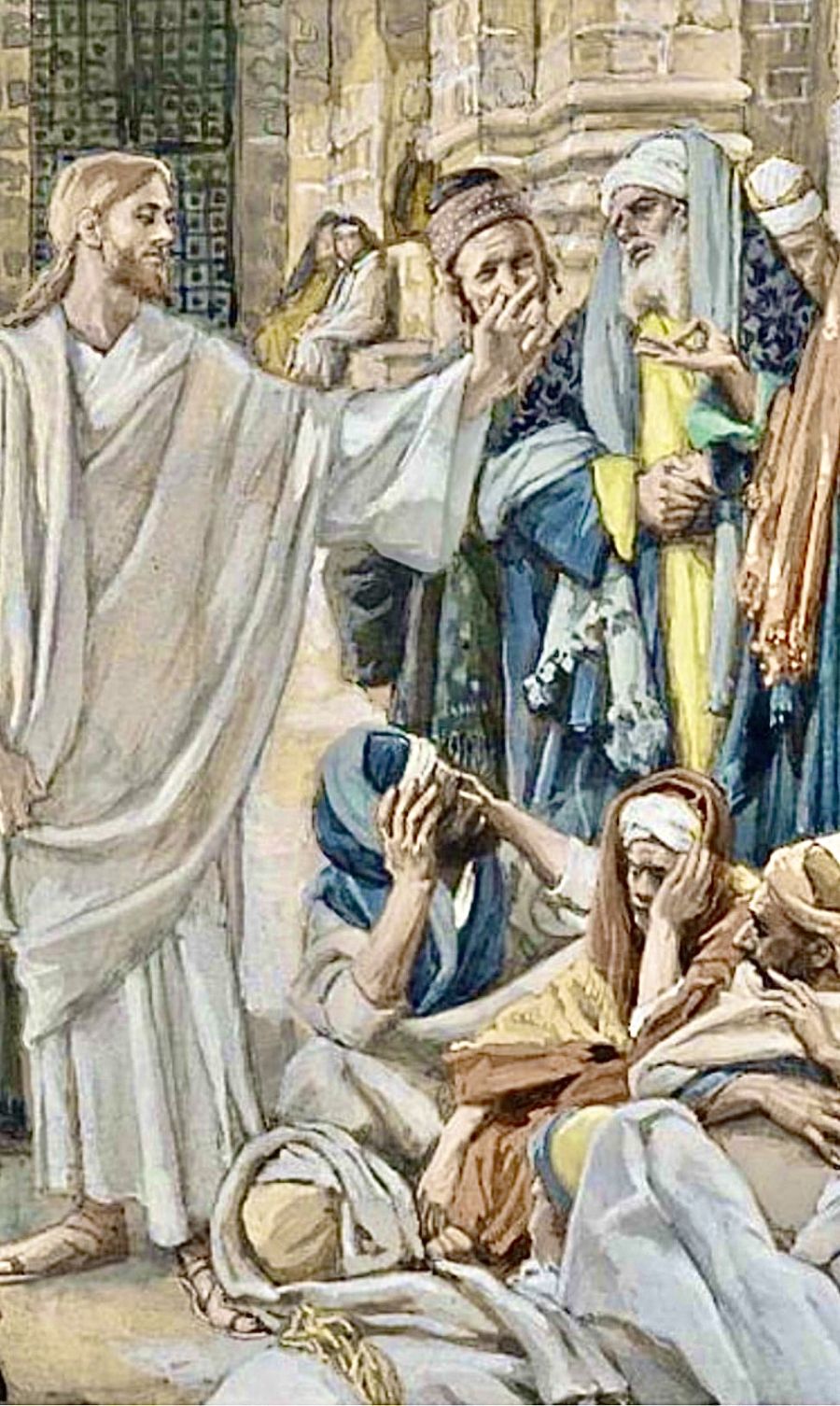
Jesus is questioned to retort: and why do you not keep the one commandment that even God fulfils - the Sabbath rest?

The unique disposition in which the Father recognizes himself is Love, not some particular precept - because only profound Quality obliges.

The spiritual proposal of the Master makes the narrative of God's people and the practice of the Prophets its own: all heart, feet, hands - and intelligence.

Complete Love for God envelops the creature in every decision [heart], every moment and aspect of its concrete 'life', all its resources [strength].

Mt does not explicitly mention this last aspect, perhaps to emphasize that the Father does not absorb energies in any way, but transmits them.

And Jesus adds to the nuances of authentic understanding with God enumerated in the First Testament an unexpected side to those who think of love as a feeling only emotional.

The Lord suggests study, discernment and understanding of our perceptions (v.37) - the mental and deep intelligence aspect that complements Dt 6.

At first glance, it appears to be a secondary facet or even a frill for the qualitative leap from a common religious sense to the wisely and personally configured existence of Faith.

The exact opposite is true: we are children of a Father who does not supplant us, nor absorb our forces or potential, depersonalising us; not even from the mental point of view.

Practicality alone makes us fragile, not very aware; and when we are not convinced, we will not be reliable either, always at the mercy of changing situations and the conformist, fashionable, other people’s opinion.

Jesus does not speak of love for God in terms of intimacy and feeling, but of a totally involving affinity, made less oscillating precisely by the development of our sapiential measure on issues.

Here is a decisive appointment, of the Love in the round.

It would be unnatural to recognise a Lord of Heaven who does not come to meet us and instead towers over us with an objective of his own, which is extrinsic to us and makes us marginal.


Loving «How [and Because] yourself»: it is a new Genesis in the spirit of Giving.

All this involves practising kindness, even towards oneself. The journey to Heaven is intertwined with the path of the Person.

God’s «great commandment» encompasses real life and concerns not only the quality of our relationship with the world and our neighbour, but also our overall reflection on ourselves. 

The paradox suggested by Jesus is that we love for the care to meet - and because we love ourselves - by expanding the ‘I’ into the ‘You’.

The ‘You’ that speaks to us of ourselves.


We should not be afraid of other doctrines and disciplines, neglecting the challenges even intellectual ones that call into question beliefs, works, one’s worldview, language, style, and thought itself.

All added values.

Needless to complain, if the ecclesial realities that do not update or deepen, and remain in the inherited commonplaces [or vogues] slowly decay, then disappear.

Therefore to the ancient notes of true love, the Son of God adds the ‘quality of mind’: we are not gullible, clueless, one-sided.

Our outstretched hands are the result of free and conscious choice. No forced surrender.

«Faith that does not become culture is a faith that is not fully accepted, not entirely thought out, not faithfully lived» [John Paul II].


To internalize and live the message:


What is Great for you? Do you document and update yourself in order to better correspond to God’s Call?


[Friday 20th wk. in O.T.  October 25, 2026]

27 Last modified on Saturday, 24 October 2026 11:20
don Giuseppe Nespeca

Giuseppe Nespeca è architetto e sacerdote. Cultore della Sacra scrittura è autore della raccolta "Due Fuochi due Vie - Religione e Fede, Vangeli e Tao"; coautore del libro "Dialogo e Solstizio".

The question makes apparent the concern, present in ancient Jewish tradition, over finding a unifying principle in the various formulations of God's will […] Emphasis is placed on the totality of this dedication to God, listing the three faculties that define man in his deep psychological structures: heart, soul and mind. The word mind, diánoia, contains the rational element (Pope Benedict)
La domanda lascia trasparire la preoccupazione, presente nell’antica tradizione giudaica, di trovare un principio unificatore delle varie formulazioni della volontà di Dio […] L’accento è posto sulla totalità di questa dedizione a Dio, elencando le tre facoltà che definiscono l’uomo nelle sue strutture psicologiche profonde: cuore, anima e mente. Il termine mente, diánoia, contiene l’elemento razionale (Papa Benedetto)
A “year” of grace: the period of Christ’s ministry, the time of the Church before his glorious return, an interval of our life (Pope Francis)
Un “anno” di grazia: il tempo del ministero di Cristo, il tempo della Chiesa prima del suo ritorno glorioso, il tempo della nostra vita (Papa Francesco)
The Church, having before her eyes the picture of the generation to which we belong, shares the uneasiness of so many of the people of our time (Dives in Misericordia n.12)
Avendo davanti agli occhi l'immagine della generazione a cui apparteniamo, la Chiesa condivide l'inquietudine di tanti uomini contemporanei (Dives in Misericordia n.12)
Addressing this state of mind, the Church testifies to her hope, based on the conviction that evil, the mysterium iniquitatis, does not have the final word in human affairs (Pope John Paul II)
Di fronte a questi stati d'animo la Chiesa desidera testimoniare la sua speranza, basata sulla convinzione che il male, il mysterium iniquitatis, non ha l'ultima parola nelle vicende umane (Papa Giovanni Paolo II)
Jesus reminds us today that the expectation of the eternal beatitude does not relieve us of the duty to render the world more just and more liveable (Pope Francis)
Gesù oggi ci ricorda che l’attesa della beatitudine eterna non ci dispensa dall’impegno di rendere più giusto e più abitabile il mondo (Papa Francesco)
Those who open to Him will be blessed, because they will have a great reward: indeed, the Lord will make himself a servant to his servants — it is a beautiful reward — in the great banquet of his Kingdom He himself will serve them [Pope Francis]
E sarà beato chi gli aprirà, perché avrà una grande ricompensa: infatti il Signore stesso si farà servo dei suoi servi - è una bella ricompensa - nel grande banchetto del suo Regno passerà Lui stesso a servirli [Papa Francesco]
The fool in the Bible, the one who does not want to learn from the experience of visible things, that nothing lasts for ever but that all things pass away, youth and physical strength, amenities and important roles. Making one's life depend on such an ephemeral reality is therefore foolishness (Pope Benedict)
L’uomo stolto nella Bibbia è colui che non vuole rendersi conto, dall’esperienza delle cose visibili, che nulla dura per sempre, ma tutto passa: la giovinezza come la forza fisica, le comodità come i ruoli di potere. Far dipendere la propria vita da realtà così passeggere è, dunque, stoltezza (Papa Benedetto)
As sometimes happens in the Gospel, faced with the trap set by his enemies, Jesus, with his response, rises above the contingent controversy and goes far beyond the particular and mutually divergent positions (Pope John Paul II)

Due Fuochi due Vie - Vol. 1 Due Fuochi due Vie - Vol. 2 Due Fuochi due Vie - Vol. 3 Due Fuochi due Vie - Vol. 4 Due Fuochi due Vie - Vol. 5 Dialogo e Solstizio I fiammiferi di Maria

duevie.art

don Giuseppe Nespeca

Tel. 333-1329741


Disclaimer

Questo blog non rappresenta una testata giornalistica in quanto viene aggiornato senza alcuna periodicità. Non può pertanto considerarsi un prodotto editoriale ai sensi della legge N°62 del 07/03/2001.
Le immagini sono tratte da internet, ma se il loro uso violasse diritti d'autore, lo si comunichi all'autore del blog che provvederà alla loro pronta rimozione.
L'autore dichiara di non essere responsabile dei commenti lasciati nei post. Eventuali commenti dei lettori, lesivi dell'immagine o dell'onorabilità di persone terze, il cui contenuto fosse ritenuto non idoneo alla pubblicazione verranno insindacabilmente rimossi.