2. Christ says: ‘If anyone loves me, they will keep my word, and my Father will love them, and we will come to them…’ (Jn 14:23). At the very heart of Christ’s teaching lies the great commandment of love. This commandment was already enshrined in the tradition of the Old Testament, as today’s first reading, taken from the Book of Deuteronomy, bears witness.
When the Lord Jesus answers the question posed by one of the scribes, he refers to this version of the divine Law, revealed in the Old Covenant: ‘Which is the first of all the commandments?’. ‘The first is… you shall love… the Lord your God with all your heart, with all your mind and with all your strength.’ ‘And the second is this: you shall love your neighbour as yourself.’ ‘There is no other commandment greater than these’ (Mk 12:29–31).
3. That interlocutor, whom Saint Mark recalls, accepted Christ’s answer thoughtfully. He accepted it with profound approval. We too, today, need to reflect briefly on this ‘greatest commandment’, so that we may accept it anew with full approval and deep conviction. First and foremost, Christ emphasises the primacy of love in human life and vocation. Man’s greatest vocation is the call to love. Love also gives definitive meaning to human life. It is the essential condition of human dignity, the proof of the nobility of the human soul. St Paul will say that it is ‘the bond of perfection’ (Col 3:14). It is the greatest thing in human life, for true love embodies the dimension of eternity. It is immortal: ‘Love never fails’, as we read in the First Letter to the Corinthians (1 Cor 13:8). A person dies in the flesh, for such is the fate of everyone on earth; yet this death does not harm the love that has matured in their life. Certainly, it remains above all to bear witness to man before God, who is love. It designates man’s place in the Kingdom of God; within the order of the Communion of Saints. The Lord Jesus, speaking to his interlocutor in today’s Gospel – seeing that he understands the primacy of love amongst the commandments – says: “You are not far from the Kingdom of God” (Mk 12:34).
4. There are two commandments of love – as the Master expressly states in his reply – but there is only one love. One and the same love embraces both God and one’s neighbour. God: above all things, for He is above all. One’s neighbour: on a human scale, and therefore “as oneself”.
These ‘two loves’ are so closely linked that one cannot exist without the other. St John says as much elsewhere: ‘For whoever does not love their brother whom they have seen cannot love God whom they have not seen’ (1 John 4:20). One love cannot, therefore, be separated from the other. True love for one’s neighbour, precisely because it is true love, is, at the same time, love for God. This may surprise some people. It is certainly surprising. When the Lord Jesus presents to his listeners the vision of the Last Judgement, as recounted in the Gospel of Saint Matthew, he says: ‘I was hungry and you gave me food, I was thirsty and you gave me drink; I was a stranger and you welcomed me; I was naked and you clothed me; I was ill and you visited me; I was in prison and you came to see me’ (Mt 25:35–36).
Then those who hear these words are astonished, for we hear them ask: ‘Lord, when did we ever do any of these things for you?’. And the reply: ‘Truly I tell you: whenever you did these things for one of these least of my brothers and sisters – that is, for your neighbour: for one of your fellow human beings – you did it for me’ (cf. Mt 25:37, 40).
5. This truth is of great importance for our whole life and for our conduct. It is particularly important for those who seek to love their fellow human beings, but ‘do not know whether they love God’ or even declare that they do not ‘know’ how to love him.
This difficulty is easy to explain when one takes into account the whole nature of man, his entire psychology. It is, in a certain sense, easier for man to love what he sees than what he does not see (cf. 1 John 4:20).
6. Yet man is called—and called with great firmness, as the words of the Lord Jesus bear witness—to love God, to a love that surpasses all else. If we reflect on this commandment, on the meaning of the words already written in the Old Testament and repeated with such determination by Christ, we must recognise that they tell us a great deal about man himself. They reveal the deepest and, at the same time, definitive perspective on his being, on his humanity. If Christ assigns to man such love as a task—that is, the love of God which he, as a human being, cannot see—this means that the human heart harbours within itself the capacity for this love, that the human heart is created ‘tailored to such love’. Is this not, perhaps, the first truth about man, namely that he is the image and likeness of God himself? Does not Saint Augustine speak of the human heart which remains restless until it finds rest in God? Thus, then, the commandment to love God above all things reveals a scale of man’s inner possibilities. This is not an abstract scale. It has been reaffirmed and is constantly confirmed by all those who take their faith—the fact of being Christian—seriously. Yet there is no shortage of people who have heroically confirmed this scale of man’s inner possibilities.
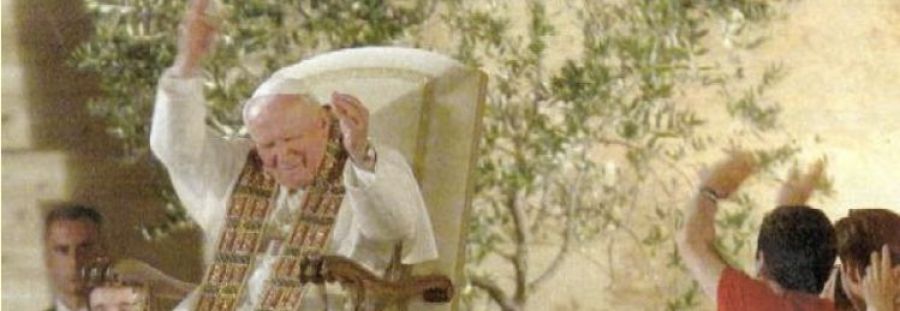
[Pope John Paul II, homily, 4 November 1979]