


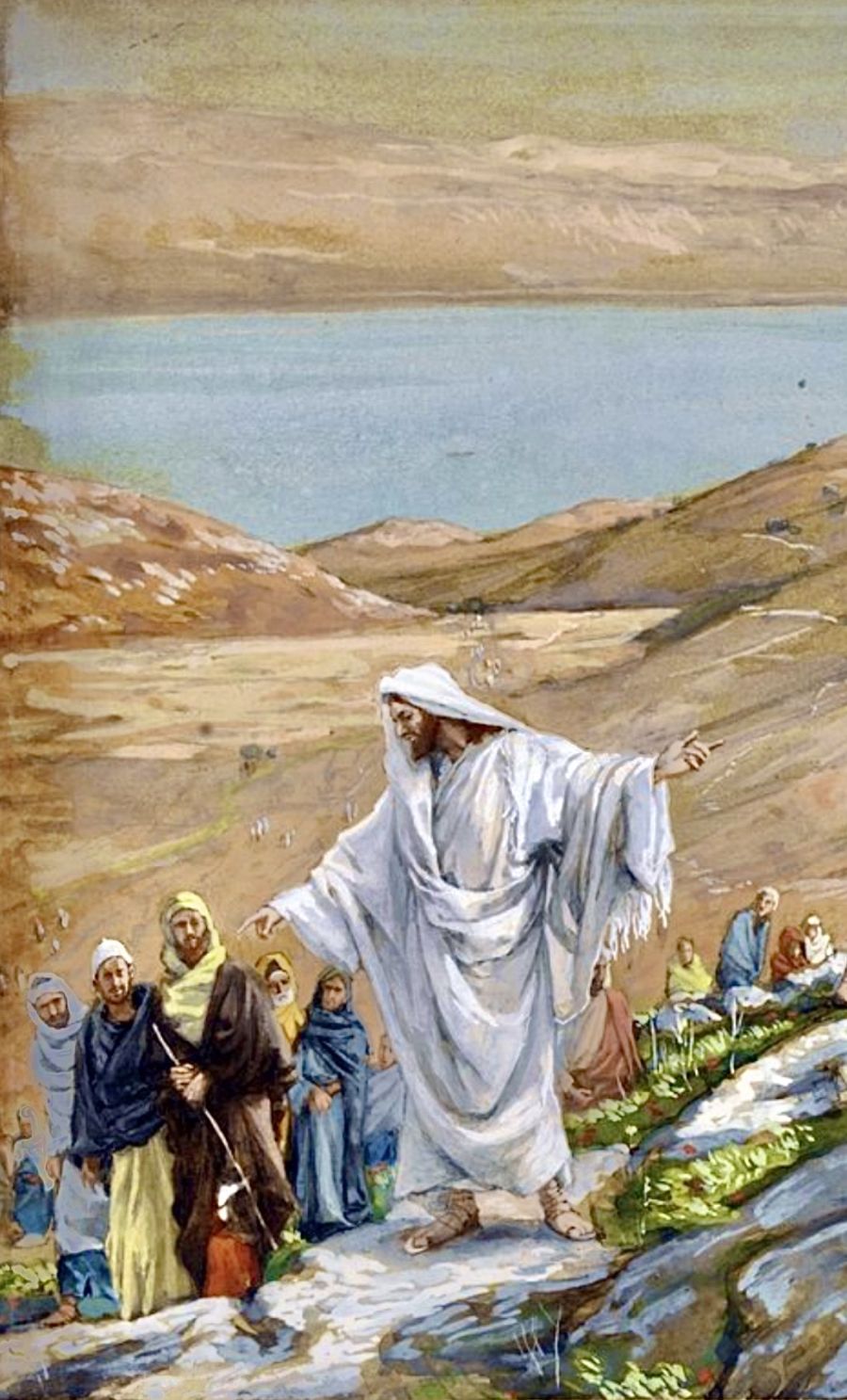
Satisfied sobriety: new Depth
(Lk 9:1-6)
At the time of Jesus, there was no lack of various renewal movements that sought to revive community life, undermined by economic and social collapse, and political and religious servility.
Essenes, Pharisees and Zealots had their missionaries, who although sent by those who most radically desired a new way of co-presence, were totally biased against other interlocutors.
They did not trust people, nor the customs or food of others, which was also legally considered unclean.
Instead, the Apostles must learn to accept hospitality; trusting people, and imagine being welcomed even by those whom common devotion considers defiled.
The person of Faith differs from the fundamentalist religious believer because he has an opposite criterion of fraternity and coexistence: he denounces the laws of ritual, cultural and social exclusion.
He/she have a new depth.
Access to 'purity' is in the intimate and personal relationship with God, and in the quality of open relationships; not elsewhere. And the Church is an eccentric reality; it does not live for itself, for advantage, to win.
It has only the task of keeping alive the Message that guides all to full Happiness.
Each one, and the Community itself, focus on the [real, through life] Announcement that has transforming power. Absolutely the Church is not established to impose ideas and triumph, far from it.
Thus the son of God on the way cannot spend time improving his lodging, as if it were a sign of social and spiritual rank - perhaps moving from an initial makeshift accommodation to more and more affluent and conspicuous forms on the territory (v.4).
The authentic witness to Christ has in his heart quite another Promise.
Lk insists that the Mission must take place in absolute poverty - a condition for continuing the dream of Jesus - and even takes away from the believer in Christ the [helpless] shortage of the travelling stick that Mk (6:8) leaves him instead.
Relationships with events, relationships with people and the blind forces of power, and natural contingencies, must become in us Encounter.
Stunning of new Empathy that in itself announces wisdom, healing, and victory over infirmity (vv.1-2) - introducing even the distant and desperate to the incisiveness of Faith.
This Journey of finding one's own and others' lives in the hands of the Father is not yet over.
The Truth of the Risen One is open to an updated and perspective, unframed Hope - to be enlivened again. The need for works transmuting the ancient world acquires an ever invigorated topicality.
It continues to the present day, but with needs, motives, horizons and offers of redemption in totally surprising “divine” forms - also due to multifaceted cultural contexts [or even internal interferences, with their unchanging attempts at rigid and pious respectability or fashionable obfuscation of the human spirit].
What matters is not the Means, tools [which are used from time to time], which differ according to environment or are more or less limited, but the proclamation of the Truth that one 'does', not that one 'has'.
In itself, material deprivation is a “chair”, but also a showcase. In other religions, there are forms of individual poverty and dispossession [compared to ours] that are heroic and astonishing, yet perhaps inaccessible and circle-like in their incredible athleticism - and depersonalisation.
The Church must be free, available, all dedicated, defenceless.
Its specific weight - a true guarantee of credibility - remains to be discerned in the order of a universal and perfect life ‘as saved ones’ [recovered by Grace], not like aseptic phenomena chiselled in minute detail.
We see it today, in the time of global crisis: we need to reinvent ourselves in order to be reborn, even in terms of the sacredness criteria.
In short: we have to stop sabotaging our spontaneous natural resources, and become who we are, starting from day-to-day frailties - in a more genuine [and at the same time, deeper] way.
Sometimes it will be necessary to make use of the very aspects that were once considered to be a weakness of character... precisely to be excluded, in a world that is all exterior, falsely extroverted, mannered, self-important.
In order to build one Family and one People of God, freed from fetters that humble the joy, all credible ‘facts’ and conforming ‘means’ - fragrant and spontaneous, or even culturally honed - can be welcomed, taken into account, reinvented.
The absolute and non-negotiable option is the good of the concrete woman and man, not a belief in pureness, or “cultural” appropriateness.
What matters is the concern for our relationship with God in the communion with our brothers and sisters as equals, for a conviviality of differences that enriches us, personally and together.
The quality of understanding is enough for everything, and marks a wise difference to idolizing aspects... such as material rivalry, control of weak consciences, and expansion into the territory - figures that are so important for ideologies and unfortunately also for some imposing forms of our beliefs [rigid or surreptitious].
If, on the other hand, we root ourselves in an exclusively convivial and broad-minded disposition of coexistence, we will inform our entire way of life. This, in the satisfied sobriety of those who already possess the authentic Treasure, within and without: the universal Christ, resurrected for the «multitudes»; Source and Summit of the Kingdom to be built.
To internalize and live the message:
How do you proclaim the Kingdom of God?
Do you bring what you, first, experienced, or do you prefer other people’s ideas, artificial attitudes, schemes, thoughts, organisation charts and ‘names’?
What do you think complicates the Announcement today?
[Wednesday 25th wk. in O.T. September 23, 2026]








