Aug 12, 2026 Written by 

The Feast, the Robe

Everyone is called, but with which trousseau? Without artifices

(Mt 22:1-14)


The «wedding dress» (vv.11-12) is not here a figure of the our outside image, but of the essential -  of what really matters.

The Kingdom of God announced by Jesus does not admit personal and civil disregard [cf. Mt 21]. And the Banquet preached by the Master is not a Garden of Eden for a future in the afterlife, but a direct thread.

His Meal Table is the new condition into which the person who trusts his proposal is introduced.

But there are those who feel satiated, because they feel they already have enough for a life without too many problems.

It was the situation of the authorities, satisfied with the superabundant religious structure, which seemed to offer just social security, and certainty even before God.

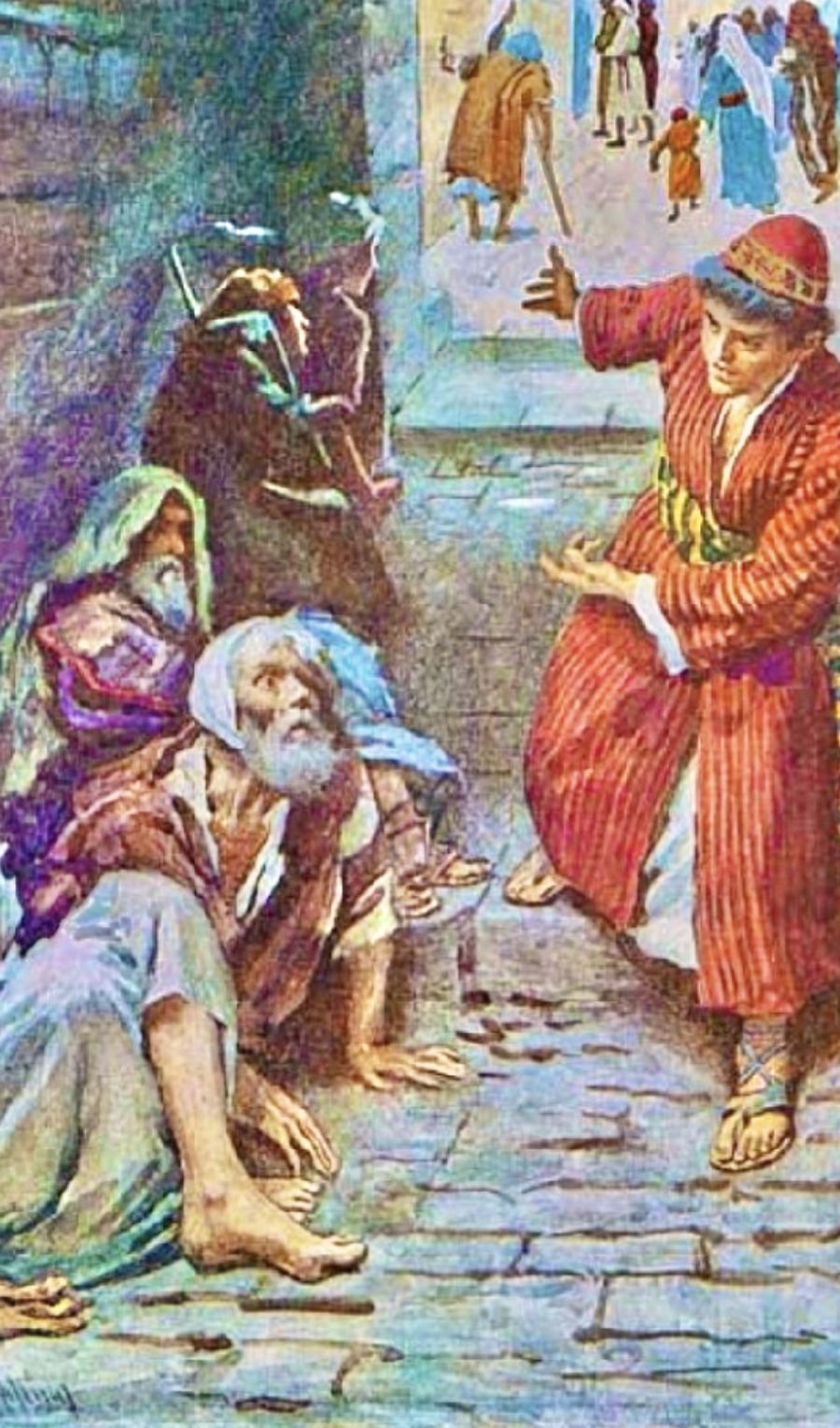
All are called (v.14) to the Banquet, yet someone did not keep the white robe of Baptism in Christ. He has totally changed his outfit, and presents himself with the rags of ancient life.

Jesus resumes speaking with the leaders and confronts them without half measures, because He does not compare the Kingdom of the Father to a solemn assembly, but to a wedding feast!

In the simple, popular, immediate and playful frankness of a marriage there is a human reality characterizing the divine condition: the spontaneous Joy of genuine relations, face to face.

The proposal for a cheering novelty, however, is rejected. Self-sufficient and experienced venerate another master: interest. 

Opportunism cannot be an ingredient of the Sacred: profit turns people back on itself, closes their eyes, makes them unilateral, gloomy.

And despicable calculations lead the same people to destruction (v.7).

The background of the parable is the friction between Jews and converted pagans.

Considering themselves chosen - «elected» (v.14) - the former refused to break the Bread, share, catch up with the latter.

It is interesting however that the faithful servants, pushing pushing, stood out (backwards): in any circumstance they remained willing to enter "last" at the Banquet.

In short, the space opened by the self-exclusion of the nation called first would not have succeeded in putting an "end" to the efforts of those who have always fought for life and authenticity.

Fruiting trees do not like to prevaricate. They risk and occupy only the last place; being close to the uncertain, and encouraging them. 

Therefore at v.9 Mt invites us to go to the «outlets of the streets» [Greek text] ie in the existential suburbs where life is not obvious, but pulsates always new. Where you cannot be indifferent.

The Greek term indicates the end of urban (reassuring) roads and the beginning of the paths poorly cared for and risky.

In Semitic mentality, they were the boundary of the pure territory and the threshold of precarious, contaminated places.

Not only that: God’s offer of love gathers first the "bad guys" [«wicked»: v.10 Greek text] to emphasize that Heaven is not ‘at points’.

It is available to the needy, to those who recognise themselves as such.

But everyone can be misdressed outside, not inside: that is, vigilant to the brothers, and diligent. We are called to abandon neglect and carelessness.

By Faith that incorporates us without conditions to the Bridegroom, the clean and sumptuous dress is always made available by the Landlord.

But wearing it is the result of a conscious choice, made its own: wanting «to give birth to a new world, where all of us are brothers and sisters, where there is room for all those whom our societies discard» [Fratelli Tutti (Brethren All), n. 278].

God's people cannot live in a parallel, disconnected, double world - as if the only God they worship is 'marketing and convenience'.


[Thursday 20th wk. in O.T.   August 20, 2026]

102 Last modified on Wednesday, 12 August 2026 03:05
don Giuseppe Nespeca

Giuseppe Nespeca è architetto e sacerdote. Cultore della Sacra scrittura è autore della raccolta "Due Fuochi due Vie - Religione e Fede, Vangeli e Tao"; coautore del libro "Dialogo e Solstizio".

The invitation has three characteristics: freely offered, breadth and universality. Many people were invited, but something surprising happened: none of the intended guests came to take part in the feast, saying they had other things to do; indeed, some were even indifferent, impertinent, even annoyed (Pope Francis)
L’invito ha tre caratteristiche: la gratuità, la larghezza, l’universalità. Gli invitati sono tanti, ma avviene qualcosa di sorprendente: nessuno dei prescelti accetta di prendere parte alla festa, dicono che hanno altro da fare; anzi alcuni mostrano indifferenza, estraneità, perfino fastidio (Papa Francesco)
Those who are considered the "last", if they accept, become the "first", whereas the "first" can risk becoming the "last" (Pope Benedict)
Proprio quelli che sono considerati "ultimi", se lo accettano, diventano "primi", mentre i "primi" possono rischiare di finire "ultimi" (Papa Benedetto)
The dialogue of Jesus with the rich young man, related in the nineteenth chapter of Saint Matthew's Gospel, can serve as a useful guide for listening once more in a lively and direct way to his moral teaching [Veritatis Splendor n.6]
Il dialogo di Gesù con il giovane ricco, riferito nel capitolo 19 del Vangelo di san Matteo, può costituire un'utile traccia per riascoltare in modo vivo e incisivo il suo insegnamento morale [Veritatis Splendor n.6]
St Augustine rightly commented: “Christ showed himself indifferent to her, not in order to refuse her his mercy but rather to inflame her desire for it” (Sermo 77, 1: PL 38, 483) [Pope Benedict]
Sant’Agostino commenta giustamente: “Cristo si mostrava indifferente verso di lei, non per rifiutarle la misericordia, ma per infiammarne il desiderio” (Sermo 77, 1: PL 38, 483) [Papa Benedetto]
In the divine attitude justice is pervaded with mercy, whereas the human attitude is limited to justice. Jesus exhorts us to open ourselves with courage to the strength of forgiveness, because in life not everything can be resolved with justice. We know this (Pope Francis)
Nell’atteggiamento divino la giustizia è pervasa dalla misericordia, mentre l’atteggiamento umano si limita alla giustizia. Gesù ci esorta ad aprirci con coraggio alla forza del perdono, perché nella vita non tutto si risolve con la giustizia; lo sappiamo (Papa Francesco)
The Second Vatican Council's Constitution on the Sacred Liturgy refers precisely to this Gospel passage to indicate one of the ways that Christ is present:  "He is present when the Church prays and sings, for he has promised "where two or three are gathered together in my name there am I in the midst of them' (Mt 18: 20)" [Sacrosanctum Concilium, n. 7]
La Costituzione sulla Sacra Liturgia del Concilio Vaticano II si riferisce proprio a questo passo del Vangelo per indicare uno dei modi della presenza di Cristo: "Quando la Chiesa prega e canta i Salmi, è presente Lui che ha promesso: "Dove sono due o tre riuniti nel mio nome, io  sono in mezzo a loro" (Mt 18, 20)" [Sacrosanctum Concilium, 7]
For Jesus we are not a "mass", a "multitude"! We are individual "persons" with an eternal value, both as creatures and as re-deemed persons! He knows us! He knows me, and loves me and gave himself for me! (Gal 2:20) [John Paul II]
Non siamo “massa”, “moltitudine”, per Gesù! Siamo “persone” singole con un valore eterno, sia come creature sia come persone redente! lui ci conosce! lui mi conosce, e mi ama e ha dato se stesso per me! (Gal 2,20) [Giovanni Paolo II]

Due Fuochi due Vie - Vol. 1 Due Fuochi due Vie - Vol. 2 Due Fuochi due Vie - Vol. 3 Due Fuochi due Vie - Vol. 4 Due Fuochi due Vie - Vol. 5 Dialogo e Solstizio I fiammiferi di Maria

duevie.art

don Giuseppe Nespeca

Tel. 333-1329741


Disclaimer

Questo blog non rappresenta una testata giornalistica in quanto viene aggiornato senza alcuna periodicità. Non può pertanto considerarsi un prodotto editoriale ai sensi della legge N°62 del 07/03/2001.
Le immagini sono tratte da internet, ma se il loro uso violasse diritti d'autore, lo si comunichi all'autore del blog che provvederà alla loro pronta rimozione.
L'autore dichiara di non essere responsabile dei commenti lasciati nei post. Eventuali commenti dei lettori, lesivi dell'immagine o dell'onorabilità di persone terze, il cui contenuto fosse ritenuto non idoneo alla pubblicazione verranno insindacabilmente rimossi.






