Jul 21, 2026 Written by 

What can Jesus do in the face of death?

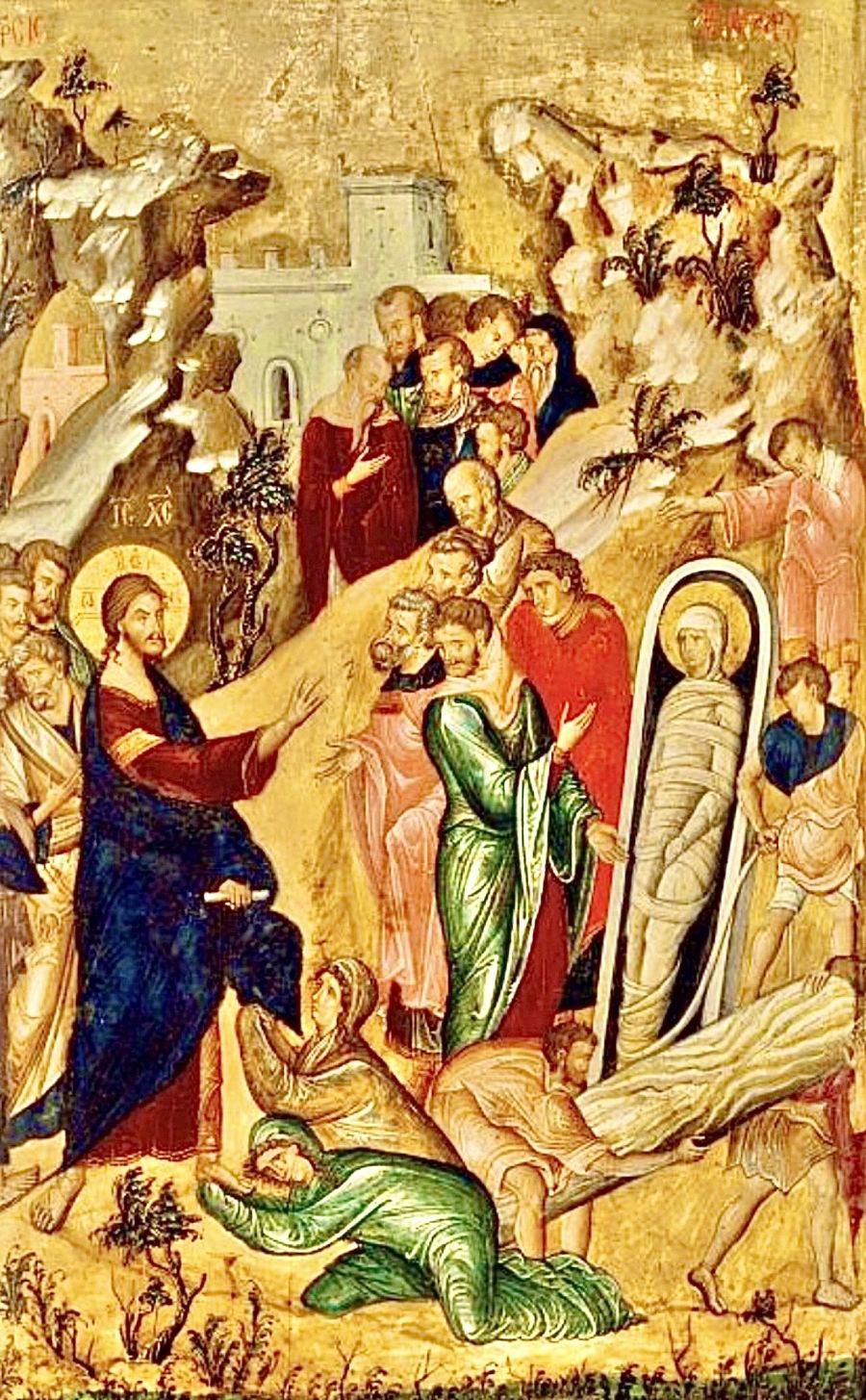
The Lord of Life (or the pale sign)

Jn 11:19-27 (1-45)


The event of death is disconcerting, and that of a friend of God in community [Bethany] perhaps accentuates the questions about the meaning of our belief and commit ourselves thoroughly.

Why in the time of greatest need does the Lord let us fall? Why does He seem not to be there (v.21)?

Letting even His dearest friends die, Jesus educates us: it is not His intention to procrastinate biological existence (vv.14-15), nor simply improve it a little.

“Eternal” [in the Gospels, the very Life of the Eternal: Zoe aiònios] is not this form of life [in the Gospels: Bìos - possibly strengthened] but only its times of strong love.

Ultimate World does not interfere with the natural course.

For this reason the Lord does not enter the “village” where others went to console and give condolences.

He wants Mary to leave the house where everyone cries in despair and mourns funeral - as if everything was over.

He intends to get us out of the “small hamlet” where it is believed that the earthly end can be only delayed, until the tomb without a future.

The natural emotion for detachment does not hold back tears, which spontaneously «flow from the eyes, sliding down» [dakryein-edakrysen].

Intimate upheaval does not produce a broken and screamed cry [klaiein] as the inconsolable one of the Jews (vv.33.35).

No farewell. For this reason, it follows the order to remove the stone that at that time closed the tombs (v.39).

The strong Call is absolutely imperative: the ‘deceased’ ones are not ‘dead’ ones, as ancient religions believed; their lives goes on.


«Lazarus, out here!» (v.43): it is the cry of the victory of life. 

In the adventure of Faith in Christ we discover that life has no stones on it. Enough, mourning the deadly situations, and the "dead ones"!

The Appeal that the Lord makes is that there is no disappeared souls’ world, separated from us; stand-alone, devoid of communication with the actual one.

Archaic beliefs imagined Hades or Sheôl as a dark, fog-soaked cavern, populated here and there by insubstantial wandering larvae.

On the contrary, the world of the living ones is not separated from that of the ‘deceased’ ones.

«Lazarus is asleep» (v.11), that is: he is not a fallen, because men do not die. They pass from the creaturely life [bìos] to full Life [Zoe].

The ‘deceased’ left this world and entered the world of God, re-Born and begotten to his authentic, complete and definitive being.

Then: «Untie him and let him go!».

In short, Lazarus did not simply end up in the pit, nor, having been well put back on his feet by Christ, did he reappear in this form of life for another stretch... inexorably marked by the limit.

In the Gospel passage, in fact, while everyone goes to Jesus, Lazarus does not.

It is not this not what Jesus can do in the face of death. He does not immortalize this condition, otherwise all existence would continue to be a useless escape from the decisive appointment.

And it is time to stop crying our loved ones: «deceased», not ‘dead’.

We must not hold them back with obsessive visits, tormented memories, talismans, condolences: let them exist happily in their new condition!

Life for us and Life for those who have already flourished in the world of God's Peace - where we will live fully: with each other and for each other.


[St  Martha, Mary and Lazarus, July 29]

100 Last modified on Tuesday, 21 July 2026 16:56
don Giuseppe Nespeca

Giuseppe Nespeca è architetto e sacerdote. Cultore della Sacra scrittura è autore della raccolta "Due Fuochi due Vie - Religione e Fede, Vangeli e Tao"; coautore del libro "Dialogo e Solstizio".

Christ is not resigned to the tombs that we have built for ourselves (Pope Francis)
Cristo non si rassegna ai sepolcri che ci siamo costruiti (Papa Francesco)
Many situations, then, which unfortunately do not conform to the legitimate predictions and rules established, are anything but negative; and instead of taking away confidence for the harassment they cause, They should have it more generous and far-sighted in favor of their process of responsible decantation (Pope Paul VI)
Molte situazioni, poi, che non sono purtroppo conformi alle legittime previsioni e alle norme stabilite, sono tutt’altro che del tutto negative; e invece di togliere la fiducia per la molestia che arrecano, esse dovrebbero averla più generosa e lungimirante in favore del loro processo di responsabile decantazione (Papa Paolo VI)
We must not fear the humility of taking little steps, but trust in the leaven that penetrates the dough and slowly causes it to rise (cf. Mt 13:33) [Pope Benedict]
Occorre non temere l’umiltà dei piccoli passi e confidare nel lievito che penetra nella pasta e lentamente la fa crescere (cfr Mt 13,33) [Papa Benedetto]
The joy of the Gospel fills the hearts and lives of all who encounter Jesus. Those who accept his offer of salvation are set free from sin, sorrow, inner emptiness and loneliness. With Christ joy is constantly born anew [Evangelii Gaudium n.1]
La gioia del Vangelo riempie il cuore e la vita intera di coloro che si incontrano con Gesù. Coloro che si lasciano salvare da Lui sono liberati dal peccato, dalla tristezza, dal vuoto interiore, dall’isolamento. Con Gesù Cristo sempre nasce e rinasce la gioia [Evangelii Gaudium n.1]
The Spirit of the Lord continues to pour out his gifts upon the Church to guide us into all truth, to show us the meaning of the Scriptures and to make us credible heralds of the word of salvation before the world [Pope Benedict, Verbum Domini]
Lo Spirito del Signore continua ad effondere i suoi doni sulla Chiesa perché siamo condotti alla verità tutta intera, dischiudendo a noi il senso delle Scritture e rendendoci nel mondo annunciatori credibili della Parola di salvezza [Papa Benedetto, Verbum Domini]
This belonging to each other and to him is not some ideal, imaginary, symbolic relationship, but – I would almost want to say – a biological, life-transmitting state of belonging to Jesus Christ (Pope Benedict)
Questo appartenere l’uno all’altro e a Lui non è una qualsiasi relazione ideale, immaginaria, simbolica, ma – vorrei quasi dire – un appartenere a Gesù Cristo in senso biologico, pienamente vitale (Papa Benedetto)
Jesus invites us to discern the words and deeds which bear witness to the imminent coming of the Father’s kingdom. Indeed, he indicates and concentrates all the signs in the enigmatic “sign of Jonah”. By doing so, he overturns the worldly logic aimed at seeking signs that would confirm the human desire for self-affirmation and power (Pope John Paul II)
Gesù invita al discernimento in rapporto alle parole ed opere, che testimoniano l'imminente avvento del Regno del Padre. Anzi, Egli indirizza e concentra tutti i segni nell'enigmatico "segno di Giona". E con ciò rovescia la logica mondana tesa a cercare segni che confermino il desiderio di autoaffermazione e di potenza dell'uomo (Papa Giovanni Paolo II)
In reality, an abstract, distant god is more comfortable, one that doesn’t get himself involved in situations and who accepts a faith that is far from life, from problems, from society. Or we would even like to believe in a ‘special effects’ god (Pope Francis)

Due Fuochi due Vie - Vol. 1 Due Fuochi due Vie - Vol. 2 Due Fuochi due Vie - Vol. 3 Due Fuochi due Vie - Vol. 4 Due Fuochi due Vie - Vol. 5 Dialogo e Solstizio I fiammiferi di Maria

duevie.art

don Giuseppe Nespeca

Tel. 333-1329741


Disclaimer

Questo blog non rappresenta una testata giornalistica in quanto viene aggiornato senza alcuna periodicità. Non può pertanto considerarsi un prodotto editoriale ai sensi della legge N°62 del 07/03/2001.
Le immagini sono tratte da internet, ma se il loro uso violasse diritti d'autore, lo si comunichi all'autore del blog che provvederà alla loro pronta rimozione.
L'autore dichiara di non essere responsabile dei commenti lasciati nei post. Eventuali commenti dei lettori, lesivi dell'immagine o dell'onorabilità di persone terze, il cui contenuto fosse ritenuto non idoneo alla pubblicazione verranno insindacabilmente rimossi.






