Mar 29, 2026 Written by 

Independent Easter, which snaps: for us

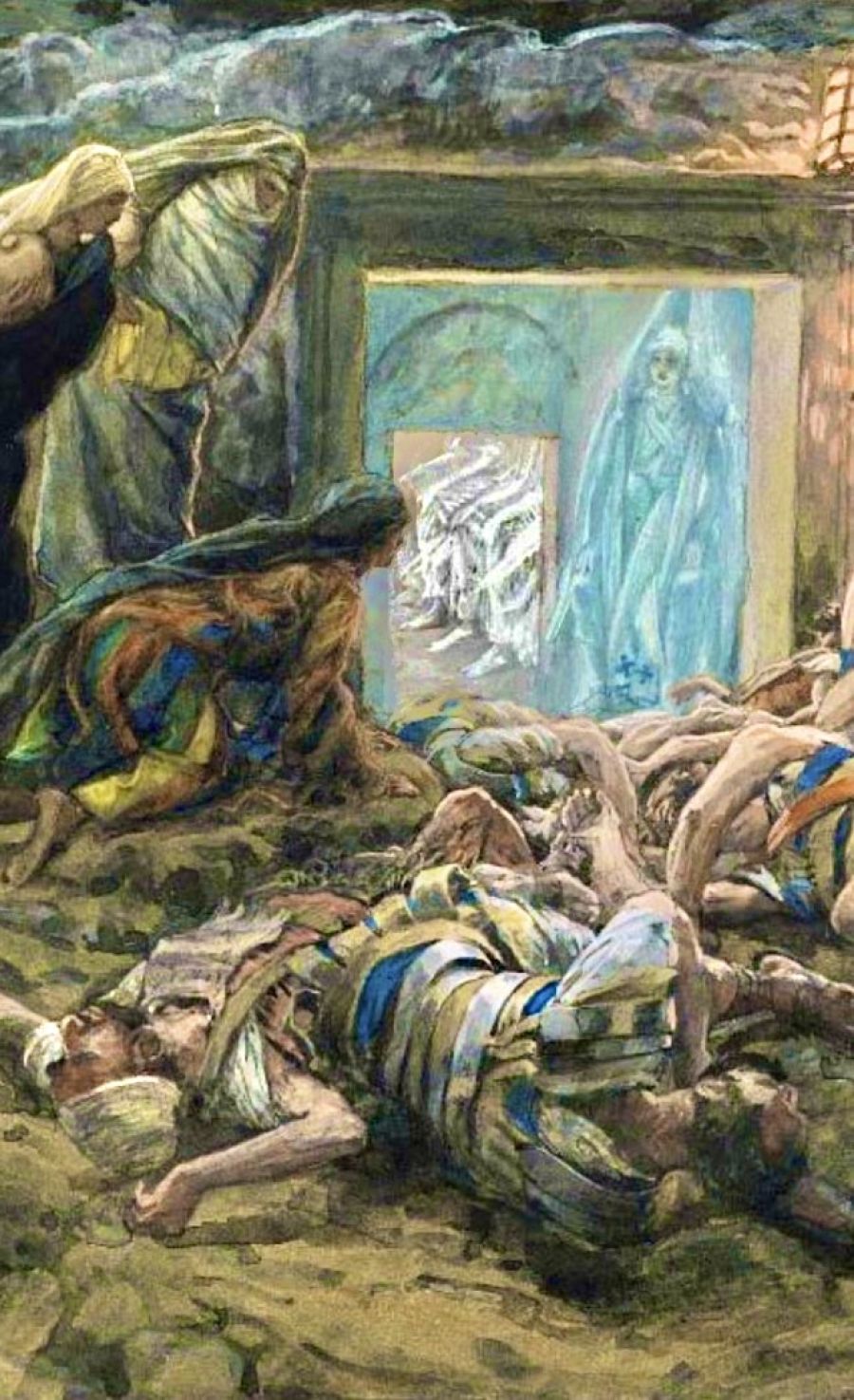
The Gospels do not describe the chronicle of Christ‘s Resurrection, but the experience of the Risen One in the early church.

All the evangelists hint at the fact that the fulfilment of law (Sabbath) delays both the unrepeatable understanding and the awareness of the power of Life unleashed by the Person, the Word, the whole story and proposal of Jesus.

Mk and in particular Mt reiterate the appointment of «Galilee»: theological and existential territory as opposed to Judea of official religiosity.

Today, we would perhaps speak of "spirit of the origins" - primeval experience of the Lord - or of "rough daily brief life"; and of an «outgoing Church».

Mt specifies that it is the event of «the Mount»: we experience the Living One in embodying the Beatitudes, the humble but vital Spirit of Love.

Reversal that sometimes throws away idols to the air - by forcing us to meet, in the dignity of our own imprint carried within the uniqueness, in the family spirit, for eternity.

Lk recommends not looking for the Friend [our starting point, guide, panache and silent knowledge] among dead realities that clutter.

To the disciples of Emmaus, He reveals himself in the capacity for overturned interpretation of inglorious events, and in an ardent Scriptures’ understanding.

In particular, He manifests himself in the breaking of bread [‘breaking of life’]: in the reciprocity of those who receive and become “food”, without inhibiting the character, and exceptional choices.

Jn insists that we must turn our gaze first planted on the tomb. In the pit of a sepulcher there is nothing but a Birth.

The fourth Gospel gives the essential criterion for recognizing the manifestation of the living Jesus: his Peace.

Not the Pax Romana type (the empire was at peace) but Shalôm-fullness. We would say: complete Happiness - true ‘golden age’.

Therefore the missionary Mandate that the Lord sends us does not proclaim a different doctrine.

It is the invitation to be fully oneself in Him, and thus to be able to embody the same Tenderness of the Father - vast, not according to rule, inclusive.


But: what has changed for us with the Resurrection? Is there any evidence that Jesus lives? Why does not He appear? What would be the signs?  And the big benefits?

O. Wilde stated: «When the gods want to punish us, they answer our prayers». We must get rid of these kinds of demands.

Prayers stranded by common expectations or intentions, are sometimes like the "women" of the Easter morning Gospels.

Still planted on funeral laments, they seek Life in the wrong places: that are infertile, because linked to ideas of corpses.

There is a different characterizing track, for each of us, that drags from within, and is growing. For a decisive peak, not an external one.

Victory of life means: ceasing to bind oneself to idolatries that are inactive, that seem suitable; however, as a fallback.

We can make the innate Appeal of the essence fly, wich we do not yet see but which ardently pulses and unquenchably.

It will not be the conventional, conditioned, conforming, in-tone and “as-is befitting”, but one-sided, shoddy objective - that will give us Joy.

It captures the unseen energy, «by name». That wants to sprout from the dark and opposite sides.


Birth and death are experiences of many times: why? For the uninterrupted “Genesis”, and other possibilities.

For healthy growth towards humanizing fulfillment, in generosity and baptismal aptitude, the jammed soul must be set free.

Our unusualness feels lost in the vicious circles of normal hopes.

And what we had imagined inexorably equal, therefore vain and stagnant - muddies the astonishment of surprises that go beyond expectations and intentions.

By eliminating conventional and other people's intentions in favor of personal Dreams that exaggerate, we will come to know the atypicality of God leaping up from the rubble and chaos of patterns.

The missionaries know this: it is not from Judea that certainty comes, but from Galilee, that is, from uncertainty. Their safety is in insecurity.

It is the darkness that makes us reborn.

Laying down what we previously interpreted with a sense of permanence, we will marvel at the Treasures that hide behind shaky sides. And of the independent Life that snaps, between signs of death.


Perhaps not a few people are still surprised by the 'empty tomb': that is, a Risen Jesus only 'personal', lived in love, in the free normal, in the self-giving that overcomes death. But without any 'mausoleum'.


[Easter, Resurrection of the Lord].

104 Last modified on Sunday, 29 March 2026 07:47
don Giuseppe Nespeca

Giuseppe Nespeca è architetto e sacerdote. Cultore della Sacra scrittura è autore della raccolta "Due Fuochi due Vie - Religione e Fede, Vangeli e Tao"; coautore del libro "Dialogo e Solstizio".

From ancient times the liturgy of Easter day has begun with the words: Resurrexi et adhuc tecum sum – I arose, and am still with you; you have set your hand upon me. The liturgy sees these as the first words spoken by the Son to the Father after his resurrection, after his return from the night of death into the world of the living. The hand of the Father upheld him even on that night, and thus he could rise again (Pope Benedict)
Dai tempi più antichi la liturgia del giorno di Pasqua comincia con le parole: Resurrexi et adhuc tecum sum – sono risorto e sono sempre con te; tu hai posto su di me la tua mano. La liturgia vi vede la prima parola del Figlio rivolta al Padre dopo la risurrezione, dopo il ritorno dalla notte della morte nel mondo dei viventi. La mano del Padre lo ha sorretto anche in questa notte, e così Egli ha potuto rialzarsi, risorgere (Papa Benedetto)
The Church keeps watch. And the world keeps watch. The hour of Christ's victory over death is the greatest hour in history (John Paul II)
Veglia la Chiesa. E veglia il mondo. L’ora della vittoria di Cristo sulla morte è l’ora più grande della storia (Giovanni Paolo II)
Before the Cross of Jesus, we apprehend in a way that we can almost touch with our hands how much we are eternally loved; before the Cross we feel that we are “children” and not “things” or “objects” [Pope Francis, via Crucis at the Colosseum 2014]
Di fronte alla Croce di Gesù, vediamo quasi fino a toccare con le mani quanto siamo amati eternamente; di fronte alla Croce ci sentiamo “figli” e non “cose” o “oggetti” [Papa Francesco, via Crucis al Colosseo 2014]
The devotional and external purifications purify man ritually but leave him as he is replaced by a new bathing (Pope Benedict)
Al posto delle purificazioni cultuali ed esterne, che purificano l’uomo ritualmente, lasciandolo tuttavia così com’è, subentra il bagno nuovo (Papa Benedetto)
If, on the one hand, the liturgy of these days makes us offer a hymn of thanksgiving to the Lord, conqueror of death, at the same time it asks us to eliminate from our lives all that prevents us from conforming ourselves to him (John Paul II)
La liturgia di questi giorni, se da un lato ci fa elevare al Signore, vincitore della morte, un inno di ringraziamento, ci chiede, al tempo stesso, di eliminare dalla nostra vita tutto ciò che ci impedisce di conformarci a lui (Giovanni Paolo II)
The school of faith is not a triumphal march but a journey marked daily by suffering and love, trials and faithfulness. Peter, who promised absolute fidelity, knew the bitterness and humiliation of denial:  the arrogant man learns the costly lesson of humility (Pope Benedict)
La scuola della fede non è una marcia trionfale, ma un cammino cosparso di sofferenze e di amore, di prove e di fedeltà da rinnovare ogni giorno. Pietro che aveva promesso fedeltà assoluta, conosce l’amarezza e l’umiliazione del rinnegamento: lo spavaldo apprende a sue spese l’umiltà (Papa Benedetto)
If, in his prophecy about the shepherd, Ezekiel was aiming to restore unity among the dispersed tribes of Israel (cf. Ez 34: 22-24), here it is a question not only of the unification of a dispersed Israel but of the unification of all the children of God, of humanity - of the Church of Jews and of pagans [Pope Benedict]
Se Ezechiele nella sua profezia sul pastore aveva di mira il ripristino dell'unità tra le tribù disperse d'Israele (cfr Ez 34, 22-24), si tratta ora non solo più dell'unificazione dell'Israele disperso, ma dell'unificazione di tutti i figli di Dio, dell'umanità - della Chiesa di giudei e di pagani [Papa Benedetto]

Due Fuochi due Vie - Vol. 1 Due Fuochi due Vie - Vol. 2 Due Fuochi due Vie - Vol. 3 Due Fuochi due Vie - Vol. 4 Due Fuochi due Vie - Vol. 5 Dialogo e Solstizio I fiammiferi di Maria

duevie.art

don Giuseppe Nespeca

Tel. 333-1329741


Disclaimer

Questo blog non rappresenta una testata giornalistica in quanto viene aggiornato senza alcuna periodicità. Non può pertanto considerarsi un prodotto editoriale ai sensi della legge N°62 del 07/03/2001.
Le immagini sono tratte da internet, ma se il loro uso violasse diritti d'autore, lo si comunichi all'autore del blog che provvederà alla loro pronta rimozione.
L'autore dichiara di non essere responsabile dei commenti lasciati nei post. Eventuali commenti dei lettori, lesivi dell'immagine o dell'onorabilità di persone terze, il cui contenuto fosse ritenuto non idoneo alla pubblicazione verranno insindacabilmente rimossi.






