


Sharp Personal experience, which starts to become more valid than judgements
(Jn 9:1-41)
Having escaped from the Temple, Jesus encounters the excluded. He takes the opportunity to make us understand who the Eternal One is, and our own story of Faith, continuing the Father's creative work.
God's coming to us does not proceed from the decrees chiselled by the priestly class and chasing Moses (v.29), but from the attitude towards the needy.
In this way, the 'blindness' to which the passage alludes is constitutive of every woman and man: we do not always 'see' what the right choices to make are.
We realise that our journey of Faith is first and foremost a love story, but also an ever-clearer 'seeing', an 'opening of our eyes' to the whole of reality - to the point of acquiring a clear and personal judgement.
Being a figure of the human, creaturely situation, the protagonist of the Gospel passage has no name, because being born with a defect of vision and orientation brings us together; it is not a fault, but a condition.
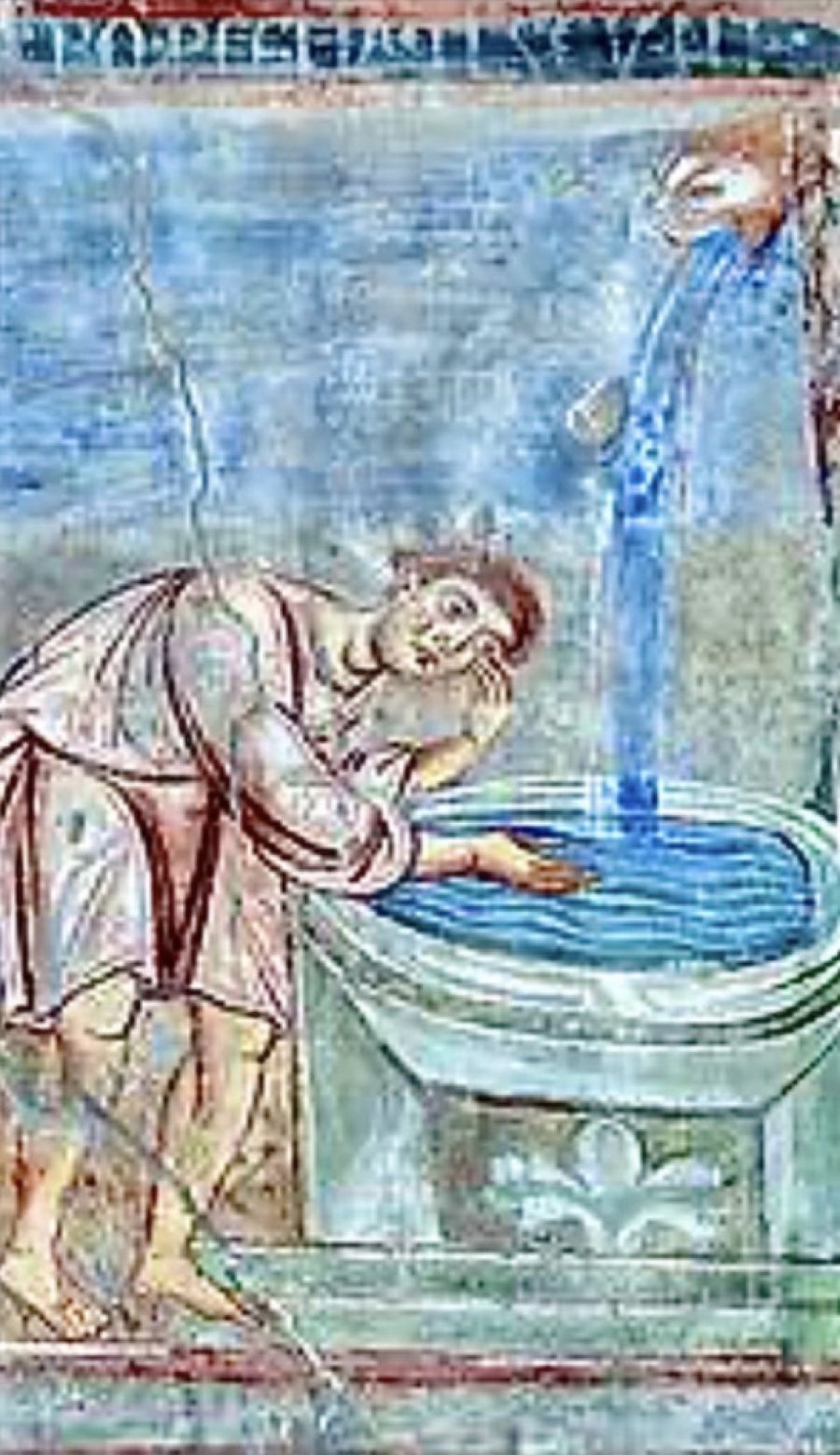
Jesus proposes that we allow Him to open our eyes wide, so that our 'mud' and his Breath can trigger the creation of a new person.
In religious leaders there is no joy at the healing (vv.16ff).
Jesus, on the other hand, increases the dose: once we have been sent to Life in the Spirit symbolised here by the Water, the Master goes off the scene.
To grow, you have to stand on your own two feet. God is not a paternalist who is always sticking his nose into everything: He wants us free [only then able to love].
And there remain many doors to be thrown open; many, the thresholds to be crossed.
The world of the élites defends itself by all means, attempting the usual intimidations. Don't worry: these are not signs of strength, but of imminent defeat.
Now the neighbours do not recognise the born blind. He looks like him, but he cannot be him... Those around him are puzzled.
The former blind man says: «I am» (v.9), i.e. in restored humanity he claims divine status.
When we encounter Christ, his dignity is passed on. Shyness is transformed into an ever renewed attitude to fullness.
In the Faith freed from conformity, to have an opinion of one's own is to start Exodus, aiming for the Land of Freedom - because woman and man have realised to what honour and Dream they are called.
He who has been given the Light does not stop, becoming more and more confident, mature, decisive. Now the man «sees», and is finally emancipated.
Excluded from the institution (v.34) just like the Lord (Jn 8:59), he is now truly a Person. For he begins to consider his experience more valid than the judgement of the official spiritual leaders.
It is the primacy of naturalness and personal awareness over standard or dominant thinking, roles, and codes - which are no longer able to communicate life. And that is what counts.
In fact, although put on the sidelines, it is now Christ who seeks him out and stands at his side (v.35). Without conditions.
Our instinctive and genuine common sense overrides both fixed beliefs and glamorous, current, à la page opinions.
Kicked out of the devout circle or power groups, the «born blind» - suffering from such insecurity, malformity, 'sin of origin' - will find virtue in its fullness.
By finally putting in the background the routine that makes everything banal, flat, automatic... he no longer flees.
He understands the importance of variation that disrupts plans. It makes them unique.
With new personal Energy he faces the unexpected: life of Love that realizes us, and knows how to turn over a new leaf.
4th Sunday in Lent (year A), Laetare [March 15, 2026]








