


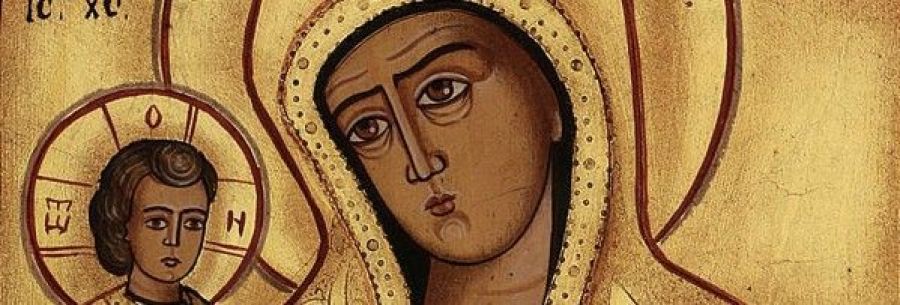
(Lk 1:39-45)
'Incarnation': if our gaze does not fixate on a few ideas but lightly begins to rest on the human condition, then a reign of peace begins.
The hesitant crowd in the ancient coat of arms can rejoice, because that faint but decisive Presence arrives that liberates and gives us breath.
Unusual opportunity for redemption on the scale of women and men, even children.
The people have a Dream: to grasp their identity and mission, despite the religion of mediocrity, of abuse - sullen looks and fears.
Mary helps each one to understand how to substitute the caress of a heart of flesh for so many extraneous prescriptions on cold stone slabs.
Her peace-shalom is not wished on the practitioner of the sacred. He omits the oneness of the Call, the Surprise, the Person.
Zechariah does not live Beatitudes: he is already identified, therefore radically unbelieving.
The great reminiscences and his typical role make him refractory to the Newness of the Spirit.
It is useless even to speak to him, although he is master of the House in which the Promises are 'remembered'. A habit of remembrance that now waits for nothing.
The decisive Encounter? Perhaps there will be... but who knows when.
Mythical waiting distracts, it does not involve. Idolatrous re-actualisation does not cheer; it stares, it does not make one dance.
The feast is a sign that the Lord has come to the family; not on the set, really. [It is not easy to understand this in the time of externality].
Mary does not aspire to be and show herself to be a 'VIP'; she places herself spontaneously among ordinary people, who suffer a painful condition.
She does not chase after projects, her previous ideas, some constrained tic that bounces around in her thinking. This is the purity of Mary.
Those who resemble her have no need to beg or display recognition, achievements, credentials, titles, merits. This is her purity.
She did not misunderstand God by exchanging him for appearances. She did not allow herself to be caged by clichés, because she did not hinder her unrepeatable identity by thinking she was wrong.
With a silent mind and detachment from judgement she allowed her vocational instinct to regenerate, conceive, give life.
She did not pursue an ideal, weightless (and meaningless) image, as if she were cast in a character - and conformist.
If she corrected herself, she did not do so by folding in on herself, but by overtaking and pulling straight; thus she discovered how to adjust, but to fly.
Everything did not go well for him, as if he already had the film of his life in his head. He had hiding places and doubts, travails to overcome.
He didn't think, he didn't speak, he didn't act as if he were 'infinite'; but decisively, yes.
She was not always successful, and yet she did not retract just veraciously.
She faced conflicts, yet without those mental burdens that bridle us with fixations [even sacred ones] that God does not care about, and block the way.
In events and within herself she seized moments of insecurity to remind herself of the Pearl to be sifted.
A passionate search that kept her alive, knowing that things of the soul are different.
She was not a do-gooder saint, she waged battles - and with spiritual denunciation.
In fact, she did not ask for permission to embark on a daring journey.
Nor does she 'see' the man of the official institution: the priest with his rituals punctuated in minute detail.
Instead, he recognises himself in Elizabeth. She too is a forgotten one, but one who cultivates the promise ("Eli-shébet": the Lord My-Personal has 'sworn'; as in "God is faithful to Me").
Zechariah, on the other hand ("zachar-Ja" the Lord yes but not 'My' but of Israel, 'remember') fails to move from regular religiosity to Faith involving his founding Eros.
Mary did not want to be fake, she did not wish to become artificial - therefore useless, and in time shattered.
She aspired to plant herself further and better on her own Roots.
If she couldn't understand something, she used these suspensions to project herself forward, in search of the precious treasure chest of her destination.
He gave no space to the toxins of the mind created by dreamless habit, by the paradigms of his place and time. She did not imagine that she would always remain the same.
She chose not to lay down the evolutionary side: she understood that she could be stimulated precisely by the bitterness, the abandonments, the impacts, the wounds.
Ark of the Covenant with visionary and viable intimacy, without (inside) icy tables of legalisms; because God does not express Himself by issuing rules, but in Love - which does not demolish.
He had with Heaven a relationship of Incarnation; not external and without Oneness [of stone as in intimidated obedience]. In its marrow: Resembling - from Equal to Equal.
From the religion of the many subordinates to the Faith?
Not a Church of the wedges: Mary is the new consciousness and the different orientation of humanity.
Magnificat: religious kinship, and the outburst of Faith
(Lk 1:46-55)
Although the Greek-language context of the earliest codices alludes to a canticle proper to Elisabeth (vv.42-46), later tradition placed the hymn on Mary's lips.
Their song-together summarises and celebrates the history of salvation. It reflects a Judeo-Christian liturgical lauda characteristic of the first communities of 'anawim.
[Today, as then, the small and faithful experience the ideal outline of history, of which they paradoxically become the engine].
Mary and Elizabeth give voice to the poor and minority 'churches', often challenged by the forces of imperial power in dramatic duels.
Fraternities that experienced a God who does not remain impassive to the cry of the persecuted least.
In a framework of family visitation and (indeed) praise, the whole destination of the new People is reflected.
The difference between the two women emphasises the outburst of Faith in Mary, as opposed to the expectations of religious 'kinship'.
In Elizabeth, the First Covenant has already run its full course, and would not go much further.
The history of men is barren, but the Eternal makes it fruitful with newness and joy, which finally changes the boundaries.
The planned ways have come to an end; still blind and subservient to the powers of the earth - self-divining...
But here it is revealed that the security of the great is vain, non-existent; seeking only profit.
And despite the millennia, there are still too many who clothe their positions with seemingly pious proclamations - insubstantial proclamations of love that helps and enriches the little ones, that make the weak strong.
Faith entirely transmutes the foundations of anti-divine history, because it allows the Spirit to take possession of personal life and fertilise it, making it capable of blessing action.
In Mary's way of believing we know what we do not know - because we have a guiding Vision, an Image that acts within like an innate instinct.
And we already possess what we hope for - because Faith is a stroke of the hand, an action that is appropriated, an act-calm (cf. Heb 11:1).
Its apex will be to discover impossible recovery stupors, starting from the shadowy and detested sides of us [the very discarded].
The hymn thus expresses the trajectory of the believer's life in Christ and the direction of our existence that little by little or suddenly recomposes the shaky being in the new harmony of the divine plan.
A classical thesis already from the First Testament: God lifts the wretched from the dust and raises the poor - the marginalised (with indifference) - from the rubbish.
He does not address himself to those who are full of themselves and with identified roles, but to those who know how to turn to the depths, and like Mary he extends them to others.
Within such a story of losing oneself in order to find oneself again - a logic embodied both by the disciples and the churches - is to be found the experience of Easter morning, whose Gospels 'describe' the Resurrection as the ability to see the tombs open and to discern life even amidst signs of absence, and in the place of death.
Lk evangelist of the poor celebrates this reversal of situations in many episodes: Pharisee and publican, prodigal son and firstborn, Samaritan and Levite priest, Lazarus and rich Epulon, first and last place, Beatitudes and 'troubles'...
The Magnificat also reiterates: the Lord's choices are truly whimsical for the religious nomenclature mentality.
Freely He passes for the defeated, the mocked, deemed stupid, ignoble; the weak, marginalised by cliques, rejected by the club of the acclaimed.
The canticle is a perfect 'type' of this predilection, which finds gain in loss and life from death, in people and events on the margins.
Mary in particular becomes an expressive figure of lowliness [ταπείνωσις (tapeínōsis, "lowering"), from ταπεινός (tapeinós, "low"); v.48 Greek text] as the 'root' of the transformation of being - in God's Unpredictable.
In Mary and Elizabeth the 'anawim contemplated the feast of the triumph of the children, of the creatures who repeat in themselves the Passover of Christ.
Happening and proposal that even in times of emergency makes life flourish again from the failure of the mythologies of power and force.
In the Risen One who always shows the wounds, believers everywhere have realised: the poverty of heart and life lived by Christ and the (Church) Mother is the true disruptive force of history.
God is faithful.
"My soul magnifies the Lord, and my spirit exults in God my Saviour, because he has turned his face to the lowliness of his handmaid" (Lk 1:46b-48a).
To internalise and live the message
Do you consider divine munificence a property?
How do you proclaim your personal and ecclesial awareness - of fulfilment in Christ - of the Covenant Promises?








