


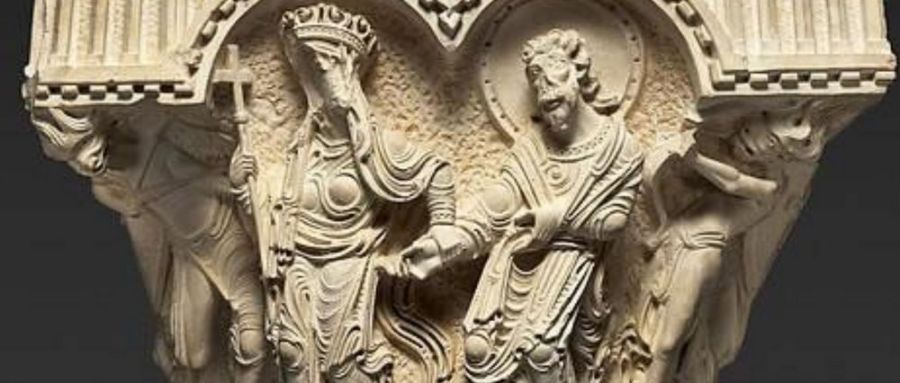
Raised up and lifted up from themselves, from above and from below
(Jn 8:21-30)
At the end of the first century, the Jews raised quite a few questions concerning the prayerful reading that Christ's disciples made of the events and words of the Master - considered to be the expression of the Word of God and the summit of salvation history.
The theme of misunderstanding about the origin and mission of the Son is dramatised in a controversy in which each side stands on a different ground: belonging to the world of Faith, or to that of religion that encloses the Mystery in what is already known.
To help the faithful deepen their understanding of the Lord's call, in the Johannine communities of Asia Minor, the transmission through catechesis of the extent (and preciousness) of involvement in the life of Faith took place through question-and-answer dialogues.
The inglorious end of Jesus and his destination posed various questions. The text reiterates that the crucial point was the prejudice of the always victorious Face of God.
Tara that prevented them from recognising him in the Son humiliated by the authorities, and in the sons who had followed him, equally defeated... but who considered themselves victorious.
Compared to the world around them, Christians oriented their gestures and words without banal closed-mindedness, to which we too would sometimes like to conform.
And even today - thanks to this drive, Motive and Drive - it is only because of this conviction that we are able to acquire a different vision, and overcome sin.
The term in the singular here in v.21 [cf. "the sin of the world" in Jn 1:29] does not refer to small daily transgressions, but to the (devout) humbling of unbridgeable distances [compared to the crowning of being].
Only the meaning of Jesus' story sweeps away the emptiness of intimate energy aroused by the perception of the creaturely condition - from which descends the inability to correspond to one's intimate vocation.
A lacerating and bizarre inefficiency, because it is induced and sustained precisely by official structures that are paradoxically "worldly" - and by the mentality spread by them, as well as ensured over time.
The same term used in the plural ["sins", in the moral sense] emphasised and reiterated in v.24 alludes to the torment inoculated in people's souls and lives, precisely by the "normal" cloak of pious convictions.
They enclose the path of individual exceptional personalities within a useless, spasmodic search for imperfections, by nature inevitable - with the torment of comparisons with external models.
The result: women and men whose lives stagnate in the strident attempt to overcome the genuine contradictions of their own faces that complete us, with extreme and vacuous expenditure of virtue.
In the sphere of tradition, or rather of custom, in order to identify, correct, and reaffirm (other people's) norms every day, souls are subjected to a regime of retreats that affect both summary conduct and the leading lines of personality.
Such forms of 'government' that are not very inclusive close non-opportunist vocations within themselves, with serious social damage as well: a typical outcome of a climate of people who naively rely on external, mannerist, ethical or intimist ideologies.
In the graniticity of the principles of domination of the beghine structures of sin over individual affairs, the attitude of suspicion of deviance makes the lives of humble and more sensitive people swampy.
Here one risks death - in the very still sands of the sins of return, of addition and gratification, that were originally intended to be exorcised.
Those who embrace the conformity of abstract excellence that wants to re-emerge at all costs - without eminent criteria, nor re-elaboration, and path of personal enhancement with prospects for a critical future - will experience the total reversal of good intentions; then, crazy, sudden thuds.
The swamp of restrained vital powers sets up excellent screens but rots existence, overturning expectations.
It is as if Jesus were saying, "try what a beating you might make by falling from so high up, so you will understand!".
The frame of reference of the leaders of the winning mentality or of ancient devotion, is not the gaze planted on the authentic and full life of the people, but rather the judgmental scrutiny from an already antiquated fashion, without openings.
Basically: the usual or power-assured, stone-hearted and all ready-made one. At hand, as if chiselled down to the tiniest detail - in clichéd institutions, rooted in the territory - representative only of itself.
In this sense, the veteran, experienced leaders had difficulty understanding the meaning of Christ's elevation.
The authentic Messiah was elevated to the 'right hand' of the Eternal One and raised on the Cross - the ultimate Revelation of the 'I Am' or Emmanuel in His Personality, Wisdom, Uniqueness, Future and already Presence.The Crucified One, who in Jn 19:30 and 20:22 delivers the Spirit without temporal delay, radiates the image of the divine "position". And through the bond of Faith he makes us live in his contact; which is of debasement and lowliness, but of weight and prominence - humanising promotion (vv.28-29).
What in the "Son of Man" we also experience within such a founding Relationship with the Father is made explicit precisely in a Confluence, Nucleus, Active Bridge, and Hinge. Liberation and Salvation that enables us to treasure pitfalls, paradoxes, upheavals.
He operates in a reversal of the idea of 'glory', climbing, and supremacy. He operates in a principled opposition (which seems devoutly incomprehensible) between two 'worlds' - the self-styled 'best' of which seeks its redemption at 'the top'.
And yet it creates consternation. It does not yet know how to take life from death.
So the discourse is 'internal': it is about the worldly criteria of judgement on the Lord who trust in themselves, who crush us in the coils of doubt; not against the Jews.
It is for anyone who regrets lost small certainties and - precisely - does not yet know how to take sap from the earth.
The petty world remains that sadly marked by the shrewd, mediocre, saltieri, constantly compromising and conniving with power - as well as the very coffers of the Temple.
For them, that of Jesus and his people who are serious is suicide (v.22), a condition that - in the thinking of the time - would have led to the eternal state of the darkest hell.
Indeed, the Sanctuary seemed a bright, desirable, spiritual and secluded perimeter; instead, it was only separated... from access to life, and to the thought of Heaven - the only fruitful Centre of gravity.
Tremendous vocation, so unheard of and perilous to the point of mortal risk - to arouse indignation, for every ideology of power: that weighs down the spontaneous and mysterious vitality of today, even broken, bitter, downgraded.
In its ambitious and agonistic reality, aiming to prevail [all decorum, pirouettes, opportunism, reputation] the established institution would not succeed in conveying to Christians the specific sense of their Faith. It imposes itself in the heart, even though it seems deplorable.
The worldly gears distorted and rendered unrecognisable the identity of the paradisiacal condition, confused and bartered with that of the one who wins, towers above, receives honours - without any qualitative leap about the authenticity of the One Subject of history.
The Pharisees of all times and creeds still orient themselves on the basis of titles and honours.
The Man-God reflects a different inclination from the expectations of so many sedentary, mundane, mimetic synagogues, who do everything they can to stand up and avoid the low.
"To die in sin" means to close oneself in the criteria that exclude true honour: that of total self-giving - for a further and widespread outcome.
Clear key point of the Son's life, claiming human-divine fullness (v.28).
To the question "Who are you?" Christ answers by giving an appointment of complete Life, on Calvary.
For those of us who feel it pulsating within, the same gratuitousness will not be the impossible fruit of a voluntarist choice, but of discipleship in respect of the personal Vocation - which seeks and makes room for the new kingdom.
Wise discipleship will lead each one from the religious experience of useless and deadly submission to the adventure of Faith in the Lord, with no more qualms that would hinder the journey towards self and neighbour.
With the Son of Man lifted up, we will pass from the dull and deadened life of servants to that of friends, therefore brothers (cf. Jn 13:13; 15:15; 20:17).
To internalise and live the message:
When you are questioned about your identity as a being, do you commit yourself to parading titles and goals?
What does it mean for you to be from down here or up there?








