


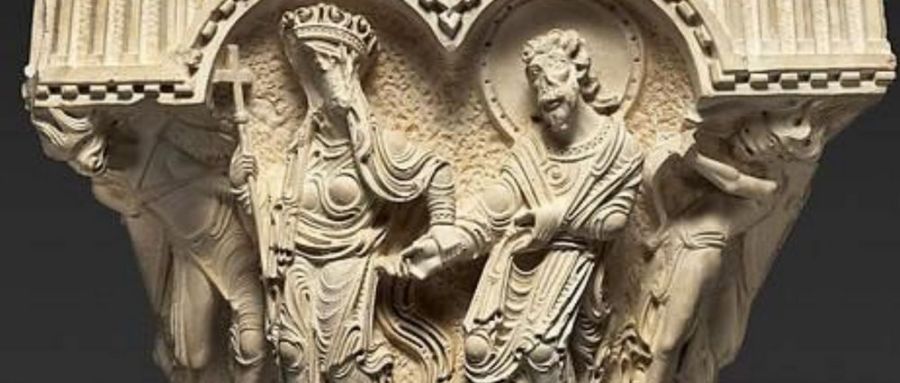
Gratitude: the Kingdom at hand and Prayer Incarnate
(Mt 9,35-10,1.6-8)
Jesus differs from the Rabbis of his time because he does not wait for the exhausted and prostrate people (v.36) to come to him: he seeks them out.
And the group of his own must participate, both in works of healing and deliverance - fraternity motivated by luminous selflessness.
He enters prayer assemblies with pastoral anxiety: to teach, not to disquisition. He does not lecture in logical analysis, but lets the One who dwell in him emerge.
He proclaims a Kingdom that is totally different from how it was inculcated by the manipulators of consciences (overflowing with detailed convictions) - who certainly did not exercise gratuitousness.
The ancient doctrines and its protagonists dampened any dissonance and produced the worst: intimate coercion, anonymity, loneliness, passivity.
They inculcated that it was decisive to acquire their flat securities, certainly not to open up to the personal Mystery, to the innate character - fruitfully not conforming to the context.
In fact, they sought to disturb the journeys of the soul, which sometimes wanders to find itself, and which prefers new glimpses to the usual way of seeing - swampy, stagnant.
They did not admit that in each believer could dwell a fundamental option that did not conform to their ideology and way of seeing.
Everything about other people's lives had to work perfectly according to their goals. So they did not preach upheaval, but static.
Nothing new was to happen that would challenge the social balance, their authoritarian influence... and their income.
Nothing different was to be explored and found.
Yet, yesterday as today, within each woman and man resides a volcano of potential energies - which according to the dominant ideology only had to be stifled and aligned.
For all that still drags on, we conversely seek a God to be experienced, who is lovable, not 'artfully' constructed... nor invisible or far removed from our condition.
We want the One who gives breath, and understands us.
This is clearly understood: what we hatch is not a miserable illusion, to be extinguished in favour of external balances.
In fact, the Gospel (v.35) proclaims Grace: the face of the Father - who wants nothing for himself, but gives everything to transmit his own Life to us. And he does this not to deaden our inner energy.
The Glad Tidings proclaim a Friend who comes, who does not force us to "ascend" [in the abstract] nor imprison us within guilt, exhausting the already subdued creatures - making them even more desolate than before.
Here is revealed a Heaven that makes one feel adequate, does not chastise or even impress, but promotes and puts everyone at ease; a Merciful One who is not only good: exclusively good.
The prodigal Father welcomes people as the Son does in the Gospels - just as they are; not inquiring. Rather by expanding.
His Word-event also does not only reactivate: it reintegrates imbalances and enhances them in the perspective of paths as a real person - without judging or dispersing, nor breaking anything.
For such a work of wise recomposition of being, the Master invites to Prayer (v.38) - the disciples' first form of commitment.
Access to different attunements in the Spirit teaches us to stimulate the soul's gaze, to value and understand everything and everyone.
So - after making them less ignorant - Jesus invites his disciples to involve themselves in missionary work; not to act like scholars or moral lecturers.
That would be careless posturing, which makes the hopeless feel even more lost.
The Mission grows from a small but boundless dimension - that of intimate perception, which becomes aware of the needs and mystery of a favourable Presence.
New configurations of understanding, in spirit: fully discovered only in deep prayer (v.38). Incarnate prayer.
It is not meant to distract us from inner realisation; on the contrary, it acts as a guide, and returns the soul, dispersed in the many common practices to be performed, to its own centre.
It makes us experience the yearning and understanding of the perfect condition: the Father does not intend to absorb our aptitudes, but to strengthen them. For everyone has an intimate project, a Calling by Name, their own place in the world.
It seems paradoxical, but the outgoing Church - the one that does not speculate, nor engage in mass proselytising to impress the mainstream - is first and foremost a matter of formation and internal awareness.
In short, one recognises oneself and becomes not unaware of things through prayer-presentment, unitive.
In Christ, it is not performance or devout expression, but rather understanding and first and foremost listening to the God who reveals and calls in a thousand subtle forms.
The commitment to heal the world is not won without an awareness of vocation, nor by allowing oneself to be plagiarised and going haphazardly.Rather, by sharpening our gaze, and reinvesting virtue and character even in our own sides that are still in shadow.
Nor does it remain essential to always cross every boundary (Mt 10:5-6) with a logic of flight.
For not infrequently - unfortunately - only those who love strength start from the too far removed from themselves [from the far off and out of reach].
The 'sheep' lost and weary of trying and trying again - the excluded, the considered lost, the marginalised - are not lacking. They are close at hand, and there is no immediate urge to extricate oneself. Almost as if to exempt oneself from those closest.
The horizon expands itself, if one is convinced and does not like masks or subterfuges.
The sense of proximity to oneself, to others and to reality is an authentic bearer of the Kingdom that is revealed: the Near.
Understanding the nature of creatures and conforming to it in a growing way, all are inspired to change and complete themselves, enriching even cultural sclerosis, without alienating forcings.
Exercising a practice of goodness even with oneself.
Some of the most quoted aphorisms from the Tao culture read: "The way of doing is being"; "he who knows others is wise, he who knows himself is enlightened"; "a long journey of a thousand miles begins with a single step"; "the master observes the world, but trusts his inner vision"; "if you correct your mind, the rest of your life will fall into place"; "when you accept yourself, the whole world accepts you".
So in the battle against infirmity (Mt 9:35-10:1): we recover and overcome by sharpening our gaze and reinvesting the energy and character even of our own still-dulled sides.
All the gratuitousness (Mt 10:8) that may flow from this to build up life for the sake of the brethren, will burst forth not as puerile [hysterical] reciprocation or engagement.
It will be spontaneous, solid and cheering Love Dialogue, because it will be free of those imbalances that smoulder under the ashes of facade conditioning.
The sense of closeness (v.7) to oneself, to others, and to reality will be an authentic - not programmatic, nor alienated - port of the Reign that is revealed: Beside.
To internalise and live the message:
Does Prayer in Christ shake your conscience?
What consolation do you expect from the God Who Comes?
Perhaps a reward?
Or a gratuitousness that triggers - here and now - true Love-understanding, attentive to the calls of every subtle Voice?








