


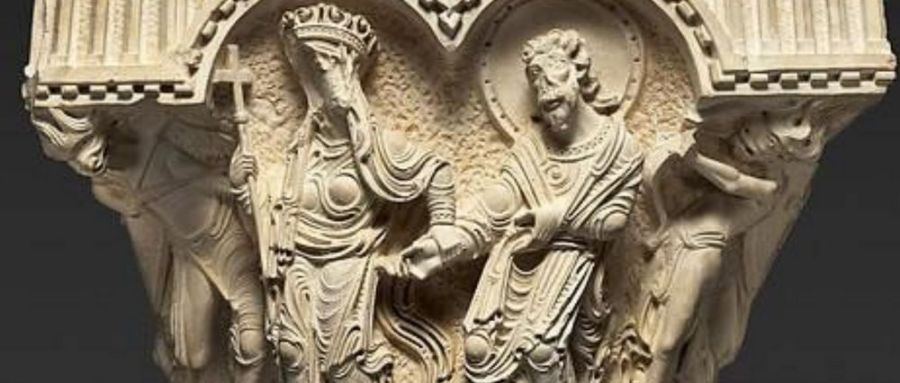
Gratis eccentric, forward: Sacrament of humanity as such
(Lk 17:1-6)
The knowledge of God is not a confiscated commodity or an acquired and already plundered science: it moves from one action and another, unceasingly; it is realised in an ever-living Encounter, which does not block or dissolve us.
Typical, the experience of the "little ones" [mikròi v.2]. From the earliest communities of faith, they have been those who lacked security and energy; unstable and without support.
From time immemorial, "Little Ones" have been the incipients; the new ones, who have heard of Christian brotherhood, but are sometimes forced to stand in line, aside, or give up the journey.
But the criterion of welcome, tolerance, communion even of material goods, has been the first and main catalyst for the growth of the assemblies.
Even the origin and meaning of all the formulas and signs of the liturgy.
The existential and ideal centre to which to converge. For a proactive and in itself transformative Faith.
In the Spirit of the Master, even for us the conciliation of friction is not simply a work of magnanimity.
It is the beginning of the future world. The beginning of an unpredictable and unspeakable adventure. And we with it suddenly reborn: coming into frank contact in Christ. He who does not extinguish us at all.
Hence the Christian forgiveness of children, which is not... 'looking positive', and 'turning a blind eye': rather, Newness of God that creates an environment of Grace, propulsive, with enormous possibilities.
Force that breaks through and paradoxically lets the dark poles meet, instead of shaking them off. Genuinely eliminating useless comparisons, words and ballasts, which block the transparent Exodus.
Dynamics that guide one to the indispensable and unavoidable: waves to shift one's gaze. Teaching one to notice one's own hysterics, to know oneself, to face anxiety, its reason; to manage situations and moments of crisis.
Mouldable virtue that places one in intimate listening to the personal essence.
Hence, solid, broad empathy, which introduces new energies; it brings one's own deep states, even standard life, together... arousing other knowledge, different perspectives, unexpected relationships.
Thus without too much struggle it renews us, and curbs the loss of veracity [typical, that in favour of circumstantial manners]. It accentuates capacities and horizons of Peace - crumbling primates, swampy balances.
The discovery of new sides of the being that we are, conveys a sense of better wholeness, then spontaneously curbs external influences, dissolves prejudices, does not make one act on an emotional, impulsive basis.
Rather, it puts us in a position to reveal the hidden and astounding meaning of being. It unfolds the crucial horizon.
Activating 'Forgiveness' is gratuitously a surrender of one's character range, of all lost dignity, and far beyond.
By laying down sentences, the art of tolerance expands the [also intimate] gaze. It enhances and strengthens the dull sides; those we ourselves had detested.
In this eccentric way it transforms those considered distant or mediocre [mikroi] into outriders and brilliant inventors. For what was unthought of yesterday will be clarifying and driving tomorrow.
Confusions will make sense - precisely because of the thinking of the minds in crisis, and because of the action of the despised, intruders, outside of all spin and predictability.
Life of pure Faith in the Spirit: i.e., the imagination of the 'weak'... in power.
Because it is the paradoxical mechanism that makes the crossroads of history assess, activates passions, creates sharing, solves real problems.
And so it supplants difficult moments forwards (bringing us back to the true path) by orienting reality to the concrete good.
By making it fly towards itself.
The 'win-or-lose' alternative is false: we must get out of it. It is in such 'emptiness' and Silence that God makes His way.
Mystery of Presence, overflowing. New Covenant.
Increasing faith: a dull, intimidated life, or the door of hope
Perhaps we, too, have been inculcated with the idea that faith must be asked for, so God will increase it for us. Instead, we have a say, but not in the sense of a plea to Heaven.
Faith is a gift, but in the sense of a relational, face-to-face proposal and initiative; that asks for welcoming perception. Therefore, it does not grow by falling from a packet - as if by precipice, or by infusion from above. Even forcing it, and convincing the Father.
Nor is it a simple assent linked to good-naturedness. It is not a baggage of notions that some have and prove right; others less so, or not at all.
In falling in love one can be more or less involved!
Faith is not believing that God exists, but adhering to a springing suggestion that (without imposition) guides us to disregard reputation.
The person of Faith cares not for expense or risk, even for the lives of others. He holds particular customs in abeyance; he does not put circle affections first. Forgives without limit.Often we agree only in part and accept a little bit - perhaps until love goes all the way, or calls us into question.
Thus the head, the quirks, the concatenation of values, and the small world to which we are attached.
Increasing Faith? The Gift is not a gift, but an Appeal.
Therefore, Jesus does not even respond to such a ridiculous request - nevertheless, it makes one think about the results of possible adherence.
All it would take is the slightest involvement and there would be extraordinary results in the world (v.6); in community, in families and in personal life.
We would achieve the impossible and important. Real problems would be solved. Even the simplest actions would be transformed.
Then there are great events planted in every man's heart, which we perhaps consider unrealisable: e.g. universal brotherhood, victory over hunger, a dignified and beautiful life for all, a world and a Church without volatile, corrupt and vain characters.
Because we consider them impossible situations, we don't even begin to build them - we immediately drop our arms.
But maturation is the result of secret sides, not of impermeable mental armour.
As a Nobel Prize winner said: 'The innocent did not know that their project was impossible, so they realised it'.
And it is not that after a life spent in service - at the orders of the Principal - in the afterlife we will finally command, on the basis of the rank we have earned [although this too may have been passed on to us].
One of the wonders that Faith in Christ accomplishes in us - here and now - is to make us aware of the beauty and joy of having the freedom to come down from the pedestals we have already identified, in order to favour the full life (of all).
And at the 'end of the month' - at the 'reckoning' or the 'pay' - we will not finally become bosses - at least in heaven!
Because God is Communion, conviviality of differences; and He does not accept the servant-master scheme, even as a reward.








