


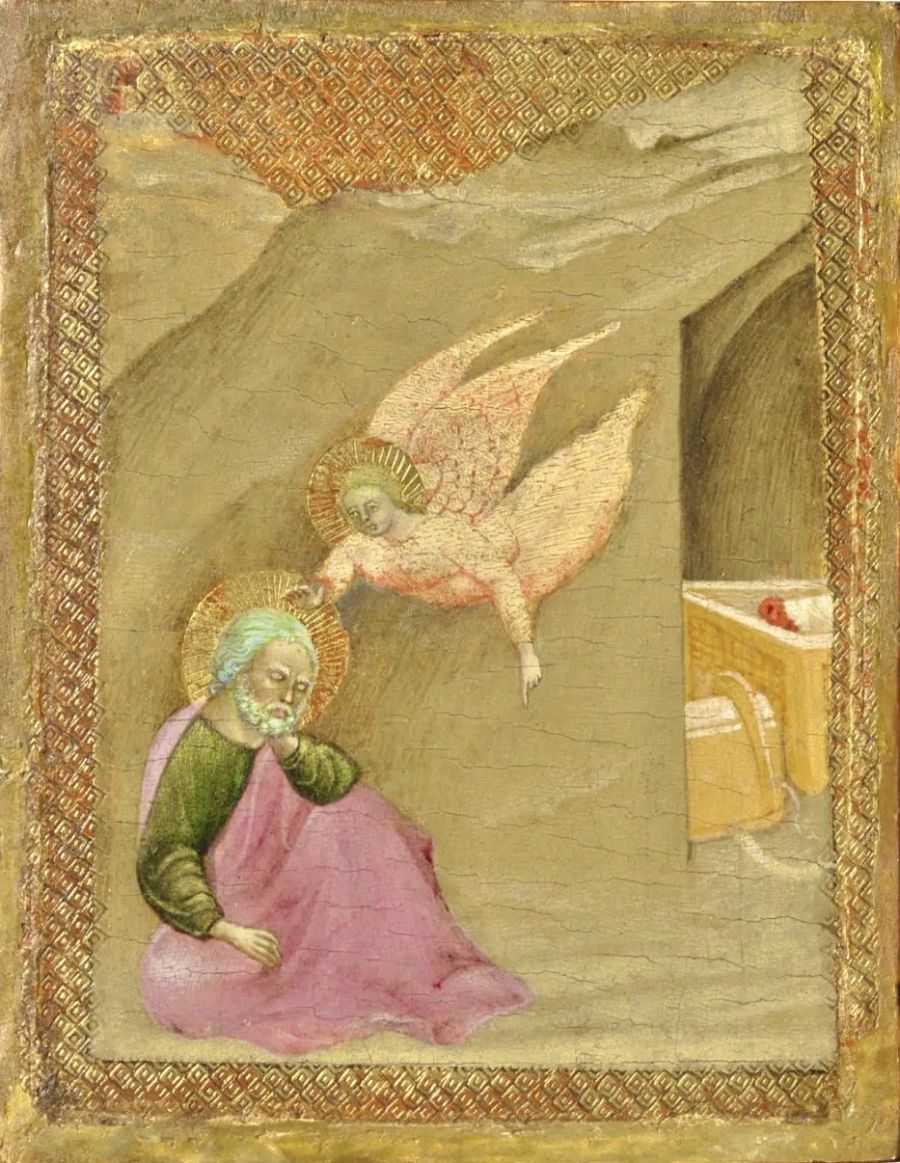
IV Sunday in Advent (year A) [21 December 2025]
May God bless us and the Virgin protect us! As we approach Christmas, the Word of God reminds us of the Lord's faithfulness even when the unfaithfulness of his people might weary him (first reading). The Gospel introduces us to Saint Joseph, the man who silently accepts and fulfils his mission as father of the Son of God.
*First Reading from the Book of the Prophet Isaiah (7:10-14)
It is around 735 BC. The kingdom of David has been divided into two states for two centuries: Samaria in the north and Jerusalem in the south, where Ahaz, a young king of twenty, reigns. The political situation is dramatic: the Assyrian empire, with its capital at Nineveh, dominates the region; the kings of Damascus and Samaria, already defeated by the Assyrians, now rebel and besiege Jerusalem to replace Ahaz with an allied ruler. The king panics: 'the heart of the king and the heart of the people were agitated like the trees of the forest by the wind' (Isaiah 7:2). The prophet Isaiah invites him to calm down and have faith: God has promised to keep David's dynasty alive; stability depends on trust in the Lord: if you do not believe, you will not remain steadfast. But Ahaz does not listen: he turns to idols and goes so far as to commit an atrocious act forbidden by the prophets, sacrificing his only son by passing him through the fire (cf. 2 Kings 16:3). He then decides to ask Assyria for help, a choice that entails the loss of political and religious independence. Isaiah strongly opposes this: it is a betrayal of the Covenant and of the liberation that began with Moses. In this context, Isaiah offers a sign: "Ask for a sign from the Lord your God." Ahaz responds hypocritically, pretending humility by not asking for it so as not to tempt the Lord, while he has already decided to entrust himself to Assyria. Isaiah replies rather harshly, saying not to weary 'my God', as if to indicate that Ahaz has now placed himself outside the Covenant. Despite the king's unfaithfulness, God remains faithful and, says Isaiah, 'the Lord himself will give you a sign': the young woman (the queen) is pregnant and the child will be called Immanuel, 'God with us'. This message from Isaiah is one of the classic texts of biblical messianism. Neither the enemies nor the king's sin can nullify the promise made by God to David. The child – probably the future king Hezekiah – will know how to choose good thanks to the Spirit of the Lord, and even before he grows up, the threat from Samaria and Damascus will disappear. In fact, shortly afterwards, the two kingdoms are destroyed by the Assyrians. Human freedom remains intact, and even Hezekiah will make mistakes; but Isaiah's prophecy affirms that nothing can prevent God's faithfulness to David's descendants. For this reason, throughout the centuries, Israel will wait for a king who will fully realise the name of Immanuel. The birth of the child is more than good news: it is an announcement of forgiveness. By sacrificing his son to the god Moloch, Ahaz compromised the promise made to David; but God does not withdraw his commitment. The birth of the new heir shows that God's faithfulness surpasses the unfaithfulness of men. The 'sign' thus takes on another encouraging messianic dimension, which we see more clearly in this Sunday's Gospel.
Important elements to remember: +Historical context: 735 BC, divided kingdom, threats from Syria, Samaria and Assyria. +Ahaz's panic and Isaiah's invitation to faith. +Serious unfaithfulness of the king: idolatry and sacrifice of his son. +Wrong political choice: alliance with Assyria. +Isaiah's sign: birth of the child called Immanuel. +Immediate fulfilment: destruction of Syria and Samaria by Assyria. +Central theme: the unfaithfulness of men does not nullify God's faithfulness. +Birth as an announcement of forgiveness and continuity of the Davidic promise.
Responsorial Psalm (23/24, 1-2, 3-4, 5-6)
The psalm takes us to the temple in Jerusalem: a great procession arrives at the gates and two choirs dialogue, asking: 'Who may ascend the mountain of the Lord? Who may stand in his holy place?' The image recalls Isaiah, who describes the thrice-holy God as a consuming fire before which no one could 'stand' without his help. The people of Israel have discovered that this totally 'Other' God also becomes the totally 'near' God, allowing man to remain in his presence. The psalm's answer is: 'Those who have clean hands and a pure heart, who do not turn to idols'. This is not primarily a matter of moralism, because the people know that they are admitted before God by grace, not by their own merit. Here, 'pure heart' means an undivided heart, turned solely to the one God; 'innocent hands' are hands that have not offered sacrifices to idols. The expression 'does not turn/literally does not lift up his soul' indicates not turning to empty deities: 'lifting up one's eyes' in the Bible means invoking, praying, recognising someone as God. This verse recalls the prophets' great struggle against idolatry. Isaiah had already opposed Ahaz in the eighth century; and even during the Exile in Babylon, the people - immersed in a polytheistic culture - were tempted to return to idols. The psalm, sung after the Exile, reminds us that the first condition of the Covenant is to remain faithful to the one God. Seeking the face of God is an image taken from the language of the court: only those who are faithful to the King can be admitted into his presence. Idols are defined as 'empty gods': Psalm 115 masterfully describes their nullity – they have eyes, mouths, hands, but they do not see, speak or act. Unlike these statues, God is alive and truly works. Fidelity to the one God is therefore the condition for receiving the blessing promised to the fathers and for entering into his plan of salvation. This is why Jesus will say: 'No one can serve two masters' (Matthew 6:24).
This fidelity, however, does not remain abstract: it concretely transforms life. The pure heart becomes a heart of flesh capable of eliminating hatred and violence; innocent hands become hands incapable of doing evil. The psalm says: "He will obtain blessing from the Lord, justice from God his salvation": this means both conforming to God's plan and living in right relationship with others. Here we already glimpse the light of the Beatitudes: Blessed are the pure of heart, for they will see God... blessed are those who hunger and thirst for justice. The expression 'lift up your eyes', expressed here as 'those who do not turn to idols' (v. 4), returns in Zechariah and in the Gospel of John: 'They will look on the one they have pierced' (Jn 19:37), a sign of a new encounter with God.
Important elements to remember: +Scene in the temple with the dialogue of the choirs. +God is thrice holy and at the same time close: he allows man to 'stand' before him. +'Pure heart' and 'innocent hands' as fidelity to the one God, not idolatry and the prophets' constant struggle against idolatry (Ahaz, Exile). +Idols as 'empty gods'; criticism of Psalm 115. +Fidelity to the one God as the first condition of the Covenant, which has as its ethical consequences a righteous life, a renewed heart, and non-violent hands.
Second Reading from the Letter of St Paul to the Romans (1:1-7)
St Paul opens his letter to the Romans by summarising the whole Christian faith: the promises contained in the Scriptures, the mystery of Christ, his birth and resurrection, the free election of the holy people and the mission of the Apostles to the pagan nations. Writing to a community he has not yet met, Paul introduces himself with two titles: 'servant of Jesus Christ and apostle by calling', that is, sent, one who acts by mandate. He immediately attributes to Jesus the title of Christ, which means Messiah: to say 'Jesus Christ' is to profess that Jesus of Nazareth is the expected Messiah. Paul claims to have been 'chosen to proclaim the Gospel of God', the Good News: proclaiming the Gospel means proclaiming that God's plan is totally benevolent and that this plan is fulfilled in Jesus Christ. This Good News, says Paul, had already been promised in the prophets. Without the Old Testament, one cannot understand the New Testament because God's plan is unique, revealed progressively throughout history. The Resurrection of Christ is the centre of history, the heart of the divine plan from the beginning, as Paul also recalls in his letter to the Ephesians, where he speaks of God's will to recapitulate all things in Christ (Eph 1:9-10). 'According to the flesh': Jesus is a descendant of David, therefore a true man and Messiah. "According to the Spirit": Jesus is constituted Son of God "with power" through his Resurrection, and in the Resurrection God enthrones him as King of the new humanity. For Paul, this is the event that changes history because "if Christ has not been raised, then your faith is futile" (cf. 1 Cor 15:14). For this reason, he proclaims the Resurrection everywhere, so that "the name of Jesus Christ may be recognised", as he also writes in his letter to the Philippians (2:9-11), God has given him the Name above every other name, that of "Lord". Paul feels that his apostolic mission is "to bring about the obedience of faith in all peoples". "Obedience" is not servility, but trusting listening: it is the attitude of the child who trusts in the Father's love and welcomes his Word. Paul concludes with his typical greeting: 'Grace to you and peace from God', which is expressed in the priestly blessing in the Book of Numbers: grace and peace always come from God, but it is up to man to accept them freely.
Most important elements to remember: +Summary of the Christian faith: the promises are fulfilled in Christ, in the Resurrection, election and mission. +Paul's titles are servant and apostle, while the title 'Christ' is 'Messiah', which is a profession of faith. +The Gospel is God's merciful plan fulfilled in Christ. +Unity between the Old and New Testaments and Christ in his identity 'according to the flesh' and 'according to the Spirit': he is at the centre of God's plan from the beginning. +The Resurrection is the decisive event, and 'obedience of faith' is trusting listening. +Final blessing: grace and peace, in human freedom.
From the Gospel according to Matthew (1:18-24)
Matthew opens his Gospel with the expression: "Genealogy of Jesus Christ", that is, the book of the genesis of Jesus Christ, and presents a long genealogy that demonstrates Joseph's Davidic descent. Following the formula "A begot B", Matthew arrives at Joseph, but breaks with the pattern: he cannot say "Joseph begot Jesus"; instead, the evangelist writes: "Jacob begot Joseph, the husband of Mary, of whom was born Jesus, who is called Christ" (Mt 1:16). This formula shows that the genealogy undergoes a change: for Jesus to be included in the line of David, his birth is not enough; Joseph must adopt him. The Son of God, in a certain sense, entrusts himself to the freedom of a man: the divine plan depends on Joseph's 'yes'. We are familiar with the Annunciation to Mary in Luke's Gospel, which is widely represented in art. Much less represented, however, is the Annunciation to Joseph, even though it is decisive: the human story of Jesus begins thanks to the free acceptance of a righteous man. The angel calls Joseph 'son of David' and reveals to him the mystery of Jesus' sonship: conceived by the Holy Spirit, yet recognised as his son. 'Do not be afraid to take Mary as your wife' means that Jesus will enter Joseph's house, and it will be he who will give him his name. Matthew also explains the meaning of the name Jesus: it means 'The Lord saves'. His mission is not only to free Israel from human power, but to save his people from sin. In Jewish tradition, the expectation of the Messiah included a total renewal: new creation, justice and peace. Matthew sees all this encapsulated in the name of Jesus. The text specifies: 'the child conceived in her is from the Holy Spirit'. There are two accounts of the virgin birth: this one by Matthew (Annunciation to Joseph) and the one by Luke (Annunciation to Mary). The Church professes this truth as an article of faith: Jesus is both true man, born of a woman, included in the lineage of David thanks to Joseph's free choice; and true Son of God, conceived by the Holy Spirit. Matthew links all this to Isaiah's prophecy: "The virgin shall conceive and bear a son, and they shall call his name Emmanuel, which means 'God-with-us'". The Greek translation of Isaiah (Septuagint), which Matthew quotes, uses the term 'virgin' (parthenos), while the Hebrew text uses almah, which means 'young woman' who is not yet married: even the ancient translation reflected the belief that the Messiah would be born of a virgin. Matthew insists: the child will be called Jesus (the Lord saves), but the prophet calls him Emmanuel (God-with-us). This is not a contradiction: at the end of Matthew's Gospel, Jesus will say, 'I am with you always, even unto the end of the world' (Mt 28:20). His name and his mission coincide: to save means to be with man, to accompany him, never to abandon him. Joseph believed and welcomed the presence of God. As Elizabeth said to Mary, 'Blessed is she who believed' (Lk 1:45), so we can say, 'Blessed is Joseph who believed: thanks to him, God was able to fulfil his plan of salvation'. Matthew uses the word "genesis" twice (Mt 1:1, 18), as in the book of Genesis when speaking of the descendants of Adam. This suggests that the entire history of humanity is recapitulated in Jesus: he is the New Adam, as St Paul will say.
Most important elements to remember: Break in the genealogy: Jesus is not "begotten" by Joseph but through adoption fulfils the plan of salvation. Joseph's freedom is fundamental in the fulfilment of God's plan. Title "son of David" and Joseph's legal role. Name of Jesus = "The Lord saves" mission of salvation from sins. +Virgin conception: mystery of faith, true man and true Son of God. +Quotation from Isaiah 7:14 according to the Greek translation ("virgin"). +Jesus and Emmanuel: salvation as the constant presence of God. +Parallel with Elizabeth's beatitude: Joseph's faith. +Jesus as the "New Adam" according to the reference to "Genesis".
Commentary by St Augustine, Sermon 51, on the Incarnation
"Joseph was greater in silence than many in speech: he believed the angel, accepted the mystery, protected what he did not fully understand. In him we see how faith does not consist in understanding everything, but in trusting God who works in secret." Augustine thus emphasises Joseph's unique role: his faith is trusting obedience; he welcomes Christ without possessing him; he becomes the guardian of the mystery that saves the world.
+Giovanni D'Ercole








