


don Giuseppe Nespeca
Giuseppe Nespeca è architetto e sacerdote. Cultore della Sacra scrittura è autore della raccolta "Due Fuochi due Vie - Religione e Fede, Vangeli e Tao"; coautore del libro "Dialogo e Solstizio".
To avoid the walk of life "in the square", trapped there like in a labyrinth
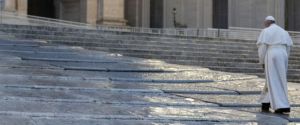
The Pope's reflection took its starting point from the first reading of the day, taken from the book of Exodus (23:20-23), in which "the Lord promises a very special help to his people and to all of us who walk on the road of life". For we read: "Behold, I send an angel ahead of you to keep you on the path and to bring you into the place I have prepared". And the Church celebrates precisely these 'our companions on the way, our protectors on the path: the angels, who guard us and are right with us, on the path'. Because, added Francis, 'it is true: life is a journey, and we must be helped to walk well, because on the journey there are pitfalls, there are dangers'. A path in which man easily runs the risk of losing his coordinates: 'We need a compass: but a human compass, or a compass that resembles the human and that helps us to see where we have to go'.
First of all, man must face a first danger: that of "not walking". Indeed, "how many people settle down and do not walk, and the whole life is still, without moving, without doing anything.... This is a danger'. These, the Pontiff explained, are situations similar to the one described in the Gospels, where it speaks of the man 'who was afraid to invest his talent'. After burying it, he repeated to himself: 'I am at peace, I am calm. I will not make a mistake. So I don't risk it'. The same happens to so many people who 'do not know how to walk or are afraid to take risks and stop'. But, said the Pope, 'we know that the rule is that whoever is stationary in life ends up corrupting himself. Like water: when the water is still there, the mosquitoes come, they lay eggs, and everything becomes corrupted. Everything'. It is precisely in such circumstances, he added, that 'the angel helps us, urges us to walk'.
But this is not the only risk in the journey of life. "There is another danger", which is that of "taking the wrong path". Here too, Francis recalled experiences common to all people: 'We too - let us tell the truth - how many times have we taken a wrong turn, for not listening to the inspiration of our fellow traveller or the advice of our brothers and sisters'. Again, the man is comforted by a certainty: "The angel is there to help us not to take the wrong path. He is with us for this: because if you make a mistake, at the beginning it is easy to correct, but after so many years - so many years - you go far away, somewhere other than where you should go".
Continuing his reflection, the Pontiff identified a further dangerous attitude. Indeed, he said, 'there are some who walk, but not on the road: they walk in the square. They do the walk of life in the square. And they go, they go to the square, always like that. And some are more creative: they go into the square, but inside the square they go one way and the other, like in a labyrinth'. Once again a concrete image to recall and better understand an inner, spiritual reality: "The labyrinth never leads you to the end: you remain trapped there. It therefore happens that man is convinced: "I am not standing still, I am walking", but he does not realise that he is not walking "on the road". In this situation too, the angel comes to "help us walk the road".
Of course, the Pope explained, that of the angel is a reality that must be recognised: "We must pray to him: 'But help me'". Even in Scripture we read: 'Have respect for his presence'. Because 'the angel is authoritative, he has authority to guide us', but we must 'listen to him', we must 'listen to the inspirations, which are always from the Holy Spirit, but it is the angel who inspires us'.
At this point, Francis addressed those present directly: 'But I would like to ask you all a question: do you talk to your angel? Do you know the name your angel has? Do you listen to your angel? Do you allow yourselves to be led by the hand on the road or to be pushed to move?". It was a call to bring everyone to an important awareness, because "the angel's presence in our lives is not only to help us on the way" but also "to show us where we must arrive".
In this regard, the Pontiff also recalled the Gospel of the day (Matthew, 18, 1-5.10) in which Jesus, faced with the disciples who ask: "But who is the greatest in the kingdom of heaven?", takes a child and says "a very beautiful thing". Indeed, he says: "This is the greatest" and, continuing, invites them not to despise children because "their angels in heaven always see the face of my Father who is in heaven". This is an important detail: 'Our angel,' the Pope emphasised, 'is not only with us, but sees God the Father. He is in relationship with him. He is the daily bridge, from the hour we get up to the hour we go to bed, who accompanies us and is in connection between us and God the Father". Therefore 'the angel is the daily door to transcendence, to the encounter with the Father': that is, he 'helps me to go because he looks at the Father and knows the way'.
Hence Francis' final exhortation - "let us not forget these companions on our journey" - and the advice: "Let each one think: do I pray to my angel? Do I listen to inspirations? Do I stop when I feel that there is something he is saying to me? And do I know, am I sure that he is a bridge to the Father, because he is looking at the Father?". This was the Pope's concluding prayer: "May the Lord give us all, on this feast of the guardian angels, the grace to understand this mystery of the guardianship of the angel, of companionship on the road, and of contemplation of the angel. Contemplation to God the Father."
[Pope Francis, s. Marta, in L'Osservatore Romano 03/10/2018]
Two by two: including opposite polarities
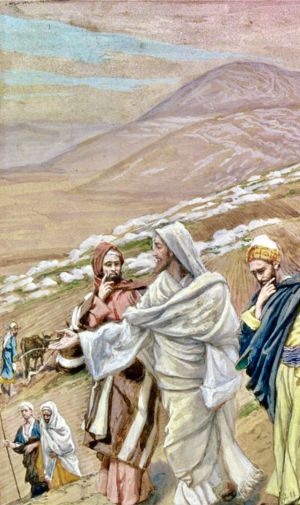
And move the neighbors
(Lk 10:1-12)
Jesus notes that the Apostles are not free people (cf. Lk 9). Their way of being is so grounded on standard attitudes and obligatory behaviors that it translates into impermeable mental armour.
Their predictability is too limiting: it gives no breathing space to the path of those who instead want to reactivate themselves, discover, value surprises behind the secret sides of reality and personality.
That wich remains tied to ancient customs and usual protagonists does not make you dream, it is not an amazing appearance and testimony of Elsewhere; it takes away expressive richness from the Announcement and from life.
The Lord is forced to call the Samaritans [the heretics of religion] gathered elsewhere, not coming from "correct" observances, but able to walk, understand, and not be picky.
The new envoys go on the road helpless. Not being able to count on the usual tricks, they are certainly damaged, defrauded and - if they touch all the exposed nerves - torn to pieces.
But their being modest and not doctoral makes us reflect, arouses new knowledge, and awareness. Thus their spontaneous and innocent friendship.
In blocked situations this ‘disorder’ of new amazements will introduce renewed charm, evoke potential, widen expressive opportunities and everyone's field of action.
Once in a territory, it will be good not to go from house to house: from a makeshift accommodation, to the apartment, the villa, and then the palace, because the search for better comforts makes God's Novelty disappear.
The care of the sick and deviations is a cornerstone of the Mission, because it is precisely from insecurities or eccentricities that a different ‘kingdom’ sprouts, the one that notices and takes charge - in the love of those who do not abandon.
And let no time be wasted by combing the “sitting” environment: even a voluntary removal educates to be free.
The momentum of life will awaken consciences and prevail over the negative: on the path that belongs to us, accusations will count for less and less.
Unlike the fruitless action of the Apostles (Lk 9 passim), the return of the new evangelizers is full of joy and results (vv. 17-20).
It is the last and different ones who bring down from "heaven" - and replace - the enemies of humanity and of our Gladness (vv. 5-6).
In the perspective of the Peace-Felicity [Shalom] to be announced, what had always seemed imperfections and flaws become preparatory energies, which complete and fulfil us also spiritually.
Now the flourishing Salvation [life as saved persons] is within reach of all (v.9), no longer a privilege.
The sides judged to be crazy, extraneous or materially inconclusive are preparing our new paths.
In the great Mystery of perceiving oneself as ‘being in the Gift’ - «two by two» (v.1) to live in fullness - the self understands the opposite polarities of its essence.
Only thus ‘widened’ do we become a being With and For the other. On the Way, in the form of the Cross.
[Thursday 26th wk. in O.T. October 1st, 2026]
Two by two, including opposite polarities
And move the neighbours
(Lk 10:1-12)
And I and You
"Truth is not at all what I have. It is not at all what you have. It is what unites us in suffering, in joy. It is what unites us in our union, in the pain and pleasure we give birth to. Neither I nor You. And me and You. Our common work, permanent amazement. Its name is Wisdom'.
(Irénée Guilane Dioh)
Jesus notes that the Apostles are not free people, that is why they do not emancipate anyone and even prevent any breakthrough (cf. Lk 9).
Their way of being is so grounded in standard attitudes and obligatory behaviour that they result in impermeable mental armour.
Their predictability is too limiting: it gives no breathing space to the path of those who instead want to reactivate themselves, discover and value surprises behind the secret sides of reality and personality.
That which remains bound to ancient customs and usual protagonists does not make one dream, it is not an apparition and amazing testimony of the Other; it takes away expressive richness from the Announcement and from life.
The Lord is compelled to call the Samaritans (the heretics of religion) gathered elsewhere, not from 'correct' observances - but capable of walking, understanding and not being picky.
At least they do not disprove the Word they proclaim with a life behind the scenes: what you see, they are.
He is practically induced to fly over the Twelve, with insecure but transparent '72s', in the uncertainty of the (many) wolves who feel destabilised.
The new envoys go on the road helpless. Unable to rely on their usual wiles, they are sure to be damaged, defrauded and - if they touch all the exposed nerves - mauled.
But their low and unassuming being makes them think, arouses new knowledge and awareness. Thus their spontaneous and innocent friendship.
Then, in blocked situations, it will be this 'disorder' of new stupefaction that will introduce renewed fascination; evoke potentialities, broaden the possible expressive inclinations, and the field of action of all.
It is the critical witnesses who transmute the world and lead people to praise (because they may have simply regained resources they did not even know they possessed or had lost sight of).
Those who never cease to surprise must beware of the fakers and profiteers who are disturbed by the smile of the newly naive - and very careful. Only here must one be difficult: let there be no more scruples!
Once in a territory, it will be good not to go from house to house: from a makeshift accommodation to the flat, to the villa, then to the palace, because the search for better comforts makes the Newness of God disappear.
Caring for the sick and deviant is a cornerstone of the Mission, because it is precisely from insecurities or eccentricities that a different kingdom sprouts, one that notices and takes charge - in the love of those who do not abandon.
And let us not waste time combing the environment sitting on the false truncated-altar ideology: even a voluntary departure educates to gratuitousness. On the contrary, it is precisely the religious leaders [old-fashioned and otherwise] and their circle devotees who remain attached to positions of social visibility, to the idol of the place, to the disease of the title (without which they do not feel like characters), that astound and reflect.
They are manipulative, and fill our heads with breeziness.
The spy of the sovereign - the 'satan' [his acolytes are many and unsuspected] enemy of humanity's progress - will no longer be relevant.
The momentum of life will awaken consciences and prevail over the negative: on the path that belongs to us, the accusations of the interested overseers will count for less and less.
Unlike the scrupulous but sad and deviant action of the Apostles [Lk 9 passim] the return of the new evangelisers aggregated by direct Calling and without intermediate rituals is full of verve and results (vv.17-20).
It is the last and different ones - not the best known and self-referential aggregates - who bring down from "heaven" and replace the Satan-functionaries, enemies of humanity and inclusive Joy (vv.5-6).
In the perspective of the Peace-Felicity [Shalôm] to be proclaimed, what had always seemed imperfections and flaws become preparatory energies, which also fulfil and realise us spiritually.
Now the blossoming Salvation [saved life, conclusive] is within reach for all (v.9), no longer a privilege.
The sides judged sickly, deranged, suffering, invalid, crazy, or materially inconclusive are preparing our new paths.
In the vocational dynamic, the fixed point does not reside in a satisfactory adherence to criteria of reason, nor in some ingenious elaboration of novelty.
Neither does it lie in the heroicity or fixity of conformed, yet convinced, behaviour.
Our certainty is a surprise that comes.It awakens us, but it resides solely in a perception of the inner eye: in the slight recurring image that dwells there and mysteriously appears, drags and guides.
And cures fears.
The only certainty will be that slight vision that - corresponding and reaffirming its comings and goings - turns each one to its unexpressed personal desire, weaving an ineffable dialogue with the soul and its Way.
The Gift imposes itself upon the intimate scenario, to turn each Name to its destination.
To attract and actualise Future. Of course: not the return to the previous situation that many advocate; today, even in times of global crisis.
There is no other fixed point than our Calling.
It comes to enter into a spousal relationship with the unpredictable and unprecedented work of the personal Faith-Calamite.
Attraction that seduces the soul, frees it from insecurities by infusing it with passion, and demands to be respected.
Only in a vocational and intimately strong sense does the call of the Dream, which emerges to the heart's perception, make us tenacious.
And it revives a wandering existence amidst the storms - like that of a planet adrift - intertwining life with Christ.
It is our Peace in chaos, which also invites introspection.
"Magnet-counter" in the external artifice of being led by others' goals.
Nor is it enough to find a modern antidote to the frenzy that stings us, still making our wandering worse.
Nor is imposing a style that conflicts with the independence of the personal spirit.
A parenthesis is not enough to annihilate the tension of contemporary life.
After all, we do not lack an oasis to reflect on the world, understand ourselves, and friends or those far away.
"I have no peace" - we hear ourselves repeated by people who feel adrift. And this feeling is contagious; rampant today.
How do we proclaim harmony and reconciliation in the home (v.5), in a world besieged by provocations, global maladies and competitions, which if considered responsibly immediately make our wrists shake?
In a New Year's greetings address to the diplomatic corps accredited to the Holy See, John Paul II summarised four epochal emergencies for the new millennium:
"Life, bread, peace and freedom: these are the great challenges of humanity today".
An outlier for our nature.
How can the man of Faith announce balance and prosperity, if weakness is not protected, if the criterion of nature today seems volatile, if nourishment is not abundant and varied for all, if fraternity is not discernible even in protected environments [at most it is mistaken for generic sympathy for advertising purposes, in a church of events - as Pope Francis says], or if belligerence can have theological motivations (in order not to accept the vital needs of others)... if one does not recognise that one can realise oneself 'in a way that corresponds to one's nature'?
This, in my opinion, is the pivotal point: the prerogative of the Vocation and the inner imagery it arouses; of our response of personal and creative spousal trust.
John Paul said: freedom is light "because it allows one to responsibly choose one's goals and the way to reach them".
Not a light that dazzles, but one that rests, and weaves patterns.
A redeemed light, which becomes relationship, the possibility of sharing; Presence that conveys meaning.
Free will pales, hand in hand with our voluntarism, and even the ability to self-determine for the good is not enough for us. We have always known this.
In his second Satire, Juvenal writes:
"Practices have given you this ringworm/
And to many they give it, like sheep/
Or of swine in a herd one communicates/
To all others scabies and dandruff/
And one grain is enough to spoil a bunch/
From this fashion to uglier matters/
Adagio adagio you will pass: the ladder/
Of vices you will not descend/
In short they will make you one of their own/
Those who at home gird their foreheads".
One must live by Communion, even with oneself, or there is no authentic life.
In the great Mystery of perceiving oneself as a "being in the Gift" - "two by two" (v.1) - to enjoy fullness, the self understands the opposite polarities of its essence.
Only thus expanded do we become a being "with" and "for" the other.
Not infrequently, the sacral proposal isolates us or places us in one-sided watertight compartments, which truncate dreams [not disembodied fantasies, which are corollary to them].
The beautiful ancient customs, or the patterns of abstract sociology, and local styles or customs, determine the tracks of our race: the usual totems of costume. Or the fashions of others; external mannerisms.
Jesus (precisely) notes the failure of his own, who fail to liberate people - and even pretend to prevent it [Lk 9].
So he also calls the Samaritans (v.1), that is, the badly indoctrinated, half-breeds and bastards.
In short, he broadens the horizon of the designated tribes, appealing to pagan nations, for a universal task.
The Lord knows that the 'lay' Faith is not of the circle.It does not willingly conform to models without intimate strength; therefore, it does not block evolution, because it makes life out of Relationship and Character.
This, in the midst of all facets of being and history: precisely with and for others, but not outwardly - but firmly within oneself.
In this way, in the friendship of self and neighbour, we become by grace and genuinely much more trustworthy than those who are driven by articulate convictions or strong club voluntarism.
The latter are often very dangerous illusions, if they do not recognise as an absolute value the concrete good of the real man, the right to his Happiness.
Totality or integration resulting from the well-being of a completion in being, no longer reduced.
Messianic Presence [Announcement of the Shalôm] that does not devalue; it does not remain one-sided.
The Falling Spy, and the Little Brains
The spy of the "ruler" - the "Satan" [his acolytes are many and unsuspected], the enemy of humanity's progress - will no longer be prominent.
Dethroned from the condition of power over men, it falls into the abyss (v.18).
It means that thanks to the mission in Christ, the momentum of life will prevail over the negative.
In the path that belongs to us, the accusations of the interested overseers will count for zero.
The old kings and prophets had only sighed for the fullness of the Messiah. They felt themselves to be great, but they had not met the Eternal One in superabundance of Person.
They were still slaves to cosmic elements, sometimes subject to the irrational power of evil; often overcome by common thinking, by their own and others' misery, by the attractions of the surrounding worldly reality.
The 'little ones', on the other hand, even today remain open to the Mystery and receive a renewed being.
The wise suppose that the only life is on their side; they think themselves powerful and convincing. They do not need light, nor do they need a Friend.
It is on this level that one of the definitive revelations about the authentic Man that manifests the divine condition is formulated.
The Son blesses the Father for the gift bestowed upon the insignificant in society, and discovers the crux of the Mystery of our communication with the Most High: the spirit of knowing oneself to be in the Family, in its own right.
Ancient religious holiness rested on separation [Qadosh-Santo: it is an attribute of the God who dwells in distinct, remote, inaccessible places] not on essence.
The new name for (domestic) holiness reflected in the Person of Christ and in that of His brethren is no longer synonymous with 'cut off from others and set apart', but 'United'.
Despite the crutches he wears, he remains in himself 'dignified' and even 'called'; hence enabled to be promoted, without further conditions of ideological or cultic purity.
Father and Son constitute a Mystery of reciprocity and dedication into which only those who wish to receive and welcome themselves in the source - in God, to allow themselves to be enveloped by a Friendship that encompasses the whole being - penetrate.
Dialogue that expands even the smallest qualities, sublimates the unknown and obscure sides of the personality into Pearls; to expand the wave of existence, without chasing the voices of the external world [only apparently vital].
Thus Sending and Mission have as their core the unfolding of the intense quality, of the same intimate and indestructible divine reality: Love.
The only Fire that annihilates the consuming powers, in people, in nations, in history.
Precisely, unlike the scrupulous but sad and deviant work of the Apostles [Lk 9 passim], the return of the new evangelisers aggregated by direct Calling and without intermediate rituals is full of joy and results (vv.17-20).
We recall Tagore: 'If Christians were like their Master, they would have all India at their feet'.
They are the last and different - the new protagonists of the proclamation.
Not the best known and self-opinionated co-opted ones succeed in bringing down from heaven and replacing the Satan-functionaries, enemies of humanity and our democratic Joy (vv.5-6).
In the perspective of the Peace-Felicity [Shalôm] to be proclaimed, what had always seemed imperfections and flaws become preparatory energies, which complement, include and fulfil us spiritually as well.
Now the Salvation [life of the saved] that flourishes is within reach of all who have a caring spirit and virtue as family members. No longer the privilege of circles that feel secure [but lose uniqueness].
Tagore again: 'Kindly, deliberately make yourself small, come into this small abode [...] As a friend, as a father, as a mother make yourself small, come into my heart. I too with my hands will make myself small before the master of the universe; with my small intelligence I will know you and make you known".
The Mystery resists the "learned" who make profession of high wisdom (v.21).
Conversely, the Kingdom opens to those not imprisoned by conformist and interposed ideas - slaves to thoughts and conventions.
Here is the Hymn of Jubilation (vv.21-24) that introduces the Commandment of Love (vv.25ff).I remember my Augustinian professor of Patristics: he insisted that one of the nicknames earned by the early Christians was 'little brains'.
They were simple people, but full of aptitudes for fullness, and wise new awareness, which astounded the professors and philosophers of the ancient world.
We, too, ask ourselves: what makes us come close to what we are called to do?
Well, perhaps we already know: the sufficiency of those who profess cerebral doctrine - in reality - only leads to falling from the sky.
It annihilates humble self-perception, makes the ability to notice pale; it closes one to forgiveness, to benevolent acceptance, to listening to the soul and to others, to availability. Even to the acumen of innate knowledge, that which belongs to us and would solve real problems.
Precisely those sides that are judged crazy or materially inconclusive - even in the weave of small things - would make us face the external events that beset us... as opportunities for growth.
They are indeed preparing our new paths, and a germ of an alternative society.
To internalise and live the message:
What happened in you when you accepted the modest (and full) status of son?
What new awareness of yourself and the world did you acquire?
Did you also discover outbursts of gratuitousness, as well as gratitude?
Scientists and Little Ones
(Lk 10:21-24)
That which remains bound to ancient customs and usual protagonists does not make one dream, it is not an apparition and an astonishing testimony of the Other; it takes away expressive richness from the Announcement and from life.
The leaders looked at religiosity with a purpose of interest. Professors of theology were accustomed to assessing every comma from their own ridiculously supponent knowledge - unrelated to real events.
The new envoys go on the road helpless.
The Master rejoices in their and his own experience, which brings a non-epidermal joy and a teaching from the Spirit - about those who are well disposed to understand the depths of the Kingdom in ordinary things.
In short, after an initial moment of enthusiastic crowds, the Master delves deeper into the issues and finds everyone against him, except God and the least: the weightless, but eager to start from scratch.
Gleam of the Mystery that leavens history - without making it a possession.
At the conclusion of the encyclical Fratelli Tutti, Pope Francis cites the figure and experience of Charles de Foucauld, who - subverting conformism - "only by identifying himself with the least came to be a brother to all" (no.287).
At first, even Jesus was stunned by the rejection of those who were already satisfied with the official religious structure and no longer expected anything that could arouse custom and profit.
Then he understands, praises and blesses the Father's plan.
He understands that the authentic person is born from the depths, in any case from another elaboration and genesis, which upsets the established, inert and reassuring religious relationship - never profound nor decisive for human destiny.
God is Simple Relationship: it demythologises the idol of greatness.
The Eternal One is not the master of creation who manifests himself through the irrepressible powers of nature.
He is Refreshment that refreshes, because He makes us feel complete and lovable; He seeks us out, He is attentive to the language of the heart.
He is Keeper of the world, even of the unlearned - of the "infants" (v.21) spontaneously empty of boastful spirit, that is, of those who do not remain closed in their sufficient belonging.
The Father-Son relationship is communicated to God's poor: those who are endowed with a family-like attitude (v.22).
Insignificant and invisible without great gifts, but who abandon themselves to the proposals of the providential life that comes, like children in the arms of parents.
A spirit of pietas that favours those who allow themselves to be filled, and do not proceed along the paths of thought or calculating initiative, but of innate Wisdom.
It conveys freshness in the readiness to receive - to personally receive and replenish - both the Truth as Gift... and the spontaneous enthusiasm itself, capable of realising it.
A prayer of blessing that is simple and for the simple - this of Jesus (v.21) - that makes us grow in esteem, fits perfectly with our experience, and gets along well with ourselves.
But which strangely the 'learned', who do not live 'the spirit of the neighbourhood' (FT no.152) but who claim positions and always play cunningly, did not wish to convey to us so willingly.
To internalise and live the message:
What do you feel when you are told: 'You don't count'? Does it remain a humiliating contempt or do you consider it a great Light received, as Jesus did?
As lambs in the midst of wolves: a condition for being able to say Peace

Jesus sends 70 disciples out into the great harvest, which is the world, inviting them to pray the Lord of the harvest that there may be no lack of labourers in his harvest (cf. Lk 10:1-3); but he does not send them with powerful means, but “as lambs in the midst of wolves” (v. 3), without purse, bag, or sandals (cf. v. 4). St John Chrysostom, in one of his homilies, comments: “For so long as we are sheep, we conquer: though ten thousand wolves prowl around, we overcome and prevail. But if we become wolves, we are worsted, for the help of our Shepherd departs from us” (Homily 33, 1: PG 57, 389). Christians must never yield to the temptation to become wolves among wolves; it is not with might, with force, with violence that Christ’s kingdom of peace grows, but with the gift of self, with love carried to the extreme, even towards enemies. Jesus does not conquer the world with the force of arms, but with the force of the Cross, which is the true guarantee of victory. The consequence of this for those who want to be disciples of the Lord, his envoys, is to be prepared for the passion and martyrdom, to lose their own life for him, so that in the world goodness, love and peace may triumph. This is the prerequisite needed to say, upon entering into every situation: “Peace be to this house” (Lk 10:5).
[Pope Benedict, Prayer in preparation for the Assisi Meeting, 26 October 2011]
Faith is strengthened by giving it, or it pales
1. The mission of Christ the Redeemer, which is entrusted to the Church, is still very far from completion. As the second millennium after Christ's coming draws to an end, an overall view of the human race shows that this mission is still only beginning and that we must commit ourselves wholeheartedly to its service. It is the Spirit who impels us to proclaim the great works of God: "For if I preach the Gospel, that gives me no ground for boasting. For necessity is laid upon me. Woe to me if I do not preach the Gospel!" (1 Cor 9: 16)
In the name of the whole Church, I sense an urgent duty to repeat this cry of St. Paul. From the beginning of my Pontificate I have chosen to travel to the ends of the earth in order to show this missionary concern. My direct contact with peoples who do not know Christ has convinced me even more of the urgency of missionary activity, a subject to which I am devoting the present encyclical.
The Second Vatican Council sought to renew the Church's life and activity in the light of the needs of the contemporary world. The Council emphasized the Church's "missionary nature," basing it in a dynamic way on the Trinitarian mission itself. The missionary thrust therefore belongs to the very nature of the Christian life, and is also the inspiration behind ecumenism: "that they may all be one...so that the world may believe that you have sent me" (Jn 17:21).
2. The Council has already borne much fruit in the realm of missionary activity. There has been an increase of local churches with their own bishops, clergy and workers in the apostolate. The presence of Christian communities is more evident in the life of nations, and communion between the churches has led to a lively exchange of spiritual benefits and gifts. The commitment of the laity to the work of evangelization is changing ecclesial life, while particular churches are more willing to meet with the members of other Christian churches and other religions, and to enter into dialogue and cooperation with them. Above all, there is a new awareness that missionary activity is a matter for all Christians, for all dioceses and parishes, Church institutions and associations.
Nevertheless, in this "new springtime" of Christianity there is an undeniable negative tendency, and the present document is meant to help overcome it. Missionary activity specifically directed "to the nations" (ad gentes) appears to be waning, and this tendency is certainly not in line with the directives of the Council and of subsequent statements of the Magisterium. Difficulties both internal and external have weakened the Church's missionary thrust toward non-Christians, a fact which must arouse concern among all who believe in Christ. For in the Church's history, missionary drive has always been a sign of vitality, just as its lessening is a sign of a crisis of faith.
Twenty-five years after the conclusion of the Council and the publication of the Decree on Missionary Activity Ad Gentes, fifteen years after the Apostolic Exhortation Evangelii Nuntiandi issued by Pope Paul VI, and in continuity with the magisterial teaching of my predecessors, I wish to invite the Church to renew her missionary commitment. The present document has as its goal an interior renewal of faith and Christian life. For missionary activity renews the Church, revitalizes faith and Christian identity, and offers fresh enthusiasm and new incentive. Faith is strengthened when it is given to others! It is in commitment to the Church's universal mission that the new evangelization of Christian peoples will find inspiration and support.
But what moves me even more strongly to proclaim the urgency of missionary evangelization is the fact that it is the primary service which the Church can render to every individual and to all humanity in the modern world, a world which has experienced marvelous achievements but which seems to have lost its sense of ultimate realities and of existence itself. "Christ the Redeemer," I wrote in my first encyclical, "fully reveals man to himself.... The person who wishes to understand himself thoroughly...must...draw near to Christ.... [The] Redemption that took place through the cross has definitively restored to man his dignity and given back meaning to his life in the world."
[Pope John Paul II, Redemptoris Missio]
He immediately trains them for the Mission
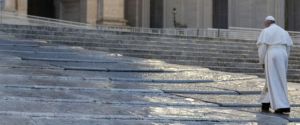
The Gospel […] speaks to us about this: the fact that Jesus is not a lone missionary, he does not want to fulfil his mission alone, but involves his disciples. And today we see that in addition to the twelve Apostles he calls another 72, and sends them to the villages, two by two, to proclaim that the Kingdom of God is close at hand. This is very beautiful! Jesus does not want to act alone, he came to bring the love of God into the world and he wants to spread it in the style of communion, in the style of brotherhood. That is why he immediately forms a community of disciples, which is a missionary community. He trains them straight away for the mission, to go forth.
But pay attention: their purpose is not to socialize, to spend time together, no, their purpose is to proclaim the Kingdom of God, and this is urgent! And it is still urgent today! There is no time to be lost in gossip, there is no need to wait for everyone's consensus, what is necessary is to go out and proclaim. To all people you bring the peace of Christ, and if they do not welcome it, you go ahead just the same. To the sick you bring healing, because God wants to heal man of every evil. How many missionaries do this, they sow life, health, comfort to the outskirts of the world. How beautiful it is! Do not live for yourselves, do not live for yourselves, but live to go forth and do good! There are many young people today in the Square: think of this, ask yourselves this: is Jesus calling me to go forth, to come out of myself to do good? To you, young people, to you boys and girls I ask: you, are you brave enough for this, do you have the courage to hear the voice of Jesus? It is beautiful to be missionaries!... Ah, you are good! I like this!
These 72 disciples, whom Jesus sent out ahead of him, who were they? Who do they represent? If the Twelve were the Apostles, and also thus represent the Bishops, their successors, these 72 could represent the other ordained ministries, priests and deacons; but more broadly we can think of the other ministries in the Church, of catechists, of the lay faithful who engage in parish missions, of those who work with the sick, with different kinds of disadvantaged and marginalized people; but always as missionaries of the Gospel, with the urgency of the Kingdom that is close at hand. Everyone must be a missionary, everyone can hear that call of Jesus and go forth and proclaim the Kingdom!
The Gospel says that those 72 came back from their mission full of joy, because they had experienced the power of Christ's Name over evil. Jesus says it: to these disciples He gives the power to defeat the evil one. But he adds: “Do not rejoice in this, that the spirits are subject to you; but rejoice that your names are written in heaven” (Lk 10:20). We should not boast as if we were the protagonists: there is only one protagonist, it is the Lord! The Lord's grace is the protagonist! He is the one hero! And our joy is just this: to be his disciples, his friends. May Our Lady help us to be good agents of the Gospel.
Dear friends, be glad! Do not be afraid of being joyful! Don't be afraid of joy! That joy which the Lord gives us when we allow him to enter our life. Let us allow him to enter our lives and invite us to go out to the margins of life and proclaim the Gospel. Don't be afraid of joy. Have joy and courage!
[Pope Francis, Angelus 7 July 2013]
Faith, caricatures and Footsteps of the Son
(Lc 9,57-62)
For Semites, parental figures indicate the link with ethnicity, tradition, past and cultural environment.
Jesus seems to exclude the correlation to such figures, although he addresses his own intimates in an exclusive and singular way.
He never speaks of fathers, but about the Father - who is not a repeater.
Therefore he imposes on everyone a horizontal cut with the customs that could delay or condition his Call, the profound discovery of the meaning of events, the rise of a new mentality, the Dishipleship.
He diversifies Vocations, to make everyone understand the intimate character, by Name, of the relationship of Covenant in the Faith - which he does not depersonalize.
Symbiosis with the surrounding mentality or intellectual knowledge itself can paradoxically obscure precisely the intelligence of the unrepeatable inclinations that in our interior manifest the incomparable signature of the Creator.
The authentic Appeal grasps woman and man in an exclusive, penetrating way, in the uniqueness of their experience.
Sometimes the best thing to do for yourself and your neighbor is to cut an umbilical cord, and take a step back from the expectations of people you usually attend.
Always attending the same conformist environments, we identify ourselves in roles, labels, characters and situations: the center of expectations and dreams is blocked.
The doors of other worlds, of another kingdom, are not opened.
Personality wants its space of autonomy, because life in fullness is experiencing a fresh cascade of rebirth in Christ - celebrating together, but standing on one’s own legs.
Jesus is peremptory, because the choice is decisive.
Those who remain with their heads down or backwards - or in confrontation - cannot experience the adventure of Faith. They does not live, but drag along the religion of the dead.
Who is only in the future and has no sense of reality, experiences illusions. But those who stay in the past or with models, are with the skeletons and do not perceive the sense of change.
Behind the main lines of the personality of each is hidden a Pearl, which in order to make significant contributions according to the Lord’s Plan must manifest its very unique nuances.
Over time, compromise becomes a habitus that makes natural trends lose: but the chromosomes of the Vocation are nested in them.
The suggestion of the forms to be perpetuated or overcome at all costs, the snare of narrow judgments, the bonds of circles, can take away from us the hidden wealth.
Self-referential configurations wich steal the present, and future: this is the real mistake to avoid!
What matters is not to restore the situation, copy the ancients or the acclaimed and strongs à la page, identify yourself to be sure and not make mistakes, but renew yourself to evolve, grow, expand, amaze.
Otherwise our clumsy problems will always be identical and there will be no exuberant Way nor Promised Land, but only a vicious circle of regrets or false reassurances.
To live the Faith of the real moment one cannot be repeating schoolchildren of the place or fashions, of the time or the day before.
[Wednesday 26th wk. in O.T. September 30, 2026]
Faith, caricatures and Discipleship
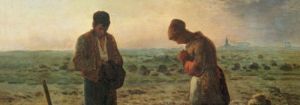
Lk 9:57-62 [cf. Mk 5:18-20]
For Semites, parental figures indicate a connection with ethnicity, tradition, the past and the cultural environment.
Jesus seems to exclude any correlation with such figures, even though he addresses his own in an exclusive and singular way.
He never speaks of fathers, but of the Father - who is not a repeater.
He therefore imposes on everyone a horizontal break with customs that could delay or condition his Call, the profound discovery of the meaning of events, the emergence of a new mentality, the Following.
He diversifies Vocations, to make each person understand the intimate character, by Name, of the relationship of Covenant in Faith - which does not depersonalise as in religions.
Paradoxically, symbiosis with the surrounding mentality or intellectual knowledge itself can obscure the very intelligence of the unique inclinations that manifest the incomparable signature of the Creator in our innermost being.
The authentic Call captures women and men in an exclusive and penetrating way, in the uniqueness of their experience. What kind of Covenant and Mission would it be otherwise?
Sometimes the best thing to do for oneself and for others is to cut the umbilical cord and distance oneself from the expectations of people one usually associates with.
This decision is essential in order to seek the meaning of the Spirit, which is only personal Love - and becomes true Passion.
Here, the inner state of individuation and independence must be very present in the soul.
By frequenting the same conformist environments, we identify with people and situations: thus blocking the centre of expectations and dreams. The doors to other worlds, to another realm, do not open.
The personality wants its space of autonomy, because life in its fullness is to experience a fresh cascade of rebirths in Christ - celebrating together, but standing on one's own two feet.
Impossible for our nature... but the Source of being leads us like a skilled director, always from novelty to novelty. And his profound Wisdom will make us dance - even if we have never learned to dance in style.
What kind of life of Faith would it be that claims to stem the waves of the open sea to keep us always in the most familiar, reassuring harbour?
Leaning on family, friends, habitual opinions, the cove of the club or the beach of the movement [in short, wanting to be like everyone else in order to gain immediate approval] does not allow us to experience new beginnings.
Jesus is peremptory, because the choice is decisive.
Those who keep their heads down or look back – or compare themselves to others – cannot experience the adventure of Faith; they do not live, but drag behind them the religion of the dead.
Those who live only in the future and have no sense of reality experience illusions. But those who remain in the past or with models, stay with skeletons (not only in the closet) and do not perceive the meaning of change.
They easily become obsessed or brooding, becoming chronic. Whereas new stimuli could introduce them to a chain of unexpected leaps.
This is why insistent family and cultural ties can take away the intensity or character of the Call by Name.
They encroach on the necessary space, invaded by too many 'Yes, sir's' - which do not belong to us and which we do not want. They only block the hidden mechanisms.
In the passionate exodus with Jesus, the pleasure of the Vocation cannot allow the inclinations of others [and conformists] to pour into, pervade and occupy our personal world and time.
In order to listen to and make the Call to Mission our own, it is necessary to build a sphere of the Self that is eminent, unassailable, friendly, and protected - one whose pace and horizons we will learn to follow over time.
This identifying sphere, with boundaries protected from interference, will help us in the Dialogue of prayer. It will remove us from the danger of being absorbed by the common, impersonal, accommodating mentality.
The defence of this confidentiality, dense with the Unpublished and non-institutional, becomes the springboard and driving force of our committed life, which does not turn back.
Over time, this Nest will teach us to express the quality of relationships in a genuine, rather than conventional, way - even complete disagreement with the prevailing external mentality, which has power, however trivial.
Those who choose otherwise will sooner or later have to compensate for the cut (of themselves) with gratifications of various kinds, which will distance them from their own face and from the ideal that intimately corresponds to it.
[Even a dreamy, saintly wickedness can serve to rediscover the intimate core of a person, the sacredness of each individual].
We are not called to conform to a neutral do-goodism that only wants to please outwardly, perhaps because it is afraid of being excluded from the circle or judged badly - even the opposite.
Behind the main lines of each person's personality lies a Pearl, which, in order to make a significant contribution according to the Lord's Plan, must manifest its own unique nuances.Especially in our spousal relationship with God, we must not adapt to roles that do not belong to us deeply.
Over time, compromise becomes a habit that causes us to lose our natural tendencies: within them lie the chromosomes of our Vocation.
The realisation of our unique missionary calling does not happen according to character or established and widespread principles – conciliatory and successful – nor because we go hand in hand with the whole world of veterans [or those who are 'à la page'].
Instead of adapting and letting ourselves be influenced by irenicism, at a certain point we deviate to follow the inner Friend who knows where to lead us and does not know the pretence of always agreeing.
Otherwise, having lost the energy-Person and the goal that lead us to our destination, Uniqueness fades in the mediations that hold us hostage - behind events, lines of thought and roles that are now obsolete.
Finally, we lose sight of our founding Eros, which wanted to move our desires, our way of knowing the world and our activities.
[Outcome: a now blurred Core, a Source that recycles and no longer gushes as before, dispersed in a thousand rivulets of transformation - astute shortcuts for a smooth career].
Hence the great dances on nothingness: that of missed dangers - staged as quiet compensation by those whom Christ would call 'empty shells' ['makers of vain things': Lk 13:27 original text].
It is not uncommon for the goals of a caste or group linked to tribal and sectoral thinking to consolidate - to take precedence over the specific weight and intimacy of values, replaced by facile and conformist slogans or adultoids that plagiarise existence.
Every missionary knows that entrusting one's life to mannered, serious and quiet opinions, reassuring initiatives or textbook choices does not bear fruit; on the contrary, it becomes counterproductive.
Concordism seems like an attractive refuge, but it only becomes a den of flattery.
According to Chinese thought, in order to acquire polish and escape a polluted and worn-out servility, the Saints 'learn from animals the art of avoiding the harmful effects of domestication that life in society imposes'.
In fact: 'Domestic animals die prematurely. And so do men, whom social conventions forbid to obey spontaneously the rhythm of universal life'.
'These conventions impose continuous, self-interested, exhausting activity [whereas it is appropriate] to alternate periods of slow living and jubilation'.
"The Saint does not submit to retreat or fasting except in order to achieve, through ecstasy, escape through long journeys. This liberation is prepared by invigorating games, which nature teaches."
"One trains for a heavenly life by imitating the pleasures of animals. To become holy, one must first become brutalised – that is, learn from children, animals and plants the simple and joyful art of living only for the sake of life."
[M. Granet, Il Pensiero Cinese, Adelphi 2019, Kindle pp. 6904-6909].
The suggestion of the past to be perpetuated, the bondage of narrow judgements and the ties of circles can rob us of hidden riches, stealing the present and the future: this is the real mistake to avoid!
What matters is not to restore the situation, copy the ancients or the acclaimed and powerful, identify with them in order to remain quiet and not make mistakes, but rather to renew ourselves in order to evolve, grow, expand and amaze.
Otherwise, our clumsy problems will always be the same and there will be no exuberant Path or Promised Land, but only a vicious circle of regrets or false reassurances.
To live the Faith of the real moment - without giving up and putting things in order - we cannot be schoolchildren repeating the place or fashions, the time or the day before.
A radical and total decision:
the Church does not promote itself
In today's Gospel (cf. Lk 9:51-62), St Luke begins the account of Jesus' last journey to Jerusalem, which will end in chapter 19. It is a long march, not only geographical and spatial, but spiritual and theological, towards the fulfilment of the Messiah's mission. Jesus' decision is radical and total, and those who follow him are called to measure themselves against it. Today, the Evangelist presents us with three characters - three cases of vocation, we might say - who highlight what is required of those who want to follow Jesus to the end, totally.
The first character promises him: 'I will follow you wherever you go' (v. 57). Generous! But Jesus replies that the Son of Man, unlike foxes that have dens and birds that have nests, 'has nowhere to lay his head' (v. 58). The absolute poverty of Jesus. Jesus, in fact, left his father's house and renounced all security in order to proclaim the Kingdom of God to the lost sheep of his people. Thus Jesus showed us, his disciples, that our mission in the world cannot be static, but is itinerant. The Christian is an itinerant. The Church, by its very nature, is on the move; it does not remain sedentary and tranquil within its own enclosure. It is open to the broadest horizons, sent forth – the Church is sent forth! – to bring the Gospel to the streets and to reach the human and existential peripheries. This is the first character.
The second person Jesus meets receives his call directly from him, but responds: “Lord, let me first go and bury my father” (v. 59). It is a legitimate request, based on the commandment to honour one’s father and mother (cf. Ex 20:12). However, Jesus replies: “Let the dead bury their dead” (v. 60). With these deliberately provocative words, He intends to affirm the primacy of following Him and proclaiming the Kingdom of God, even over the most important realities, such as family. The urgency of communicating the Gospel, which breaks the chain of death and inaugurates eternal life, does not allow for delays, but requires readiness and availability. Therefore, the Church is itinerant, and here the Church is decisive, acting quickly, in the moment, without waiting.
The third character also wants to follow Jesus, but on one condition: he will do so after saying goodbye to his relatives. And this is what he hears from the Master: 'No one who puts his hand to the plough and then looks back is fit for the kingdom of God' (v. 62). Following Jesus excludes regrets and looking back, but requires the virtue of decision.
The Church, in order to follow Jesus, is itinerant, acting immediately, quickly and decisively. The value of these conditions set by Jesus – itinerancy, readiness and decisiveness – does not lie in a series of 'no's' to good and important things in life. Rather, the emphasis should be placed on the main objective: to become a disciple of Christ! A free and conscious choice, made out of love, to reciprocate God's inestimable grace, and not made as a way to promote oneself. How sad this is! Woe to those who think they are following Jesus to promote themselves, that is, to advance their careers, to feel important or to acquire a position of prestige. Jesus wants us to be passionate about Him and the Gospel. A passion of the heart that translates into concrete gestures of closeness, of proximity to our brothers and sisters most in need of welcome and care. Just as He himself lived.
May the Virgin Mary, icon of the Church on her journey, help us to follow the Lord Jesus with joy and to proclaim the Good News of salvation to our brothers and sisters with renewed love.
(Pope Francis, Angelus, 30 June 2019)
Leaving everything behind

The biblical readings of Holy Mass […] give me the opportunity to take up the theme of Christ's call and its requirements, a topic on which I also reflected a week ago, on the occasion of the ordinations of the new priests for the Diocese of Rome. In fact, those who have the good fortune to know a young man or woman who leaves the family and studies and works in order to consecrate him- or herself to God know well what is involved, for they have before them a living example of a radical response to the divine call. This is one of the most beautiful experiences one can have in the Church: seeing and actually touching the Lord's action in people's lives; experiencing that God is not an abstract entity but a reality so great and strong that it fills human hearts to overflowing, he is a Person, alive and close, who loves us and asks to be loved.
The Evangelist Luke presents to us Jesus, walking to Jerusalem, who meets some men on the road probably young men who promise they will follow him wherever he goes. Jesus proves very demanding with them and warns them that "the Son of Man", namely, the Messiah, "has nowhere to lay his head" that is to say, he has no permanent dwelling place of his own and that those who choose to work with him in God's field cannot turn back (cf. Lk 9:57-58; 61-62). On the other hand Christ says to someone else: "Follow me", asking him to sever completely his ties with his family (cf. Lk 9:59-60). These requirements may seem too harsh but in fact they express the newness and absolute priority of the Kingdom of God that is made present in the very Person of Jesus Christ. All things considered, it is a question of that radicalism that is due to the Love of God, whom Jesus himself was the first to obey. Those who give up everything, even themselves, to follow Jesus, enter into a new dimension of freedom that St Paul defines as "walk[ing] by the Spirit" (cf. Gal 5:16). "For freedom Christ has set us free", the Apostle writes, and he explains that this new form of freedom acquired from Christ consists in being "servants of one another" (Gal 5:1, 13). Freedom and love coincide! On the contrary, complying with one's own egoism leads to rivalry and conflict.
Dear friends, the month of June, characterized by the devotion to the Sacred Heart of Christ, is now coming to an end. On the Feast of the Sacred Heart we renewed our commitment to sanctification together with the priests of the whole world. Today, I would like to invite everyone to contemplate the mystery of the divine and human Heart of the Lord Jesus, to draw from the very source of God's Love. Those who fix their gaze on that pierced Heart that is ever open for our love sense the truth of this invocation: "You are my inheritance O Lord" (Responsorial Psalm), and are prepared to leave everything to follow the Lord. O Mary, who answered the divine call without reserve, pray for us!
[Pope Benedict, Angelus, 27 June 2010]
Revelation speaks of a fulfilment that man is called to realise
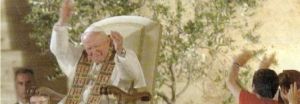
Christian revelation excludes reincarnation, and speaks of a fulfilment which man is called to achieve in the course of a single earthly existence. Man achieves this fulfilment of his destiny through the sincere gift of self, a gift which is made possible only through his encounter with God. It is in God that man finds full self-realization: this is the truth revealed by Christ. Man fulfils himself in God, who comes to meet him through his Eternal Son. Thanks to God's coming on earth, human time, which began at Creation, has reached its fullness. "The fullness of time" is in fact eternity, indeed, it is the One who is eternal, God himself. Thus, to enter into "the fullness of time" means to reach the end of time and to transcend its limits, in order to find time's fulfilment in the eternity of God.
[Pope John Paul II, Tertio Millennio Adveniente n.9]
5. We shall conclude this catechesis by turning once again to the figure of Jesus Christ, High Priest, Good Shepherd and supreme exemplar of priests. He is the model of the spoliation of earthly goods for the priest who wants to conform to the requirement of evangelical poverty. For Jesus was born and lived in poverty. St Paul admonished: 'From being rich that he was, he became poor for your sake' (2 Cor 8:9). Jesus himself, to one who wanted to follow him, said of himself: "Foxes have their dens and birds of the air their nests, but the Son of Man has nowhere to lay his head" (Lk 9:57). These words manifest a complete detachment from all earthly comforts. It should not be concluded, however, that Jesus lived in misery. Other passages in the Gospels report that he received and accepted invitations to the homes of rich people (cf. Mt 9:10-11; Mk 2:15-16; Lk 5:29; 7:36; 19:5-6), had female co-workers to support him in his financial needs (Lk 8:2-3; cf. Mt 27:55; Mk 15:40; Lk 23:55-56) and was able to give alms to the poor (cf. Jn 13:29). There is no doubt, however, about the life and spirit of poverty that characterised Him.
[Pope John Paul II, General Audience 21 July 1993]
"His" in a very literal sense: the One whom only the Son knows as Father, and by whom alone He is mutually known. We are now on the same ground, from which the prologue of the Gospel of John will later arise (Pope John Paul II)
“Suo” in senso quanto mai letterale: Colui che solo il Figlio conosce come Padre, e dal quale soltanto è reciprocamente conosciuto. Ci troviamo ormai sullo stesso terreno, dal quale più tardi sorgerà il prologo del Vangelo di Giovanni (Papa Giovanni Paolo II)
That 'always seeing the face of the Father' is the highest manifestation of the worship of God. It can be said to constitute that 'heavenly liturgy', performed on behalf of the whole universe [John Paul II]
Quel “vedere sempre la faccia del Padre” è la manifestazione più alta dell’adorazione di Dio. Si può dire che essa costituisce quella “liturgia celeste”, compiuta a nome di tutto l’universo [Giovanni Paolo II]
But what moves me even more strongly to proclaim the urgency of missionary evangelization is the fact that it is the primary service which the Church can render to every individual and to all humanity [Redemptoris Missio n.2]
Ma ciò che ancor più mi spinge a proclamare l'urgenza dell'evangelizzazione missionaria è che essa costituisce il primo servizio che la chiesa può rendere a ciascun uomo e all'intera umanità [Redemptoris Missio n.2]
Freedom and love coincide! On the contrary, obeying one’s selfishness leads to rivalry and conflict (Pope Benedict)
Libertà e amore coincidono! Al contrario, obbedire al proprio egoismo conduce a rivalità e conflitti (Papa Benedetto)
Are they not all spirits charged with a ministry, sent to serve those who are to inherit salvation? (Heb 1:14)
Non sono essi tutti spiriti incaricati di un ministero, inviati per servire coloro che devono ereditare la salvezza? (Eb 1,14)
The Church with its permanent contradiction: between the ideal and reality, the more annoying contradiction, the more the ideal is affirmed sublime, evangelical, sacred, divine, and the reality is often petty, narrow, defective, sometimes even selfish (Pope Paul VI)
La Chiesa con la sua permanente contraddizione: tra l’ideale e la realtà, tanto più fastidiosa contraddizione, quanto più l’ideale è affermato sublime, evangelico, sacro, divino, e la realtà si presenta spesso meschina, angusta, difettosa, alcune volte perfino egoista (Papa Paolo VI)
At first they say “yes” to God’s will, but their piety becomes routine and God no longer matters to them [Pope Benedict]
Essi, prima, dicono “sì” alla volontà di Dio. Ma la loro religiosità diventa routine, e Dio non li inquieta più [Papa Benedetto]
And «each of us can say: "for love to me"» (Pope Francis)
E «ognuno di noi può dire: “per amore a me”» (Papa Francesco)
We too, to reach a more conscious confession of Jesus Christ must follow, like Peter, a path made of attentive, caring listening (Pope John Paul II)
Anche noi per giungere a una più consapevole confessione di Gesù Cristo dobbiamo percorrere, come Pietro, un cammino fatto di ascolto attento, premuroso (Papa Giovanni Paolo II)
It is a word that must be witnessed to and proclaimed explicitly, because without a consistent witness it proves to be less comprehensible and credible [Pope Benedict]
E’ una Parola che deve essere testimoniata e proclamata esplicitamente, perché senza una testimonianza coerente essa risulta meno comprensibile e credibile [Papa Benedetto]








duevie.art
don Giuseppe Nespeca
Tel. 333-1329741
Disclaimer
Questo blog non rappresenta una testata giornalistica in quanto viene aggiornato senza alcuna periodicità. Non può pertanto considerarsi un prodotto editoriale ai sensi della legge N°62 del 07/03/2001.
Le immagini sono tratte da internet, ma se il loro uso violasse diritti d'autore, lo si comunichi all'autore del blog che provvederà alla loro pronta rimozione.
L'autore dichiara di non essere responsabile dei commenti lasciati nei post. Eventuali commenti dei lettori, lesivi dell'immagine o dell'onorabilità di persone terze, il cui contenuto fosse ritenuto non idoneo alla pubblicazione verranno insindacabilmente rimossi.