


don Giuseppe Nespeca
Giuseppe Nespeca è architetto e sacerdote. Cultore della Sacra scrittura è autore della raccolta "Due Fuochi due Vie - Religione e Fede, Vangeli e Tao"; coautore del libro "Dialogo e Solstizio".
8. Redemption as a new creation
The Redeemer of the world! In him has been revealed in a new and more wonderful way the fundamental truth concerning creation to which the Book of Genesis gives witness when it repeats several times: "God saw that it was good"38. The good has its source in Wisdom and Love. In Jesus Christ the visible world which God created for man39-the world that, when sin entered, "was subjected to futility"40-recovers again its original link with the divine source of Wisdom and Love. Indeed, "God so loved the world that he gave his only Son"41. As this link was broken in the man Adam, so in the Man Christ it was reforged42. Are we of the twentieth century not convinced of the over poweringly eloquent words of the Apostle of the Gentiles concerning the "creation (that) has been groaning in travail together until now"43 and "waits with eager longing for the revelation of the sons of God"44, the creation that "was subjected to futility"? Does not the previously unknown immense progress-which has taken place especially in the course of this century-in the field of man's dominion over the world itself reveal-to a previously unknown degree-that manifold subjection "to futility"? It is enough to recall certain phenomena, such as the threat of pollution of the natural environment in areas of rapid industrialization, or the armed conflicts continually breaking out over and over again, or the prospectives of self-destruction through the use of atomic, hydrogen, neutron and similar weapons, or the lack of respect for the life of the unborn. The world of the new age, the world of space flights, the world of the previously unattained conquests of science and technology-is it not also the world "groaning in travail"45 that "waits with eager longing for the revealing of the sons of God"46?
In its penetrating analysis of "the modern world", the Second Vatican Council reached that most important point of the visible world that is man, by penetrating like Christ the depth of human consciousness and by making contact with the inward mystery of man, which in Biblical and non-Biblical language is expressed by the word "heart". Christ, the Redeemer of the world, is the one who penetrated in a unique unrepeatable way into the mystery of man and entered his "heart". Rightly therefore does the Second Vatican Council teach: "The truth is that only in the mystery of the Incarnate Word does the mystery of man take on light. For Adam, the first man, was a type of him who was to come (Rom 5:14), Christ the Lord. Christ the new Adam, in the very revelation of the mystery of the Father and of his love, fully reveals man to himself and brings to light his most high calling". And the Council continues: "He who is the 'image of the invisible God' (Col 1:15), is himself the perfect man who has restored in the children of Adam that likeness to God which had been disfigured ever since the first sin. Human nature, by the very fact that is was assumed, not absorbed, in him, has been raised in us also to a dignity beyond compare. For, by his Incarnation, he, the son of God, in a certain way united himself with each man. He worked with human hands, he thought with a human mind. He acted with a human will, and with a human heart he loved. Born of the Virgin Mary, he has truly been made one of us, like to us in all things except sin"47, he, the Redeemer of man.
9. The divine dimension of the mystery of the Redemption
As we reflect again on this stupendous text from the Council's teaching, we do not forget even for a moment that Jesus Christ, the Son of the living God, become our reconciliation with the Father48. He it was, and he alone, who satisfied the Father's eternal love, that fatherhood that from the beginning found expression in creating the world, giving man all the riches of creation, and making him "little less than God"49, in that he was created "in the image and after the likeness of God".50. He and he alone also satisfied that fatherhood of God and that love which man in a way rejected by breaking the first Covenant51 and the later covenants that God "again and again offered to man"52. The redemption of the world-this tremendous mystery of love in which creation is renewed-53 is, at its deepest root, the fullness of justice in a human Heart-the Heart of the First-born Son-in order that it may become justice in the hearts of many human beings, predestined from eternity in the Firstborn Son to be children of God54and called to grace, called to love. The Cross on Calvary, through which Jesus Christ-a Man, the Son of the Virgin Mary, thought to be the son of Joseph of Nazareth-"leaves" this world, is also a fresh manifestation of the eternal fatherhood of God, who in him draws near again to humanity, to each human being, giving him the thrice holy "Spirit of truth"55.
This revelation of the Father and outpouring of the Holy Spirit, which stamp an indelible seal on the mystery of the Redemption, explain the meaning of the Cross and death of Christ. The God of creation is revealed as the God of redemption, as the God who is "faithful to himself"56, and faithful to his love for man and the world, which he revealed on the day of creation. His is a love that does not draw back before anything that justice requires in him. Therefore "for our sake (God) made him (the Son) to be sin who knew no sin"57. If he "made to be sin" him who was without any sin whatever, it was to reveal the love that is always greater than the whole of creation, the love that is he himself, since "God is love"58. Above all, love is greater than sin, than weakness, than the "futility of creation"59, it is stronger than death; it is a love always ready to raise up and forgive, always ready to go to meet the prodigal son60, always looking for "the revealing of the sons of God"61, who are called to the glory that is to be revealed"62. This revelation of love is also described as mercy63; and in man's history this revelation of love and mercy has taken a form and a name: that of Jesus Christ.
10 . The human dimension of the mystery of the Redemption
Man cannot live without love. He remains a being that is incomprehensible for himself, his life is senseless, if love is not revealed to him, if he does not encounter love, if he does not experience it and make it his own, if he does not participate intimately in it. This, as has already been said, is why Christ the Redeemer "fully reveals man to himself". If we may use the expression, this is the human dimension of the mystery of the Redemption. In this dimension man finds again the greatness, dignity and value that belong to his humanity. In the mystery of the Redemption man becomes newly "expressed" and, in a way, is newly created. He is newly created! "There is neither Jew nor Greek, there is neither slave nor free, there is neither male nor female; for you are all one in Christ Jesus"64. The man who wishes to understand himself thoroughly-and not just in accordance with immediate, partial, often superficial, and even illusory standards and measures of his being-he must with his unrest, uncertainty and even his weakness and sinfulness, with his life and death, draw near to Christ. He must, so to speak, enter into him with all his own self, he must "appropriate" and assimilate the whole of the reality of the Incarnation and Redemption in order to find himself. If this profound process takes place within him, he then bears fruit not only of adoration of God but also of deep wonder at himself. How precious must man be in the eyes of the Creator, if he "gained so great a Redeemer"65, and if God "gave his only Son "in order that man "should not perish but have eternal life"66.
In reality, the name for that deep amazement at man's worth and dignity is the Gospel, that is to say: the Good News. It is also called Christianity. This amazement determines the Church's mission in the world and, perhaps even more so, "in the modern world". This amazement, which is also a conviction and a certitude-at its deepest root it is the certainty of faith, but in a hidden and mysterious way it vivifies every aspect of authentic humanism-is closely connected with Christ. It also fixes Christ's place-so to speak, his particular right of citizenship-in the history of man and mankind. Unceasingly contemplating the whole of Christ's mystery, the Church knows with all the certainty of faith that the Redemption that took place through the Cross has definitively restored his dignity to man and given back meaning to his life in the world, a meaning that was lost to a considerable extent because of sin. And for that reason, the Redemption was accomplished in the paschal mystery, leading through the Cross and death to Resurrection.
The Church's fundamental function in every age and particularly in ours is to direct man's gaze, to point the awareness and experience of the whole of humanity towards the mystery of God, to help all men to be familiar with the profundity of the Redemption taking place in Christ Jesus. At the same time man's deepest sphere is involved-we mean the sphere of human hearts, consciences and events.
[Pope John Paul II, Redemptor Hominis]
Jesus knows well that Peter and the others still have a long way to go to become his Apostles!
At that point, the Teacher turns to all those who were following Him, clearly presenting them the path to follow: “If any man would come after me, let him deny himself and take up his cross and follow me” (v. 24). Always, today too, the temptation is that of wanting to follow a Christ without the cross, on the contrary, of teaching God which is the right path; like Peter: “No, no Lord! This shall never happen”. But Jesus reminds us that his way is the way of love, and that there is no true love without self sacrifice. We are called to not let ourselves be absorbed by the vision of this world, but to be ever more aware of the need and of the effort for we Christians to walk against the current and uphill.
Jesus completes his proposal with words that express a great and ever valid wisdom, because they challenge the egocentric mentality and behaviour. He exhorts: “whoever would save his life will lose it, and whoever loses his life for my sake will find it (v. 25). This paradox contains the golden rule that God inscribed in the human nature created in Christ: the rule that only love gives meaning and happiness to life. To spend one’s own talents, one’s energy and one’s time only to save, protect and fulfil oneself, in reality leads to losing oneself, i.e. to a sad and barren existence. Instead let us live for the Lord and base our life on love, as Jesus did: we will be able to savour authentic joy, and our life will not be barren; it will be fruitful.
In the Eucharistic celebration we relive the mystery of the Cross; we not only remember, but we commemorate the redeeming Sacrifice in which the Son of God completely loses Himself so as to be received anew by the Father and thus find us again, we who were lost, together with all creatures. Each time we take part in the Holy Mass, the love of the crucified and Risen Christ is conveyed to us as food and drink, so that we may follow Him on the daily path, in concrete service to our brothers and sisters.
May Mary Most Holy, who followed Jesus up to Calvary, accompany us too and help us not to be afraid of the cross, but with Jesus nailed [to it], not a cross without Jesus, the Cross with Jesus, which is the cross of suffering for love of God and of our brothers and sisters, because this suffering, by the grace of Christ, bears the fruit of resurrection.
[Pope Francis, Angelus, 3 September 2017]
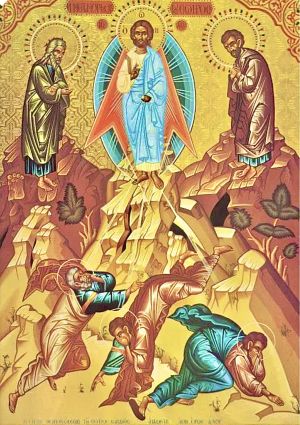
Against the tide Transfiguration: Faith and Metamorphosis
(Lk 9:28b-36)
In biblical language, the experience of «the Mount» is an icon of the Encounter between God and man. Yes, for us it is like “losing our minds”, but in a very practical way - not at all visionary.
The Master imposes it on the three eminent figures of the first communities, not because he considers them the chosen ones, but the exact opposite: he realizes that it is his captains who need verification.
The synoptic Gospels do not speak of Transfiguration any, but of «Metamorphosis» [Greek text of Mk 9:2 and Mt 17:2]: a passing under a different ‘form’.
In particular, Lk 9:29 emphasizes that «the appearance of his face became ‘other’». Not because of a paroxysmal state.
It sounds crazy, but the hieratic magnificence of the Eternal One is revealed against the tide: in the image of the humble servant.
The experience of divine Glory is unsustainable for the eminent disciples - not in reference to physical flashes of light.
As in Oriental icons, they find themselves face to earth [Mt 17:6 - in ancient Eastern culture it meant precisely: "defeated" in their aspirations] and frightened. Fearful of being they too called to the gift of self (Mk 9:6; Mt 17:6; Lk 9:34-36).
The vertigo of the experience of God was not what they cultivated and wanted.
The dazzling light to which the passage refers (Mk 9:3; Mt 17:2.5; Lk 9:29) is that of a Revelation that opens our eyes to the "impossible" identity of the Son.
He was popularly expected as resembling David, powerful sovereign, able to assure the people a quick and easy well-being.
He is ‘revealed’ in a reversal: the Glory of God is Communion in simplicity, which qualifies us everyone.
The ‘shape’ of the "boss" is that of the attendant, who has the freedom to step down in altitude to put the least at ease: the humanly defeated one!
Peter elbows more than others to have his say. As usual, he wants to emerge and reiterate ancient ideas, but he reveals himself as the most ridiculous of all (Mk 9:6; Lk 9:33): he is ranting.
For him [again!] at the centre of the triptych remains Moses (Mk 9:5; Mt 17:4; Lk 9:33).
With the help of prophecies animated by fiery zeal [Elijah], according to Simon, Jesus would be one of the many who makes others practise the legalistic tradition.
At foundatiion remain the Commandments, not the Beatitudes.
The first of the apostles just does not want to understand that the Lord does not impose a Covenant based on obeying, but on Resembling!
Of course, the other "great ones" were also half asleep. Who knows what they were dreaming of... then bewildered, they all look for a Jesus according to Moses and Elijah (Mk 9:8-10; Mt 17:8; Lk 9:36).
In the culture of the time, the new, observant and disruptive Prince was expected during the Feast of Huts.
He would inaugurate the rule of the chosen people over all the nations of the earth (Zk 14:16-19); in practice, the golden age.
In Judaism, the Feast of Booths commemorated the ‘Mirabilia Dei’ of the Exodus [Lk 9:31: here, the new and personalised liberation from the land of slavery] and looked to the future by celebrating the prospects of victory for the protagonist ethnicity.
But the Kingdom of the Lord is not an empire affected by prodigious and immediate verticalism.
To build the Church of God there are no shortcuts, no numb defence points, and there sitting quiet - at a safe distance - by raving about accolades.
[Transfiguration of the Lord, August 6]
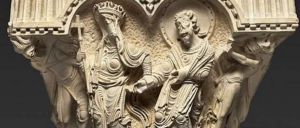
Faith and Metamorphosis
(Mt 17:1-9; Mk 9:2-13; Lk 9:28-36)
"The mountain - Tabor like Sinai - is the place of closeness with God. It is the elevated space, compared to everyday existence, where one can breathe the pure air of creation. It is the place of prayer, where one can be in the presence of the Lord, like Moses and like Elijah, who appear next to the transfigured Jesus and speak with Him of the "exodus" that awaits Him in Jerusalem, that is, of His Passover. The Transfiguration is an event of prayer: by praying, Jesus immerses himself in God, unites himself intimately with Him, adheres with his own human will to the Father's will of love, and thus light invades Him and the truth of His being appears visibly: He is God, Light from Light. Jesus' robe also becomes white and blazing. This brings to mind Baptism, the white robe worn by the neophytes. He who is born again in Baptism is clothed with light, anticipating the heavenly existence, which Revelation represents with the symbol of the white garments (cf. Rev 7:9, 13). Here is the crucial point: the transfiguration is an anticipation of the resurrection, but this presupposes death. Jesus manifests his glory to the Apostles, so that they have the strength to face the scandal of the cross, and understand that it is necessary to go through many tribulations to reach the Kingdom of God. The voice of the Father, resounding from on high, proclaims Jesus his beloved Son as at the Baptism in the Jordan, adding: "Listen to him" (Mt 17:5). To enter eternal life, one must listen to Jesus, follow him on the way of the cross, carrying in one's heart like him the hope of the resurrection. "Spe salvi", saved in hope. Today we can say: 'Transfigured in hope'" [Pope Benedict].
In biblical language, the experience of "the Mount" is an icon of the encounter between God and man. It is like losing one's mind, but in a very practical way - not at all visionary.
The Master imposes it on the three eminent figures of the first communities, not because he considers them to be the chosen ones, but the exact opposite: he realises that it is his captains who need verification.
The Synoptic Gospels do not speak of transfiguration at all, but of "Metamorphosis" [Greek text of Mt 17:2 and Mk 9:2]: passage in a different form.
In particular Lk 9:29 emphasises that "the appearance of his face became other" [Greek text]. Not because of a paroxysmal state.
It sounds crazy, but the hieratic magnificence of the Eternal One is revealed against the grain: in the image of the resigned henchman.
The experience of divine glory is unbearable for the eminent disciples - not in reference to physical flashes of light.
As in oriental icons, they find themselves face down on the ground. "And hearing the disciples fell on their faces and were greatly seized with fear" (Mt 17:6).
In the culture of the ancient East it meant precisely: 'defeated' in their aspirations - and afraid. Afraid that they too would be called to the gift of self: Mt 17:6; Mk 9:6; Lk 9:34-36.
The vertigo of experiencing God was not what they cultivated and wanted.
The dazzling glimmer referred to in the passage (Mt 17:2.5; Mk 9:3; Lk 9:29) is that of a Revelation that opens one's eyes to the "impossible" identity of the Son.
He was popularly expected to resemble David, a powerful ruler, able to ensure the people's easy and ready welfare.
He reveals himself in reverse. A glaring manifestation of God is: Communion in simplicity, which qualifies us all.
The form of the 'leader' is that of the caretaker, who has the freedom to step down to make the least comfortable: the humanly defeated!
Peter struggles more than others to have his say. As usual, he wants to emerge and reiterate old ideas, but he reveals himself as the most ridiculous of all (Mk 9:6; Lk 9:33): he rambles.
For him [again!] at the centre of the triptych remains Moses (Mt 17:4; Mk 9:5; Lk 9:33).
With the help of prophecies animated by fiery zeal [Elijah], according to Simon Jesus would be one of many who would have the legalistic tradition practised.
The Commandments, not the Beatitudes, remain the foundation.
The first of the apostles just doesn't want to understand that the Lord does not impose a Covenant based on obeying, but on Resembling!
Of course, the other "great ones" were also asleep. Who knows what they were dreaming of... then bewildered they all seek a Jesus according to Moses and Elijah (Mt 17:8; Mk 9:8-10; Lk 9:36).
In the culture of the time, the new observant and disruptive Prince was expected during the Feast of Booths.
He would inaugurate the rule of the chosen people over all the nations of the earth (Zech 14:16-19); in practice, the Golden Age.
In Judaism, the Feast of Tents commemorated the 'mirabilia Dei' of the Exodus [Lk 9:31: here, the new and personalised deliverance from the land of bondage] celebrating the prospects of victory.But the Kingdom of the Lord is not an empire to be enjoyed, prodigious and immediate - taking care not to do too much harm, that is, keeping a safe distance.
No smooth-running life proposition. Rather, change of face and cosmos.
Unexpected development and passage, which, however, convinces the soul: it invites introspection and acknowledgement - thus it completes us and makes us wince (with perfect virtue).
To build the Church of God, there are no shortcuts, no numbing points of safety, and there to sit quietly and cultivate consensus - sheltered from wounds, or blind to other relationships.
The experience of glory is 'sub contraria specie': in the kingship that pushes down.
But in parsimony it makes us discover awe-inspiring metamorphoses - so close to our roots.
Elijah, John, Jesus: Evolution of the Sense of Community
Curved trajectory, and the model that is not the "sphere"
(Mt 17:10-13)
The experience of "the Mount" - the so-called Transfiguration - is followed by the episode of Elijah and John [cf. Mt 17:10-13 and parallel Mk 9:2-13].
Jesus introduced the disciples in view but more stubborn than the others to the perception of the Metamorphosis (Mt 17:2 Greek text) of the divine Face and to an inverted idea of the expected Messiah (vv.4-7).
The experts of the sacred Scriptures believed that the return of Elijah was to anticipate and prepare for the coming of the Kingdom of God.
Since the Lord was present, the early disciples wondered about the value of that teaching.
Even in the communities of Mt and Mk, the question arose among many from Judaism about the weight of ancient doctrines in relation to Christ.
The Gospel passage is endowed with a powerful personal, Christological specificity [the redeeming, closest brother: Go'El of the blood].
To this is added a precise communitarian meaning, because Jesus identifies the figure of the prophet Elijah with the Baptist.
At the time, in the Palestinian area, economic difficulties and Roman domination forced people to retreat to an individual model of life.
The problems of subsistence and social order had resulted in a crumbling of relationship life (and bonds) both in clans and in families themselves.
Clan nuclei, which had always provided assistance, support and concrete defence for the weakest and most distressed members.
Everyone expected that the coming of Elijah and the Messiah would have a positive outcome in the reconstruction of fraternal life, which had been eroded at the time.
As it was said: "to turn the hearts of the fathers back to the sons and the hearts of the sons back to the fathers" [Mal 3:22-24 announced precisely the sending of Elijah] in order to rebuild the disintegrated coexistence.
Obviously the recovery of the people's internal sense of identity was frowned upon by the system of domination. Let alone the Jesuit figure of the Calling by Name, which would have opened the people's pious life wide to a thousand possibilities.
John had forcefully preached a rethinking of the idea of conquered freedom (the crossing of the Jordan), the rearrangement of established religious ideas (conversion and forgiveness of sins in real life, outside the Temple) and social justice.
Having an evolved project of reform in solidarity (Lk 3:7-14), in practice it was the Baptizer himself who had already fulfilled the mission of the awaited Elijah [Mt 17:10-12; Mk 9:11-13].
For this reason he had been taken out of the way: he could reassemble a whole people of outcasts - outcasts both from the circle of power and of the verticist, accommodating, servile, and collaborationist religiosity.
A watertight compartmentalised devotion, which allowed absolutely no 'remembrance' of themselves, nor of the old communitarian social order, prone to sharing.
In short, the system of things, interests, hierarchies, forced to take root in that unsatisfactory configuration. But here is Jesus, who does not bend.
Whoever has the courage to embark on a journey of biblical spirituality and Exodus learns that everyone has a different way of going out and being in the world.
So, is there a wise balance between respect for self, context, and others?
Jesus is presented by Mt to his communities as the One who wanted to continue the work of Kingdom building.
With one fundamental difference: with respect to the bearing of ethno-religious conceptions, the Master does not propose to all a kind of ideology of body, which ends up depersonalising the eccentric gifts of the weak - those unpredictable to an established mentality, but which trace a future.
In the climate of the clan that has been strengthened, it is not infrequently those without weight and those who know only abysses (and not summits) who come as if driven to the assent of a reassuring conformation of ideas - instead of dynamic - and a forge of wider acceptance.Those who know no summits but only poverty, precisely in moments of crisis are the first invited by adverse circumstances to obscure their gaze on the future.
The miserable remain the ones who are unable to look in another direction and move, charting a different destiny - precisely because of tares external to them: cultural, of tradition, of income, or 'spiritual'.
All recognisable boxes, perhaps not alarming at times, but far removed from our nature.
And right away: with the condemnation at hand [for lack of homologation].
Sentence that wants to clip the wings, annihilate the hidden and secret atmosphere that truly belongs to personal uniqueness, and lead us all - even exasperatedly.
The Lord proposes an assembly life of character, but not stubborn or targetted - not careless ... as in the extent to which it is forced to go in the same old course as always. Or in the same direction as the chieftains.
Christ wants a more luxuriant collaboration that makes good use of resources (internal and otherwise) and differences.
Set-up for the unprecedented: so that, for example, falls or inexorable tensions are not camouflaged - on the contrary, they become opportunities, unknown and unthinkable but very fruitful for life.
Here even crises become important, indeed fundamental, in order to evolve the quality of being together - in the richness of the "polyhedron" that as Pope Francis writes "reflects the confluence of all the partialities that in it maintain their originality" [Evangelii Gaudium no. 236].
Without regenerating oneself, only by repeating and tracing collective modalities - from the sphere model (ibid.) - or from others, that is, from nomenclature, not personally re-elaborated or valorised, one does not grow; one does not move towards one's own unrepeatable mission.
One does not fill the lacerating sense of emptiness.
By attempting to manipulate characters and personalities to guide them to 'how they should be', one is not at ease with oneself or even side by side. The perception of esteem and adequacy is not conveyed to the many different ones, nor is the sense of benevolence - let alone joie de vivre.
Curved or trial-and-error trajectories suit the Father's perspective, and our unrepeatable growth.
Difference between religiosity and Faith.
To internalise and live the message:
When in your life has your sense of community grown sincerely and unconstrained by circumstances?
How do you contribute in a convinced way to concrete fraternity - sometimes prophetic and critical (like John and Jesus)? Or have you remained with the fundamentalist zeal of Elijah and the uniting but purist zeal of the precursors of the Lord Jesus?
In all the Synoptics, the passage of the Metamorphosis of Glory is followed by the episode of the healing of the epileptic boy [in Matthew precisely after the issue of the Return of Elijah that Mark includes]. A theme that the other evangelists draw precisely from Mk 9:14-29. Let us go directly to that source, which is very instructive in order to grasp and specify the profound meaning of the subject and the essential common proposal, introduced by the Authors in the catechesis of the so-called "Transfiguration":
Faith, Prayer of attention, Healings: no holds barred
(Mk 9:14-29)
How to adjust in helplessness in the face of the dramas of humanity? Even in the journey of Faith, at a certain point in our journey we perceive an irrepressible need to transform ourselves.
We want to realise our being more fully, and to do good, even to others. It is an innate urge.
The need for life does not arise from reasoning: it arises spontaneously, so that new situations, other parts of us, emerge.
Change is a law of nature, of every Seed.
Such motion 'calls' to us from the depths of our Core, so that we come to change balances, convictions, ways of going about things that have had their day.
This vocation can be answered by making ourselves available, in order to discover different points of view. Even external ones, but starting from the discovery of a kind of 'new self' that actually lay in the shadows of our virtues.
Energies that we had not yet allowed to breathe.
Conversely, we may instinctively oppose this process, due to various fears, and then every affair becomes difficult; like an obstacle course.
Finally, in our itinerary of transformation we often encounter opposition from others, who may appear more experienced than us...
They appear to be experts and veterans, yet they too are 'frightened' by the fact that we do not intend to stop at the post already dictated.
In any case, the drive for change will not let go.
We will take new actions, express different opinions, show opposite sides of the personality; we will leave more room for the life wave.
No more compromises, even if others may doubt that we have become 'tortuous'.
In short, what power does the coming of the choice of Faith have in life, even in the midst of people's disbelief?And - as in the Gospel passage - in the incapacitated scepticism [of the apostles themselves, who would be the first to manifest it]?
Even today, some of the old 'characters' and guides are waning, displaced by the new onset of awareness, or by changing enigmas, and different units of measurement.
The old 'form' no longer satisfies. On the contrary, it produces malaise. But there is around - precisely - a whole system of expectations, even 'spiritual', or at least rather conformist 'religious' ones.
What is the point, if even we priests are no longer reassuring? And what does God think?
The messianicity of Christ and Salvation itself belong to the sphere of Faith and Prayer.
They are the realms of intimate listening, acute perception, trusting spousal acceptance, and liberating drive.
The Master himself - fluid and concrete - did not immerse himself in the system of rigid social [mutual] expectations of his time, and decided to step out of the 'group'.
On this point, Jesus rails against the mediocrity and peak-less action - all predictable - of his own (vv.18-19) and is forced to start again from scratch (vv.28-29).
Of course, perhaps the others also lack creative Faith without inflection and turbulence, but at least they recognise it (v.24) and with extreme reserve wish to be helped, well before becoming teachers of others (v.14).
Sometimes the very intimates of the true Master, perhaps still poorly versed in the great signs of God, seek only the hosanna of roles, and consent in the spectacular.
So much so that "having entered into His house", that is, into His Church (v.28), He must begin again to do basic catechism [perhaps pre-catechism, precisely to His leaders].
Without wanting to concede any outside festivals to the crowds, as the 'intimates' would probably have done.
The passage is structured along the lines of the early catechumenal liturgies.
The Lord wants people enslaved by normal thinking, power ideology and false religion to be brought to Him (v.19) and demands the Faith of those who lead them (vv.23-24).
The beginner goes through a life overhaul that "contorts" and "brings one to the ground".
This is because one can be plagued by dirigiste, unwise, covertly manipulative - despite being ineffective and underneath insecure - 'spiritual' guides.
Then it is a real heartbreak to discover that from childhood (v.21) we have been governed by a mortifying model - made up of easy classifications, which however do not realise, but dehumanise.
Perhaps we too have been conditioned by unwise directors.
And it was only through arduous, harrowing experiences that we discovered that precisely what we had been taught as sublime - and capable of assuring us communion with God - was conversely the primary cause of detachment from Him, and from a more harmonious and full personal and ecclesial existence.
In order to be liberated and rise to new life (v.27), the candidate of the path of Faith passes as if through a death - a sort of baptismal immersion, which drowns his old [de facto] paganising formation.
At the time of Mk many spoke of the expulsion of demons.
In the typology of the new baptism, the community of Rome wanted to express the goal of the Glad Tidings of the Gospels: to help people rise up - freeing themselves from the conditioning fears of evil.
That is not the real power.
In the passage, the child's deafness and muteness indicate the lack of the 'Word' that becomes an 'event' - unceasing, growing life, capable of transforming the marked, standard fate of 'earth'.
A lack that exists both among the bewildered people and - unfortunately - first and foremost among the disciples, sick of protagonism and one-sidedness.
The young man's very behaviour (vv.18.20.26) traces the existential modes of people subjugated by invincible forces, because they are self-destructive - therefore in the grip of obsessive, unrelenting lacerations.
Contrary to the quintessence of personal character.
It is a harrowing situation indeed: that of those who discover they have been deceived by a religiosity of all-too-common convictions - with the epidermic, persuasive trick of herd or mass directions.
The coming of the Kingdom of God already meant the coming of an 'internal' power stronger than the Roman army itself, whose legions were used precisely to maintain situations of civil oppression, even religious fear.
Even today, a no-holds-barred struggle rages between the drives that induce deep-seated illnesses [like something that has taken hold of us] and the presence of the Messiah.
The two opposite poles cannot stand each other; they spark.
But the solution is not to amaze the crowds, nor is it to attempt to remake things that finally return to sacralising the status quo.
Thus, it sometimes seems that we are in no condition to initiate genuine healing processes (v.18b).
Yet evil does not give way by miracle and clamour, nor by man's force or insistence, but by attunement and Gift (v.29). From internal powers-events.
Here is the space of prayer-hearing.
Prayer brings one out of the confines and puts one in contact with other energies and surprises that one was not aware of: innate virtues and Grace, which allow one to see every situation with other eyes, liberated.
For solutions that solve real problems, from within, we constantly need not conformist rules, but a new reading.
Here is the dissymmetrical gaze.
Says the Tao Tê Ching (i): 'The Tao [way of conduct] that can be said is not the Eternal Tao. The name that can be named is not the Eternal Name'. Master Wang Pi comments: 'An effable Tao indicates a practice.
Our life is not about the initiative of what we are already able to set up and practice - or interpret, design and predict (vv.14-19) - but about Attention (v.29).
The "mountain" to be moved [parallel v. Mt 17:20 - cf. Mt 19:20ff; Mk 10:20ff; Lk 18:21ff] is not outside, but within us.
In this way, the conformist idea that discourages us, or all obstacles (instead of harming us) will be precious opportunities for growth.
We will be at the centre of the reality of Incarnation.
To internalise and live the message:
How do you live your conflicts? What is your healing experience?
To overcome that "something of unbelief",
and "putting meat on the fire"
Miracles still exist today. But to enable the Lord to perform them there is a need for courageous prayer, capable of overcoming that "something of unbelief" that dwells in the heart of every man, even if he is a man of faith. A prayer especially for those who suffer from wars, persecutions and every other drama that shakes society today. But prayer must "put flesh on the fire", that is, involve our person and commit our whole life, to overcome unbelief [...].
Returning to the Gospel episode, the Holy Father reproposed the question of the disciples who had not been able to drive out the evil spirit from the young man: "But why could we not drive him out? This kind of demons, Jesus explained, cannot be driven out in any way except by prayer". And the boy's father "said: I believe Lord, help my unbelief". His was "a strong prayer; and this prayer, humble and strong, enables Jesus to perform the miracle. Prayer to ask for an extraordinary action,' the Pontiff explained, 'must be a prayer that involves all of us, as if we were committing our whole life to it. In prayer we must put meat on the fire'.
The Pontiff then recounted an episode that took place in Argentina: "I remember something that happened three years ago in the sanctuary of Luján. A seven-year-old girl had fallen ill, but the doctors could not find a solution. She was getting worse and worse, until one evening, the doctors said there was nothing more they could do and that she only had a few hours to live. "The father, who was an electrician, a man of faith, became like mad. And driven by that madness he took the bus and went to the sanctuary of Luján, two and a half hours by bus, seventy kilometres away. He arrived at nine in the evening and found everything closed. And he began to pray with his hands clinging to the iron gate. He was praying and crying. So he stayed the whole night. This man was fighting with God. He was really struggling with God for the healing of his maiden. Then at six in the morning he went to the terminal and took the bus. He arrived at the hospital at nine o'clock, more or less. He found his wife crying and thought the worst: what happened? I don't understand. What happened? The doctors came, his wife told him, and they said the fever is gone, she's breathing well, there's nothing.... They will only keep her another two days. But they don't understand what has happened. And this,' the Pope commented, 'still happens. There are miracles. But prayer is needed! A courageous prayer, which struggles to reach that miracle, not those prayers out of courtesy: Ah, I will pray for you! Then a Pater Noster, an Ave Maria and I forget. No! It takes courageous prayer, like that of Abraham who wrestled with the Lord to save the city; like that of Moses who prayed with his hands up and tired praying to the Lord; like that of so many people who have faith and with faith pray, pray".
Prayer works miracles, "but," Pope Francis concluded, "we must believe it. I think we can make a beautiful prayer, not a prayer out of courtesy, but a prayer with the heart, and say to Him today throughout the day: I believe Lord! Help my unbelief. We all have unbelief in our hearts. Let us say to the Lord: I believe, I believe! You can! Help my unbelief. And when we are asked to pray for so many people who suffer in wars, in their plight as refugees, in all these dramas we pray, but with our hearts, and we say: Lord, do. I believe, Lord. But help my unbelief".
[Pope Francis, St. Martha, in L'Osservatore Romano 20-21/05/2013].

Dear Brothers and Sisters,
This Sunday, Mark the Evangelist recounts that Jesus took Peter, James and John with him up a high mountain and was transfigured before them, becoming so dazzlingly bright that they were "whiter than the work of any bleacher could make them" (Mk 9: 2-10).
Today, the liturgy invites us to focus our gaze on this mystery of light. On the transfigured face of Jesus a ray of light which he held within shines forth. This same light was to shine on Christ's face on the day of the Resurrection. In this sense, the Transfiguration appears as a foretaste of the Paschal Mystery.
The Transfiguration invites us to open the eyes of our hearts to the mystery of God's light, present throughout salvation history. At the beginning of creation, the Almighty had already said: "Fiat lux - let there be light!" (Gn 1: 2), and the light was separated from the darkness. Like the other created things, light is a sign that reveals something of God: it is, as it were, a reflection of his glory which accompanies its manifestations. When God appears, "his brightness was like the light, rays flashed from his hand" (Heb 3: 3ff.).
Light, it is said in the Psalms, is the mantle with which God covers himself (cf. Ps 104[103]: 2). In the Book of Wisdom, the symbolism of light is used to describe the very essence of God: wisdom, an outpouring of his glory, is "a reflection of eternal light" superior to any created light (cf. Wis 7: 27, 29ff.).
In the New Testament, it is Christ who constitutes the full manifestation of God's light. His Resurrection defeated the power of the darkness of evil forever. With the Risen Christ, truth and love triumph over deceit and sin. In him, God's light henceforth illumines definitively human life and the course of history: "I am the light of the world", he says in the Gospel, "he who follows me will not walk in darkness, but will have the light of life" (Jn 8: 12).
In our time too, we urgently need to emerge from the darkness of evil, to experience the joy of the children of light! May Mary, whom we commemorated yesterday with special devotion on the annual Memorial of the Dedication of the Basilica of St Mary Major, obtain this gift for us. May the Blessed Virgin also obtain peace for the peoples of the Middle East, overwhelmed by fratricidal fighting! We know well that peace is first and foremost God's gift to be implored insistently in prayer, but at this time let us also remember that it is a commitment for all people of good will. May no one shirk this duty!
Thus, in the face of the bitter observation that so far the voices asking for an immediate ceasefire in that tormented region have gone unheard, I feel the urgent need to renew my pressing appeal in this regard, asking everyone to make an effective contribution to build a just and lasting peace. I entrust this renewed appeal to the intercession of the Most Holy Virgin.
[Pope Benedict, Angelus, 6 August 2006]
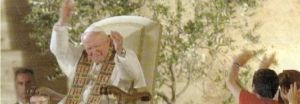
The mystery of the Transfiguration takes place at a very precise moment in Christ's preaching of his mission, when he begins to confide to his disciples that he must "go up to Jerusalem and suffer much ... and be killed and rise again on the third day" (Mt 16:21). With reluctance they accept the first announcement of the passion and the divine Master, before repeating and confirming it, wants to give them proof of his total rootedness in the will of the Father so that before the scandal of the cross they will not succumb. The passion and death will in fact be the way by which the heavenly Father will lead "the beloved Son", raised from the dead, to glory. This will henceforth also be the way of his disciples. No one will come to the light except through the cross, symbol of the sufferings that afflict human existence. The cross is thus transformed into an instrument of atonement for the sins of all humanity. United with his Lord in love, the disciple participates in his redemptive passion.
[Pope John Paul II, homily 7 March 1993]
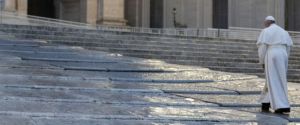
Jesus takes Peter, James and John with him up the mountain and is revealed to them in all his beauty as Son of God (cf. Mt 17:1-9).
Let us pause a moment over this scene and ask ourselves: Of what does this beauty consist? What do the disciples see? A spectacular effect? No, that is not it. They see the light of God’s holiness shining on Jesus’ face and clothes, the perfect image of the Father. God’s majesty, God’s beauty is revealed. But God is Love. Therefore, the disciples saw with their eyes the beauty and splendour of divine Love incarnate in Christ. They had a foretaste of paradise. What a surprise for the disciples! They had had the face of Love before their very eyes for a long time without ever being aware of how beautiful it was! Only now do they realize it, and with great joy, with immense joy.
In reality, through this experience, Jesus is forming them, preparing them for an even more important step. Soon after that, in fact, they will have to recognize the same beauty in him when he is placed on the cross and his face is disfigured. Peter struggles to understand: he would like to stop time, “pause” the scene, stay there and prolong this marvellous experience. But Jesus does not allow it. Indeed, his light cannot be reduced to a “magical moment”! It would thus become something false, artificial, something that would dissolve into the fog of passing sentiment. On the contrary, Christ is the light that orients our journey like the pillar of fire for the people in the desert (cf. Ex 13:21). Jesus’ beauty does not alienate his disciples from the reality of life, but gives them the strength to follow him all the way to Jerusalem, all the way to the cross. Christ’s beauty is not alienating. It always brings you forward. It does not make you hide. Go forward!
Brothers and sisters, this Gospel traces a path for us too. It teaches us how important it is to remain with Jesus even when it is not easy to understand everything he says and does for us. In fact, it is by staying with him that we learn to recognize on his face the luminous beauty of love he gives us, even when it bears the marks of the cross. And it is in his school that we learn to glimpse the same beauty on the faces of the people who walk beside us every day — family, friends, colleagues who take care of us in the most varied ways. How many bright faces, how many smiles, how many wrinkles, how many tears and scars reveal love around us! Let us learn to recognize them and to fill our hearts with them. And then let us set out in order to bring the light we have received to others as well, through concrete acts of love (cf. 1 Jn 3:18), diving into our daily affairs more generously, loving, serving, and forgiving with greater earnestness and willingness. The contemplation of God’s wonders, the contemplation of God’s face, of the Lord’s face, must move us to the service of others.
We can ask ourselves: Do we know how to recognize the light of God’s love in our lives? Do we recognize it with joy and gratitude on the faces of the people who love us? Do we look around us for the signs of this light that fills our heart and opens it to love and service? Or do we prefer the straw fires of idols that alienate us and lead us to withdraw into ourselves? The great light of the Lord and the false, artificial light of idols. Which do I prefer?
May Mary, who kept the light of her Son in her heart even in the darkness of Calvary, accompany us always on the way of love.
[Pope Francis, Angelus, 5 March 2023]
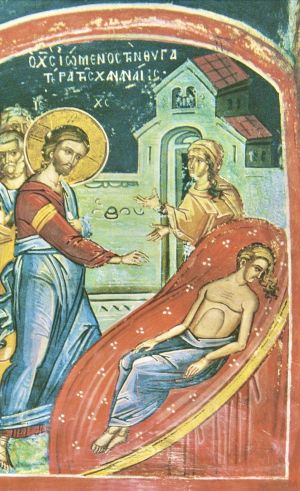
Faith: Crumbs and "nose", integral parts. Signs of universal gathering
(Mt 15:21-28)
Religious law prevented dealing with foreign people and other ethnicities, borders, or culture.
At the beginning, Jesus [that is: He in the first communities, his Mystical Body] seems not to want to occupy himself with it (v.26).
But after helping the crowds and his own intimates to emancipate themselves from the prison of purity norms (vv.10-20), the young Rabbi himself had emerged from the conformist ways of experiencing God.
He makes an Exodus even from national and race territories that at that time were seizing the vital sap of the souls - thus flying over the "sacred" preconceptions.
To make us grow in Faith, Christ promotes the most varied existence. In this way, outside the standard myopia, He can find astounding adherences.
Faith: New Principle, which does not alienate us from ourselves. And crumbles any illusion of exclusivity.
The singular initiatives of the Son are born on the basis of the all-personal experience of the divine, of a Father who bestows unconditionally.
Provident, and unequal from the stingy God of ancient religions: sovereign all discordant from creatures, alien, predatory, and incomprehensibly addicted to habit.
With an unusual stunt, the young Rabbi tries to open the Judaizing mentality, overcoming borders.
Even the dialogue with a woman not of his people was a "novelty" alien to the mentality of the time’s crowds. Initiative foreign even to the conceptions of the first two generations of believers; marked by a creed still blocked and mixed with idols.
But there was a whole people of strangers [the mestizo «Woman» and her spiritual ‘offspring’] who felt they had no future... and this called into question the many aprioriisms of the time.
In short, even the church of Mt had not fully grasped the meaning of the «bread of the sons» - all available, for it to be “recognized”.
Because of rivalry, ancient peoples used to call foreigners with the contemptuous nickname of «dog»: synonymous with impudence, meanness and ignoble baseness.
The Lord's very harsh phrase (v.26) reflects a comparison coming from poor areas and from family life, where once there were plenty of pets and youth.
There was also a difference between ‘children’ generated by listening to the Word of God and those who adjusted themselves “by scent”. But although no one denied sustenance to the «sons» to give it to the «dogs» around them - the latter had at least the right of crumbs fallen on the ground.
For differents and far - even bad-considered - it is not a problem to resort to Jesus in an instinctive way; indeed, even today they would be satisfied with the shatters.
[Unfortunately, not infrequently strangers and difforms are hungrier of the real Manna from Heaven].
Christian community should not lack the nourishment of the body and the food of wisdom for everyone (Mt 14:20-21).
Faith has no nationality, and it is the only immediate language and relationship valid for communication between God and woman and man.
Christ is a sapiential feeds for a free circulation; not a sign to be hindered and kept closed.
To break the Bread is to participate our existence at root; what we have and are. Metre of what we proclaim, believe and practice.
[Wednesday 18th wk. in O.T. August 5, 2026]
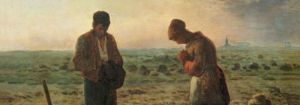
Faith: Crumbs and “nose”, integral parts. Signs of universal gathering
Mt 15:21-28 (21-37)
Jesus discovered the will of the Father in the events of life. The same was true for the growth of awareness of the first communities, which carried no small prejudices, at least until the third generation of believers (inclusive) - as witnessed by the Synoptics.
Religious law prevented dealing with foreigners and people of other ethnicities, borders or cultures. At first, Jesus [i.e.: He in the first communities, His Mystical Body] seems not to want to deal with them (v.26).
But after helping the crowds and his own to emancipate themselves from the prison of the norms of purity (vv.10-20) Christ breaks out of conformist ways of experiencing God.
He even exoduses himself from national and racial territories that then sequester the life-bloods - thus overcoming sacred preconceptions.
The Son's singular initiatives arise on the basis of a wholly personal experience of the divine, of a Father munificent in bestowing without conditions.
Provident and unequal from the stingy God of religions: the latter discordant from creatures, alien, and (incomprehensibly) habitual.
The Lord himself helps us in his story to experience the transcendent in even summary life. Thus, to get out of the contrived doctrinal ways that cage existence [territory, customs, ideology, memberships of various kinds - even 'internal'].
With an unusual gimmick, the young Rabbi tries to open up the Judaizing mentality, crossing borders.
The intent is to make us develop his own Faith. It promoted diverse existence, and outside of traditional myopia could thus find astounding adherences.
No boundary fences, no obstacles ... can contain our will to live: we want to feed not on pride (or resistance) but on love at risk, not debased - and express ourselves completely.
Even dialogue with a woman not of his people was a 'thought' alien to the mentality of the crowds of the time - alien even to the conceptions of the first two generations of believers, in this respect still entrenched and mixed with idols.
But there was a whole people of strangers [the mestizo 'woman' and her spiritual 'descendants'] who felt they had no future. And this challenged the many apriorisms of the time.
In short, even the church of Mt had not fully grasped the meaning of the 'bread of the sons' - all available to be 'recognised'.
Because of atavistic rivalries, ancient peoples used to call foreigners by the derogatory appellation 'dog', synonymous with impudence, meanness and ignoble baseness.
They were widespread misgivings about the sense of human brotherhood - from primitive vision [and not only, in the age of access].
The Lord's harsh sentence (v.26) reflects a comparison from poor areas and family life, where pets and youth once abounded.
There was still a difference between 'children' generated by hearing the Word of God and those who adjusted 'by scent'.
But although no one denied sustenance to the 'children' in order to give it to the 'dogs' around - the latter at least had the right to the crumbs that fell on the ground.
In fact, the text speaks of 'little dogs' [kynaría-kynaríois] as pets loved by the very young and who easily fed them leftovers during meals.
In a certain sense, they belonged to 'the house'.
For the different and distant - even the misunderstood - it is not a problem to resort to Jesus instinctively; on the contrary, they would be content with the scraps.
According to this, the community of the sons should not lack bodily nourishment and wisdom food for anyone (Matt 14:20-21).
However, the old-timers who considered themselves family members of entitlement and asserted registry rights, sulked and in the assemblies pretended not to allow everyone to partake of the communion, the Eucharistic grains, the gifts of the festive kingdom.
But thanks to the appeal of the Gospels [quite different from the exaggerated imperial or legionary 'evangelical' proclamations] the dominion of evil was coming to an end (v.28).
According to Matthew, there should be no obsession, chain or preconception that can take away our orientation of progress and energy, so that with extreme freedom we are enabled to work and open ourselves to the needs of others, even pagans (Mt 14:22a).
So in the Judeo-Christian fraternities of Galilee and Syria, a debate arises about the conditions of community membership.
What is the position of converts from paganism? Do they have the right to participate in the breaking of the Bread without prior doctrine-discipline? Is there or is there not a break with the observant tradition?
Mt emphasises that we have no pre-emption: the principle of universal salvation is the attitude of Faith; not a right.
The community of the baptised is not allowed to live on rent. The Gospel is open, overriding the biblical priority of the chosen people.
The reason for any exception is sensitive love, which has the freedom to yield, which becomes the only principle of membership.
The condition of membership in the new people of God is Faith in the heart and not in the blood or in the head, nor in the discipline that distances us from ourselves, God and others.
Faith: a new principle, which shatters every illusion of exclusivity.
With the Father, in the Son, it is no longer a matter of mortifying oneself, depending, striving and struggling, in order to stand before one another.
Legal purity is inadequate (vv.1-20), indeed now it is the person even of disconcerting origins - previously an outsider - who emerges 'victorious' from the fight with the Lord.
Spousal entrustment is appreciable everywhere, by anyone: foundational Eros gushing from every soul, and not bound to repertoires. It overcomes any particularism.
Of course, it has its criteria - but they are essential: transparency, freshness, tension towards unity, overcoming conditions and taboos; value of the person; secret empathy of energies.
The Gospel passage traces a whole path of adherence to Christ.
Those who are far away can approach and even start from the popular - inconvenient - idea that Jesus is the expected 'Son of David' (v.22): a military commander and ruler who was supposed to seize power, subjugate the nations, ensure the golden age, fulfil the prescriptions of the Law himself as if he were a Model, and impose their observance on all.
The starting point of the journey may be a miserable glimmer, a beginning that perhaps does not promise much. In fact, in this specific case, it is decidedly confusing: the Master does not answer (v.23).
The title attributed to Him has nothing to do with God, nor does it concern the authentic Firstborn. He is not a powerful Messiah - a predatory, homologated image - but a servant.
It makes no sense even to ask Him for "Mercy" (v.22)! Indeed - let's face it - despite the superficial ritual habits we have, here Christ seems quite angry (v.23).
This is not the healthy relationship with the Lord: He does not chastise or enjoy being begged by the needy.
Rather, He educates as He does a friend, brother or parent; and He does not grant graces by lottery, or miracles by sympathy and protection, or favours by territory - like pagan gods.
That image is totally deviant, but it is a bogus figure that comes out of the very "insiders" (vv.23-24), who would have nothing to object to (v.23).
Indeed, their own catechesis is the source of it: the title 'son of David' sounds strange, on the lips of a pagan.
Even today, this homologising paternalistic idea - of inculcated guilt - tends to drive away those who seek an amiable companion.
The priority for 'Israel' is acknowledged by Jesus because it is precisely the eldest sons who must be converted to a new Face of the first God of Sinai - still assessed as Lawgiver and Judge, instead of Creator and Redeemer of our intelligence and freedom.
[Albeit in a good-natured way, they unfortunately continue to spread it, as a sullen notary, since pre-catechism].
Jesus distances himself from those who make claims and at the same time divert the souls of the needy who seek him.
Then, in spiritual terms, no one can boast a right to anything: the truly sacred Gifts do not derive from any selective election relationship, nor even clientelistic [of the buying and selling kind].
So, to become intimate with Christ... can one be content with the Eucharistic 'crumbs' - i.e. 'minimal salvation'?
Can one be satisfied with the mere crumbs that fall from the table of the supponent closed in small schemes (vv.26-27)?
Certainly, because it is Faith that saves (v.28), not a grand gesture or long practice in the disciplines of the arcane - nor a code of purity.
The authentic Lord only says:
"Woman, great is your Faith! Do as thou wilt with me" (v.28) - that is, go forth to the joy of a full life, transmissible to an "offspring" not destined for torment or premature death.
And without the judgement of others, the one with the usual deceitful tares of inadequacy, on your back.
Thanks to Him we are not introduced into a summary religious practice, but into a Relationship that is chiselled over time (vv.22-28).
How to orient oneself?
Instead of the narrow Law, it is the Gospel that fully empowers us.
As if we were "little dogs" (vv.26-27) that seek life and nourishment, instinctively proceeding [by "sniffing"] along unexplored paths. And that according to character, inclination, Calling by Name, appeal to other secret forces.
In short, all men - although still far from an explicit adherence of faith - are inhabited by this knowledge that is at once personal and primordial, that gives immediate and infallible direction.
So in simplicity will we too, to find the Way.For Faith has no nationality, and is the only valid language-relation-trajectory for communication between God and woman and man.
It is universal; it crosses time, denominational and even religious borders.
Commenting on the Tao Te Ching (LVIII), Master Wang Pi states:
"He who rules well has no form or name, he does not initiate administrations. The various categories divide and separate, that is why the people are fragmented'.
Master Ho-shang Kung adds:
'When the ruler is liberal, the people are united in wealth and satiety: people love each other and get along well'.
Today it is about sharing the minutiae and fragments of the 'more' we in the West inherited from past generations.
A very instructive and affluent 'more'; lavishly bestowed, yet received without 'anything too much' [ne quid nimis] nor much merit or risk (as 'good Christians...').
And respecting in everything the nomenclature of the veterans, of the cordate and the powerful - always disinclined to real coexistence.
Christ, on the other hand, is sapiential food for free circulation; not impeded food, to be kept locked in tabernacles.
His virtue is now understood only outside the sacristies - from far and wide (vv.21-22) - where even a minuet of bread makes one trust and rise, in sharing.
To break the Eucharist as source and summit is to proclaim it as a Gift not to be withheld or kept intact, but rather to be exposed and distributed without moralising.
To share that Food is to participate in the root of existence, what we have and are; the yardstick of what we proclaim, believe and practise.
Sadly, not infrequently the strangers and dissimilar are hungrier for the true Manna from Heaven.
Saturated to the point of nausea - and perhaps still unable to comprehend its meaning - why live the shared Nourishment [perhaps with little regard for its meaning] as a problem and fear?
To internalise and live the message:
If not of 'your people', do you at least want to talk to them - even if veterans, inner clubs and regulars forbid it?
Don't you think the synodal path is a good opportunity to review abstract positions?
Do you know of any ecclesial parishes that do not give outsiders a chance?
Do you know people hurt by exclusions? What do you do, silence-assent?
Multiplication by Division, in itinerancy
The simple (Eucharistic) Mystery
(Mt 15:29-37)
"Man is the limit-being who has no limit" (Fratelli Tutti n.150).
In our hearts we have a great desire for fulfilment and Happiness. The Father has put it there, He Himself satisfies it - but He wants us associated with His work - inside and outside of us.
The Son reflects God's plan in his compassion for the crowds in need of everything (vv.30.32) and - despite the plethora of teachers and experts - lacking any authentic teaching [cf. Mt 9:36. 14:14].
His solution is very different from that of all "spiritual" guides, because he does not overlook us with an indirect paternalism [cf. Mt 14:16] that would dry tears, heal wounds, erase humiliations.
It invites us to make use of what we are and have, even though it may seem ridiculous. But it teaches in an absolutely clear way that by shifting energies, prodigious results are achieved.
This is how we respond in Christ to the world's great problems: by recovering the condition of the man viator - a being of passage, his essential mark - and by sharing goods; not letting everyone make do [cf. Mt 14:15].
Our real nakedness, the vicissitudes and the experience of our many brothers and sisters, who are different, are resources not to be evaluated with distrust, "as dangerous competitors or enemies" of our fulfilment (FT n.151).
Not only will the little we bring be enough to satiate us: it will advance for others and with identical fullness of truth, human, epochal [vv.34.37: the passage insists on the Semitic symbolism of the number "seven"].
In Mt Jesus is the new Moses who ascends 'the mountain' of authentic relationships - to inaugurate an alternative Time, which marks true history.
People no longer stay at the bottom of the valley waiting: they gather around Him, coming as they are, with the burden of so many different needs.
The new people of God are not a settled crowd, of the elect, chosen and pure.
Each one brings with him his own path, his own troubles and problems, which the Lord heals - healing not with a solution from above or from without.
In short: another world is possible, but through breaking one's own (even miserable) bread.
A wise, uninterrupted, effective solution, if one brings it out from within, on the way and standing in the middle - not in front, not at the head, not on top (v.36).
The place of God's revelation was to be the place of lightning, on a "mountain" smoking like a furnace (Ex 19:18)... but finally even Elijah's violent zeal had to recant (1 Kings 19:12).Even to the pagans, the Son reveals a Father who does not simply erase infirmities: he makes them understood as a place that is preparing a personal development, and that of the Community.
He imagined that in the time of the Messiah, the lame, the deaf and the blind would disappear (Is 35:5ff.). Golden age: everything at the top, no abyss.
In Jesus - distributed Bread - an unusual fullness of times is manifested, apparently nebulous and fragile, but real and capable of restarting people and relationships.
The Spirit of God acts not by descending like a thunderbolt from above, but by activating in us capacities that appear intangible, yet are capable of regrouping our dispersed being, classified as insubstantial - involving the everyday summary - and re-evaluating it.
The Incarnation reweaves our hearts, in dignity and promotion; it truly unfolds, because it not only drags obstacles away, but rests on them.
And it does not erase them at all: thus it overpowers them, but transmutes - posing new life.
Lymph that draws juice and sprouts Flowers from the one muddy, fertile soil, and communicates them.
Solidarity to which all are invited, not just those deemed to be in a state of perfection and compactness.
Our shortcomings make us attentive, and unique. They are not to be despised, but taken up, placed in the Son's hands and energised (v.36).
Falls themselves can be a valuable sign: in Christ, they are no longer reductive humiliations, but rather path markers. Perhaps we are not making the best use and investment of our resources.
Thus, collapses can quickly turn into rises - different, not packaged - and a search for total completion in Communion.
Therefore, in the ideal of realising the Vocation and sensing the type of contribution to be made, nothing is better than a living environment that does not clip the wings: a lively fraternity in exchange and coexistence.
Not so much to dampen the jolts, but so that we are enabled to build stores of wisdom not calibrated by nomenclature - which everyone can draw from, even those who are different and far from us.
If a shortcoming is found here too, it will be to teach us to be present in the world according to (perhaps) other and further directions, or to bring out mission and creative maturity - not to remain fixated on partiality and minutiae.
The allusion to the seven loaves (multiplied because divided) supports the quotations on the mouldable magma of biblical icons.
Here Moses and Elijah on "the Mount": figures from the five Books of the Pentateuch (the First Foods), plus the two sections of Prophets and Writings.
All together "seven loaves": fullness of food and wisdom for the soul, called to proceed beyond the surrounding hedgerows, breaking the banks of the subjugated mentality.
It is the basic nourishment of the human-divine spirit, to which, however, is added a young and fresh companion food, which precisely involves us (v.34).
[As St Augustine said: "The Word of God that is daily explained to you and in a certain sense 'broken' is also daily Bread" (Sermo 58, IV: PL 38, 395)].
Complete food: basic food and 'companion' - historical and ideal, in code and in deed.
Here we become in Christ as an actualised and propulsive corpus of sensitive witnesses (and Scriptures!).
Certainly reduced, not yet affirmed - and lacking in heroic phenomena, but emphatically sapiential and practical.
Announcers and sharers, without resounding proclamations of self-sufficiency.
Never enclosed within archaic fences: always in fieri - therefore able to perceive unknown tracks.
And to 'break the Bread'... that is, to be active, to go further, to share the little - to nourish, to overflow (multiplying the listening and the action of God) and to make even the desperate regain esteem.
We are children: like few and small fish (v.34), but not wallowing in competitions that make life toxic.
On the contrary: called in the first person to write a singular, empathic and sacred Word-event.
Infants in the Lord, we swim in this different Water. Sometimes perhaps outwardly veiled or muddy and murky....
Finally made transparent if only because it is yielding, compassionate (v.32) and benevolent.
The old exclusive puddle of religion that does not dare the risk of Faith (v.33) would not have helped us to assimilate the proposal of the Jesus Messiah, Son of God, Saviour - acrostic of the Greek word Ichtys [fish].
He is the Father's Initiative-Answer, support in the (unethereal) journey in search of the Hope of the poor - of all of us destitute waiting.
The working Faith thus has as its emblem the Eucharist, a revolution of sacredness. It seems strange, for us who have grown accustomed to it.
In fact, the purpose of evangelisation is to participate in and emancipate the complete being from all that threatens it, not only in its extreme limitation: also in its everyday actions - to the point of seeking the communion of goods.
In Mark (7:31-37) the prodigy is placed after the opening of the "senses". Here after the healings by the Lake of Galilee (vv.29-31).
The Source and Summit Sign of the community of sons is a creative gesture that imposes a shift of vision, an absolutely new eye.
In the face of the destitution of the many - caused by the greed of the few - the attitude of the authentic Church does not take pleasure in emblems and fervour, nor in partial calls to distinguish itself in almsgiving.
The breaking of the Bread takes over from the Manna dropped from above in the desert (Mt 15:33) and involves its distribution - not only in special situations.
There is no settling, in multiplying life for all.
This is the attitude of the living Body of the thaumaturgic Christ [not the miracle worker] who feels called to be active in every circumstance.
If Eucharistic participation does not only provoke punctual alms-giving, external pietism and mannerly welfarism, here is the result:
Women and men will eat, remain full, and there will be food left over for others (not all of God's intended guests are still present...).
We note that it had not even occurred to the disciples that the solution might come from the people themselves and their spirit.
Not just from the paternalism of the leaders, or from some individual benefactor.
Unexpected solution: the question of food is solved not from above, but from within the people and with the few loaves they brought with them.
There is no solution with the verb 'multiply' - that is, 'increase' ... relationships that count, increase property, pile up wiles.
The only therapy is 'to break', 'to give', 'to offer' (v.36). And everyone is involved, no one privileged.
At that time, competitiveness and class mentality characterised the society of the empire - and began to infiltrate even the small community, just starting out.
As if the Lord and the God of retribution could live side by side, yet.
It is the communion of the needy that conversely rises to the top in the non-artisanal Church.
Real sharing acts as the professor of the ubiquitous veteran, pretentious people, the only ones yet to be converted.
The germ of their 'longevity' should be not altitude and role, but love.
Such is the only meaning of sacred gestures; not other projects tinged with prevarication, or appearance.
The 'belonging' astound.
For the Lord, the distant (though still poised in their choices) are full participants in the messianic banquet - without preclusions, nor disciplines of the arcane with nerve-racking expectations.
Conversely, that Canteen presses in favour of others who have yet to be called. For a kind of re-establishment of the original Unity.
In short, the Redemption does not belong to elites concerned about the stability of their rule - which it is even the weak who must sustain.
Saved life comes to us by incorporation.
To internalise and live the message:
Have you ever broken your bread, passed on happiness and made recoveries that renew relationships, putting people who do not even have self-esteem back on their feet? Or have you favoured selflessness, chains and elite attitudes?

Dear Brothers and Sisters,
This […] Gospel passage begins by indicating the district to which Jesus was going: Tyre and Sidon, to the north-west of Galilee, a pagan land. And it was here that he met a Canaanite woman who spoke to him, asking him to heal her daughter who was possessed by a demon (cf. Mt 15:22).
In her supplication we can already discern the beginning of a journey of faith, which in her conversation with the divine Teacher grows and becomes stronger.
The woman was not afraid to cry to Jesus “Have mercy on me”, an expression that recurs in the Psalms (cf. 50:1), she calls him “Lord” and “Son of David” (cf. Mt 15:22), thus showing a firm hope of being heard. What was the Lord’s attitude to this cry of anguish from a pagan woman?
Jesus’ silence may seem disconcerting, to the point that it prompted the disciples to intervene, but it was not a question of insensitivity to this woman’s sorrow. St Augustine rightly commented: “Christ showed himself indifferent to her, not in order to refuse her his mercy but rather to inflame her desire for it” (Sermo 77, 1: PL 38, 483).
The apparent aloofness of Jesus who said: “I was sent only to the lost sheep of the house of Israel” (v. 24), did not discourage the Canaanite woman who persisted: “Lord, help me” (v. 25). And she did not even desist when she received an answer that would seem to have extinguished any hope: “it is not fair to take the children’s bread and throw it to the dogs” (v. 26). She had no wish to take anything from anyone; in her simplicity and humility a little was enough for her, crumbs sufficed, no more than a look, a kind word from the Son of God. And Jesus was struck with admiration for an answer of such great faith and said to her: “Be it done for you as you desire” (v. 28).
Dear friends, we too are called to grow in faith, to open ourselves in order to welcome God’s gift freely, to have trust and also to cry to Jesus “give us faith, help us to find the way!”. This is the way that Jesus made his disciples take, as well as the Canaanite woman and men and women of every epoch and nation and each one of us.
Faith opens us to knowing and welcoming the real identity of Jesus, his newness and oneness, his word, as a source of life, in order to live a personal relationship with him. Knowledge of the faith grows, it grows with the desire to find the way and in the end it is a gift of God who does not reveal himself to us as an abstract thing without a face or a name, because faith responds to a Person who wants to enter into a relationship of deep love with us and to involve our whole life.
For this reason our heart must undergo the experience of conversion every day, every day it must see us changing from people withdrawn into themselves to people who are open to God’s action, spiritual people (cf. 1 Cor 2:13-14), who let themselves be called into question by the Lord’s word and open their life to his Love.
Dear brothers and sisters, let us therefore nourish our faith every day with deep attention to the word of God, with the celebration of the Sacraments, with personal prayer as a “cry” to him, and with charity to our neighbour.
Let us invoke the intercession of the Virgin Mary, whom we shall contemplate tomorrow in her glorious Assumption into Heaven in body and soul, so that she may help us proclaim and witness with our lives to the joy of having encountered the Lord.
[Pope Benedict, Angelus 14 August 2011]
He is “the very stone which the builders rejected” (cf. Mt 21:42), because they judged him to be hostile to the law and a danger to public order [Pope Benedict]
Egli è “la pietra che i costruttori hanno scartato” (cfr Mt 21,42), perché l’hanno giudicato nemico della legge e pericoloso per l’ordine pubblico [Papa Benedetto]
"His" in a very literal sense: the One whom only the Son knows as Father, and by whom alone He is mutually known. We are now on the same ground, from which the prologue of the Gospel of John will later arise (Pope John Paul II)
“Suo” in senso quanto mai letterale: Colui che solo il Figlio conosce come Padre, e dal quale soltanto è reciprocamente conosciuto. Ci troviamo ormai sullo stesso terreno, dal quale più tardi sorgerà il prologo del Vangelo di Giovanni (Papa Giovanni Paolo II)
That 'always seeing the face of the Father' is the highest manifestation of the worship of God. It can be said to constitute that 'heavenly liturgy', performed on behalf of the whole universe [John Paul II]
Quel “vedere sempre la faccia del Padre” è la manifestazione più alta dell’adorazione di Dio. Si può dire che essa costituisce quella “liturgia celeste”, compiuta a nome di tutto l’universo [Giovanni Paolo II]
But what moves me even more strongly to proclaim the urgency of missionary evangelization is the fact that it is the primary service which the Church can render to every individual and to all humanity [Redemptoris Missio n.2]
Ma ciò che ancor più mi spinge a proclamare l'urgenza dell'evangelizzazione missionaria è che essa costituisce il primo servizio che la chiesa può rendere a ciascun uomo e all'intera umanità [Redemptoris Missio n.2]
Freedom and love coincide! On the contrary, obeying one’s selfishness leads to rivalry and conflict (Pope Benedict)
Libertà e amore coincidono! Al contrario, obbedire al proprio egoismo conduce a rivalità e conflitti (Papa Benedetto)
Are they not all spirits charged with a ministry, sent to serve those who are to inherit salvation? (Heb 1:14)
Non sono essi tutti spiriti incaricati di un ministero, inviati per servire coloro che devono ereditare la salvezza? (Eb 1,14)
The Church with its permanent contradiction: between the ideal and reality, the more annoying contradiction, the more the ideal is affirmed sublime, evangelical, sacred, divine, and the reality is often petty, narrow, defective, sometimes even selfish (Pope Paul VI)
La Chiesa con la sua permanente contraddizione: tra l’ideale e la realtà, tanto più fastidiosa contraddizione, quanto più l’ideale è affermato sublime, evangelico, sacro, divino, e la realtà si presenta spesso meschina, angusta, difettosa, alcune volte perfino egoista (Papa Paolo VI)
At first they say “yes” to God’s will, but their piety becomes routine and God no longer matters to them [Pope Benedict]
Essi, prima, dicono “sì” alla volontà di Dio. Ma la loro religiosità diventa routine, e Dio non li inquieta più [Papa Benedetto]
And «each of us can say: "for love to me"» (Pope Francis)
E «ognuno di noi può dire: “per amore a me”» (Papa Francesco)
We too, to reach a more conscious confession of Jesus Christ must follow, like Peter, a path made of attentive, caring listening (Pope John Paul II)
Anche noi per giungere a una più consapevole confessione di Gesù Cristo dobbiamo percorrere, come Pietro, un cammino fatto di ascolto attento, premuroso (Papa Giovanni Paolo II)








duevie.art
don Giuseppe Nespeca
Tel. 333-1329741
Disclaimer
Questo blog non rappresenta una testata giornalistica in quanto viene aggiornato senza alcuna periodicità. Non può pertanto considerarsi un prodotto editoriale ai sensi della legge N°62 del 07/03/2001.
Le immagini sono tratte da internet, ma se il loro uso violasse diritti d'autore, lo si comunichi all'autore del blog che provvederà alla loro pronta rimozione.
L'autore dichiara di non essere responsabile dei commenti lasciati nei post. Eventuali commenti dei lettori, lesivi dell'immagine o dell'onorabilità di persone terze, il cui contenuto fosse ritenuto non idoneo alla pubblicazione verranno insindacabilmente rimossi.