1. "Rejoice, Holy Church, for today Christ, King of heaven, has crowned you with his Cross and adorned your walls with the splendour of his glory".
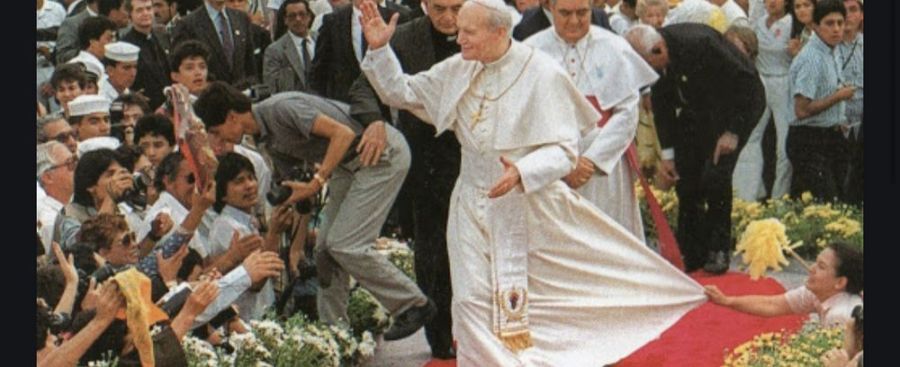
Your liturgy sings these words on many occasions, dear brothers and sisters of the Armenian people who have come here to celebrate your Jubilee. The Bishop of Rome extends his cordial greeting to you all and gives you a fatherly embrace.
I exchange a holy kiss of brotherhood with His Beatitude Nerses Bedros XIX, Patriarch of Cilicia for Armenian Catholics, and the Bishops who accompany him. On this happy occasion, I express my best wishes for the Synod which in a few days will begin in this city of Rome. I greet the priests, the religious and all the lay people who have come for this meeting and for today's celebration.
"Today Christ has crowned you with his Cross". Supreme shame, ignoble torture, the cross of the condemned has become a crown of glory. We exalt and venerate what was the despicable sign of abandonment and shame for everyone. How is this paradox possible? The hymn you will sing in this evening's Office explains it to us: "You were hung on this holy Cross, O God, and you spilled your precious blood upon it". Our salvation originates in Christ's total humiliation.
"I, when I am lifted up from the earth", he said, "I will draw all men to myself" (Jn 12: 32).
The power that triumphs over death is born of the inexpressible pain of love, and the Spirit, sent into the world by the crucified One, restores the rich foliage of the earthly paradise to the withered tree of humanity.
Humanity is astounded by this mystery; it can only kneel and adore the divine plan of our liberation.
2. Brothers and sisters, a few months ago the celebrations of the 1,700th anniversary of the Baptism of the Armenian people began. With this act, accomplished by your ancestors, the holy waters of redemption have brought forth new seeds of life and prosperity among the thorns and thistles that the earth had produced as a consequence of our first parents' sin. This Jubilee of the universal Church opens your Jubilee, in a wonderful continuity of spirit and theological content: from the Cross, from the side of the crucified Lord, flowed the water of your Baptism. May this anniversary be the opportunity for a precious renewal, for rediscovered hope, and for deep communion among all believers in Christ.
The Armenian people know the Cross well: they bear it engraved upon their hearts. It is the symbol of their identity, of the tragedies of their history and of the glory of their recovery after every adverse event. In all epochs, the blood of your martyrs has mingled with that of the crucified One.
Whole generations of Armenians have not hesitated to give their lives in order not to deny the faith which, as one of your historians says, belongs to you as the colour belongs to your skin.
The crosses with which your land is strewn are of bare stone, just as human pain is bare; at the same time they are carved with elegant volutes, to show that the whole world is sanctified by the Cross, that pain is redeemed. This evening you will bless the four cardinal points with the Cross, to recall that this poor instrument of torture has become the measure of the world's judgement, a cosmic symbol of the blessing of God, which sanctifies all things and makes all things fruitful.
3. May this blessing reach your regions and bring them serenity and trust! I pray to the crucified One first of all for your communities in Armenia: there, new and serious forms of poverty are putting your brothers and sisters to the test, giving rise to the temptation of new exoduses to seek elsewhere the means to live and assure safety to their families. Your people are asking for bread and justice, asking politics to be what they should be by their profound vocation: the honest and disinterested service of the common good, the struggle to enable the poorest and the most forsaken, always clothed in spite of all in the indelible dignity of every child of God, to live a dignified and human life. Do not abandon your suffering brethren: today, more than ever, may Armenians across the world who, through their hard work, have achieved financial and social security, take charge of their compatriots in a common effort for rebirth!
Today the Pope wants to carry with you the cross of those who suffer. He reminds you that in privations and daily suffering your gaze must be raised to the Cross, from which salvation continues to come. The Gospel is not only a comfort, it is also an incitement to live to the full the values which restore dignity to civil life, uprooting from the depths of the human heart the temptation of violence and injustice, of the exploitation of the lowly and the poor by the powerful and the rich. It is only by putting Christ the Lord at the centre of life that society will be just and that the selfishness of the few will give way to the good of all.
In addition to the Catholics, my remembrance and my greeting are extended to the children of the Armenian Apostolic Church: may they rest assured that the Pope of Rome is following with concern their efforts to be "the salt of the earth and the light of the world", so that the world will believe and find the strength to hope and to fight. The Catholic Church intends to uphold this effort as though it were her own, in the love which unites us all in Christ.
4. Dear friends, I invoke the blessings of the Lord upon you here, upon all your loved ones, upon the entire Armenian people and particularly upon the sick, the elderly and all who are suffering in body and in soul.
Today I will be with you in spirit during your pilgrimage of faith which is a fundamental dimension of the Jubilee. The pilgrimage reminds us that our being is on the way towards the fullness of the kingdom, which will be given to us when, with grateful wonder, we will see the Lord of the ages come again in glory, still bearing on his Body the marks of the Passion: "per Crucem ad gloriam".
Do not forget to pray for me too, so that the Lord will guide my steps on the path of peace!
I cordially impart my Blessing to everyone!
[Pope John Paul II, Audience Armenian Patriarchate 14 September 2000]