Mar 28, 2026 Written by 

Waiting becomes Singing

1. “Why do you seek the living among the dead? He is not here, but has risen” (Lk 24:5).

These words of the two men dressed “in dazzling apparel” rekindle the hope of the women who had rushed to the tomb at the break of dawn. They had experienced the tragic events culminating in Christ’s crucifixion on Calvary; they had felt the sadness and the confusion. In the hour of trial, however, they had not abandoned their Lord.

They go secretly to the place where Jesus was buried in order to see him again and embrace him one last time. They are moved by love, that same love that led them to follow him through the byways of Galilee and Judea, all the way to Calvary.

What blessed women! They did not yet know that this was the dawn of the most important day of history. They could not have known that they, they themselves, would be the first witnesses of Jesus’ Resurrection.

2. “They found the stone rolled away from the tomb” (Lk 24:2).

So narrates the evangelist Luke, adding that, “when they went in they did not find the body of the Lord Jesus” (cf. 24:3). In one brief moment, everything changes. Jesus “is not here, but has risen”. This announcement, which changed the sadness of these pious women into joy, re-echoes with changeless eloquence throughout the Church in the celebration of this Easter Vigil.

A singular Vigil of a singular night. A Vigil, the mother of all vigils, during which the whole Church waits at the tomb of the Messiah, sacrificed on the Cross. The Church waits and prays, listening again to the Scriptures that retrace the whole of salvation history.

But on this night, it is not darkness that dominates but the blinding brightness of a sudden light that breaks through with the starling news of the Lord’s Resurrection. Our waiting and our prayer then become a song of joy: “Exultet iam angelica turba caelorum . . . Exult, O chorus of Angels!”

The perspective of history is completely turned around: death gives way to life, a life that dies no more. In the Preface we shall shortly sing that Christ “by dying destroyed our death, by rising restored our life”. This is the truth that we proclaim with our words, but above all with our lives. He whom the women thought was dead is alive. Their experience becomes our experience.

3. O Vigil imbued with hope, you fully express the meaning of the mystery! O Vigil rich in symbolism, you disclose the very heart of our Christian existence! On this night, everything is marvellously summed up in one name, the name of the Risen Christ.

O Christ, how can we fail to thank you for the ineffable gift which, on this night, you lavish upon us? The mystery of your Death and Resurrection descends into the baptismal waters that receive the old, carnal man and make him pure with divine youthfulness itself.

Into the mystery of your Death and Resurrection we shall shortly be immersed, renewing our baptismal promises; in a special way, the six catechumens will be immersed in this mystery as they receive Baptism, Confirmation and the Eucharist.

4. Dear Brother and Sister Catechumens, I greet you with all the warmth of my heart, and in the name of the Church gathered here I welcome you with brotherly affection. You come form different nations: Japan, Italy, China, Albania, the United States of America and Peru.

Your presence here in Saint Peter’s Square is indicative of the variety of cultures and peoples who have opened their hearts to the Gospel. On this night death gives way to life for you too, as for all the baptized. Sin is erased and a new life begins. Persevere to the end in fidelity and love. And do not be afraid when difficulties arise, for “Christ being raised from the dead will never die again; death no longer has dominion over him” (Rom 6:9).

5. Yes, dear Brothers and Sisters, Jesus lives and we live in him. For ever. This is the gift of this night, which has definitively revealed to the world the power of Christ, Son of the Virgin Mary, whom he gave to us as Mother at the foot of the Cross.

This Vigil makes us part of a day that knows no end. The day of Christ’s Passover, which for humanity is the beginning of a renewed springtime of hope.

“Haec dies quam fecit Dominus: exsultemus et laetamur in ea - This is the day that the Lord has made: let us rejoice in it and be glad”. Alleluia!

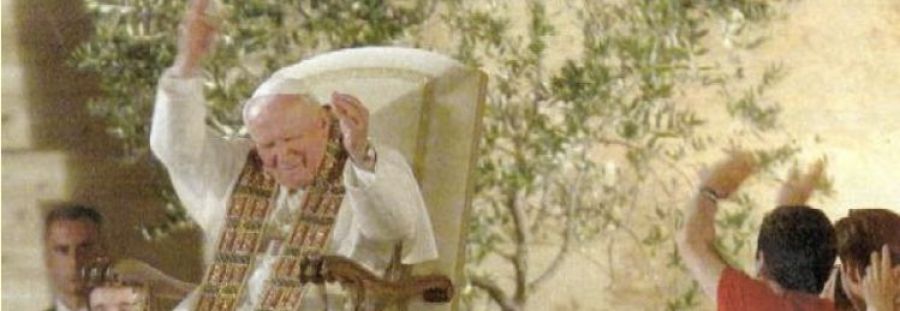
[Pope John Paul II, homily at the Easter Vigil 14 April 2001]

61 Last modified on Saturday, 28 March 2026 06:08
don Giuseppe Nespeca

Giuseppe Nespeca è architetto e sacerdote. Cultore della Sacra scrittura è autore della raccolta "Due Fuochi due Vie - Religione e Fede, Vangeli e Tao"; coautore del libro "Dialogo e Solstizio".

Email This email address is being protected from spambots. You need JavaScript enabled to view it.
To be Christians means to be missionaries, to be apostles (cfr. Decree Apostolicam Actuositatem, n.2). It is not enough to discover Christ - you must bring Him to others! [John Paul II]
Essere cristiani significa essere missionari-apostoli (cfr. «Apostolicam Actuositatem», 2). Non basta scoprire Cristo - bisogna portarlo agli altri! [Giovanni Paolo II]
What is meant by “eat the flesh and drink the blood” of Jesus? Is it just an image, a figure of speech, a symbol, or does it indicate something real? (Pope Francis)
Che significa “mangiare la carne e bere il sangue” di Gesù?, è solo un’immagine, un modo di dire, un simbolo, o indica qualcosa di reale? (Papa Francesco)
What does bread of life mean? We need bread to live. Those who are hungry do not ask for refined and expensive food, they ask for bread. Those who are unemployed do not ask for enormous wages, but the “bread” of employment. Jesus reveals himself as bread, that is, the essential, what is necessary for everyday life; without Him it does not work (Pope Francis)
Che cosa significa pane della vita? Per vivere c’è bisogno di pane. Chi ha fame non chiede cibi raffinati e costosi, chiede pane. Chi è senza lavoro non chiede stipendi enormi, ma il “pane” di un impiego. Gesù si rivela come il pane, cioè l’essenziale, il necessario per la vita di ogni giorno, senza di Lui la cosa non funziona (Papa Francesco)
In addition to physical hunger man carries within him another hunger — all of us have this hunger — a more important hunger, which cannot be satisfied with ordinary food. It is a hunger for life, a hunger for eternity which He alone can satisfy, as he is «the bread of life» (Pope Francis)
Oltre alla fame fisica l’uomo porta in sé un’altra fame – tutti noi abbiamo questa fame – una fame più importante, che non può essere saziata con un cibo ordinario. Si tratta di fame di vita, di fame di eternità che Lui solo può appagare, in quanto è «il pane della vita» (Papa Francesco)
The Eucharist draws us into Jesus' act of self-oblation. More than just statically receiving the incarnate Logos, we enter into the very dynamic of his self-giving [Pope Benedict]
L'Eucaristia ci attira nell'atto oblativo di Gesù. Noi non riceviamo soltanto in modo statico il Logos incarnato, ma veniamo coinvolti nella dinamica della sua donazione [Papa Benedetto]
Jesus, the true bread of life that satisfies our hunger for meaning and for truth, cannot be “earned” with human work; he comes to us only as a gift of God’s love, as a work of God (Pope Benedict)
Gesù, vero pane di vita che sazia la nostra fame di senso, di verità, non si può «guadagnare» con il lavoro umano; viene a noi soltanto come dono dell’amore di Dio, come opera di Dio (Papa Benedetto)
The locality of Emmaus has not been identified with certainty. There are various hypotheses and this one is not without an evocativeness of its own for it allows us to think that Emmaus actually represents every place: the road that leads there is the road every Christian, every person, takes. The Risen Jesus makes himself our travelling companion as we go on our way, to rekindle the warmth of faith and hope in our hearts and to break the bread of eternal life (Pope Benedict)
La località di Emmaus non è stata identificata con certezza. Vi sono diverse ipotesi, e questo non è privo di una sua suggestione, perché ci lascia pensare che Emmaus rappresenti in realtà ogni luogo:  la strada che vi conduce è il cammino di ogni cristiano, anzi, di ogni uomo. Sulle nostre strade Gesù risorto si fa compagno di viaggio, per riaccendere nei nostri cuori il calore della fede e della speranza e spezzare il pane della vita eterna (Papa Benedetto)

Due Fuochi due Vie - Vol. 1 Due Fuochi due Vie - Vol. 2 Due Fuochi due Vie - Vol. 3 Due Fuochi due Vie - Vol. 4 Due Fuochi due Vie - Vol. 5 Dialogo e Solstizio I fiammiferi di Maria

duevie.art

don Giuseppe Nespeca

Tel. 333-1329741


Disclaimer

Questo blog non rappresenta una testata giornalistica in quanto viene aggiornato senza alcuna periodicità. Non può pertanto considerarsi un prodotto editoriale ai sensi della legge N°62 del 07/03/2001.
Le immagini sono tratte da internet, ma se il loro uso violasse diritti d'autore, lo si comunichi all'autore del blog che provvederà alla loro pronta rimozione.
L'autore dichiara di non essere responsabile dei commenti lasciati nei post. Eventuali commenti dei lettori, lesivi dell'immagine o dell'onorabilità di persone terze, il cui contenuto fosse ritenuto non idoneo alla pubblicazione verranno insindacabilmente rimossi.






