


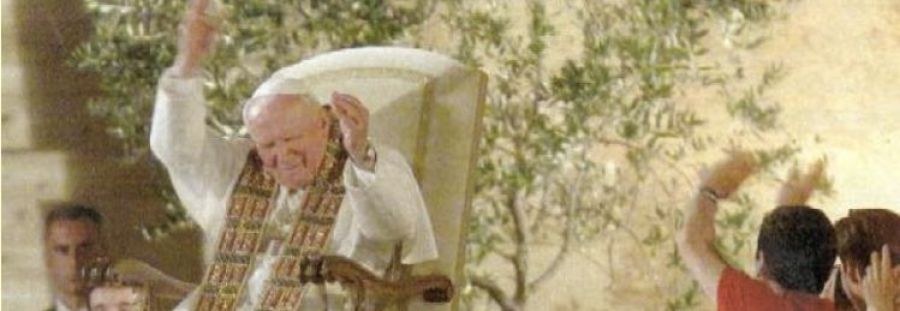
1. I have longed to come back to the town of Jesus, to feel once again, in contact with this place, the presence of the woman of whom Saint Augustine wrote: “He chose the mother he had created; he created the mother he had chosen” (Sermo 69, 3, 4). Here it is especially easy to understand why all generations call Mary blessed (cf. Lk 2:48).
I warmly greet Your Beatitude Patriarch Michel Sabbah, and thank you for your kind words of presentation. With Archbishop Boutros Mouallem and all of you – Bishops, priests, religious women and men, and members of the laity – I rejoice in the grace of this solemn celebration. I am happy to have this opportunity to greet the Franciscan Minister General, Father Giacomo Bini, who welcomed me on my arrival, and to express to the Custos, Father Giovanni Battistelli, and the Friars of the Custody the admiration of the whole Church for the devotion with which you carry out your unique vocation. With gratitude I pay tribute to your faithfulness to the charge given to you by Saint Francis himself and confirmed by the Popes down the centuries.
2. We are gathered to celebrate the great mystery accomplished here two thousand years ago. The Evangelist Luke situates the event clearly in time and place: “In the sixth month, the angel Gabriel was sent by God to a town in Galilee called Nazareth, to a virgin betrothed to a man named Joseph. . . The virgin’s name was Mary” (1:26-27). But in order to understand what took place in Nazareth two thousand years ago, we must return to the Reading from the Letter to the Hebrews. That text enables us, as it were, to listen to a conversation between the Father and the Son concerning God’s purpose from all eternity. “You who wanted no sacrifice or oblation prepared a body for me. You took no pleasure in holocausts or sacrifices for sin. Then I said. . . ?God, here I am! I am coming to obey your will’” (10:5-7). The Letter to the Hebrews is telling us that, in obedience to the Father’s will, the Eternal Word comes among us to offer the sacrifice which surpasses all the sacrifices offered under the former Covenant. His is the eternal and perfect sacrifice which redeems the world.
The divine plan is gradually revealed in the Old Testament, particularly in the words of the Prophet Isaiah which we have just heard: “The Lord himself will give you a sign. It is this: the virgin is with child and will soon give birth to a child whom she will call Emmanuel” (7:14). Emmanuel - God with us. In these words, the unique event that was to take place in Nazareth in the fullness of time is foretold, and it is this event that we are celebrating here with intense joy and happiness.
3. Our Jubilee Pilgrimage has been a journey in spirit, which began in the footsteps of Abraham, “our father in faith” (Roman Canon; cf. Rom 4:11-12). That journey has brought us today to Nazareth, where we meet Mary, the truest daughter of Abraham. It is Mary above all others who can teach us what it means to live the faith of “our father”. In many ways, Mary is clearly different from Abraham; but in deeper ways “the friend of God” (cf. Is 41:8) and the young woman of Nazareth are very alike.
Both receive a wonderful promise from God. Abraham was to be the father of a son, from whom there would come a great nation. Mary is to be the Mother of a Son who would be the Messiah, the Anointed One. “Listen!”, Gabriel says, “ You are to conceive and bear a son. . . The Lord God will give him the throne of his ancestor David. . . and his reign will have no end” (Lk 1:31-33).
For both Abraham and Mary, the divine promise comes as something completely unexpected. God disrupts the daily course of their lives, overturning its settled rhythms and conventional expectations. For both Abraham and Mary, the promise seems impossible. Abraham’s wife Sarah was barren, and Mary is not yet married: “How can this come about”, she asks, “since I am a virgin?” (Lk 1:34).
4. Like Abraham, Mary is asked to say yes to something that has never happened before. Sarah is the first in the line of barren wives in the Bible who conceive by God’s power, just as Elizabeth will be the last. Gabriel speaks of Elizabeth to reassure Mary: “Know this too: your kinswoman Elizabeth has, in her old age, herself conceived a son” (Lk 1:36).
Like Abraham, Mary must walk through darkness, in which she must simply trust the One who called her. Yet even her question, “How can this come about?”, suggests that Mary is ready to say yes, despite her fears and uncertainties. Mary asks not whether the promise is possible, but only how it will be fulfilled. It comes as no surprise, therefore, when finally she utters her fiat: “I am the handmaid of the Lord. Let what you have said be done to me” (Lk 1:38). With these words, Mary shows herself the true daughter of Abraham, and she becomes the Mother of Christ and Mother of all believers.
5. In order to penetrate further into the mystery, let us look back to the moment of Abraham’s journey when he received the promise. It was when he welcomed to his home three mysterious guests (cf. Gen 18:1-15), and offered them the adoration due to God: tres vidit et unum adoravit. That mysterious encounter foreshadows the Annunciation, when Mary is powerfully drawn into communion with the Father, the Son and the Holy Spirit. Through the fiat that Mary uttered in Nazareth, the Incarnation became the wondrous fulfilment of Abraham’s encounter with God. So, following in the footsteps of Abraham, we have come to Nazareth to sing the praises of the woman “through whom the light rose over the earth” (Hymn Ave Regina Caelorum).
6. But we have also come to plead with her. What do we, pilgrims on our way into the Third Christian Millennium, ask of the Mother of God? Here in the town which Pope Paul VI, when he visited Nazareth, called “the school of the Gospel”, where “we learn to look at and to listen to, to ponder and to penetrate the deep and mysterious meaning of the very simple, very humble and very beautiful appearing of the Son of God” (Address in Nazareth, 5 January 1964), I pray, first, for a great renewal of faith in all the children of the Church. A deep renewal of faith: not just as a general attitude of life, but as a conscious and courageous profession of the Creed: “Et incarnatus est de Spiritu Sancto ex Maria Virgine, et homo factus est.”
In Nazareth, where Jesus “grew in wisdom and age and grace before God and men” (Lk 2:52), I ask the Holy Family to inspire all Christians to defend the family against so many present-day threats to its nature, its stability and its mission. To the Holy Family I entrust the efforts of Christians and of all people of good will to defend life and to promote respect for the dignity of every human being.
To Mary, the Theotókos, the great Mother of God, I consecrate the families of the Holy Land, the families of the world.
In Nazareth where Jesus began his public ministry, I ask Mary to help the Church everywhere to preach the “good news” to the poor, as he did (cf. Lk 4:18). In this “year of the Lord’s favour”, I ask her to teach us the way of humble and joyful obedience to the Gospel in the service of our brothers and sisters, without preferences and without prejudices.
“O Mother of the Word Incarnate, despise not my petitions, but in your mercy hear and answer me. Amen”
[Pope John Paul II, homily in Nazareth, 25 March 2000]








