


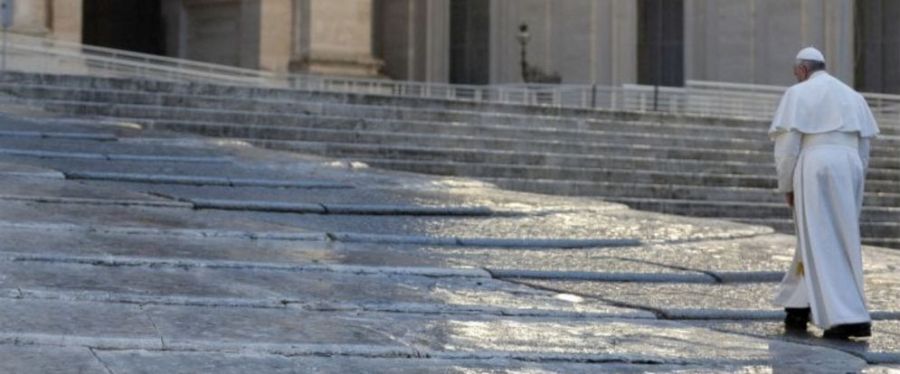
To know our true identity, we cannot be "sitting Christians" but must have the "courage to always set out to seek the face of the Lord", because we are "the image of God". In the Mass celebrated at Santa Marta on Tuesday, 10 February, Pope Francis, commenting on the first liturgical reading - the account of creation in the book of Genesis (1:20 - 2:4) - reflected on an essential question for every person: "Who am I?".
Our 'identity card', said the Pope, is found in the fact that human beings were created 'in the image, according to the likeness of God'. But then, he added, "the question we can ask ourselves is: How do I know the image of God? How do I know what he is like in order to know what I am like? Where do I find the image of God?" The answer is to be found "certainly not on the computer, not in encyclopaedias, not in books", because "there is no catalogue where the image of God is". There is only one way "to find the image of God, which is my identity" and that is to set out: "If we do not set out, we will never know the face of God".
This desire for knowledge is also found in the Old Testament. The psalmists, Francis noted, "many times say: I want to know your face"; and "even Moses once said this to the Lord". But in reality "it is not easy, because setting out means leaving behind so many certainties, so many opinions of what the image of God is like, and seeking him". It means, in other words, "letting God, life, put us to the test", it means "risking", because "only in this way can one come to know the face of God, the image of God: by setting out".
The Pope drew again on the Old Testament to recall that "this is what God's people did, this is what the prophets did". For example "the great Elijah: after having conquered and purified the faith of Israel, he feels the threat of that queen and is afraid and does not know what to do. He sets out. And at a certain point, he prefers to die". But God "calls him, gives him food and drink and says: keep walking". So Elijah "arrives at the mountain and there he finds God". His was therefore 'a long journey, a painful journey, a difficult journey', but it teaches us that 'whoever does not set out, will never know the image of God, will never find the face of God'. It is a lesson for all of us: 'the seated Christians, the quiet Christians,' said the Pontiff, 'will not know the face of God. They have the presumption to say: 'God is like this, like that...', but in reality they 'do not know him'.
To walk, on the other hand, 'you need that restlessness that God himself has placed in our hearts and that leads you forward to seek him'. The same thing, the Pontiff explained, happened "to Job who, with his trial, began to think: but how is God, who allows this to me?". Even his friends 'after a great silence of days, began to talk, to discuss with him'. But all this was not helpful: 'with these arguments, Job did not know God'. Instead, 'when he allowed himself to be challenged by the Lord in the trial, he met God'. And it is precisely from Job that we can hear "that word that will help us so much in this journey of searching for our identity: 'I knew you by hearsay, but now my eyes have seen you'". This is the heart of the matter according to Francis: "the encounter with God" that can happen "only by setting out".
Certainly, he continued, "Job set out with a curse", even "he had the courage to curse life and his history: 'Cursed is the day I was born...'". Indeed, the Pope reflected, 'sometimes, in the journey of life, we do not find meaning in things'. The same experience was had by the prophet Jeremiah, who "after being seduced by the Lord, he heard that curse: 'But why me?'". He wanted to "sit quietly" and instead "the Lord wanted to make him see his face".
This is true for each of us: "to know our identity, to know the image of God, we must set out", be "restless, not quiet". Precisely this "is to seek the face of God".
Pope Francis then also referred to the passage in Mark's Gospel (7:1-13), in which "Jesus encounters people who are afraid to set out" and who build a sort of "caricature of God". But that "is a false identity card" because, the Pontiff explained, "these non-restless ones have silenced the restlessness of the heart: they paint God with the commandments" but in so doing "they forget God" in order to observe only "the tradition of men". And "when they are unsure, they invent or make another commandment". Jesus says to the scribes and Pharisees who heap up commandments: "So you nullify the Word of God with the tradition you have handed down, and of such things you do many. Precisely this 'is the false identity card, the one we can have without setting out, quiet, without the restlessness of the heart'.
In this regard, the Pope highlighted a "curious" detail: the Lord in fact "praises them but rebukes them where the sore point is. He praises them: 'You are truly skilful in rejecting God's commandment in order to observe your tradition'", but then "he rebukes them where the strongest point of the commandments is with your neighbour". In fact, Jesus recalls that Moses said, "Honour your father and your mother, and whoever curses father or mother shall be put to death". He continues: "You, on the other hand, say: if one declares to one's father or mother that "what I should help you with, that is, give you food, give you clothing, give you to buy medicine, is Korbàn, an offering to God", do not allow them to do anything more for their father and mother". In doing so "they wash their hands of the tenderest, strongest commandment, the only one that has a promise of blessing". And so "they are quiet, they are quiet, they do not set out". This then "is the image of God that they have". In reality theirs is a path 'in quotes': that is, 'a path that does not walk, a quiet path. They deny their parents, but they fulfil the laws of tradition that they have made'.
Concluding his reflection, the bishop of Rome reproposed the meaning of the two liturgical texts as 'two identity cards'. The first is 'the one we all have, because the Lord has made us that way', and it is 'the one that tells us: set out and you will know your identity, because you are the image of God, you are made in God's likeness. Set out and seek God". The other instead reassures us: 'No, rest assured: fulfil all these commandments and this is God. This is the face of God'. Hence the wish that the Lord "give us all the grace of the courage to always set out, to seek the face of the Lord, that face that one day we will see but which here, on earth, we must seek."
[Pope Francis, St. Martha, in L'Osservatore Romano 11/02/2015]








