Jan 25, 2026 Written by 

Movement and wonder

Today we are celebrating the Feast of the Presentation of the Lord: when the infant Jesus was presented in the Temple by the Virgin Mary and Saint Joseph. Today is also World Day of Consecrated Life which recalls the great treasure in the Church of those who follow the Lord assiduously, by professing the evangelical counsels.

The Gospel (cf. Lk 2:22-40) narrates that 40 days after his birth, Jesus’ parents took their child to Jerusalem to consecrate him to God, as prescribed by Jewish Law. And as it describes a rite prescribed by tradition, this event brings to our attention the behaviour of some of the protagonists. They are caught at the very moment they experience the encounter with the Lord in the place where he makes himself present and close to mankind. They are Mary and Joseph, Simeon and Anna who are examples of welcome and offering as they offered their own lives to God. These four were not the same. They were all different but they all sought God and allowed themselves to be guided by the Lord.

The evangelist Luke describes all four of them in a twofold attitude: the attitude of movement and the attitude of wonder.

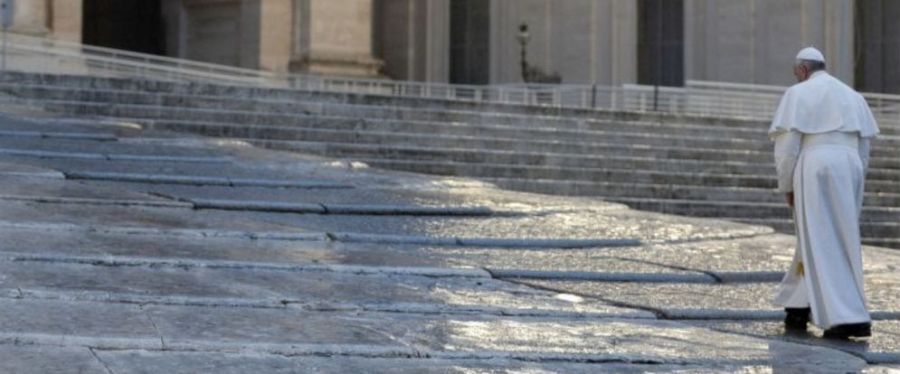
The first attitude is movement. Mary and Joseph head towards Jerusalem: meanwhile, moved by the Spirit, Simeon goes to the Temple, while Anna tirelessly serves God day and night. In this way the four protagonists of the Gospel passage show us that Christian life requires dynamism, and it requires a willingness to walk, allowing the Holy Spirit to guide one. Immobility suits neither Christian witness nor the Church’s mission. The world needs Christians who allow themselves to be moved, who do not tire of walking on life’s streets, to bring the comforting Word of Jesus to everyone. Every baptized person has received the vocation to proclaim — to proclaim something, to proclaim Jesus — the vocation and mission to evangelize: to proclaim Jesus! Parishes and various ecclesial communities are called to foster the commitment of young people, families and the elderly so that everyone can have a Christian experience, living the Church’s life and mission as protagonists.

The second attitude with which Saint Luke presents the four protagonists in the narrative is wonder. Mary and Joseph: “marvelled at what was said about him” (v. 33). Wonder is also an explicit reaction of the aged Simeon, who sees with his own eyes in the Child Jesus the redemption of God for his people: that redemption which he had awaited for years. And the same is true of Anna who “gave thanks to God” (v. 38) and went about pointing Jesus out to the people. She was a saintly chatterbox. She talked well, she talked of good, not bad things. She spoke, she announced: a saint who went from one woman to the next, making them see Jesus. These figures of believers were wrapped in wonder because they allowed themselves to be captivated by and involved in the events that occurred right before their eyes. The ability to be amazed at things around us promotes religious experience and makes the encounter with the Lord more fruitful. On the contrary, the inability to marvel makes us indifferent and widens the gap between the journey of faith and daily life.

Brothers and sisters, always [be] on the move and open to wonder!

May the Virgin Mary help us to contemplate every day in Jesus, God’s gift to us, and to allow ourselves to be engaged by him in the movement of the gift with joyful wonder so that our whole life may become a praise to God in the service to our brothers and sisters.

[Pope Francis, Angelus 2 February 2020]

0 Last modified on Sunday, 25 January 2026 03:14
don Giuseppe Nespeca

Giuseppe Nespeca è architetto e sacerdote. Cultore della Sacra scrittura è autore della raccolta "Due Fuochi due Vie - Religione e Fede, Vangeli e Tao"; coautore del libro "Dialogo e Solstizio".

Email This email address is being protected from spambots. You need JavaScript enabled to view it.
The ability to be amazed at things around us promotes religious experience and makes the encounter with the Lord more fruitful. On the contrary, the inability to marvel makes us indifferent and widens the gap between the journey of faith and daily life (Pope Francis)
La capacità di stupirsi delle cose che ci circondano favorisce l’esperienza religiosa e rende fecondo l’incontro con il Signore. Al contrario, l’incapacità di stupirci rende indifferenti e allarga le distanze tra il cammino di fede e la vita di ogni giorno (Papa Francesco)
An ancient hermit says: “The Beatitudes are gifts of God and we must say a great ‘thank you’ to him for them and for the rewards that derive from them, namely the Kingdom of God in the century to come and consolation here; the fullness of every good and mercy on God’s part … once we have become images of Christ on earth” (Peter of Damascus) [Pope Benedict]
Afferma un antico eremita: «Le Beatitudini sono doni di Dio, e dobbiamo rendergli grandi grazie per esse e per le ricompense che ne derivano, cioè il Regno dei Cieli nel secolo futuro, la consolazione qui, la pienezza di ogni bene e misericordia da parte di Dio … una volta che si sia divenuti immagine del Cristo sulla terra» (Pietro di Damasco) [Papa Benedetto]
And quite often we too, beaten by the trials of life, have cried out to the Lord: “Why do you remain silent and do nothing for me?”. Especially when it seems we are sinking, because love or the project in which we had laid great hopes disappears (Pope Francis)
E tante volte anche noi, assaliti dalle prove della vita, abbiamo gridato al Signore: “Perché resti in silenzio e non fai nulla per me?”. Soprattutto quando ci sembra di affondare, perché l’amore o il progetto nel quale avevamo riposto grandi speranze svanisce (Papa Francesco)
The Kingdom of God grows here on earth, in the history of humanity, by virtue of an initial sowing, that is, of a foundation, which comes from God, and of a mysterious work of God himself, which continues to cultivate the Church down the centuries. The scythe of sacrifice is also present in God's action with regard to the Kingdom: the development of the Kingdom cannot be achieved without suffering (John Paul II)
Il Regno di Dio cresce qui sulla terra, nella storia dell’umanità, in virtù di una semina iniziale, cioè di una fondazione, che viene da Dio, e di un misterioso operare di Dio stesso, che continua a coltivare la Chiesa lungo i secoli. Nell’azione di Dio in ordine al Regno è presente anche la falce del sacrificio: lo sviluppo del Regno non si realizza senza sofferenza (Giovanni Paolo II)
For those who first heard Jesus, as for us, the symbol of light evokes the desire for truth and the thirst for the fullness of knowledge which are imprinted deep within every human being. When the light fades or vanishes altogether, we no longer see things as they really are. In the heart of the night we can feel frightened and insecure, and we impatiently await the coming of the light of dawn. Dear young people, it is up to you to be the watchmen of the morning (cf. Is 21:11-12) who announce the coming of the sun who is the Risen Christ! (John Paul II)
Per quanti da principio ascoltarono Gesù, come anche per noi, il simbolo della luce evoca il desiderio di verità e la sete di giungere alla pienezza della conoscenza, impressi nell'intimo di ogni essere umano. Quando la luce va scemando o scompare del tutto, non si riesce più a distinguere la realtà circostante (Giovanni Paolo II)

Due Fuochi due Vie - Vol. 1 Due Fuochi due Vie - Vol. 2 Due Fuochi due Vie - Vol. 3 Due Fuochi due Vie - Vol. 4 Due Fuochi due Vie - Vol. 5 Dialogo e Solstizio I fiammiferi di Maria

duevie.art

don Giuseppe Nespeca

Tel. 333-1329741


Disclaimer

Questo blog non rappresenta una testata giornalistica in quanto viene aggiornato senza alcuna periodicità. Non può pertanto considerarsi un prodotto editoriale ai sensi della legge N°62 del 07/03/2001.
Le immagini sono tratte da internet, ma se il loro uso violasse diritti d'autore, lo si comunichi all'autore del blog che provvederà alla loro pronta rimozione.
L'autore dichiara di non essere responsabile dei commenti lasciati nei post. Eventuali commenti dei lettori, lesivi dell'immagine o dell'onorabilità di persone terze, il cui contenuto fosse ritenuto non idoneo alla pubblicazione verranno insindacabilmente rimossi.






