Jan 20, 2026 Written by 

Looking inside us

When Jesus spoke, he used simple words and he also used images which were examples taken from daily life, in order to be easily understood by all. This is why they listened to him willingly and appreciated his message which directly touched their heart. And it was not that complicated language which was difficult to understand, as that used by the Doctors of the Law of that time, which was not easily understood, was very rigid and distanced people. And with this language Jesus made the mystery of the Kingdom of God understood; it was not complicated theology. And one example is that of today’s Gospel passage: the parable of the sower (cf. Mt 13:1-23).

The sower is Jesus. With this image, we can see that he presents himself as one who does not impose himself, but rather offers himself. He does not attract us by conquering us, but by donating himself: he casts seeds. With patience and generosity, he spreads his Word, which is not a cage or a trap, but a seed which can bear fruit. And how can it bear fruit? If we welcome it.

Therefore, the parable concerns us especially. In fact, it speaks more of the soil than of the sower. Jesus carries out, so to speak, a “spiritual X-ray” of our heart, which is the soil on which the seed of the Word falls. Our heart, like the soil, may be good and then the Word bears fruit — and a great deal — but it can also be hard and impermeable. This happens when we hear the Word but it bounces off of us, just as on a street: it does not enter.

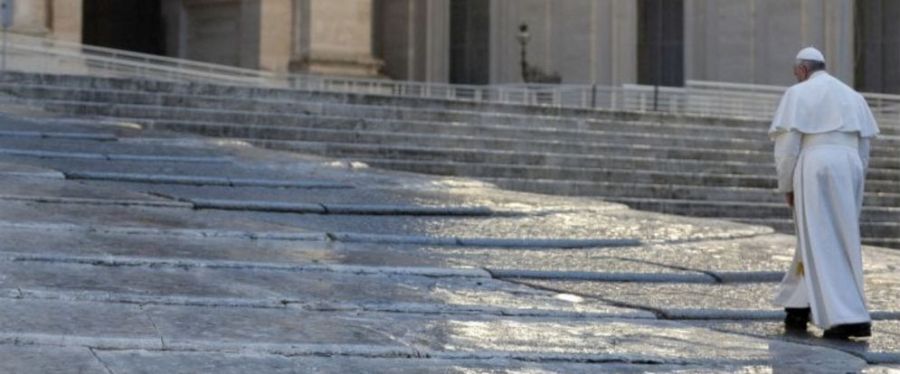
Between the good soil and the street; the asphalt — if we throw a seed on the “sanpietrini” (cobblestones), nothing grows — there are however, two intermediate types of soil which, in different amounts, we can have within us. The first, Jesus says, is rocky. Let us try to imagine it: rocky ground is a terrain that “does not have much soil” (cf. Mt 13:5), so the seed sprouts but is unable to put down deep roots. This is how the superficial heart is: it welcomes the Lord, wants to pray, love and bear witness, but does not persevere; it becomes tired and never “takes off”. It is a heart without depth, where the rocks of laziness prevail over the good soil, where love is fickle and fleeting. But whoever welcomes the Lord only when they want to does not bear fruit.

Then, there is the last ground, the thorny one, filled with briars which choke the good plants. What do these thorns represent? “The cares of the world and the delight in riches” (v. 22), as Jesus says explicitly. The thorns are the vices which come to blows with God, which choke his presence: above all these are the idols of worldly wealth, living avidly, for oneself, for possessions and for power. If we cultivate these thorns, we choke God’s growth within us. Each of us can recognize his or her big or small thorns, the vices that inhabit the heart, those more or less deeply rooted briars that God does not like and that prevent us from having a clean heart. It is necessary to tear them out, otherwise the Word cannot bear fruit, the seed will not grow.

Dear brothers and sisters, Jesus invites us today to look inside ourselves: to give thanks for our good soil and to tend the soil that is not yet good. Let us ask ourselves if our heart is open to welcome the seed of the Word of God with faith. Let us ask ourselves if our rocks of laziness are still numerous and large; let us identify our thorns of vice and call them by name. Let us find the courage to reclaim the soil, to effect a nice conversion of our heart, bringing to the Lord in Confession and in prayer our rocks and our thorns. In doing this, Jesus, the Good Sower will be glad to carry out an additional task: purify our hearts by removing the rocks and the thorns which choke his Word.

May the Mother of God, whom we remember today with the title of Blessed Virgin of Mount Carmel, unparalleled in welcoming the Word of God and putting it into practice (cf. Lk 8:21), help us to purify our hearts and welcome the Lord’s presence there.

[Pope Francis, Angelus 16 July 2017]

52 Last modified on Tuesday, 20 January 2026 05:21
don Giuseppe Nespeca

Giuseppe Nespeca è architetto e sacerdote. Cultore della Sacra scrittura è autore della raccolta "Due Fuochi due Vie - Religione e Fede, Vangeli e Tao"; coautore del libro "Dialogo e Solstizio".

Email This email address is being protected from spambots. You need JavaScript enabled to view it.
And He continues: «Think of salvation, of what God has done for us, and choose well!». But the disciples "did not understand why the heart was hardened by this passion, by this wickedness of arguing among themselves and seeing who was guilty of that forgetfulness of the bread" (Pope Francis)
E continua: «Pensate alla salvezza, a quello che anche Dio ha fatto per noi, e scegliete bene!». Ma i discepoli «non capivano perché il cuore era indurito per questa passione, per questa malvagità di discutere fra loro e vedere chi era il colpevole di quella dimenticanza del pane» (Papa Francesco)
[Faith] is the lifelong companion that makes it possible to perceive, ever anew, the marvels that God works for us. Intent on gathering the signs of the times in the present of history […] (Pope Benedict, Porta Fidei n.15)
[La Fede] è compagna di vita che permette di percepire con sguardo sempre nuovo le meraviglie che Dio compie per noi. Intenta a cogliere i segni dei tempi nell’oggi della storia […] (Papa Benedetto, Porta Fidei n.15)
But what do this “fullness” of Christ’s Law and this “superior” justice that he demands consist in? Jesus explains it with a series of antitheses between the old commandments and his new way of propounding them (Pope Benedict)
Ma in che cosa consiste questa “pienezza” della Legge di Cristo, e questa “superiore” giustizia che Egli esige? Gesù lo spiega mediante una serie di antitesi tra i comandamenti antichi e il suo modo di riproporli (Papa Benedetto)
For so long as we are sheep, we conquer: though ten thousand wolves prowl around, we overcome and prevail. But if we become wolves, we are worsted, for the help of our Shepherd departs from us (St John Chrysostom)
Finché saremo agnelli, vinceremo e, anche se saremo circondati da numerosi lupi, riusciremo a superarli. Ma se diventeremo lupi, saremo sconfitti, perché saremo privi dell’aiuto del Pastore (S. Giovanni Crisostomo)
Today, as on the day of our Baptism, we hear the words of Jesus addressed to us: “Ephphatha, be opened!” Open your ears. Jesus, I want to open myself to your Word; Jesus, open myself to listening to you; Jesus, heal my heart from being closed, heal my heart from haste, heal my heart from impatience (Pope Francis)
Sentiamo rivolta a noi oggi, come nel giorno del Battesimo, quella parola di Gesù: “Effatà, apriti”! Apriti le orecchie. Gesù, desidero aprirmi alla tua Parola; Gesù, aprirmi al tuo ascolto; Gesù, guarisci il mio cuore dalla chiusura, guarisci il mio cuore dalla fretta, guarisci il mio cuore dall’impazienza (Papa Francesco)
And this is the problem: when the People put down roots in the land and are the depository of the Law, they are tempted to place their security and joy in something that is no longer the Word of God: in possessions, in power, in other ‘gods’ that in reality are useless, they are idols. Of course, the Law of God remains but it is no longer the most important thing, the rule of life; rather, it becomes a camouflage, a cover-up, while life follows other paths, other rules, interests that are often forms of egoism, both individual and collective. Thus religion loses its authentic meaning, which is to live listening to God in order to do his will — that is the truth of our being — and thus we live well, in true freedom, and it is reduced to practising secondary customs which instead satisfy the human need to feel in God’s place. This is a serious threat to every religion which Jesus encountered in his time and which, unfortunately, is also to be found in Christianity. Jesus’ words against the scribes and Pharisees in today’s Gospel should therefore be food for thought for us as well (Pope Benedict)

Due Fuochi due Vie - Vol. 1 Due Fuochi due Vie - Vol. 2 Due Fuochi due Vie - Vol. 3 Due Fuochi due Vie - Vol. 4 Due Fuochi due Vie - Vol. 5 Dialogo e Solstizio I fiammiferi di Maria

duevie.art

don Giuseppe Nespeca

Tel. 333-1329741


Disclaimer

Questo blog non rappresenta una testata giornalistica in quanto viene aggiornato senza alcuna periodicità. Non può pertanto considerarsi un prodotto editoriale ai sensi della legge N°62 del 07/03/2001.
Le immagini sono tratte da internet, ma se il loro uso violasse diritti d'autore, lo si comunichi all'autore del blog che provvederà alla loro pronta rimozione.
L'autore dichiara di non essere responsabile dei commenti lasciati nei post. Eventuali commenti dei lettori, lesivi dell'immagine o dell'onorabilità di persone terze, il cui contenuto fosse ritenuto non idoneo alla pubblicazione verranno insindacabilmente rimossi.






