


Teresa Girolami
Teresa Girolami è laureata in Materie letterarie e Teologia. Ha pubblicato vari testi, fra cui: "Pellegrinaggio del cuore" (Ed. Piemme); "I Fiammiferi di Maria - La Madre di Dio in prosa e poesia"; "Tenerezza Scalza - Natura di donna"; co-autrice di "Dialogo e Solstizio".
Francis and Clare (amidst the weeds): born and raised in a humble religion
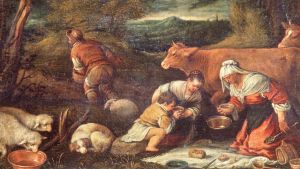
Praise and littleness, darkness and inspiration

The Gospel is a hymn of praise to God the Father by Jesus in the dimension of the weakness and vulnerability of the little ones.
He had experienced the disappointment of the 'great', suspicious of his wonders.
Instead of asking the Father for help, as Son he praises him in his dark moments.
Looking at our Poverello, all this is evident.
Short in stature, humble in spirit and a minor by profession, Francis of Assisi made littleness his existential mark and taught his brothers the same.
To be humble and minimal in the following of the Lord was the essential trait of the friar - precisely minor - who wanted to live in communion at the Portiuncula.
Turning to the great and wise of this world, the Saint found resistance in making his proposal of poverty and essentiality of life understood.
They often replied to him: "The poverty you seek, remain for ever with you, and your children, and your descendants after you" (cf. FF 1964).
In the Sources we find again that "Blessed Francis, hearing these words, marvelled in his heart and gave thanks to God, saying:
«Be blessed, O Lord God, who has kept these things hidden from the wise and prudent and revealed them to the little ones!
Yea, O Father, for thus it pleased thee!
O Lord, Father and master of my life, do not abandon me in their gathering, nor let me fall into that shame, but by your grace grant me to find what I seek, for I am your servant and the Son of your handmaid»" (FF 1965).
Furthermore, it must be remembered that "The servant of God, Francis, small in stature, humble of spirit and a minor by profession, while he lived here on earth, chose for himself and his brothers a small portion of the world [...] and they were certainly inspired by God who, in ancient times, called the place Porziuncola, the place that fell to those who did not want to possess anything on this earth [...].
There stood in this place a church dedicated to the Virgin Mother who, by her particular humility, deserved, after her Son, to be Sovereign of all Saints.
It was here that the Order of the Minors began, and their noble edifice rose wide and harmonious, as if resting on a solid foundation.
The Saint loved this place more than any other, and commanded the friars to venerate it with special devotion.
He wanted it always to be kept as a mirror of the Order in humility and highest poverty, reserving its ownership to others and keeping its use for himself and his own only" (FF 604).
So littleness was an eloquent sign of his being a child of God.
It was precisely from this position of concealment, in the difficult and dark periods of his journey of faith, that Francis raised praise to God the Father for what he was doing:
«Most High, Almighty, Good Lord,
Thine are the praises, the glory and the honour and every blessing [...].
Praised be You, my Lord, with all Your creatures [...]» (FF 263).
Francis composed this masterpiece at the cruellest and most suffering moment of his life, ill and in darkness.
Yet, he raised to God an authentic hymn of praise.
Like Jesus, who at the moment of loneliness and apparent defeat, of failure, raised his voice to the Father - to bless and praise him.
The blind alley and the darkness became a source of inspiration, and of a deeper relationship with the Lord; combined with that vulnerable littleness, entrusted to the Father for his Kingdom.
«I praise you, Father [...] for you have hidden these things from the wise and the learned and revealed them to babes» (Mt 11:25)
Wednesday of the 15th wk. in O.T. (Mt 11,25-27)
The Sower of the Word, and the Beautiful Soil. «River of Paradise» and Clare
Francis and Clare. The Humble, not the learned: great hearts, modest dwellings
The Welcomings of Francis and Clare. Actively Taking Up the Cross
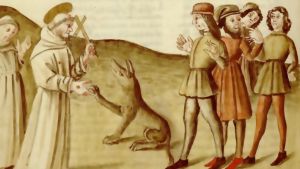
Francis and Clare: Littleness, and in the background. Personal Universality
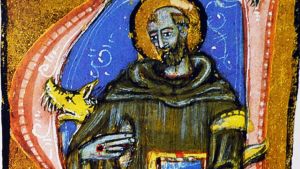
Free of charge, quite simply: Francis and Clare’s ‘the Kingdom Nearby’
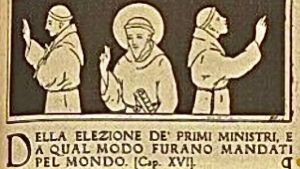
Franciscan Corpus Christi
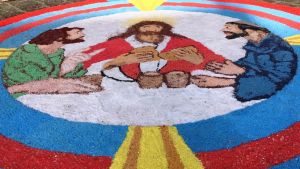
Franciscan Most Holy Trinity
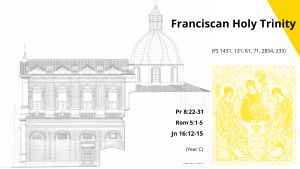
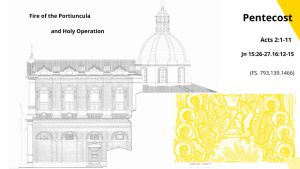
Franciscan PENTECOST. Gospel and Sources
The Cross of Jesus is our one true hope! That is why the Church “exalts” the Holy Cross, and why we Christians bless ourselves with the sign of the cross. That is, we don’t exalt crosses, but the glorious Cross of Christ, the sign of God’s immense love, the sign of our salvation and path toward the Resurrection. This is our hope (Pope Francis)
La Croce di Gesù è la nostra unica vera speranza! Ecco perché la Chiesa “esalta” la santa Croce, ed ecco perché noi cristiani benediciamo con il segno della croce. Cioè, noi non esaltiamo le croci, ma la Croce gloriosa di Gesù, segno dell’amore immenso di Dio, segno della nostra salvezza e cammino verso la Risurrezione. E questa è la nostra speranza (Papa Francesco)
In the divine attitude justice is pervaded with mercy, whereas the human attitude is limited to justice. Jesus exhorts us to open ourselves with courage to the strength of forgiveness, because in life not everything can be resolved with justice. We know this (Pope Francis)
Nell’atteggiamento divino la giustizia è pervasa dalla misericordia, mentre l’atteggiamento umano si limita alla giustizia. Gesù ci esorta ad aprirci con coraggio alla forza del perdono, perché nella vita non tutto si risolve con la giustizia; lo sappiamo (Papa Francesco)
The basis of Christian construction is listening to and the fulfilment of the word of Christ (Pope John Paul II)
Alla base della costruzione cristiana c’è l’ascolto e il compimento della parola di Cristo (Papa Giovanni Paolo II)
These divisions are seen in the relationships between individuals and groups, and also at the level of larger groups: nations against nations and blocs of opposing countries in a headlong quest for domination [Reconciliatio et Paenitentia n.2]
Queste divisioni si manifestano nei rapporti fra le persone e fra i gruppi, ma anche a livello delle più vaste collettività: nazioni contro nazioni, e blocchi di paesi contrapposti, in un'affannosa ricerca di egemonia [Reconciliatio et Paenitentia n.2]
Mary "Girl" [...] point of convergence and arrival of a complex of divine promises, mysteriously echoed in the very heart of history (Pope John Paul II)
Maria “Bambina” […] punto di convergenza e di arrivo di un complesso di promesse divine, echeggiate misteriosamente nel cuore stesso della storia (Papa Giovanni Paolo II)
Luke’s passage puts before the eyes a double slavery: that of man «with his hand paralyzed, slave of his illness», and that of the «Pharisees, scribes, slaves of their rigid, legalistic attitudes» (Pope Francis)
Il racconto di Luca mette davanti agli occhi una duplice schiavitù: quella dell’uomo «con la mano paralizzata, schiavo della sua malattia», e quella «dei farisei, degli scribi, schiavi dei loro atteggiamenti rigidi, legalistici» (Papa Francesco)
Origen says “we should practise this symphony” (Commentary on the Gospel according to Matthew, 14,1), in other words this harmony within the Christian community [Pope Benedict]
Dice Origene che “dobbiamo esercitarci in questa sinfonia” (Commento al Vangelo di Matteo 14, 1), cioè in questa concordia all’interno della comunità cristiana [Papa Benedetto]
Thus in communion with Christ, in a faith that creates charity, the entire Law is fulfilled. We become just by entering into communion with Christ who is Love (Pope Benedict)
Così nella comunione con Cristo, nella fede che crea la carità, tutta la Legge è realizzata. Diventiamo giusti entrando in comunione con Cristo che è l'amore (Papa Benedetto)








duevie.art
don Giuseppe Nespeca
Tel. 333-1329741
Disclaimer
Questo blog non rappresenta una testata giornalistica in quanto viene aggiornato senza alcuna periodicità. Non può pertanto considerarsi un prodotto editoriale ai sensi della legge N°62 del 07/03/2001.
Le immagini sono tratte da internet, ma se il loro uso violasse diritti d'autore, lo si comunichi all'autore del blog che provvederà alla loro pronta rimozione.
L'autore dichiara di non essere responsabile dei commenti lasciati nei post. Eventuali commenti dei lettori, lesivi dell'immagine o dell'onorabilità di persone terze, il cui contenuto fosse ritenuto non idoneo alla pubblicazione verranno insindacabilmente rimossi.