


Third Easter Sunday (year A) [19 April 2026]
*First Reading from the Acts of the Apostles (2:4, 22b–33)
The same Peter who, out of fear, had denied Jesus during his trial and who, after his death, had been holed up with the other disciples in a locked room, we find today, just fifty days later, standing and delivering an impromptu speech before thousands of people; and if Luke notes that he is standing, it is because the posture is symbolic: in a sense, Peter is awakening, coming back to life, rising up. Before going any further, it should be noted that up to this point Peter had not been a model of boldness, and yet it is precisely to him that Jesus now entrusts the boldest of missions: to continue the work of evangelisation, a mission that cost the Son of God himself his life, and the man who not long before had denied the Master will soon rejoice in being persecuted. This entirely new strength, this boldness, Peter does not draw from himself, but is a gift from God. Let us return to that Pentecost morning in the year of Jesus’ death, when Jerusalem was teeming with people: they were pilgrims who had come from all over for the festival because, just like Peter and the other apostles of Jesus, they shared the hope of Israel, and it is on this hope that Peter relies to proclaim that the long-awaited Messiah has come and that we have had the privilege of knowing him. Peter emphasises in his speech the continuity of God’s work, which for him is a crucial point, and invokes the testimony of Psalm 15/16. His listeners are the least prepared to accept his words precisely because, having always awaited the Messiah, they have had time to form their own ideas about him—human ideas—and God cannot help but surprise our human ideas. One of the most unacceptable aspects of the mystery of Jesus for his contemporaries is his death on the cross: on Good Friday, Jesus, abandoned by all, truly seemed cursed by God himself, and so how could he be the Messiah? On Easter evening, the apostles realised that he was indeed the Messiah because they had witnessed his Resurrection. Peter concludes by appealing to his listeners, telling them that if they have not been direct witnesses of the Resurrection, the only possible experience is that of seeing and hearing the twelve apostles transformed by the Holy Spirit
*Responsorial Psalm (15/16)
In the verses of Psalm 15/16, which are set before us today, some phrases seem to convey perfect happiness and everything appears so simple. The psalmist declares: ‘Lord, you are my God; I have made you my refuge; I have no good apart from you.’ In other verses, however, one senses the echo of danger, and Israel pleads, asking not to be abandoned to death nor to be allowed to see corruption. Here lies all the joy of Israel when the heart rejoices, the soul is in celebration because the Lord is ‘my portion and my cup, and I have no good apart from you’. Here Israel is likened to a Levite, to a priest who dwells ceaselessly in the temple of God and lives in intimacy with Him. The expression “Lord, my portion and my cup; upon You my lot depends” is an allusion to when the division of the land of Israel among the tribes of Jacob’s descendants was made by lot. At that time, the members of the tribe of Levi had not received a portion of land: their portion was the House of God, that is, service in the Temple, service to God, and their entire lives were consecrated to worship. They therefore had no territory, and their livelihood was secured by tithes and a portion of the harvests and meat offered in sacrifice. This also helps us understand the other verse of this psalm, which we do not hear today, where the psalmist says, ‘My portion makes me glad; I truly have the finest inheritance’. The Levites guarded the Temple day and night, and this is alluded to when the psalm notes, ‘even at night my heart instructs me’. In this psalm, one also senses the echo of danger, and the plea, ‘you cannot abandon me to death, nor let your holy one see corruption’, conveys the often-suffered tribulations of the chosen people. The opening plea for help, ‘Preserve me, O God, for in you I take refuge’, and the repeated expressions of trust suggest a period when, indeed, trust was hard to come by, and this cry for help is at the same time a profession of faith, for it reflects the struggle against idolatry to remain faithful to the one God. In another verse of the psalm we read that all the idols of the land never cease to spread their harm, and people rush to follow them. This shows that Israel sometimes succumbed to idolatry but made a commitment not to fall back into it, and the statement ‘I have made you, my God, my only refuge’ conveys this resolve. We can then appreciate how eloquent the image of the Levite is, for it is a way of saying that by choosing to remain faithful to the true God, the people of Israel made the true choice that brings them into intimacy with God, and Israel’s trust inspires such striking phrases as ‘eternity of delights’ or ‘you cannot abandon me to death, nor let your friend see corruption’. One might wonder whether, when the psalm was written, there was already, albeit in a confused form, a first glimmer of faith in the Resurrection, even though we know that belief in individual resurrection appeared very late in Israel. Here it seems rather that the focus is on the people whose survival is in danger because of their succumbing to idolatry. But they are convinced that God will not abandon them, and that is why they affirm: ‘You cannot abandon me to death, nor let your friend see corruption’. Around the second century BC, when belief in the resurrection of each of us began to take hold, the phrase ‘you will not abandon me to death, nor let your friend see decay’ was understood in this sense, and later Christians reinterpreted this psalm in their own way, as we heard in the first reading. On the morning of Pentecost, Peter quoted this psalm to the Jewish pilgrims who had come in great numbers to Jerusalem for the feast, to show them that Jesus was truly the Messiah. He recalled that when David composed this psalm, without realising it, he was already announcing the Resurrection of the Messiah. Here we have an example of the first Christian preaching addressed to Jews, that is, how the first apostles reinterpreted Jewish tradition, discovering within it a new dimension: the proclamation of Jesus Christ. Over the centuries, this psalm has carried the prayer of Israel in its expectation of the Messiah, becoming enriched with new meanings; yet it was the first Christian generation that discovered and demonstrated that the Scriptures find their full meaning in Jesus Christ.
*Second Reading from the First Letter of the Apostle Peter (1:17–21)
In the first reading from the Acts of the Apostles, we read Peter’s speech on the morning of Pentecost, a model of the first Christian preaching addressed to Jews. Here, however, in Peter’s letter, we see a sermon addressed to pagans—non-Jews who had become Christians—and it is obvious that the discourse is not the same, for it is the ABC of communication to adapt one’s language to the audience. And even though we do not know exactly to whom the letter is addressed—since in the opening lines Peter merely states that he is writing to the elect living as strangers in the five provinces of present-day Turkey, Pontus, Galatia, Cappadocia, Asia and Bithynia, what suggests they were not of Jewish origin is the phrase ‘you have been redeemed from the futile ways inherited from your fathers’. Peter, being Jewish himself, would not say such a thing to Jews, knowing all too well what hope runs through the Scriptures and how the whole life of his people is directed towards God. What strikes the eye in this simple passage is the striking number of allusions to the Bible, with expressions such as the blood of the Lamb without blemish or spot, the Father who judges impartially, and the fear of God; and if Peter uses them without explaining them, it is because his audience is familiar with them. But this is only possible if they are non-Jews. The most likely hypothesis is that many sympathisers gathered around the synagogues, and among them a significant number of those called ‘God-fearing’, who were so close to Judaism that they observed the Sabbath; they listened to all the synagogue readings on Saturday mornings, and consequently knew the Hebrew Scriptures well but had never gone so far as to ask for circumcision. It is thought that the early Christians were recruited mainly from among them, and it is worth returning to two expressions in Peter’s letter that may strike us as odd if we do not place them in their biblical context. First of all, the expression ‘fear of God’ has a particular meaning precisely because God revealed himself to his people as Father. The fear of God, therefore, is not fear but a filial attitude made up of tenderness, respect, veneration and total trust, and Peter says that since you call upon God as your Father, you live in the fear of God by behaving as children. If you call upon as Father the One who judges everyone impartially according to their deeds, you therefore live in the fear of God. From Peter’s emphasis on the One who judges everyone impartially according to their deeds, we can surmise that some of these new Christians, coming from paganism, felt inferior to Christians of Jewish origin, and Peter therefore wishes to reassure them by saying, in essence: you are children just like the others; simply behave as children. The second phrase that might cause offence is: ‘you have been redeemed by the precious blood of Christ’. The risk is of seeing this as a horrendous bartering, without being able to say clearly between whom and whom. But reading Peter’s sentence in full – “not with perishable things such as silver or gold were you redeemed from the empty way of life handed down to you from your forefathers, but with the precious blood of Christ, a lamb without blemish or defect” – two things become clear: firstly, this is not a matter of bartering; our liberation is free, and Peter takes care to say ‘not with gold or silver’, a way of saying it is free. Secondly, Peter does not place the emphasis where we do, because the blood of a lamb without blemish or defect is the blood that was shed every year at Passover and which marked Israel’s liberation from all forms of slavery. This blood that was shed heralded God’s ongoing work to free his people and, for a reader familiar with the Old Testament, is a reference to the feast of freedom—a freedom on the journey towards the Promised Land. But now, Peter notes, definitive liberation has been accomplished in Jesus Christ. We have now entered a new life better than the Promised Land, and this liberation consists precisely in calling upon God as Father. We can then better understand the phrase: you have been redeemed, that is, freed from the superficial way of life inherited from your fathers; ‘superficial’ here means that it leads nowhere, as opposed to eternal life. Since the Son lived as a man in trust until the end, it is all of humanity that has rediscovered the path of a filial attitude. Ultimately, it is a matter of having rediscovered the path to the tree of life, to use the image from Genesis. Paul would say: you have passed from the slave’s attitude of fear and mistrust to the filial reverence proper to children.
*From the Gospel according to Luke (24:13–35)
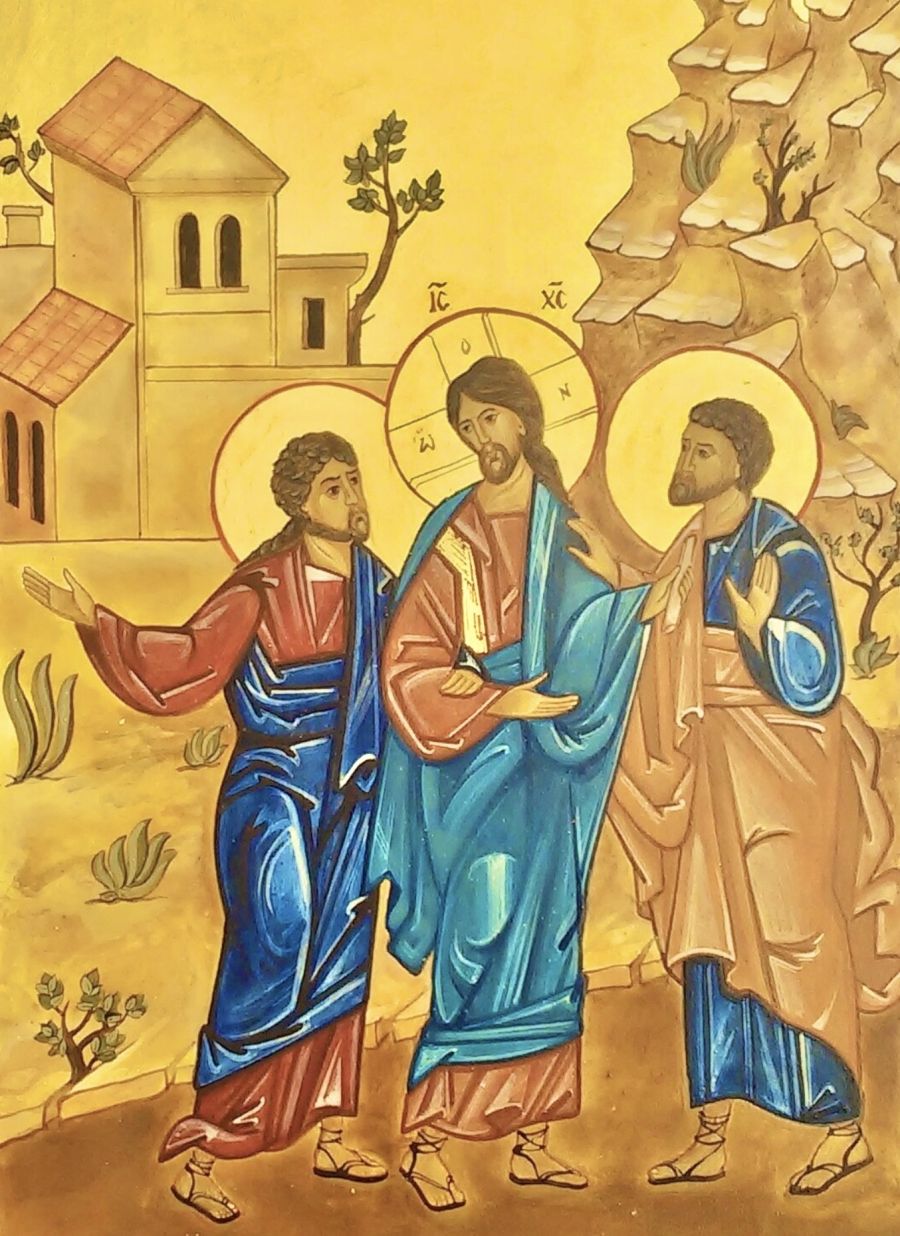
Note the parallel between these two phrases: their eyes were prevented from recognising him, and then their eyes were opened; this means that the two disciples of Emmaus passed from the deepest discouragement to enthusiasm simply because their eyes were opened. Why were they opened? Because Jesus explained the Scriptures to them, and beginning with Moses and all the Prophets, he interpreted in all the Scriptures what concerned him. This means that Jesus Christ is at the centre of God’s plan revealed in Scripture. The Old Testament must not, however, be reduced to a mere backdrop for the New, because to read the prophets as if they were announcing only the historical coming of Jesus Christ is to betray the Old Testament and strip it of all its historical depth, given that the Old Testament is the testimony of God’s long-suffering patience in revealing himself to his people and enabling them to live in his Covenant. The words of the prophets, for example, apply first and foremost to the era in which they were spoken, and we must not forget that reading Jesus Christ as the centre of human history and therefore also of Scripture is a Christian interpretation. The Jews have a different one, and we Jews and Christians agree in invoking God the Father of all mankind and in reading in the Old Testament the long wait for the Messiah, but let us not forget that recognising Jesus as the Messiah is not self-evident; it becomes so for those whose eyes are somehow opened and whose hearts consequently burn within them, just as those of the disciples of Emmaus did. It would be wonderful to know all the biblical texts that Jesus went through with the two disciples of Emmaus. We do know, however, that at the end of this biblical journey Jesus concludes by asking: ‘Was it not necessary for the Christ to suffer these things and enter into his glory?’ This phrase presents a real difficulty for us because it lends itself to two possible interpretations. The first possible interpretation is “it was necessary for the Christ to suffer in order to deserve to enter into his glory”, as if there were a requirement on the part of the Father; but this interpretation betrays the Scriptures because it presents Jesus’ relationship with the Father in terms of merit, which is not at all in keeping with the Old Testament revelation that Jesus developed. God is nothing but Love, Gift and Forgiveness, and with Him it is not a matter of balance, merit, arithmetic or calculation. It is also true that the New Testament often speaks of the fulfilment of the Scriptures, but not in this sense. There is, however, a second way of reading this phrase: ‘it was necessary for the Christ to suffer in order to enter into his glory’: the glory of God is his presence manifested to us. Now we know that God is Love. One could rephrase the sentence thus: ‘it was necessary for the Christ to suffer’ so that God’s love might be manifested and revealed. Jesus himself gave a foreshadowing of his death when he said to his disciples, ‘There is no greater love than to lay down one’s life for those one loves’. It was therefore necessary for love to go that far, to the point of facing hatred, abandonment and death, so that we might discover that God’s love is the greatest love, so that we might discover how far God’s love goes—so far beyond our own way of loving and so unimaginable in the true sense of the word. It was necessary for it to be revealed to us, and for it to be revealed, it had to go that far. “It was necessary” does not therefore mean a requirement on God’s part, but a necessity for us; and to say that the events of Jesus’ life fulfil the Scriptures is to say that his entire life is a revelation in action of this love of the Father, whatever the circumstances, including persecution, hatred, condemnation and death. The Resurrection of Jesus authenticates this revelation: this love is stronger than death.
+Giovanni D’Ercole








