


Solemnity of Christ the King of the Universe [23 November 2025]
May God bless us and may the Virgin protect us. We close the liturgical year C with grateful hearts as we prepare to resume our journey with Advent.
*First Reading from the Second Book of Samuel (5:1-3)
These are the first steps of the monarchy in Israel. It all begins in Hebron, an ancient city in the mountains of Judea, where the patriarchs of Israel rest: Abraham and Sarah, Isaac and Rebecca, Jacob and Leah, and even Joseph, whose bones were brought back from Egypt. It is a place steeped in memory and faith, and it is here that David becomes king of all the twelve tribes of Israel. After the death of Moses, around 1200 BC, the people of Israel settled in Palestine. The tribes lived independently, united only by the memory of their liberation from Egypt and their faith in their one God. In times of danger, God raised up temporary leaders, the Judges, who guided the people and often also acted as prophets. One of these was Samuel, a great man of God. Over time, however, the Israelites wanted to be 'like other peoples' and asked Samuel for a king. The prophet was troubled by this, because Israel was to recognise only God as King, but in the end, on God's command, he consecrated Saul, the first king of Israel. After a promising start, Saul fell into disobedience and madness, and God chose another man: David, the young shepherd from Bethlehem, on whom Samuel poured the oil of anointing. David did not immediately take power: he served Saul faithfully, became his musician and valiant warrior, loved by the people and bound by deep friendship to Jonathan, Saul's son. But the king's jealousy turned to hatred, and David was forced to flee, while always refusing to raise his hand against 'the Lord's anointed'. After Saul's death, Israel was divided: David reigned in Hebron over the tribe of Judah, while in the north, one of Saul's sons reigned for a short time. When the latter was killed, the northern tribes gathered at Hebron and recognised David as their king. On that day, the united kingdom of Israel was born: twelve tribes under one shepherd, chosen by God and recognised by his brothers. The anointing with sacred oil made David the 'Messiah', that is, the 'anointed one of the Lord'. He was to be a king after God's own heart, a shepherd who would lead his people towards unity and peace. But history showed how difficult it was to realise this ideal. Nevertheless, hope did not die: Israel always waited for the true Messiah, the descendant of David who would establish an eternal kingdom. And a thousand years later, Jesus Christ, called "Son of David," presented himself as the Good Shepherd, the one who offers his life for his flock. Every Sunday, in the Eucharist, he renews his covenant and tells us: "You are of my own blood."
*Responsorial Psalm (121/122:1-2, 3-4, 5-6a, 7a)
"What joy when they said to me, 'We will go to the house of the Lord'." A pilgrim recounts his emotion: after a long journey, his feet finally stop at the gates of Jerusalem. We are in the time of the return from Babylonian exile: the city has been rebuilt, the Temple restored (around 515 BC), and the people find in the house of the Lord the living sign of the Covenant. Before the resurrected city, the pilgrim exclaims: Jerusalem, here you are within your walls, a compact city, where everything together forms one body! Jerusalem is not only a geographical location: it is the heart of God's people, a symbol of unity and communion. Every stone, every wall reminds us that Israel is a people gathered together by a single promise and a common destiny. God himself wanted Israel to make an annual pilgrimage to Jerusalem, so that the common journey and shared effort would keep the bond of the Covenant alive. This is why the Psalm proclaims: "There the tribes go up, the tribes of the Lord... to praise the name of the Lord." The verb "to go up" indicates both the elevated position of the city and the spiritual ascent of the people towards their liberating God, the same God who brought them up, that is, out of Egypt. The phrase 'the tribes of the Lord' recalls the mutual belonging of the Covenant: 'You shall be my people, and I will be your God.' The pilgrimage, made on foot, amid fatigue, thirst and songs, is a journey of faith and fraternity. When the pilgrim exclaims, 'Now our journey is over!', he expresses the joy of one who has reached not only a geographical destination but also a spiritual one: the encounter with God in the city of his presence. Giving thanks to the Lord is Israel's vocation. Until the whole world recognises God, Israel is called to be the people of thanksgiving in the world, witnesses to divine faithfulness. Thus, every pilgrimage to Jerusalem renews Israel's mission: to give thanks, to praise and to show the way to other nations. The prophet Isaiah had foretold this universal plan: "At the end of days, the mountain of the Lord's temple will be firm on the top of the mountains, and all nations will flock to it... From Zion will go forth the law, and from Jerusalem the word of the Lord." (Is 2:2-3) Jerusalem then becomes a prophetic sign of the renewed world, where all peoples will be united in the same praise and the same peace. The Psalm recalls again: "There the thrones of judgement are set, the thrones of the house of David." With these words, Israel recalls the promise made by God to David through the prophet Nathan: "I will raise up a king from your descendants, and I will make his kingdom firm." (2 Sam 7:12). After the exile, there is no longer a king on the throne, but the promise remains alive: God does not go back on his word. In the celebrations at the Temple, this memory becomes prayer and hope: the day will come when God will raise up a king after his own heart, just and faithful, who will restore peace and justice. The very name Jerusalem means "city of peace." When we pray, "Pray for the peace of Jerusalem; may those who love you be secure" (Ps 122:6), we are not simply expressing a wish, but a profession of faith: only God can give true peace, and Israel is called to be a witness to this in the world. With the passing of the centuries, the hope for a righteous king is fulfilled in Jesus Christ, the Son of David. It is He who inaugurates the Kingdom of life and truth, of grace and holiness, of justice, love and peace, as proclaimed in the liturgy of the feast of Christ the King. In Him, the earthly Jerusalem becomes the new Jerusalem, the city of the definitive encounter between God and man. Every Eucharist is an ascent towards that city, a pilgrimage of the soul that ends in the heart of God. Israel's pilgrimage to Jerusalem then becomes a symbol of the journey of all humanity towards communion with God. And like the pilgrims of the Psalm, we too, the Church of the New Testament, can say with joy: "What joy when they said to me, 'We will go to the house of the Lord'."
*Second Reading from the letter of St. Paul the Apostle to the Colossians (1:12-20)
The invisible face of God. Once upon a time, there was a world that sought God but did not know how to see him. People looked up to the sky, built temples, offered sacrifices, but God remained invisible, distant. Then, one day, the Word became flesh: the God whom no one had ever seen took on a human face, and that face was that of Jesus of Nazareth. Since then, every time a man looks at Jesus, he looks at God. St Paul said it with words that sound like a song: "He is the image of the invisible God, the firstborn of all creation." In Him, everything that exists finds its origin and meaning. He is not only the beginning of the world, but also its heart: in Him everything was created, and in Him everything was reconciled. This plan of God did not come about yesterday, and Paul speaks of a design that has always been in place: 'He has delivered us from the power of darkness and transferred us to the Kingdom of the Son of his love.' God has always dreamed of a free, luminous human being, capable of communion. But what God had prepared in eternity was realised in time, in the present of Christ. This is why Paul writes: "In Him we have redemption, the forgiveness of sins." The mystery of Jesus is not a memory; it is a living reality that continues to work in the hearts of believers every day. God had made man "in His own image and likeness." But that image, in sin, had become clouded. So God Himself came to show us what it means to be human. In Jesus, man is restored to his original beauty. When Pilate shows him to the crowd and says, 'Behold the man!', he does not know that he is uttering a prophecy: in that wounded face, in that humble silence, the true man is revealed, as God had intended him to be. But in that face there is also the face of God. Jesus is the visibility of the invisible. He is God who allows himself to be seen, touched, heard. "Whoever has seen me has seen the Father," he will say to Philip. And Paul will add: "In him dwells all the fullness of the Godhead bodily." In Jesus, God and man meet forever. The infinite has taken flesh, heaven has become flesh. This is the mystery of the Cross. But how can the Cross be a sign of peace and reconciliation? Paul explains it this way: "God wanted to reconcile all things to himself, making peace through the blood of his cross." It is not God who wants the suffering of his Son. It is the hatred of men that kills him. Yet God transforms that hatred into redeeming love. It is the great reversal of history: violence becomes forgiveness, death becomes life, the cross becomes a tree of peace. We have seen men in history who have witnessed to peace and been killed for it — Gandhi, Martin Luther King, Itzhak Rabin, Sadat... — but only Christ, being both man and God, was able to transform evil into grace for the whole world. In his forgiveness of his crucifiers — “Father, forgive them” — God’s own forgiveness is revealed. From that day on, we know that no sin is greater than God’s love. On the cross, everything is accomplished. Paul writes: “God wanted all fullness to dwell in him, and through him to reconcile everything.” Creation finally finds its unity, its peace. The first to enter this Kingdom is the repentant thief: "Today you will be with me in paradise." And from then on, every person who opens themselves to forgiveness enters into that same light. The Eucharist is the heart of the mystery. Faced with such a gift, there is only one possible response: to give thanks. This is why Paul invites us: "Give thanks to God the Father, who has made you capable of sharing in the lot of the saints in the light." The Eucharist — in Greek, eucharistia means precisely "giving thanks" — is the place where the Church relives this mystery. Every Mass is a living memory of this reconciliation: God gives himself, the world is renewed, man finds himself again. It is there that everything is recomposed: the visible and the invisible, earth and heaven, man and God. And so, in the history of the world, a face has revealed the invisible. A pierced heart has brought peace. A broken loaf continues to make present the fullness of love. And every time the Church gathers for the Eucharist, Paul's song is renewed as a cosmic praise: Christ is the image of the invisible God, the first and the last, the one who reconciles the world with the Father, the one in whom everything subsists. In Him, everything finds meaning. In Him, everything is grace. In Him, the invisible God finally has a face: Jesus Christ, Lord of heaven and earth.
*From the Gospel according to Luke (23:35-43)
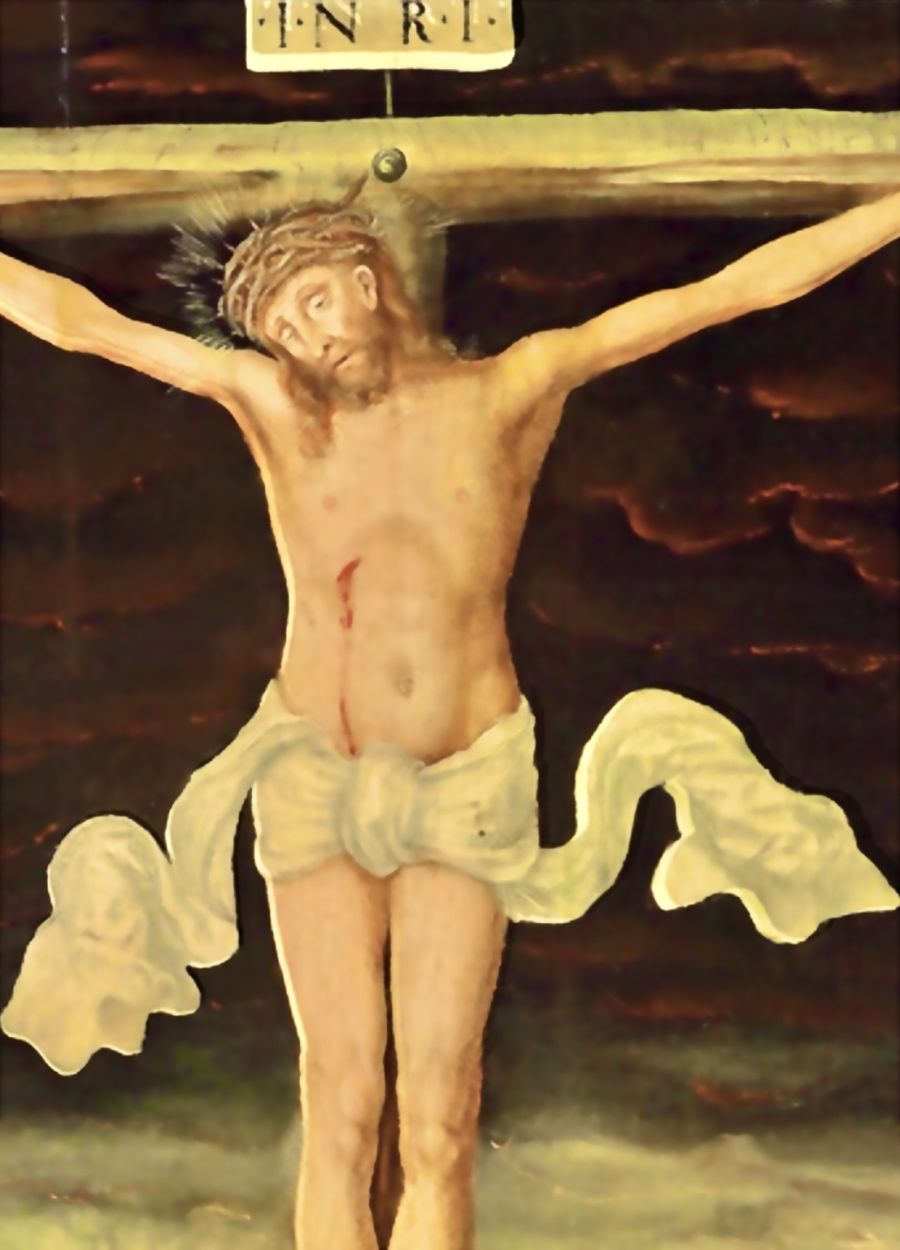
The logic of men and the logic of God. Three times, at the foot of the cross, the same provocation is repeated to Jesus: "If you are..." — "If you are the Messiah," the religious leaders mock; 'If you are the King of the Jews', sneer the Roman soldiers; 'If you are the Messiah', insults one of the criminals crucified with him. Each speaks from his own point of view: the leaders of Israel expect a powerful Messiah, but before them is a defeated and crucified man; the soldiers, men of earthly power, laugh at a defenceless 'king'; the criminal, on the other hand, awaits a saviour who will free him from death. These three voices recall the three temptations in the desert (Lk 4): even then, the tempter repeated, 'If you are the Son of God...'. Temptations of power, dominion and miracles. Jesus responded each time with the Word: 'It is written: man does not live on bread alone...' 'You shall worship the Lord your God and him alone shall you serve...' 'You shall not tempt the Lord your God'. Scripture was his strength to remain faithful to the mission of the poor and obedient Messiah. On the cross, however, Jesus is silent. He no longer responds to provocations. Yet he knows well who he is: the Messiah, the Saviour. But not according to the logic of men, who would like a God capable of saving himself, of dominating, of winning by force. Jesus dies precisely because he does not correspond to this human logic. His logic is that of God: to save by giving himself, without imposing himself. His silence is not empty, but full of trust. His very name, Jesus, means 'God saves'. He awaits his redemption from God alone, not from himself. The temptations are overcome forever: he remains faithful, totally surrendered into the hands of men, but trusting in the Father. Amidst the insults, two words encapsulate the mystery of the Cross. The first: "Father, forgive them, for they know not what they do." The second, addressed to the "good thief": "Today you will be with me in Paradise." Forgiveness and salvation: two gestures that are both divine and human. In Jesus, God himself forgives and reconciles humanity. The repentant thief — who turns to him and says, "Jesus, remember me when you come into your Kingdom" — is the first to understand who Christ truly is. He does not ask to come down from the cross, but to be welcomed. In that plea of humility and trust, the "remember" becomes the prayer that opens Paradise. Where Adam, in the Garden of Eden, had succumbed to the temptation to "be like God," Jesus, the new Adam, wins by waiting for everything from God. Adam had wanted to decide his own greatness and had been cast out of Paradise; Jesus, on the other hand, by accepting to be the Son in total abandonment, reopens Paradise to humanity. In the story of the Passion, two logics intersect: that of men, who seek a powerful God, and that of God, who saves through love and weakness. Jesus rejects the temptation to demonstrate his strength; instead, he chooses to trust the Father until the end. In his silence and forgiveness, divine power manifests itself as mercy. Beside him, the repentant thief becomes the first witness of the Kingdom: he recognises Christ as the true King, not of the powerful, but of the saved. Where Adam had closed the gates of Paradise, Jesus reopens them: 'Today you will be with me in Paradise' is God's definitive response to the logic of the world.
+ Giovanni D'Ercole








