


25th Sunday in Ordinary Time (year C) [21 September 2025]
May God bless us and may the Virgin Mary protect us. As we resume our pastoral activities, the word of God guides us to understand where the true riches of life lie.
*First Reading from the Book of the Prophet Amos (8:4–7)
This is certainly a grave moment, for this text from the prophet Amos concludes with a solemn formula: 'The Lord swears by the pride of Jacob' (v. 7). 'The pride of Jacob' is God himself, because he is (or should be) the only pride of his people; in other words, the Lord swears by himself. God can only commit himself to himself! But what is God swearing about? He assures that he will not forget "all their deeds", that is, all the misdeeds of Israel that the prophet Amos condemns because they seek only to enrich themselves at the expense of others. Amos is a prophet of the 8th century BC, when Palestine was divided into two kingdoms. A small shepherd from a village in the south (Tekoa, near Bethlehem), he was chosen by God to go and preach in the northern kingdom, also called Samaria after its capital. Under the reign of Jeroboam II, around 750 BC, Samaria experienced a period of economic prosperity, but this prosperity did not benefit everyone. On the contrary, Amos noted that the enrichment of some came at the expense of the impoverishment of others, simply because basic necessities, such as daily bread or sandals, were in the hands of unscrupulous sellers. Thus, the poor had no other solution, in order not to die of hunger or cold, than to sell themselves as slaves, 'buying the needy and the poor for a pair of sandals' (v. 6). Those who suffer injustice may try to seek justice, but whenever there is a trial for fraud or obvious scams, the courts take the side of the rich against the poor simply because the rich pay the judges. Amos says it clearly: 'They turn justice into poison and throw righteousness to the ground' (5:7). Justice itself is distorted, corrupted. The text we have heard is therefore one in which Amos speaks to announce God's judgement, and it is a veritable indictment: he states the facts, then gives his verdict: You crush the poor, you destroy the humble of the earth, and you ask when the new moon festival will be over so that we can sell our grain? The new moon, the first day of the month (called 'neomenia'), was a holiday: no work, no travel, no commercial activity was allowed because it was a day of rest like the Sabbath. This time of suspension of business served to turn man towards God. But here it seems that it is lived with impatience, because man now has another master: money, and for those whose only thought is profit, a day of rest is a loss. This is why Amos rebukes: 'Hear this, you who trample on the poor... and say, "When will the new moon be over so that we may sell our grain? (v.7). He targets dishonest sellers, for whom trade means fraud, with exorbitant prices and falsified scales. The image of the falsified scales has a double meaning: on the one hand, we understand how a crooked balance can falsify a measurement, but, more profoundly, it means that the whole of society lives on rigged scales. Ultimately, Amos reproaches the people of Samaria for living in falsehood and injustice: the scales are rigged, justice is corrupt, holidays are observed reluctantly and with ulterior motives; in short, everything is rigged. Here, then, is the judgement: 'The Lord swears by the pride of Jacob: I will not forget all their deeds' (v. 7). In other words: You who enrich yourselves unjustly, quickly forget your crimes, and the courts follow you; but the Lord declares that all this must not be forgotten and that you must not become accustomed to injustice. Amos pronounces his warning in the most solemn way possible, because there is a very serious lesson: the first thing God asks of his people is to live in justice, and a society founded on injustice and misery of all kinds can only offend God. Amos is all the more severe because, for a hundred years, the Northern Kingdom has boasted of having eliminated idolatry by abolishing the cults of Baal; but in reality, what Amos reproaches them for is having fallen into an even more dangerous idolatry: that of money.
*Responsorial Psalm (113/[112])
This psalm is the first of those that Jesus sang on Holy Thursday evening before leaving for the Mount of Olives. The first word he sang was Alleluia, which literally means Praise God: Allelu is the imperative, praise; and Ya is the first syllable of the Holy Name. Therefore, it is a psalm of praise, as can be understood from the first word: Alleluia. The composition of this psalm is interesting, consisting of two parts of four verses each, framing a central verse. The central verse is a question: 'Who is like our Lord God? (v. 5) and the two parts contemplate the two faces of the mystery of God: his holiness and his mercy. In his revelation, God has made himself known as the Transcendent, the All-Holy and as the Merciful, the All-Near. To manifest his holiness, his Name, 'the Lord', is repeated, the Name of God, revealed by himself in four letters (YHWH) which, however, are never pronounced. And as we know, in the Bible, when these four letters appear, the Hebrew reader spontaneously replaces them with 'Adonai', which means My Lord, and which does not claim to describe or define God. The term 'Lord', which expresses well the distance between God and us, is used five times, while 'the Name' is used three times, and the verb 'to praise' three times. The great discovery is found in the central verse: 'Who is like our Lord God?': the God of glory is at the same time the God of mercy. The second part of the psalm describes God's action in favour of the smallest and poorest: he lifts the weak from the dust, he raises the poor from the rubbish (v. 7). Among the weak and poor was the barren woman, who lived in constant fear of being rejected: "He settles the barren woman in her home, a joyful mother of children" (v. 9). Sarah, Abraham's wife, experienced this miraculous reversal: the joy of the barren woman who, after several years, found herself with a house full of children. The Bible loves to emphasise these reversals of situation: because nothing is impossible for God. Mary's Magnificat is full of this confident certainty. When, after the Last Supper, Jesus sang this psalm with his disciples as they climbed the Mount of Olives, he felt the verse "he lifts the weak from the dust" in a special way. He was heading towards his death, and he certainly recognised here a proclamation of his resurrection.
*Second Reading from the First Letter of Saint Paul the Apostle to Timothy (2:1-8)
At the heart of this passage is a phrase that sums up the entire Bible, is central to Paul's thinking, and above all is central to the history of humanity: "God our Saviour wants all people to be saved and to come to the knowledge of the truth" (v. 4). Every word is important: 'God wants': it is the mystery of his will, that plan of mercy that he had already established in himself to bring the times to their fullness, as the letter to the Ephesians says (cf. 1:9-10). God's will is a will for salvation that concerns all people. Paul insists on the universal dimension of God's plan: "God, our Saviour, wants all men to be saved and come to the knowledge of the truth." In sentences like this, the word "and" can be replaced by "that is"; we must therefore understand: God wants all men to be saved, that is, to come to the full knowledge of the truth. And what is truth? It is that God loves us and is always with us to fill us with his love. To be saved means to know this truth according to the biblical meaning of 'knowing': that is, to live it, to allow ourselves to be loved and transformed by it. As long as people do not know God's love, they remain prisoners, and Christ came to set us free. This is why we find the expression 'he gave himself as a ransom for all' (v. 6): each time, the word 'ransom' can be replaced with 'liberation': believing in God's love for all men and living by this love means being saved. So, true prayer, as Paul says, is entering into God's plan to be able to spread the Gospel like a spark that spreads. In the last sentence, Paul's insistence is not so much about outward appearance, but about the state of mind with which we must present ourselves in prayer: "I want men everywhere to pray, lifting up holy hands without anger or disputing." How can we enter into God's plan of love for all if our hearts are full of anger and evil intentions? Most likely, we can glimpse signs of serious difficulties, opposition, divisions, perhaps even persecution, in the community to which this letter was addressed. We cannot make precise assumptions, since we are not even sure of the date of the letter's composition, nor whether it is entirely by Paul or by one of his disciples. But that does not matter: what matters, in every age and in every difficulty, is that we must never forget that God wants all people to be saved and to come to the full knowledge of the truth, that is, of God's love.
*From the Gospel according to Luke (16:1-13)
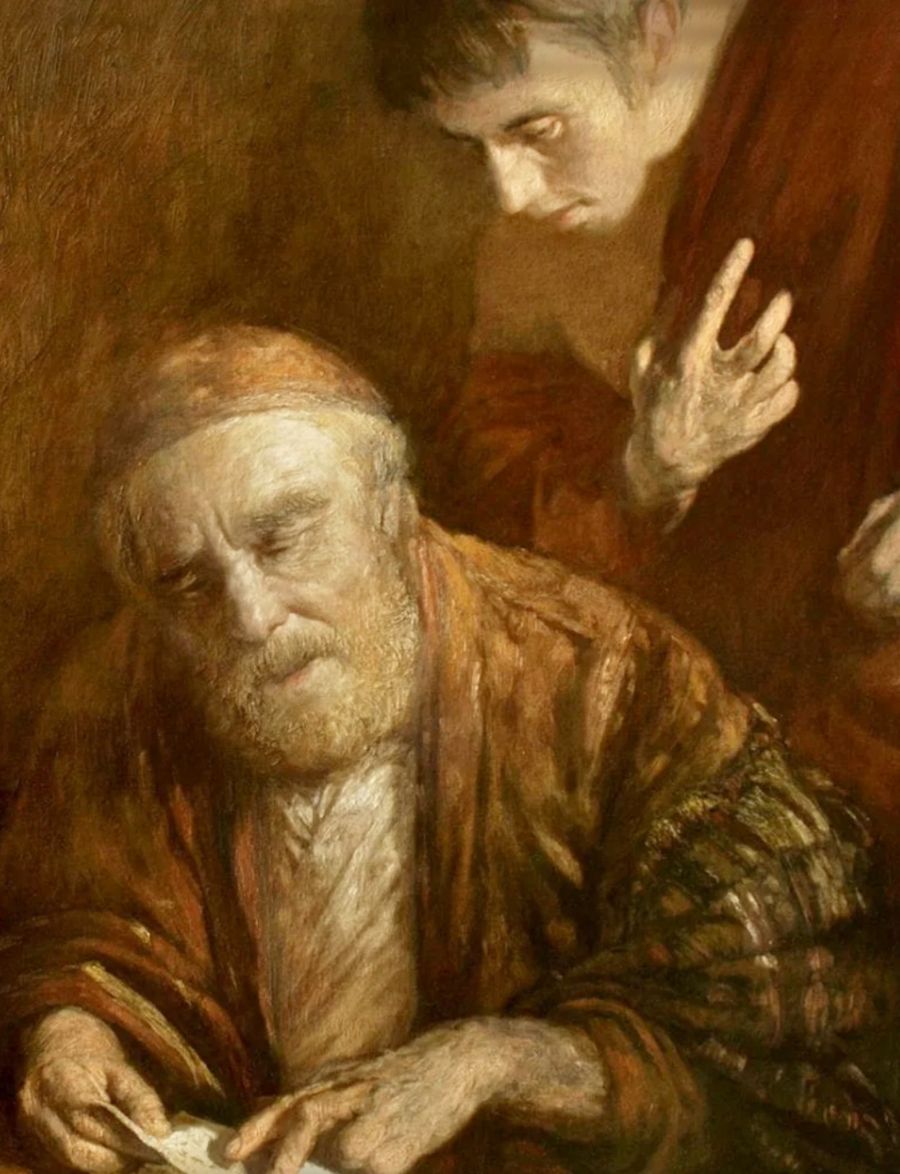
This text holds a surprise: Jesus seems to be complimenting the swindlers: 'The master praised that dishonest steward because he had acted shrewdly' (v. 8). Be careful not to misunderstand! Jesus calls him dishonest, that is, wicked, because honesty was part of the most basic morality. Therefore, Jesus' intention is certainly not to go against basic morality, and he is careful to point out that the master praises the man for his shrewdness. If Jesus uses a provocative example, it is to make us reflect on something serious, as the last sentence shows: there is an urgent choice to be made between God and money because one cannot serve both God and money. Jesus lists a series of oppositions: between the children of this world and the children of light, between a small thing and a great thing, between deceitful money and authentic good, between the goods of others and what is truly ours. All these oppositions have a single purpose: to make us discover that money is a deception and that devoting one's life to making money is the wrong path; it is as serious as idolatry, which the prophets have always fought against. In the phrase, 'You cannot serve God and money', the verb 'serve' has a religious meaning. There is only one God: do not make idols, because all idolatry enslaves you, and money can become an end in itself and no longer a means. When you are obsessed with the desire to earn money, you quickly become a slave: it is important to beware of what you possess so that you are not possessed by it, as popular wisdom says. The Sabbath was also instituted to rediscover, once a week, the taste of gratuitousness, a way to remain free. Money is deceptive in two ways: first, it makes us believe that it will ensure our happiness, but one day we will have to leave everything behind. In Jesus' words, the expression 'when it fails' (v. 9) is an allusion to death, and there is certainly no great interest in being the richest person in the cemetery! Furthermore, money deceives us if we think that it belongs only to us. Jesus does not despise money, but puts it at the service of the Kingdom, that is, for the good of others, and no one is its owner, but rather its administrator. If it is true that there is no point in being the richest person in the cemetery, it makes a lot of sense to be rich so that others can benefit from it too. The question "if you have not been faithful with dishonest wealth, who will entrust you with true wealth?" (v. 11) helps us to understand that trust is important in the use of money: God trusts us, entrusts us with money of which we are administrators and responsible. All our wealth, of whatever kind, has been entrusted to us as stewards so that we may share it, transforming it into happiness for those around us. This helps us to better understand the previous parable, the story of the steward threatened with dismissal who, in order to save himself, once again gives gifts from his master's goods to make friends who will welcome him. He was completely dishonest, but he was able to quickly find an ingenious solution to secure his future. The cunning here lies in using money as a means and not as an end. It is therefore not dishonesty that Jesus admires, but skill: what are we waiting for to find creative solutions to secure everyone's future? The thirst for gain makes many people inventive; Jesus would like our passion for justice or peace to make us just as inventive! The day we devote as much time and intelligence to seeking ways of peace, justice and sharing as we devote to accumulating more money than we need, the face of the world will change. Ultimately, the moral of the parable can be summarised as follows: choose God decisively and put the same intelligence that you would use to make money at the service of the Kingdom. The children of light know that money is only a small thing; the Kingdom is the big thing, and that is why they do not serve money as a deity, but use it for the good of all.
+ Giovanni D'Ercole








