Sep 27, 2026 Written by 

Where is the center of gravity? Where does Love come from?

Not from the precept, but from the overthrow

(Lk 10:25-37)


«You are a fool and a samaritan!» - so the Jewish leaders (Jn 8:48). «No, I am not crazy...»: this is how the Stranger defended himself from the accusation that the fanatics moved to him, of being a possessed, obsessed and mentally ill.

Yet he quietly accepted the infamous title of «Samaritan»... epithet that designated one out of the loop, a vilified by decent people. 

An excluded person from the sacred enclosure; practically alien, irritating, avulsive, heretic and impure: a «bastard» and deranged who allowed himself to preach love in all decisions [heart], at every moment [life], with any of the resources [forces], not excluding intelligence, nor the others’ legitimate desire for the full being (v.27).

Well, the non-careless perception and the very sensitive work of a "mestizo" seem to be those of God!

They answer the crucial, intimate question: «Who loves me first, so that feeling welcomed, adequate and appreciated, I too can love my neighbour?» (v.29).

We know the Gospel passage. Those obsessed with ritual purity [the ministers who had just officiated] become ruthless.

And here is a new Decalogue, with an accumulation of "verbs" of the «take charge»:

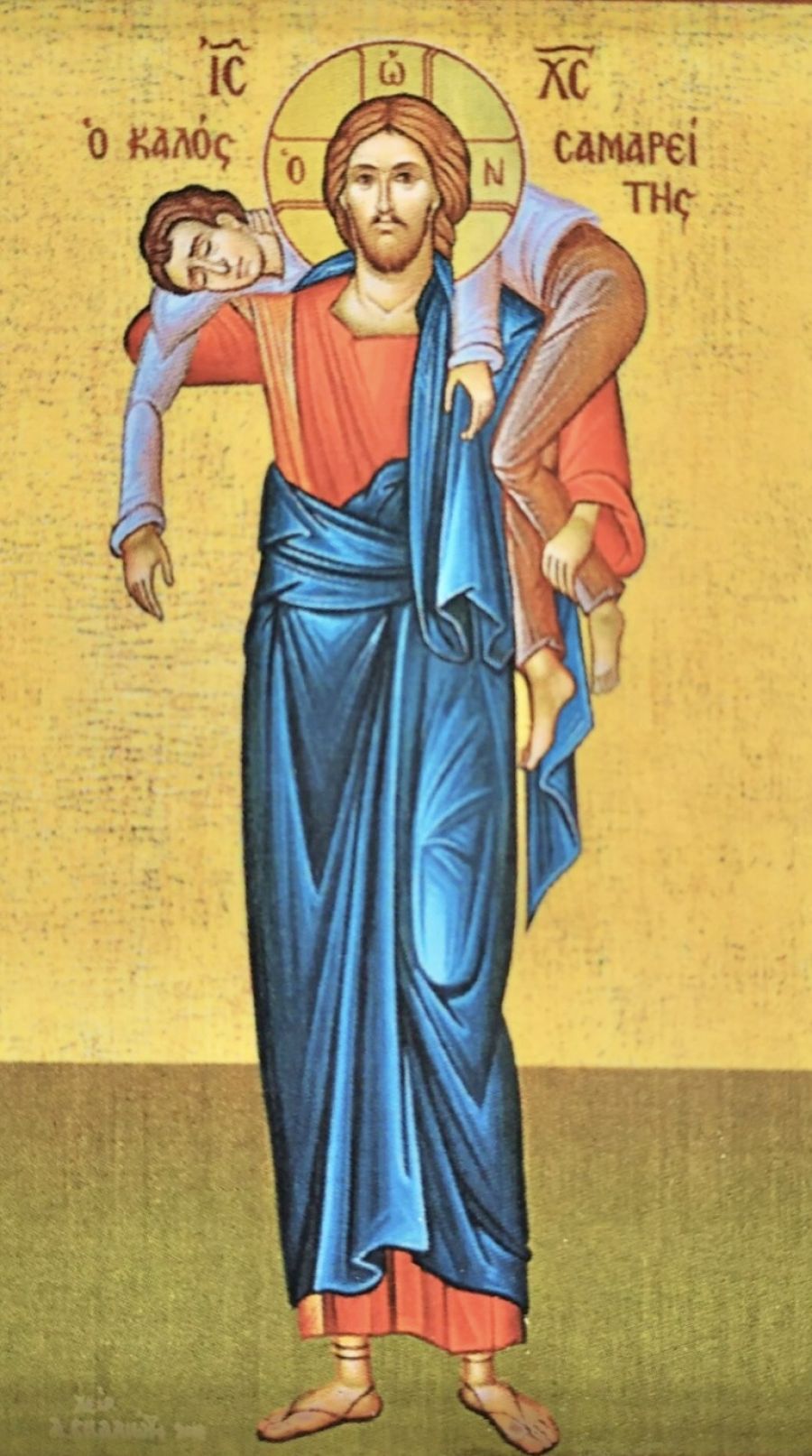
«He came near, and saw him, moved to piety, went down, poured out his first aid, wrapped the wounds, loaded the wretched on the mount, brought him in the abode that receives everyone, took care, pulled out money».

Finally He exposed himself, with special regard also for a thoughtful and further look: «I will return to pay, where necessary».


The Ten authentic new Decrees deify us without deception, in harmony with the plan and the feeling of the Father in our favor: neither He nor his intimates ‘pass beyond’ the victims.

Promise and concern that ramify on our future: when there should be something else to be put in addition, the Friend Rescuer will give it in more and always.


From here Love starts: from Someone who considers us, without conditions.

Therefore, despite the risk of becoming entangled in the situation, even the common sons of God ‘notice’ the wounds, and does not “neglect” the shaky persons.

They identifiy with, preferring to challenge the events - redeeming the beaten, cornered as refusals that now await only the coup de grâce.

He is a God of concrete experience; without patterns. And He tells us:

We are totally lovable in every condition, not "wrong" or marked for life.

From this awareness springs the desire and energy of altruistic love - even unknown and without reputation.

As the encyclical Fratelli Tutti emphasizes, so it will be possible to «start from below and, case by case, act at the most concrete and local levels, and then expand to the farthest reaches of our countries and our world, with the same care and concern that the Samaritan showed for each of the wounded man’s injuries» (n.78).


In the desert of Judah, on an engraved stone of a caravanserai that a tradition wanted to identify as the Everyone’s Home [image of the Church] to which Jesus referred in the parable - more or less halfway between Jerusalem and Jericho - an anonymous pilgrim wrote in medieval Latin:

«If even priests and the churchmen pass over your anguish, know that Christ is the good Samaritan, who will always have compassion on you, and in the hour of your death He will introduce you in the eternal Inn. Whoever you are, He will take you there».


[Monday 27th wk. in O.T.  October 5, 2026]

274 Last modified on Monday, 05 October 2026 11:59
don Giuseppe Nespeca

Giuseppe Nespeca è architetto e sacerdote. Cultore della Sacra scrittura è autore della raccolta "Due Fuochi due Vie - Religione e Fede, Vangeli e Tao"; coautore del libro "Dialogo e Solstizio".

There are also serious, dangerous omissions and we have to recognize with healthy realism that in this way things are not all right, it is not all right when errors are made. However, we must also be certain at the same time that if, here and there, the Church is dying because of the sins of men and women, because of their non-belief, at the same time she is reborn (Pope Benedict)
Ci sono anche cadute gravi, pericolose, e dobbiamo riconoscere con sano realismo che così non va, non va dove si fanno cose sbagliate. Ma anche essere sicuri, allo stesso tempo, che se qua e là la Chiesa muore a causa dei peccati degli uomini, a causa della loro non credenza, nello stesso tempo, nasce di nuovo (Papa Benedetto)
The question makes apparent the concern, present in ancient Jewish tradition, over finding a unifying principle in the various formulations of God's will […] Emphasis is placed on the totality of this dedication to God, listing the three faculties that define man in his deep psychological structures: heart, soul and mind. The word mind, diánoia, contains the rational element (Pope Benedict)
La domanda lascia trasparire la preoccupazione, presente nell’antica tradizione giudaica, di trovare un principio unificatore delle varie formulazioni della volontà di Dio […] L’accento è posto sulla totalità di questa dedizione a Dio, elencando le tre facoltà che definiscono l’uomo nelle sue strutture psicologiche profonde: cuore, anima e mente. Il termine mente, diánoia, contiene l’elemento razionale (Papa Benedetto)
A “year” of grace: the period of Christ’s ministry, the time of the Church before his glorious return, an interval of our life (Pope Francis)
Un “anno” di grazia: il tempo del ministero di Cristo, il tempo della Chiesa prima del suo ritorno glorioso, il tempo della nostra vita (Papa Francesco)
The Church, having before her eyes the picture of the generation to which we belong, shares the uneasiness of so many of the people of our time (Dives in Misericordia n.12)
Avendo davanti agli occhi l'immagine della generazione a cui apparteniamo, la Chiesa condivide l'inquietudine di tanti uomini contemporanei (Dives in Misericordia n.12)
Addressing this state of mind, the Church testifies to her hope, based on the conviction that evil, the mysterium iniquitatis, does not have the final word in human affairs (Pope John Paul II)
Di fronte a questi stati d'animo la Chiesa desidera testimoniare la sua speranza, basata sulla convinzione che il male, il mysterium iniquitatis, non ha l'ultima parola nelle vicende umane (Papa Giovanni Paolo II)
Jesus reminds us today that the expectation of the eternal beatitude does not relieve us of the duty to render the world more just and more liveable (Pope Francis)
Gesù oggi ci ricorda che l’attesa della beatitudine eterna non ci dispensa dall’impegno di rendere più giusto e più abitabile il mondo (Papa Francesco)
Those who open to Him will be blessed, because they will have a great reward: indeed, the Lord will make himself a servant to his servants — it is a beautiful reward — in the great banquet of his Kingdom He himself will serve them [Pope Francis]
E sarà beato chi gli aprirà, perché avrà una grande ricompensa: infatti il Signore stesso si farà servo dei suoi servi - è una bella ricompensa - nel grande banchetto del suo Regno passerà Lui stesso a servirli [Papa Francesco]

Due Fuochi due Vie - Vol. 1 Due Fuochi due Vie - Vol. 2 Due Fuochi due Vie - Vol. 3 Due Fuochi due Vie - Vol. 4 Due Fuochi due Vie - Vol. 5 Dialogo e Solstizio I fiammiferi di Maria

duevie.art

don Giuseppe Nespeca

Tel. 333-1329741


Disclaimer

Questo blog non rappresenta una testata giornalistica in quanto viene aggiornato senza alcuna periodicità. Non può pertanto considerarsi un prodotto editoriale ai sensi della legge N°62 del 07/03/2001.
Le immagini sono tratte da internet, ma se il loro uso violasse diritti d'autore, lo si comunichi all'autore del blog che provvederà alla loro pronta rimozione.
L'autore dichiara di non essere responsabile dei commenti lasciati nei post. Eventuali commenti dei lettori, lesivi dell'immagine o dell'onorabilità di persone terze, il cui contenuto fosse ritenuto non idoneo alla pubblicazione verranno insindacabilmente rimossi.