Jul 29, 2026 Written by 

Against the tide Transfiguration: Faith and Metamorphosis

(Lk 9:28b-36)


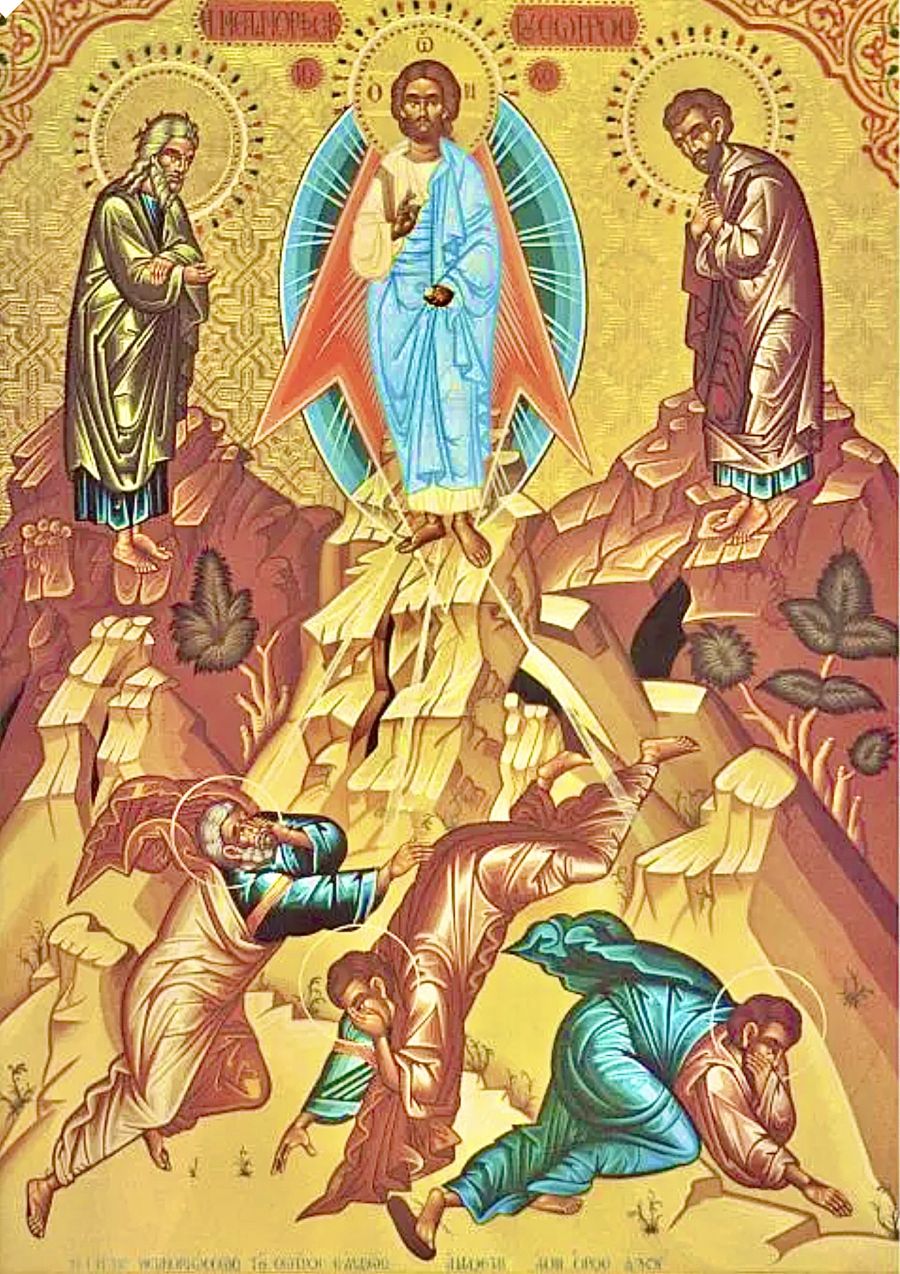
In biblical language, the experience of «the Mount» is an icon of the Encounter between God and man. Yes, for us it is like “losing our minds”, but in a very practical way - not at all visionary.

The Master imposes it on the three eminent figures of the first communities, not because he considers them the chosen ones, but the exact opposite: he realizes that it is his captains who need verification.

The synoptic Gospels do not speak of Transfiguration any, but of «Metamorphosis» [Greek text of Mk 9:2 and Mt 17:2]: a passing under a different ‘form’.

In particular, Lk 9:29 emphasizes that «the appearance of his face became ‘other’». Not because of a paroxysmal state.

It sounds crazy, but the hieratic magnificence of the Eternal One is revealed against the tide: in the image of the humble servant.

The experience of divine Glory is unsustainable for the eminent disciples - not in reference to physical flashes of light.

As in Oriental icons, they find themselves face to earth [Mt 17:6 - in ancient Eastern culture it meant precisely: "defeated" in their aspirations] and frightened. Fearful of being they too called to the gift of self (Mk 9:6; Mt 17:6; Lk 9:34-36).

The vertigo of the experience of God was not what they cultivated and wanted.

The dazzling light to which the passage refers (Mk 9:3; Mt 17:2.5; Lk 9:29) is that of a Revelation that opens our eyes to the "impossible" identity of the Son.

He was popularly expected as resembling David, powerful sovereign, able to assure the people a quick and easy well-being.

He is ‘revealed’ in a reversal: the Glory of God is Communion in simplicity, which qualifies us everyone.

The ‘shape’ of the "boss" is that of the attendant, who has the freedom to step down in altitude to put the least at ease: the humanly defeated one!

Peter elbows more than others to have his say. As usual, he wants to emerge and reiterate ancient ideas, but he reveals himself as the most ridiculous of all (Mk 9:6; Lk 9:33): he is ranting.

For him [again!] at the centre of the triptych remains Moses (Mk 9:5; Mt 17:4; Lk 9:33).

With the help of prophecies animated by fiery zeal [Elijah], according to Simon, Jesus would be one of the many who makes others practise the legalistic tradition.

At foundatiion remain the Commandments, not the Beatitudes.

The first of the apostles just does not want to understand that the Lord does not impose a Covenant based on obeying, but on Resembling!

Of course, the other "great ones" were also half asleep. Who knows what they were dreaming of... then bewildered, they all look for a Jesus according to Moses and Elijah (Mk 9:8-10; Mt 17:8; Lk 9:36).


In the culture of the time, the new, observant and disruptive Prince was expected during the Feast of Huts.

He would inaugurate the rule of the chosen people over all the nations of the earth (Zk 14:16-19); in practice, the golden age.

In Judaism, the Feast of Booths commemorated the ‘Mirabilia Dei’ of the Exodus [Lk 9:31: here, the new and personalised liberation from the land of slavery] and looked to the future by celebrating the prospects of victory for the protagonist ethnicity.

But the Kingdom of the Lord is not an empire affected by prodigious and immediate verticalism.

To build the Church of God there are no shortcuts, no numb defence points, and there sitting quiet - at a safe distance - by raving about accolades.


[Transfiguration of the Lord, August 6]

328 Last modified on Thursday, 06 August 2026 12:00
don Giuseppe Nespeca

Giuseppe Nespeca è architetto e sacerdote. Cultore della Sacra scrittura è autore della raccolta "Due Fuochi due Vie - Religione e Fede, Vangeli e Tao"; coautore del libro "Dialogo e Solstizio".

The sower is Jesus. With this image, we can see that he presents himself as one who does not impose himself, but rather offers himself. He does not attract us by conquering us, but by donating himself: he casts seeds. With patience and generosity, he spreads his Word, which is not a cage or a trap, but a seed which can bear fruit (Pope Francis)
Il seminatore è Gesù. Notiamo che, con questa immagine, Egli si presenta come uno che non si impone, ma si propone; non ci attira conquistandoci, ma donandosi: butta il seme. Egli sparge con pazienza e generosità la sua Parola, che non è una gabbia o una trappola, ma un seme che può portare frutto (Papa Francesco)
The Church desires to give thanks to the Most Holy Trinity for the "mystery of woman" and for every woman - for that which constitutes the eternal measure of her feminine dignity, for the "great works of God", which throughout human history have been accomplished in and through her (Mulieris Dignitatem n.31)
La Chiesa desidera ringraziare la Santissima Trinità per il «mistero della donna», e, per ogni donna - per ciò che costituisce l'eterna misura della sua dignità femminile, per le «grandi opere di Dio» che nella storia delle generazioni umane si sono compiute in lei e per mezzo di lei (Mulieris Dignitatem n.31)
Simon, a Pharisee and rich 'notable' of the city, holds a banquet in his house in honour of Jesus. Unexpectedly from the back of the room enters a guest who was neither invited nor expected […] (Pope Benedict)
Simone, fariseo e ricco “notabile” della città, tiene in casa sua un banchetto in onore di Gesù. Inaspettatamente dal fondo della sala entra un’ospite non invitata né prevista […] (Papa Benedetto)
God excludes no one […] God does not let himself be conditioned by our human prejudices (Pope Benedict)
Dio non esclude nessuno […] Dio non si lascia condizionare dai nostri pregiudizi (Papa Benedetto)
«The Russian mystics of the first centuries of the Church gave advice to their disciples, the young monks: in the moment of spiritual turmoil take refuge under the mantle of the holy Mother of God». Then «the West took this advice and made the first Marian antiphon “Sub tuum Praesidium”: under your cloak, in your custody, O Mother, we are sure there» (Pope Francis)
«I mistici russi dei primi secoli della Chiesa davano un consiglio ai loro discepoli, i giovani monaci: nel momento delle turbolenze spirituali rifugiatevi sotto il manto della santa Madre di Dio». Poi «l’occidente ha preso questo consiglio e ha fatto la prima antifona mariana “Sub tuum praesidium”: sotto il tuo mantello, sotto la tua custodia, o Madre, lì siamo sicuri» (Papa Francesco)
The Cross of Jesus is our one true hope! That is why the Church “exalts” the Holy Cross, and why we Christians bless ourselves with the sign of the cross. That is, we don’t exalt crosses, but the glorious Cross of Christ, the sign of God’s immense love, the sign of our salvation and path toward the Resurrection. This is our hope (Pope Francis)
La Croce di Gesù è la nostra unica vera speranza! Ecco perché la Chiesa “esalta” la santa Croce, ed ecco perché noi cristiani benediciamo con il segno della croce. Cioè, noi non esaltiamo le croci, ma la Croce gloriosa di Gesù, segno dell’amore immenso di Dio, segno della nostra salvezza e cammino verso la Risurrezione. E questa è la nostra speranza (Papa Francesco)
In the divine attitude justice is pervaded with mercy, whereas the human attitude is limited to justice. Jesus exhorts us to open ourselves with courage to the strength of forgiveness, because in life not everything can be resolved with justice. We know this (Pope Francis)

Due Fuochi due Vie - Vol. 1 Due Fuochi due Vie - Vol. 2 Due Fuochi due Vie - Vol. 3 Due Fuochi due Vie - Vol. 4 Due Fuochi due Vie - Vol. 5 Dialogo e Solstizio I fiammiferi di Maria

duevie.art

don Giuseppe Nespeca

Tel. 333-1329741


Disclaimer

Questo blog non rappresenta una testata giornalistica in quanto viene aggiornato senza alcuna periodicità. Non può pertanto considerarsi un prodotto editoriale ai sensi della legge N°62 del 07/03/2001.
Le immagini sono tratte da internet, ma se il loro uso violasse diritti d'autore, lo si comunichi all'autore del blog che provvederà alla loro pronta rimozione.
L'autore dichiara di non essere responsabile dei commenti lasciati nei post. Eventuali commenti dei lettori, lesivi dell'immagine o dell'onorabilità di persone terze, il cui contenuto fosse ritenuto non idoneo alla pubblicazione verranno insindacabilmente rimossi.






