Jul 25, 2026 Written by 

Multiplying by sharing, in itinerancy

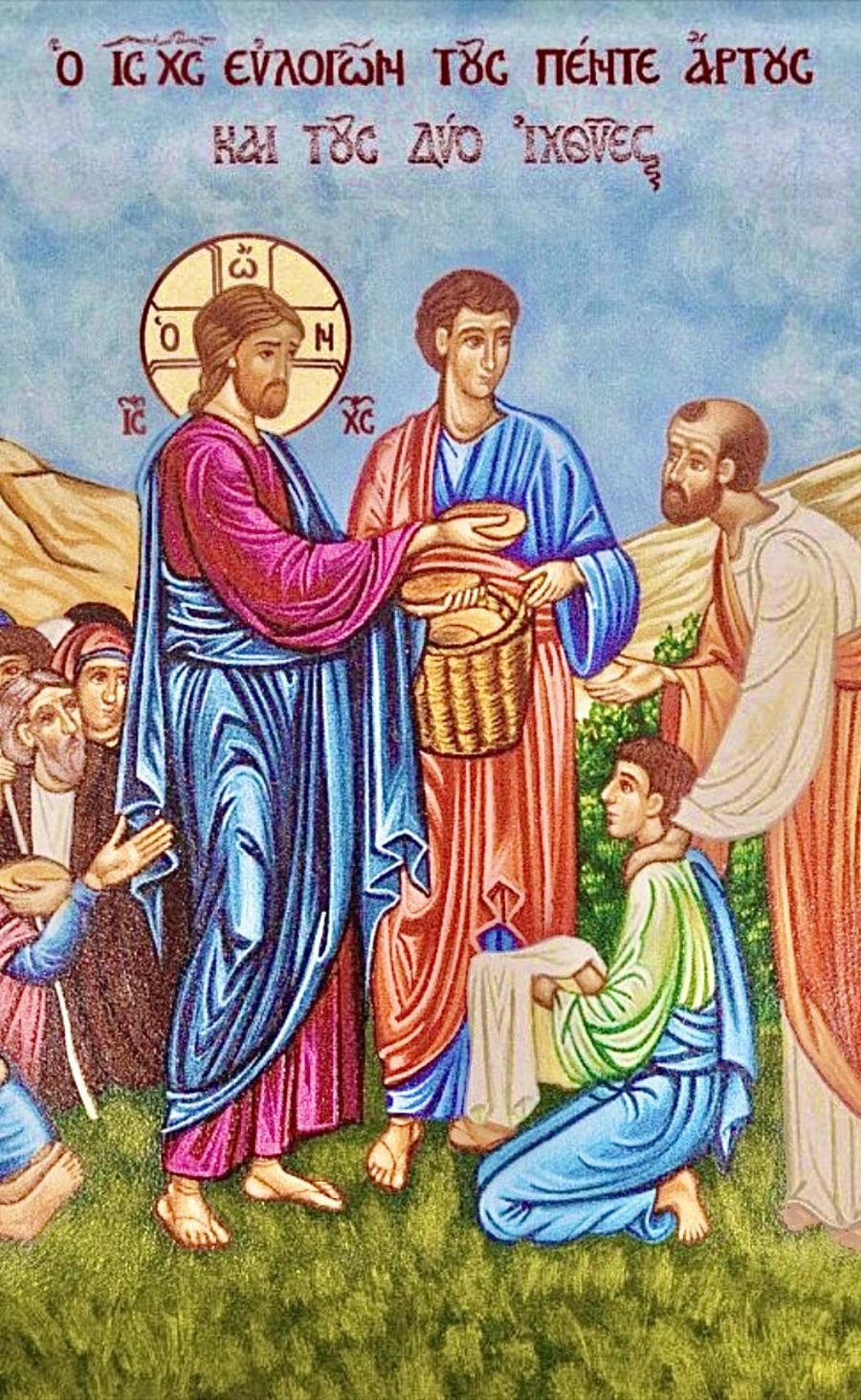
(Mt 14:13-21)


Jesus wants that contributions, resources and abilities make synergy; that they offer themselves in service and come unite for the life of multitudes (vv.13-15.19).

The Eucharistic gesture - “breaking the existence” - says: new heavens and earth do not correspond to the world in which everyone hastens to reap for himself or his circle, in order to grab the maximum of resources.

Even the Apostles - called by Jesus and still at a safe distance from Him - are not the owners of the Bread, but those who must feed everyone (v.16), to create abundance where it is not.

They must share, not command. And, in order to avoid impoverishment and damage to happiness, they must place themselves in a logic of overcoming.

The Son reflects God’s plan in compassion for the crowds in need of everything. Yet his solution does not fly over us - simply by wiping tears or erasing humiliations.

He invites us to use what we have, although it may seem ridiculous. But He teaches that shifting energies creates prodigious results.

Thus we respond in Christ to the great problems of the world: recovering the condition of ‘viator’ man - being in passing - and sharing goods.

Our real nakedness, the vicissitudes and experience of many brothers, different ones, are resources not to be evaluated with mistrust.

And the Lord disagrees with the idea that each gets off on his own (v.15).

He imposes on his intimates that «the crowds» (plurals) lie down in an atmosphere of abundance (v.19) as did the gentlemen and free people at solemn banquets.

He wants and insists that it is first of all the disciples to serve (v.19), not other slaves.

And perhaps the most astounding detail is that to none of those present imposes preventive gestures of purification, as was customary in selective religiosity.

Before the meal it postulated the ritual ablution: a ceremony that emphasized a sacral detachment between pure and impure.

The only task of the disciples is to distribute Food to be shredded, sifted and assimilated personally, to build a new world.


In order to present ourselves before God, in religion we have a long rigmarole of fulfilments to observe, which sometimes normalise us.

On the journey of Faith, it is the gratuitous Encounter with the Lord that makes us grow and complete, making each one perfect and unconditionally pure.

In this, extracting authentic Pearls; just from our eccentricities character - those that are detached from the millimeter manners.

His Kingdom? Reign of invited and brothers, also disagree. No master or ruler - even if quicker and more able to manage himself.

The Eucharist thus remains an Appeal to real Conviviality [of differences as they are] and an evergreen Call not to be satisfied with individual devotions or with a harmonisable but empty spirituality.

We must not limit ourselves in multiplying Life.

There must be no limits when spreading the ‘nourishment of wisdom’: the five «loaves», that is, the Pentateuch as ‘staple food’…

And two «fishes», that is, the Historical Books and the Prophets, feedings that accompany the Torah.

All to be «broken» for everyone - and shared, for the benefit of each person.


To internalize and live the message:


How does the Eucharistic gesture speak to you of the Revolution of Tenderness, and of your Call by Name through the Church?


[18th Sunday in O.T. (year A)  August 2nd, 2026]

241 Last modified on Sunday, 02 August 2026 12:11
don Giuseppe Nespeca

Giuseppe Nespeca è architetto e sacerdote. Cultore della Sacra scrittura è autore della raccolta "Due Fuochi due Vie - Religione e Fede, Vangeli e Tao"; coautore del libro "Dialogo e Solstizio".

Despite the scarcity of information about him, St Bartholomew stands before us to tell us that attachment to Jesus can also be lived and witnessed to without performing sensational deeds. Jesus himself, to whom each one of us is called to dedicate his or her own life and death, is and remains extraordinary (Pope Benedict)
La figura di san Bartolomeo, pur nella scarsità delle informazioni che lo riguardano, resta comunque davanti a noi per dirci che l'adesione a Gesù può essere vissuta e testimoniata anche senza il compimento di opere sensazionali. Straordinario è e resta Gesù stesso, a cui ciascuno di noi è chiamato a consacrare la propria vita e la propria morte (Papa Benedetto)
Faith is more than just empirical or historical facts; it is an ability to grasp the mystery of Christ’s person in all its depth [Pope Benedict]
La fede va al di là dei semplici dati empirici o storici, ed è capace di cogliere il mistero della persona di Cristo nella sua profondità [Papa Benedetto]
More than 600 precepts are mentioned in the Law of Moses. How should the great commandment be distinguished among these? (Pope Francis)
Nella Legge di Mosè sono menzionati oltre seicento precetti. Come distinguere, tra tutti questi, il grande comandamento? (Papa Francesco)
The invitation has three characteristics: freely offered, breadth and universality. Many people were invited, but something surprising happened: none of the intended guests came to take part in the feast, saying they had other things to do; indeed, some were even indifferent, impertinent, even annoyed (Pope Francis)
L’invito ha tre caratteristiche: la gratuità, la larghezza, l’universalità. Gli invitati sono tanti, ma avviene qualcosa di sorprendente: nessuno dei prescelti accetta di prendere parte alla festa, dicono che hanno altro da fare; anzi alcuni mostrano indifferenza, estraneità, perfino fastidio (Papa Francesco)
Those who are considered the "last", if they accept, become the "first", whereas the "first" can risk becoming the "last" (Pope Benedict)
Proprio quelli che sono considerati "ultimi", se lo accettano, diventano "primi", mentre i "primi" possono rischiare di finire "ultimi" (Papa Benedetto)
The dialogue of Jesus with the rich young man, related in the nineteenth chapter of Saint Matthew's Gospel, can serve as a useful guide for listening once more in a lively and direct way to his moral teaching [Veritatis Splendor n.6]
Il dialogo di Gesù con il giovane ricco, riferito nel capitolo 19 del Vangelo di san Matteo, può costituire un'utile traccia per riascoltare in modo vivo e incisivo il suo insegnamento morale [Veritatis Splendor n.6]
St Augustine rightly commented: “Christ showed himself indifferent to her, not in order to refuse her his mercy but rather to inflame her desire for it” (Sermo 77, 1: PL 38, 483) [Pope Benedict]
Sant’Agostino commenta giustamente: “Cristo si mostrava indifferente verso di lei, non per rifiutarle la misericordia, ma per infiammarne il desiderio” (Sermo 77, 1: PL 38, 483) [Papa Benedetto]
In the divine attitude justice is pervaded with mercy, whereas the human attitude is limited to justice. Jesus exhorts us to open ourselves with courage to the strength of forgiveness, because in life not everything can be resolved with justice. We know this (Pope Francis)

Due Fuochi due Vie - Vol. 1 Due Fuochi due Vie - Vol. 2 Due Fuochi due Vie - Vol. 3 Due Fuochi due Vie - Vol. 4 Due Fuochi due Vie - Vol. 5 Dialogo e Solstizio I fiammiferi di Maria

duevie.art

don Giuseppe Nespeca

Tel. 333-1329741


Disclaimer

Questo blog non rappresenta una testata giornalistica in quanto viene aggiornato senza alcuna periodicità. Non può pertanto considerarsi un prodotto editoriale ai sensi della legge N°62 del 07/03/2001.
Le immagini sono tratte da internet, ma se il loro uso violasse diritti d'autore, lo si comunichi all'autore del blog che provvederà alla loro pronta rimozione.
L'autore dichiara di non essere responsabile dei commenti lasciati nei post. Eventuali commenti dei lettori, lesivi dell'immagine o dell'onorabilità di persone terze, il cui contenuto fosse ritenuto non idoneo alla pubblicazione verranno insindacabilmente rimossi.






