May 29, 2026 Written by 

Without canceling the person, already naked of two cents

Small coins and festival of the voracious God, in solemn appearances

(Mk 12:38-44)


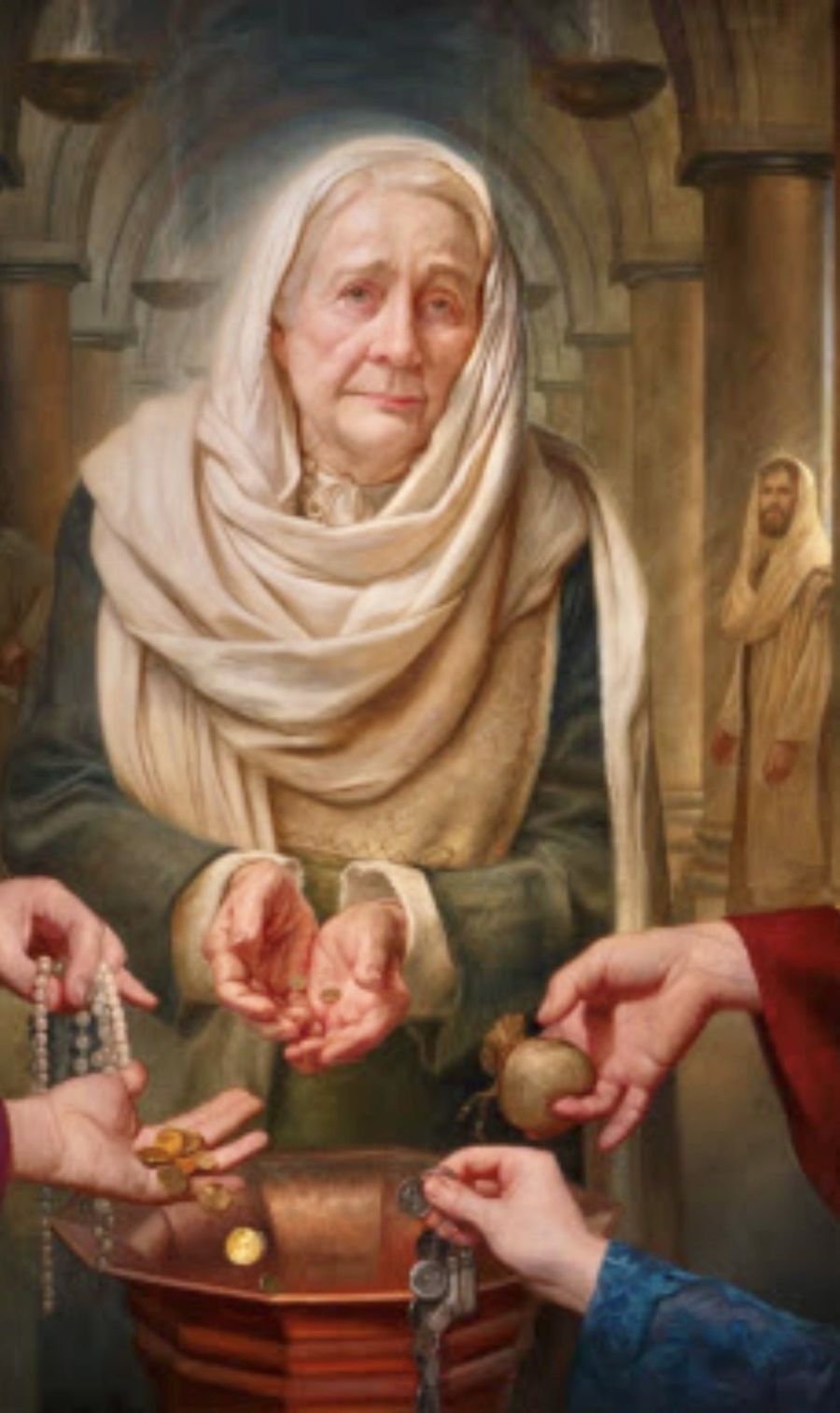
Jesus faces the treasure of the Temple, the true ‘god’ of the whole sanctuary. The comparison is ruthless: one as opposed to the other (v.41).

Enigma that could not be solved with a simple ‘purification’ of the sacred place, or a replenishment of devotion.

It will be surprising, but the Gospel passage does not sing praises of individual humility which by faith deprives itself of everything: it is rather a radical appeal to church leaders and to the sense of institution.

The Lord is saddened by every expropriation conditioned by awe. Indeed, fear takes life from those who do not enjoy fullness.

Christ weeps the subordinate condition of the poor and neglected: He does not make her take the chair. He does not credit the situation. He does not want the woman already naked by two cents to undress all.

He seems distraught for that one silent figure; to underline the difference between the voracious demands of the ancient religions’ God and those of a completely different sign - in our favor - of the Father in the Faith.


While Jesus noticed and was mourning on the minuteous gesture of the little woman, the Apostles did not even notice the irrelevant poor creature, continuing to gape at the magnificence of the Temple.

Who knows what they were dreaming about... seduced by honor.

To divert them from the fever of reputation and considerations they desired to boast of, there was a need for an awareness; but to move them out of their place and yardstick the miracles would not have been enough.

Thus Jesus seeks to convey in conscience the Good News that the Father is the exact opposite of how he had been painted to them by the spiritual guides of the time.

The Eternal disconcerts: He does not take, does not appropriate, does not plunder, nor does absorb or debilitate us - but He is the One who gives.

He does not punish if you do not placate Him with both the little coins you have, without withholding a single one - even if only by doing in half (v.2).

The honour to God is not exclusive, but inclusive.

Paraphrasing the encyclical Fratelli Tutti, we could say that in authentic communities [as in families] «everyone contributes to the common purpose; everyone works for the common good, not denying each person’s individuality but encouraging and supporting it» (n.230).


The Son notes with bitterness that the beautiful protagonists themselves «devour the houses of widows» (v.40) as vampires. So convincing as to make the souls of the simple even their supporters and victims.

Christ is saddened by such unconscious complicity, induced by the lack of knowledge of the Father’s Face - preached as a leech God.

In fact, in the path of personal Faith true believers are not repeaters of external roles (vv.38-40).

We collaborate with the creative and deifying work of the Eternal in offering ourselves as a vital food for the humanity to which the Bridegroom has been taken away - here in the figure of the poor «widow» who bleed out.

In short, we must no longer macerate and wear ourselves out, because of the glory of the Almighty, but enrich ourselves with Him and pronounce fully!

A God all substance, of little epidermal appearance.

Yet the antithesis of the rich and poor was resurfacing in the early communities... to the detriment of the isolated.

Here, precisely the reversal of the fortunes had to become characteristic of the adoring Church, which is immersed in the same rhythm of the supreme vital Source.


It will therefore be the amiable institution that will remain naked and pilgrim, even in the space of the small and unsteady.

And the action of the assemblies of believers will be able to activate a new, convivial world, humanizing disharmonies.

A reality that beats ‘time’. For a ‘Kingdom’ really not neutral. But where does the soul counts, not the curriculum.


[Saturday 9th wk. in O.T.  June 6, 2026]

309 Last modified on Saturday, 06 June 2026 12:03
don Giuseppe Nespeca

Giuseppe Nespeca è architetto e sacerdote. Cultore della Sacra scrittura è autore della raccolta "Due Fuochi due Vie - Religione e Fede, Vangeli e Tao"; coautore del libro "Dialogo e Solstizio".

Jesus invites us to discern the words and deeds which bear witness to the imminent coming of the Father’s kingdom. Indeed, he indicates and concentrates all the signs in the enigmatic “sign of Jonah”. By doing so, he overturns the worldly logic aimed at seeking signs that would confirm the human desire for self-affirmation and power (Pope John Paul II)
Gesù invita al discernimento in rapporto alle parole ed opere, che testimoniano l'imminente avvento del Regno del Padre. Anzi, Egli indirizza e concentra tutti i segni nell'enigmatico "segno di Giona". E con ciò rovescia la logica mondana tesa a cercare segni che confermino il desiderio di autoaffermazione e di potenza dell'uomo (Papa Giovanni Paolo II)
In reality, an abstract, distant god is more comfortable, one that doesn’t get himself involved in situations and who accepts a faith that is far from life, from problems, from society. Or we would even like to believe in a ‘special effects’ god (Pope Francis)
In realtà, è più comodo un dio astratto, distante, che non si immischia nelle situazioni e che accetta una fede lontana dalla vita, dai problemi, dalla società. Oppure ci piace credere a un dio “dagli effetti speciali” (Papa Francesco)
It is as though you were given a parcel with a gift inside and, rather than going to open the gift, you look only at the paper it is wrapped in: only appearances, the form, and not the core of the grace, of the gift that is given! (Pope Francis)
È come se a te regalassero un pacchetto con dentro un dono e tu, invece di andare a cercare il dono, guardi soltanto la carta nel quale è incartato: soltanto le apparenze, la forma, e non il nocciolo della grazia, del dono che viene dato! (Papa Francesco)
The Lord has our good at heart, that is, that every person should have life, and that especially the "least" of his children may have access to the banquet he has prepared for all (Pope Benedict)
Al Signore sta a cuore il nostro bene, cioè che ogni uomo abbia la vita, e che specialmente i suoi figli più "piccoli" possano accedere al banchetto che lui ha preparato per tutti (Papa Benedetto)
This Parable of the Sower is somewhat the ‘mother’ of all parables […] Such is the heart of God! Each one of us is ground on which the seed of the Word falls; no one is excluded! [Pope Francis]
Questa del seminatore è un po’ la “madre” di tutte le parabole […] Così è il cuore di Dio! Ognuno di noi è un terreno su cui cade il seme della Parola, nessuno è escluso [Papa Francesco]
Are we not perhaps all afraid in some way? If we let Christ enter fully into our lives, if we open ourselves totally to him, are we not afraid that He might take something away from us? Are we not perhaps afraid to give up something significant, something unique, something that makes life so beautiful? Do we not then risk ending up diminished and deprived of our freedom? (Pope Benedict)
Non abbiamo forse tutti in qualche modo paura - se lasciamo entrare Cristo totalmente dentro di noi, se ci apriamo totalmente a lui – paura che Egli possa portar via qualcosa della nostra vita? Non abbiamo forse paura di rinunciare a qualcosa di grande, di unico, che rende la vita così bella? Non rischiamo di trovarci poi nell’angustia e privati della libertà? (Papa Benedetto)
«Is there an attitude for those who want to follow Jesus» so that «they do not end badly, that they do not end up eaten alive - as my mother used to say: "Eat raw" - by others»? (Pope Francis)

Due Fuochi due Vie - Vol. 1 Due Fuochi due Vie - Vol. 2 Due Fuochi due Vie - Vol. 3 Due Fuochi due Vie - Vol. 4 Due Fuochi due Vie - Vol. 5 Dialogo e Solstizio I fiammiferi di Maria

duevie.art

don Giuseppe Nespeca

Tel. 333-1329741


Disclaimer

Questo blog non rappresenta una testata giornalistica in quanto viene aggiornato senza alcuna periodicità. Non può pertanto considerarsi un prodotto editoriale ai sensi della legge N°62 del 07/03/2001.
Le immagini sono tratte da internet, ma se il loro uso violasse diritti d'autore, lo si comunichi all'autore del blog che provvederà alla loro pronta rimozione.
L'autore dichiara di non essere responsabile dei commenti lasciati nei post. Eventuali commenti dei lettori, lesivi dell'immagine o dell'onorabilità di persone terze, il cui contenuto fosse ritenuto non idoneo alla pubblicazione verranno insindacabilmente rimossi.






