Mar 14, 2026 Written by 

What can Jesus do in the face of death?

The Lord of Life (or the pale sign)

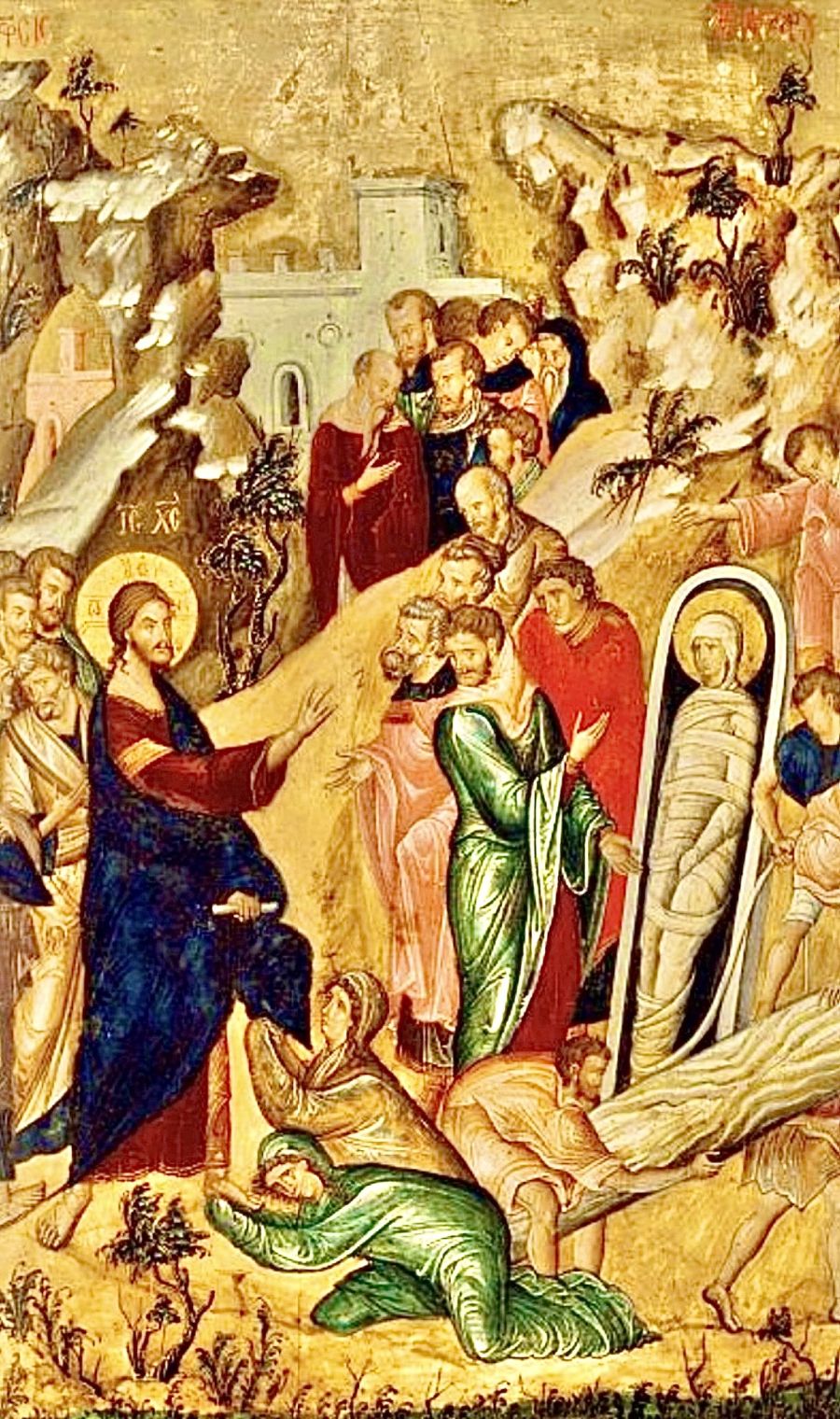
(Jn 11:1-45)


The event of death is disconcerting, and that of a friend of God in community [Bethany] perhaps accentuates the questions about the meaning of our belief and commit ourselves thoroughly.

Why in the time of greatest need does the Lord let us fall? Why does He seem not to be there (v.21)?

Letting even His dearest friends die, Jesus educates us: it is not His intention to procrastinate biological existence (vv.14-15), nor simply improve it a little.

“Eternal” [in the Gospels, the very Life of the Eternal: Zoe aiònios] is not this form of life [in the Gospels: Bìos - possibly strengthened] but only its times of strong love.

Ultimate World does not interfere with the natural course.

For this reason the Lord does not enter the “village” where others went to console and give condolences.

He wants Mary to leave the house where everyone cries in despair and mourns funeral - as if everything was over.

He intends to get us out of the “small hamlet” where it is believed that the earthly end can be only delayed, until the tomb without a future.

The natural emotion for detachment does not hold back tears, which spontaneously «flow from the eyes, sliding down» [dakryein-edakrysen].

Intimate upheaval does not produce a broken and screamed cry [klaiein] as the inconsolable one of the Jews (vv.33.35).

No farewell. For this reason, it follows the order to remove the stone that at that time closed the tombs (v.39).

The strong Call is absolutely imperative: the ‘deceased’ ones are not ‘dead’ ones, as ancient religions believed; their lives goes on.


«Lazarus, out here!» (v.43): it is the cry of the victory of life. 

In the adventure of Faith in Christ we discover that life has no stones on it. Enough, mourning the deadly situations, and the "dead ones"!

The Appeal that the Lord makes is that there is no disappeared souls’ world, separated from us; stand-alone, devoid of communication with the actual one.

Archaic beliefs imagined Hades or Sheôl as a dark, fog-soaked cavern, populated here and there by insubstantial wandering larvae.

On the contrary, the world of the living ones is not separated from that of the ‘deceased’ ones.

«Lazarus is asleep» (v.11), that is: he is not a fallen, because men do not die. They pass from the creaturely life [bìos] to full Life [Zoe].

The ‘deceased’ left this world and entered the world of God, re-Born and begotten to his authentic, complete and definitive being.

Then: «Untie him and let him go!».

In short, Lazarus did not simply end up in the pit, nor, having been well put back on his feet by Christ, did he reappear in this form of life for another stretch... inexorably marked by the limit.

In the Gospel passage, in fact, while everyone goes to Jesus, Lazarus does not.

It is not this not what Jesus can do in the face of death. He does not immortalize this condition, otherwise all existence would continue to be a useless escape from the decisive appointment.

And it is time to stop crying our loved ones: «deceased», not ‘dead’.

We must not hold them back with obsessive visits, tormented memories, talismans, condolences: let them exist happily in their new condition!

Life for us and Life for those who have already flourished in the world of God's Peace - where we will live fully: with each other and for each other.


[5th ​​Sunday of Lent (year A), March 22, 2026]

350 Last modified on Sunday, 22 March 2026 12:01
don Giuseppe Nespeca

Giuseppe Nespeca è architetto e sacerdote. Cultore della Sacra scrittura è autore della raccolta "Due Fuochi due Vie - Religione e Fede, Vangeli e Tao"; coautore del libro "Dialogo e Solstizio".

Those wounds that, in the beginning were an obstacle for Thomas’s faith, being a sign of Jesus’ apparent failure, those same wounds have become in his encounter with the Risen One, signs of a victorious love. These wounds that Christ has received for love of us help us to understand who God is and to repeat: “My Lord and my God!” Only a God who loves us to the extent of taking upon himself our wounds and our pain, especially innocent suffering, is worthy of faith (Pope Benedict)
Quelle piaghe, che per Tommaso erano dapprima un ostacolo alla fede, perché segni dell’apparente fallimento di Gesù; quelle stesse piaghe sono diventate, nell’incontro con il Risorto, prove di un amore vittorioso. Queste piaghe che Cristo ha contratto per amore nostro ci aiutano a capire chi è Dio e a ripetere anche noi: “Mio Signore e mio Dio”. Solo un Dio che ci ama fino a prendere su di sé le nostre ferite e il nostro dolore, soprattutto quello innocente, è degno di fede (Papa Benedetto)
We see that the disciples are still closed in their thinking […] How does Jesus answer? He answers by broadening their horizons […] and he confers upon them the task of bearing witness to him all over the world, transcending the cultural and religious confines within which they were accustomed to think and live (Pope Benedict)
Vediamo che i discepoli sono ancora chiusi nella loro visione […] E come risponde Gesù? Risponde aprendo i loro orizzonti […] e conferisce loro l’incarico di testimoniarlo in tutto il mondo oltrepassando i confini culturali e religiosi entro cui erano abituati a pensare e a vivere (Papa Benedetto)
The Fathers made a very significant commentary on this singular task. This is what they say: for a fish, created for water, it is fatal to be taken out of the sea, to be removed from its vital element to serve as human food. But in the mission of a fisher of men, the reverse is true. We are living in alienation, in the salt waters of suffering and death; in a sea of darkness without light. The net of the Gospel pulls us out of the waters of death and brings us into the splendour of God’s light, into true life (Pope Benedict)
I Padri […] dicono così: per il pesce, creato per l’acqua, è mortale essere tirato fuori dal mare. Esso viene sottratto al suo elemento vitale per servire di nutrimento all’uomo. Ma nella missione del pescatore di uomini avviene il contrario. Noi uomini viviamo alienati, nelle acque salate della sofferenza e della morte; in un mare di oscurità senza luce. La rete del Vangelo ci tira fuori dalle acque della morte e ci porta nello splendore della luce di Dio, nella vera vita (Papa Benedetto)
There is the path of those who, like those two on the outbound journey, allow themselves to be paralysed by life’s disappointments and proceed sadly; and there is the path of those who do not put themselves and their problems first, but rather Jesus who visits us, and the brothers who await his visit (Pope Francis)
C’è la via di chi, come quei due all’andata, si lascia paralizzare dalle delusioni della vita e va avanti triste; e c’è la via di chi non mette al primo posto se stesso e i suoi problemi, ma Gesù che ci visita, e i fratelli che attendono la sua visita (Papa Francesco)
So that Christians may properly carry out this mandate entrusted to them, it is indispensable that they have a personal encounter with Christ, crucified and risen, and let the power of his love transform them. When this happens, sadness changes to joy and fear gives way to missionary enthusiasm (John Paul II)
Perché i cristiani possano compiere appieno questo mandato loro affidato, è indispensabile che incontrino personalmente il Crocifisso risorto, e si lascino trasformare dalla potenza del suo amore. Quando questo avviene, la tristezza si muta in gioia, il timore cede il passo all’ardore missionario (Giovanni Paolo II)

Due Fuochi due Vie - Vol. 1 Due Fuochi due Vie - Vol. 2 Due Fuochi due Vie - Vol. 3 Due Fuochi due Vie - Vol. 4 Due Fuochi due Vie - Vol. 5 Dialogo e Solstizio I fiammiferi di Maria

duevie.art

don Giuseppe Nespeca

Tel. 333-1329741


Disclaimer

Questo blog non rappresenta una testata giornalistica in quanto viene aggiornato senza alcuna periodicità. Non può pertanto considerarsi un prodotto editoriale ai sensi della legge N°62 del 07/03/2001.
Le immagini sono tratte da internet, ma se il loro uso violasse diritti d'autore, lo si comunichi all'autore del blog che provvederà alla loro pronta rimozione.
L'autore dichiara di non essere responsabile dei commenti lasciati nei post. Eventuali commenti dei lettori, lesivi dell'immagine o dell'onorabilità di persone terze, il cui contenuto fosse ritenuto non idoneo alla pubblicazione verranno insindacabilmente rimossi.






