Mar 9, 2026 Written by 

Vain water, and the true Source

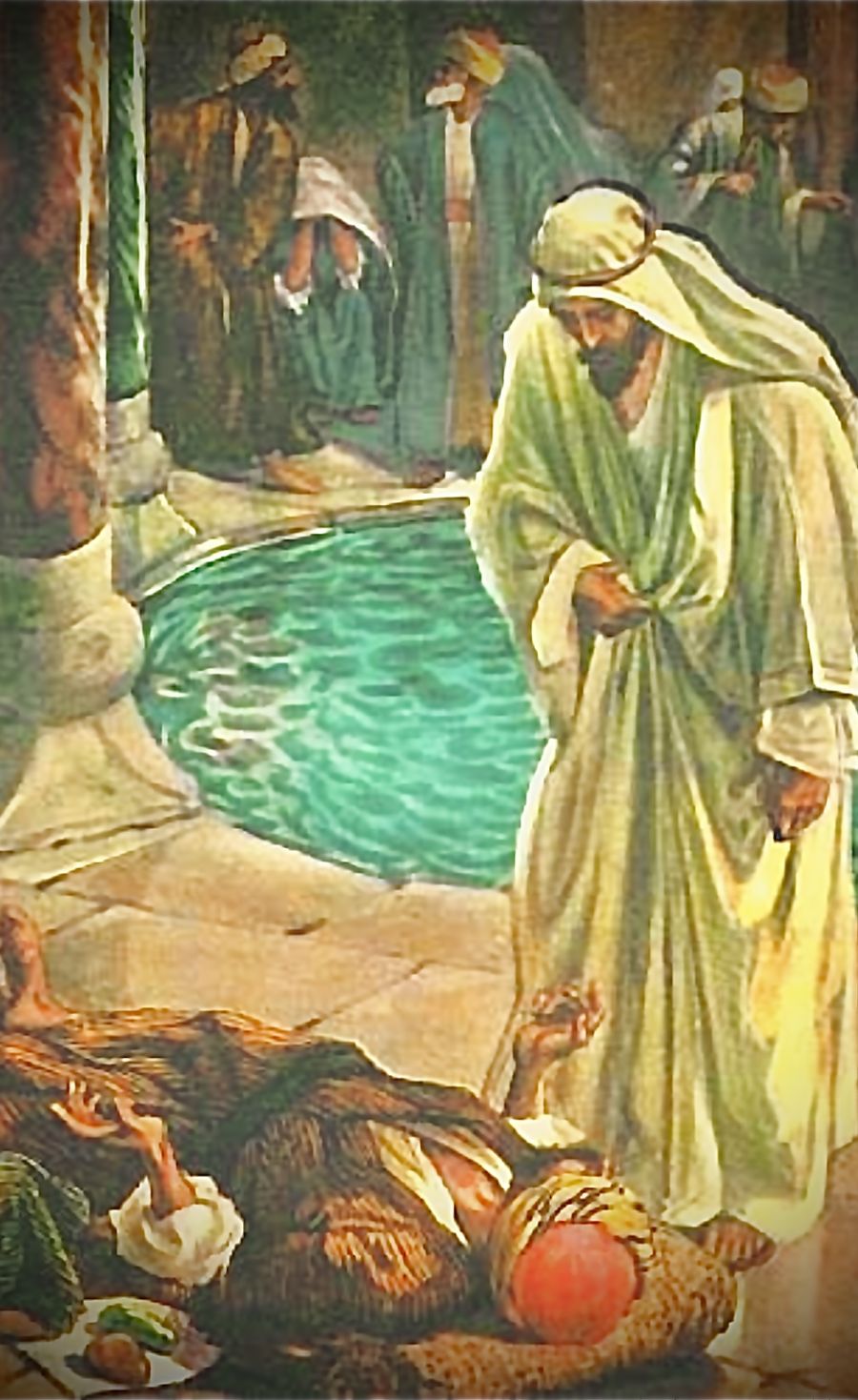
(Jn 5:1-3.5-16)


In the ‘devotion’ of competitive trophies, only the quickest heals, not the neediest.

Jesus prefers to transgress the law than to align himself with the merciless world that marginalizes the wretched.


In the holy places the cult of sacrifices required a lot of water [for the animals to be washed, then slaughtered], especially in the great feasts.

Large cisterns collected rainwater, and public baths agglomerated the sick waiting for help or recovery.

The pools outside were used to clean the lambs before the sacrifice to the Temple, and this old practise gave the water itself an aura of healing sanctity.

Many sick people flocked to bathe in the «motion of the water» [v.3: perhaps due to an intermittent source].

It was said that an angel stirred the waters of the popular baths and that the first person to enter them in the one moment the same waters became restless would be healed.

Symbol of a religion that offers false hopes to the excluded masses. 

Vain expectations attracted the imagination of the sick who did not know the man-God of their destiny.

«But he who had been healed did not know who He was, because Jesus had gone away, there being crowd in that place» (v.13).

The Face of the Son is unrecognisable in the masses pressing around, which is only distracting and content with habitual, exaggeratedly solemn forms.


Abundant conducts purified the Temple and neglected the people. The water flowed, but did not cure anyone - on the contrary, it made the situation worse.

An icon of a rich and miserable religiosity: vain, useless, harmful; that abandons those it is called upon to support.

Scribes taught the law to students in the sacred precincts, and the rabbis received clients under Solomon's porch: at the top the Torah and its trade, at the bottom and outside - close by - the treachery of the poor.

Official institution kept the unsteady at a safe distance, revealing only a ridiculous and brutal caricature of the Father's friendly, hospitable and sympathetic Face.

Crowd of the needy who were given ‘magic’ water [only randomly and by surprise] is a parable of destitute humanity, dramatically lacking everything - even genuine spiritual comfort.

On the other hand, Jesus approaches them on his own initiative (vv. 6.14).

And gets involved - at the risk of his life - with those who are most alone, awkward and clumsy; unables even to receive miracles.


We are ‘sent’ not to deserving and self-sufficient, but to those who are not able to use their ownn means to come forward.

Christ himself does not work in order to be recognized and acclaimed: «He had gone away» (v,13). Nor does He care for us, only to trigger a religious conversion.

He heals by perceiving the need, not so that the sick person ‘believes in God’.

We leave people free to go through their seasons, not stereotypes.

We enter the heart of Lent.


[Tuesday 4th wk. in Lent, March 17, 2026]

550 Last modified on Tuesday, 17 March 2026 12:00
don Giuseppe Nespeca

Giuseppe Nespeca è architetto e sacerdote. Cultore della Sacra scrittura è autore della raccolta "Due Fuochi due Vie - Religione e Fede, Vangeli e Tao"; coautore del libro "Dialogo e Solstizio".

There is the path of those who, like those two on the outbound journey, allow themselves to be paralysed by life’s disappointments and proceed sadly; and there is the path of those who do not put themselves and their problems first, but rather Jesus who visits us, and the brothers who await his visit (Pope Francis)
C’è la via di chi, come quei due all’andata, si lascia paralizzare dalle delusioni della vita e va avanti triste; e c’è la via di chi non mette al primo posto se stesso e i suoi problemi, ma Gesù che ci visita, e i fratelli che attendono la sua visita (Papa Francesco)
So that Christians may properly carry out this mandate entrusted to them, it is indispensable that they have a personal encounter with Christ, crucified and risen, and let the power of his love transform them. When this happens, sadness changes to joy and fear gives way to missionary enthusiasm (John Paul II)
Perché i cristiani possano compiere appieno questo mandato loro affidato, è indispensabile che incontrino personalmente il Crocifisso risorto, e si lascino trasformare dalla potenza del suo amore. Quando questo avviene, la tristezza si muta in gioia, il timore cede il passo all’ardore missionario (Giovanni Paolo II)
This is the message that Christians are called to spread to the very ends of the earth. The Christian faith, as we know, is not born from the acceptance of a doctrine but from an encounter with a Person (Pope Benedict)
È questo il messaggio che i cristiani sono chiamati a diffondere sino agli estremi confini del mondo. La fede cristiana come sappiamo nasce non dall'accoglienza di una dottrina, ma dall'incontro con una Persona (Papa Benedetto)
From ancient times the liturgy of Easter day has begun with the words: Resurrexi et adhuc tecum sum – I arose, and am still with you; you have set your hand upon me. The liturgy sees these as the first words spoken by the Son to the Father after his resurrection, after his return from the night of death into the world of the living. The hand of the Father upheld him even on that night, and thus he could rise again (Pope Benedict)
Dai tempi più antichi la liturgia del giorno di Pasqua comincia con le parole: Resurrexi et adhuc tecum sum – sono risorto e sono sempre con te; tu hai posto su di me la tua mano. La liturgia vi vede la prima parola del Figlio rivolta al Padre dopo la risurrezione, dopo il ritorno dalla notte della morte nel mondo dei viventi. La mano del Padre lo ha sorretto anche in questa notte, e così Egli ha potuto rialzarsi, risorgere (Papa Benedetto)
The Church keeps watch. And the world keeps watch. The hour of Christ's victory over death is the greatest hour in history (John Paul II)
Veglia la Chiesa. E veglia il mondo. L’ora della vittoria di Cristo sulla morte è l’ora più grande della storia (Giovanni Paolo II)
Before the Cross of Jesus, we apprehend in a way that we can almost touch with our hands how much we are eternally loved; before the Cross we feel that we are “children” and not “things” or “objects” [Pope Francis, via Crucis at the Colosseum 2014]
We may ask ourselves: who is a witness? A witness is a person who has seen, who recalls and tells. See, recall and tell: these are three verbs which describe the identity and mission (Pope Francis, Regina Coeli April 19, 2015)
Possiamo domandarci: ma chi è il testimone? Il testimone è uno che ha visto, che ricorda e racconta. Vedere, ricordare e raccontare sono i tre verbi che ne descrivono l’identità e la missione (Papa Francesco, Regina Coeli 19 aprile 2015)

Due Fuochi due Vie - Vol. 1 Due Fuochi due Vie - Vol. 2 Due Fuochi due Vie - Vol. 3 Due Fuochi due Vie - Vol. 4 Due Fuochi due Vie - Vol. 5 Dialogo e Solstizio I fiammiferi di Maria

duevie.art

don Giuseppe Nespeca

Tel. 333-1329741


Disclaimer

Questo blog non rappresenta una testata giornalistica in quanto viene aggiornato senza alcuna periodicità. Non può pertanto considerarsi un prodotto editoriale ai sensi della legge N°62 del 07/03/2001.
Le immagini sono tratte da internet, ma se il loro uso violasse diritti d'autore, lo si comunichi all'autore del blog che provvederà alla loro pronta rimozione.
L'autore dichiara di non essere responsabile dei commenti lasciati nei post. Eventuali commenti dei lettori, lesivi dell'immagine o dell'onorabilità di persone terze, il cui contenuto fosse ritenuto non idoneo alla pubblicazione verranno insindacabilmente rimossi.






