Nov 25, 2025 Written by 

The simple Mystery (Eucharistic)

Multiplication by Division, in itinerancy

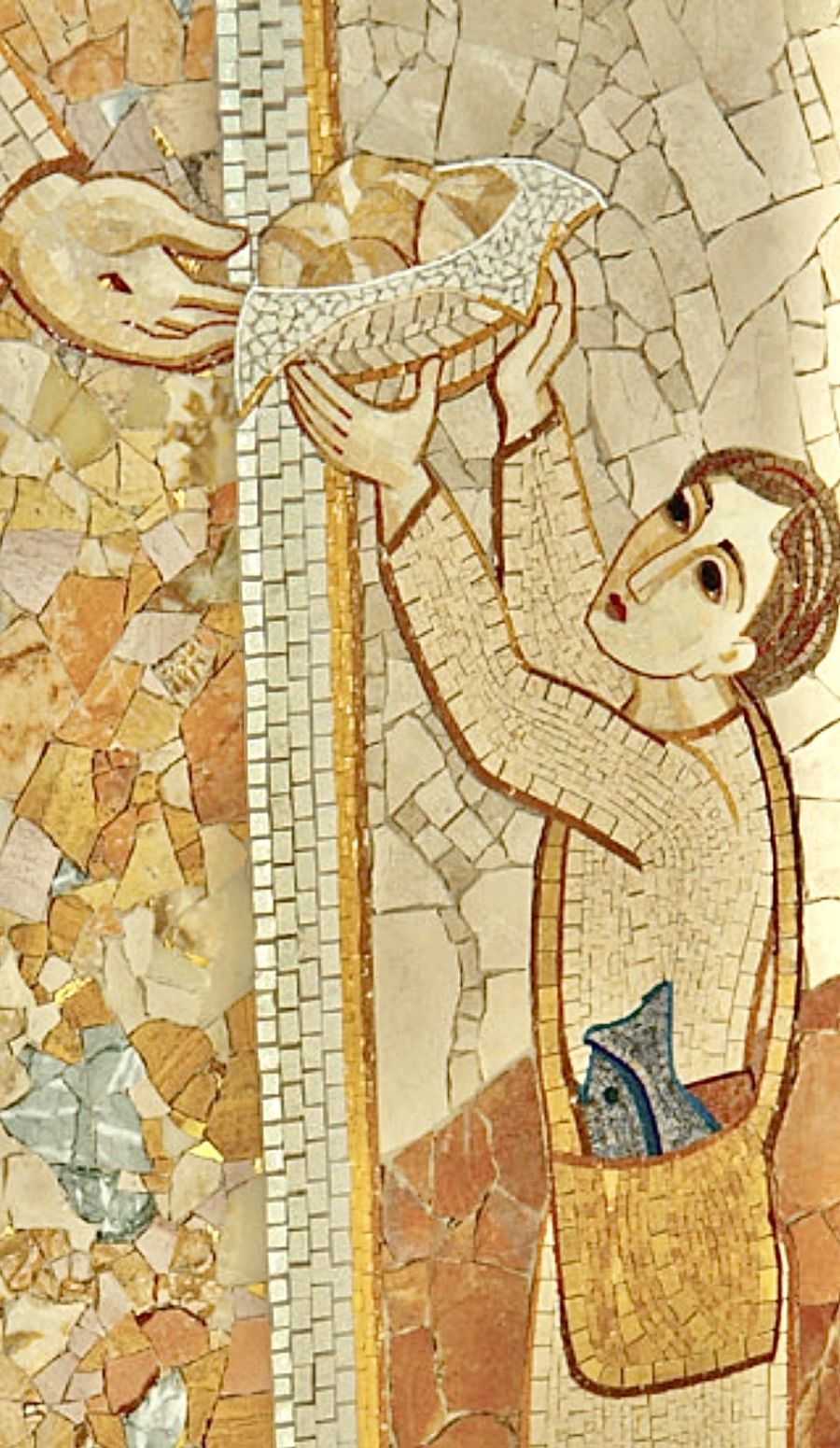
(Mt 15:29-37)


«Man is a limited being who is himself limitless» (Fratelli Tutti n.150).

The Son reflects God's plan in compassion for the needy crowds (v.32).

However, His solution does not fly over us simply drying tears or erasing humiliations.

He invites us to use what we have, although it may seem ridiculous. But teaches that shifting energies creates prodigious results.

This is how we respond in Christ to the world's great problems: by recovering the condition of the 'viator' man - a being of passage, his essential mark - and sharing goods.

Our real nakedness, the vicissitudes and experiences of our many brothers and sisters, who are different, are resources not to be evaluated with distrust, «as competitors or dangerous enemies» of our realisation (FT n.151).

Not only will the little we take with us be enough to satiate us, but it will advance for others and with identical fullness of truth, human, epochal (vv.34.37).


In Mt Jesus is the new Moses who ascends 'the Mount', but to inaugurate an alternative Time, which marks true history; of authentic relationships.

People no longer stay at the bottom of the valley waiting: they gather around Him, coming as they are, with the burden of so many different needs.

The new people of God are not a settled crowd, of the elect, of chosen, and pure.

Everyone brings with them their own path, their own troubles and problems, which the Lord cures - healing not with a solution from above or from without.

In short: another world is possible, but only through breaking one's own [even miserable] 'bread'.

Wise, unbroken, effective solution... if one brings it out from 'within', and on the way - and standing «in the midst» - not in front, not at the head, not “above” (v.36).

The place of God's revelation was to be that of lightning, on a 'mountain' steaming like a furnace (Ex 19:18)... but finally even Elijah's violent zeal had to change mind (1 Kings 19:12).


Even to the pagans, the Son reveals a Father who does not simply erase infirmities, but makes them understood as a place that is preparing personal development, and that of the Community.

It was imagined that in the time of the Messiah, the lame, the deaf and the blind would disappear (Is 35:5ff.). «Golden age»: everything at the top, no abyss.

In Jesus - distributed Bread - an unusual fullness of time is manifested, seemingly nebulous and fragile, but concrete and able to reboot people and relationships.

The Incarnation reweaves our hearts, in dignity and promotion; and it truly unfolds, because it not only drags obstacles away, but builds on them.

And it doesn't erase them at all: it surpasses them, but transmutes them - bringing new life.

Lymph that draws juice and sprouts Flowers from the one muddy, fertile soil, and communicates them.

Solidarity to whom everyone is invited, not only those considered in a condition of perfection and compactness.


Our shortcomings make us attentive, and unique. They are not to be despised, but assumed; they are to be placed in the Son's hands and energised (v.36).

Falls themselves can be a valuable sign: in Christ, they are no longer reductive humiliations, but path markers.

Perhaps we are not utilising and investing our resources in the best possible way.

So slumps can quickly turn into [different, unpackaged] upturns.


[Wednesday 1st wk. in Advent, December 3, 2025]

233 Last modified on Wednesday, 03 December 2025 12:05
don Giuseppe Nespeca

Giuseppe Nespeca è architetto e sacerdote. Cultore della Sacra scrittura è autore della raccolta "Due Fuochi due Vie - Religione e Fede, Vangeli e Tao"; coautore del libro "Dialogo e Solstizio".

Thousands of Christians throughout the world begin the day by singing: “Blessed be the Lord” and end it by proclaiming “the greatness of the Lord, for he has looked with favour on his lowly servant” (Pope Francis)
Migliaia di cristiani in tutto il mondo cominciano la giornata cantando: “Benedetto il Signore” e la concludono “proclamando la sua grandezza perché ha guardato con bontà l’umiltà della sua serva” (Papa Francesco)
The new Creation announced in the suburbs invests the ancient territory, which still hesitates. We too, accepting different horizons than expected, allow the divine soul of the history of salvation to visit us
La nuova Creazione annunciata in periferia investe il territorio antico, che ancora tergiversa. Anche noi, accettando orizzonti differenti dal previsto, consentiamo all’anima divina della storia della salvezza di farci visita
Luke the Evangelist of the Poor celebrates the reversals of the situation: pharisee and tax collector, prodigal son and firstborn, samaritan and priest-levite, Lazarus and rich man, first and last place, Beatitudes and “woe to you”... so in the anthem of the Magnificat
Luca evangelista dei poveri celebra i ribaltamenti di situazione: fariseo e pubblicano, figlio prodigo e primogenito, samaritano e sacerdote-levita, Lazzaro e ricco epulone, primo e ultimo posto, Beatitudini e “guai”... così nell’inno del Magnificat
In these words we find the core of biblical truth about St. Joseph; they refer to that moment in his life to which the Fathers of the Church make special reference (Redemtoris Custos n.2)
In queste parole è racchiuso il nucleo centrale della verità biblica su san Giuseppe, il momento della sua esistenza a cui in particolare si riferiscono i padri della Chiesa (Redemtoris Custos n.2)
The ancient priest stagnates, and evaluates based on categories of possibilities; reluctant to the Spirit who moves situations
Il sacerdote antico ristagna, e valuta basando su categorie di possibilità; riluttante allo Spirito che smuove le situazioni
«Even through Joseph’s fears, God’s will, his history and his plan were at work. Joseph, then, teaches us that faith in God includes believing that he can work even through our fears, our frailties and our weaknesses. He also teaches us that amid the tempests of life, we must never be afraid to let the Lord steer our course. At times, we want to be in complete control, yet God always sees the bigger picture» (Patris Corde, n.2)
«Anche attraverso l’angustia di Giuseppe passa la volontà di Dio, la sua storia, il suo progetto. Giuseppe ci insegna così che avere fede in Dio comprende pure il credere che Egli può operare anche attraverso le nostre paure, le nostre fragilità, la nostra debolezza. E ci insegna che, in mezzo alle tempeste della vita, non dobbiamo temere di lasciare a Dio il timone della nostra barca. A volte noi vorremmo controllare tutto, ma Lui ha sempre uno sguardo più grande» (Patris Corde, n.2)
Man is the surname of God: the Lord in fact takes his name from each of us - whether we are saints or sinners - to make him our surname (Pope Francis). God's fidelity to the Promise is realized not only through men, but with them (Pope Benedict).
L’uomo è il cognome di Dio: il Signore infatti prende il nome da ognuno di noi — sia che siamo santi, sia che siamo peccatori — per farlo diventare il proprio cognome (Papa Francesco). La fedeltà di Dio alla Promessa si attua non soltanto mediante gli uomini, ma con loro (Papa Benedetto)

Due Fuochi due Vie - Vol. 1 Due Fuochi due Vie - Vol. 2 Due Fuochi due Vie - Vol. 3 Due Fuochi due Vie - Vol. 4 Due Fuochi due Vie - Vol. 5 Dialogo e Solstizio I fiammiferi di Maria

duevie.art

don Giuseppe Nespeca

Tel. 333-1329741


Disclaimer

Questo blog non rappresenta una testata giornalistica in quanto viene aggiornato senza alcuna periodicità. Non può pertanto considerarsi un prodotto editoriale ai sensi della legge N°62 del 07/03/2001.
Le immagini sono tratte da internet, ma se il loro uso violasse diritti d'autore, lo si comunichi all'autore del blog che provvederà alla loro pronta rimozione.
L'autore dichiara di non essere responsabile dei commenti lasciati nei post. Eventuali commenti dei lettori, lesivi dell'immagine o dell'onorabilità di persone terze, il cui contenuto fosse ritenuto non idoneo alla pubblicazione verranno insindacabilmente rimossi.






