Mar 22, 2026 Written by 

Clandestine Jesus, opportunist Judas, original Mary

Allied Sign. Enchanting Path

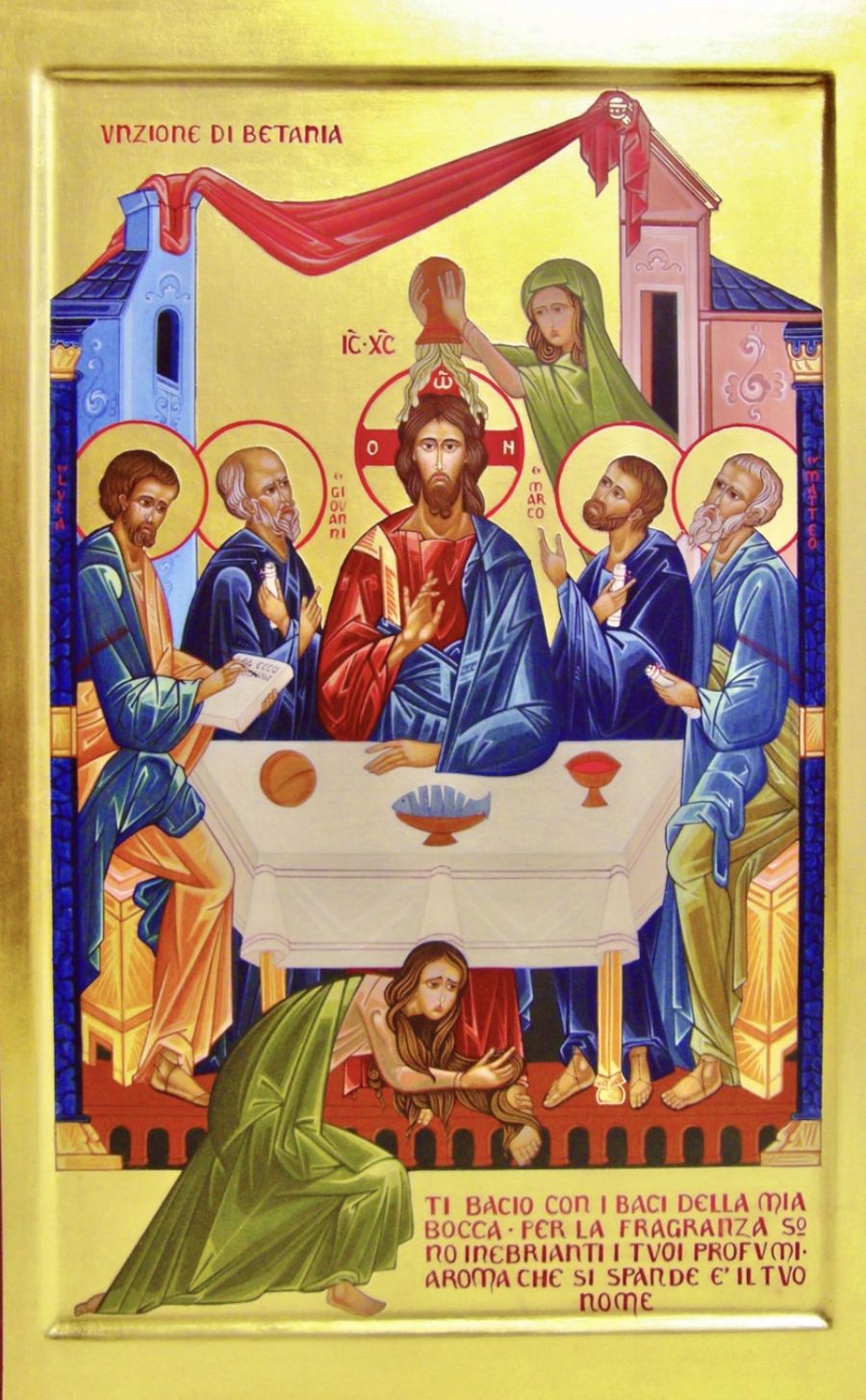
(Jn 12:1-11)


As he approaches his 'hour', Christ seems to lose his official features and becomes more and more intimate, within our reach.

His dialogue with men is more interwoven with silent gestures than words.

After yesterday's public day, it is in this way that Jesus makes himself present in the community of family members with no leaders; of brothers and sisters only.

Lord and Master without fuss or triumphs; rather, wanted and forced into hiding.

He is welcomed into a quiet House, that leaves room for emotions, even though an arrest warrant was pending on him.

Church where you can enjoy an air of peace, despite the lack of security - and contrary situations around.

This is how the poor Johannine communities of Asia Minor lived under Domitian - destitute and subtracted from the outward glory, from the hosanna of the crowds. But capable ones of healing both tensions and resistances.

They were small «listening» realities, full of a desire for communion and respectful.

Without too much pressures, they guided the energies in more natural directions. As happens among a few friends.

Climate of conversation and face to face, of wonderfully human and daily life that wants to find a place in us. Where the lesser and unsteady still refresh the Master with delicate homages.

In sharing and mutual understanding, the tiny fraternities made one startle just with daily joy and ‘new life’, transmitted to those who came from all the districts.

They were experiencing Love in simplicity. Empathy that made anyone overcome difficulties and fears.

Friendship that stirred and drew by attraction - in gestures of tender devotion, that released each from attitudes and behaviour that demeaned spontaneity.

Here is the Breaking of Bread: a priceless gesture, beyond social conventions; convincing, because an ‘allied’ free sign.

It did not reject the genuine nature of each person. The Eucharist was not an exclusive fortress.


Even today we can - like Mary - without too much calculation, «anoint the feet» of the Lord: celebrate the Gift of a Way.

The faithful were understanding that their best part could be recognized not in a model circle, but [in purest state] in people with tired feet, and in the Person of that First Coming One always about to depart - by abiding within him.

It meant serving and recognizing oneself, assimilating and consecrating one's own personal journey in that overall one of the Son of God, who became very human and divine Presence, which fills and convinces.

Christ's long Journey is a trace of the ours: from the Father's initiative to the sons’ ability to welcome him, cherish him, venerate him, correspond to him - by simply getting closer to the Roots - and not reject him, if “a loser”.

Here is the homage of friendship.

Only this fills the House of Bethany - the Church that is worth experiencing - with the fragrance of the total and living Christ, and ‘reveals’ him.

Jesus defends the right of love «from within» to express itself freely: where everything becomes possible - even the waste of Gratuitousness that does not weigh the pros and cons.

Without one-sided cunnings, therefore not ruining authentic life and all inner rebirths.


[Holy Monday, March 30, 2026]

23 Last modified on Sunday, 22 March 2026 04:37
don Giuseppe Nespeca

Giuseppe Nespeca è architetto e sacerdote. Cultore della Sacra scrittura è autore della raccolta "Due Fuochi due Vie - Religione e Fede, Vangeli e Tao"; coautore del libro "Dialogo e Solstizio".

If, in his prophecy about the shepherd, Ezekiel was aiming to restore unity among the dispersed tribes of Israel (cf. Ez 34: 22-24), here it is a question not only of the unification of a dispersed Israel but of the unification of all the children of God, of humanity - of the Church of Jews and of pagans [Pope Benedict]
Se Ezechiele nella sua profezia sul pastore aveva di mira il ripristino dell'unità tra le tribù disperse d'Israele (cfr Ez 34, 22-24), si tratta ora non solo più dell'unificazione dell'Israele disperso, ma dell'unificazione di tutti i figli di Dio, dell'umanità - della Chiesa di giudei e di pagani [Papa Benedetto]
St Teresa of Avila wrote: «the last thing we should do is to withdraw from our greatest good and blessing, which is the most sacred humanity of Our Lord Jesus Christ» (cf. The Interior Castle, 6, ch. 7). Therefore, only by believing in Christ, by remaining united to him, may the disciples, among whom we too are, continue their permanent action in history [Pope Benedict]
Santa Teresa d’Avila scrive che «non dobbiamo allontanarci da ciò che costituisce tutto il nostro bene e il nostro rimedio, cioè dalla santissima umanità di nostro Signore Gesù Cristo» (Castello interiore, 7, 6). Quindi solo credendo in Cristo, rimanendo uniti a Lui, i discepoli, tra i quali siamo anche noi, possono continuare la sua azione permanente nella storia [Papa Benedetto]
Just as he did during his earthly existence, so today the risen Jesus walks along the streets of our life and sees us immersed in our activities, with all our desires and our needs. In the midst of our everyday circumstances he continues to speak to us; he calls us to live our life with him, for only he is capable of satisfying our thirst for hope (Pope Benedict)
Come avvenne nel corso della sua esistenza terrena, anche oggi Gesù, il Risorto, passa lungo le strade della nostra vita, e ci vede immersi nelle nostre attività, con i nostri desideri e i nostri bisogni. Proprio nel quotidiano continua a rivolgerci la sua parola; ci chiama a realizzare la nostra vita con Lui, il solo capace di appagare la nostra sete di speranza (Papa Benedetto)
"Beloved" of God (cf. Lk 1: 28). Origen observes that no such title had ever been given to a human being, and that it is unparalleled in all of Sacred Scripture (cf. In Lucam 6: 7). It is a title expressed in passive form, but this "passivity" of Mary, who has always been and is for ever "loved" by the Lord, implies her free consent, her personal and original response:  in being loved, in receiving the gift of God, Mary is fully active, because she accepts with personal generosity the wave of God's love poured out upon her [Pope Benedict]
"Amata" da Dio (cfr Lc 1,28). Origene osserva che mai un simile titolo fu rivolto ad essere umano, e che esso non trova riscontro in tutta la Sacra Scrittura (cfr In Lucam 6,7). E’ un titolo espresso in forma passiva, ma questa "passività" di Maria, che da sempre e per sempre è l’"amata" dal Signore, implica il suo libero consenso, la sua personale e originale risposta: nell’essere amata, nel ricevere il dono di Dio, Maria è pienamente attiva, perché accoglie con personale disponibilità l’onda dell’amore di Dio che si riversa in lei [Papa Benedetto]
We are here touching the heart of the problem. In Holy Scripture and according to the evangelical categories, "alms" means in the first place an interior gift. It means the attitude of opening "to the other" (John Paul II)
Qui tocchiamo il nucleo centrale del problema. Nella Sacra Scrittura e secondo le categorie evangeliche, “elemosina” significa anzitutto dono interiore. Significa l’atteggiamento di apertura “verso l’altro” (Giovanni Paolo II)

Due Fuochi due Vie - Vol. 1 Due Fuochi due Vie - Vol. 2 Due Fuochi due Vie - Vol. 3 Due Fuochi due Vie - Vol. 4 Due Fuochi due Vie - Vol. 5 Dialogo e Solstizio I fiammiferi di Maria

duevie.art

don Giuseppe Nespeca

Tel. 333-1329741


Disclaimer

Questo blog non rappresenta una testata giornalistica in quanto viene aggiornato senza alcuna periodicità. Non può pertanto considerarsi un prodotto editoriale ai sensi della legge N°62 del 07/03/2001.
Le immagini sono tratte da internet, ma se il loro uso violasse diritti d'autore, lo si comunichi all'autore del blog che provvederà alla loro pronta rimozione.
L'autore dichiara di non essere responsabile dei commenti lasciati nei post. Eventuali commenti dei lettori, lesivi dell'immagine o dell'onorabilità di persone terze, il cui contenuto fosse ritenuto non idoneo alla pubblicazione verranno insindacabilmente rimossi.






