


don Giuseppe Nespeca
Giuseppe Nespeca è architetto e sacerdote. Cultore della Sacra scrittura è autore della raccolta "Due Fuochi due Vie - Religione e Fede, Vangeli e Tao"; coautore del libro "Dialogo e Solstizio".
Jesus came to Liberate, with God's Finger
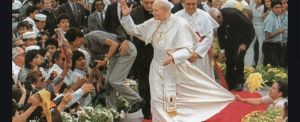
Fighting personal sin and "sin structures”
Dear Brothers and Sisters,
1. As we continue our reflection on conversion, sustained by the certainty of the Father's love, today we will focus our attention on the meaning of sin, both personal and social.
Let us first look at Jesus' attitude, since he came to deliver mankind from sin and from Satan's influence.
The New Testament strongly emphasizes Jesus' authority over demons, which he cast out "by the finger of God" (Lk11: 20). In the Gospel perspective, the deliverance of those possessed by demons (cf. Mk 5: 1-20) acquires a broader meaning than mere physical healing in that the physical ailment is seen in relation to an interior one. The disease from which Jesus sets people free is primarily that of sin. Jesus himself explains this when he heals the paralytic: ""That you may know that the Son of man has authority on earth to forgive sins' he said to the paralytic "I say to you, rise, take up your pallet and go home'" (Mk 2: 10-11). Even before working cures, Jesus had already conquered sin by overcoming the "temptations" which the devil presented to him during the time he spent in the wilderness after being baptized by John (cf. Mk 1: 12-13); Mt 4: 1-11; Lk 4: 1-13).
To fight the sin that lurks in us and around us, we must follow in Jesus' footsteps and learn the sense of his constant "yes" to the Father's plan of love. This "yes" demands our total commitment, but we would not be able to say it without the help of that grace which Jesus himself obtained for us by his work of redemption.
2. Now, looking at the world today we have to admit that there is a marked decline in the consciousness of sin. Because of widespread religious indifference or the rejection of all that right reason and Revelation tell us about God, many men and women lack a sense of God's Covenant and of his commandments. All too often the human sense of responsibility is blurred by a claim to absolute freedom, which it considers threatened and compromised by God, the supreme legislator.
The current tragic situation, which seems to have foresaken certain fundamental moral values, is largely due to the loss of the sense of sin. This fact makes us aware of the great distance to be covered by the new evangelization. Consciences must recover the sense of God, of his mercy, of the gratuitousness of his gifts to be able to recognize the gravity of sin which sets man against his Creator. Personal freedom should be recognized and defended as a precious gift of God, resisting the tendency to lose it in the structures of social conditioning or to remove it from its inalienable reference to the Creator.
3. It is also true that personal sin always has a social impact. While he offends God and harms himself, the sinner also becomes responsible for the bad example and negative influences linked to his behaviour. Even when the sin is interior, it still causes a worsening of the human condition and diminishes that contribution which every person is called to make to the spiritual progress of the human community.
In addition to all this, the sins of individuals strengthen those forms of social sin which are actually the fruit of an accumulation of many personal sins. Obviously the real responsibility lies with individuals, given that the social structure as such is not the subject of moral acts. As the Post-Synodal Apostolic Exhortation Reconciliatio et Paenitentia recalls: "Whenever the Church speaks of situations of sin, or when she condemns as social sins certain situations or the collective behaviour of certain social groups, big or small, or even of whole nations and blocs of nations, she knows and she proclaims that such cases of social sin are the result of the accumulation and concentration of many personal sins.... The real responsibility, then, lies with individuals" (n. 16).
It is nevertheless an indisputable fact, as I have often pointed out, that the interdependence of social, economic and political systems creates multiple structures of sin in today's world. (cf. Sollicitudo rei socialis, n. 36; Catechism of the Catholic Church, n. 1869). Evil exerts a frightening power of attraction which causes many types of behaviour to be judged "normal" and "inevitable". Evil then grows, having devastating effects on consciences, which become confused and even incapable of discernment. If one then thinks of the structures of sin that hinder the development of the peoples most disadvantaged from the economic and political standpoint (cf. Sollicitudo rei socialis, n. 37), one might almost surrender in the face of a moral evil which seems inevitable. So many people feel powerless and bewildered before an overwhelming situation from which there seems no escape. But the proclamation of Christ's victory over evil gives us the certainty that even the strongest structures of evil can be overcome and replaced by "structures of good" (cf. ibid., n. 39).
4. The "new evangelization" faces this challenge. It must work to ensure that people recover the awareness that in Christ evil can be conquered with good. People must be taught a sense of personal responsibility, closely connected with moral obligations and the consciousness of sin. The path of conversion entails the exclusion of all connivance with those structures of sin which, today in particular, influence people in life's various contexts.
The Jubilee offers individuals and communities a providential opportunity to walk in this direction by promoting an authentic "metanoia", that is, a change of mentality that will help create ever more just and human structures for the benefit of the common good.
[Pope John Paul II, General Audience 25 August 1999]
Falling with anaesthesia, slow apostasy
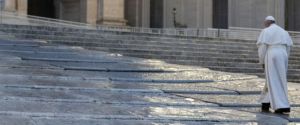
Letting oneself slip slowly into sin, relativising things and entering "into negotiation" with the gods of money, vanity and pride: from what he called a "fall with anaesthesia" the Pope warned in the homily of the Mass celebrated at Casa Santa Marta on Thursday morning, 13 February, reflecting on the story of King Solomon.
The first reading of the day's liturgy (1 Kings 11:4-13) "tells us," he began, "the apostasy, let us say, of Solomon," who was not faithful to the Lord. In fact, when he was old, his women made him "turn aside his heart" to follow other gods. He was first a 'good boy' who asked the Lord only for wisdom, and God made him wise, to the point that judges and even the Queen of Sheba, from Africa, came to him with gifts because she had heard of his wisdom. "You can see that this woman was a bit of a philosopher and asked him difficult questions," the Pontiff said, noting that "Solomon came out of these questions victorious" because he knew how to answer them.
At that time, Francis continued, one could have more than one bride, which did not mean, he explained, that it was licit to be a 'womanizer'. Solomon's heart, however, was weakened not because he had married these women - he could do so - but because he had chosen them from another people, with other gods. And Solomon therefore fell into the "trap" and allowed it when one of his wives asked him to go and worship Camos or Moloc. And so he did for all his foreign women who offered sacrifices to their gods. In a word, 'he allowed everything, he stopped worshipping the one God'. From a heart weakened by too much affection for women, 'paganism entered his life'. Therefore, Francis pointed out, that wise boy who had prayed well asking for wisdom, fell to the point of being rejected by the Lord.
"It was not an overnight apostasy, it was a slow apostasy," the Pope clarified. King David, his father, had also sinned - strongly at least twice - but immediately repented and asked for forgiveness: he had remained faithful to the Lord who kept him until the end. David wept for that sin and for the death of his son Absalom, and when he fled from him before, he humbled himself thinking of his sin, when people insulted him. "He was holy. Solomon is not holy," said the Pontiff. The Lord had given him so many gifts but he had wasted it all because he had let his heart be weakened. It is not a matter, he noted, of the 'one-time sin' but of 'slipping'.
"The women caused his heart to deviate, and the Lord rebuked him: 'You have deviated your heart'. And this happens in our lives. None of us are criminals, none of us do big sins like David did with Uriah's wife, none of us. But where is the danger? Letting yourself slip slowly because it is a fall with anaesthesia, you don't realise it, but slowly you slip, you relativise things and you lose fidelity to God," Francis remarked. "These women were from other peoples, they had other gods, and how often we forget the Lord and enter into negotiation with other gods: money, vanity, pride. But this is done slowly and if there is no grace from God, we lose everything,' he warned again.
Again the Pope recalled Psalm 105 (106) to emphasise that this mixing with the pagans and learning to act like them, means becoming worldly. "And for us this slow slide in life is towards worldliness, this is the grave sin: "Everyone does it, but yes, there is no problem, yes, really it is not the ideal, but...". These words justify us at the price of losing our allegiance to the one God. They are modern idols," Francis warned, asking us to think about "this sin of worldliness" that leads to "losing the genuine of the Gospel. The genuine of the Word of God" to "losing the love of this God who gave his life for us. You cannot be right with God and right with the devil. We all say this when we talk about a person who is a bit like this: 'This one is well with God and with the devil. He has lost faithfulness'.
And, in practice, the Pontiff continued, this means not being faithful 'neither to God nor to the devil'. Therefore, in conclusion, the Pope urged to ask the Lord for the grace to stop when one realises that the heart begins to slip. "Let us think of this sin of Solomon," he recommended, "let us think of how that wise Solomon fell, blessed by the Lord, with all the inheritances of his father David, how he fell slowly, anaesthetised towards this idolatry, towards this worldliness, and his kingdom was taken away from him.
And "let us ask the Lord," Francis concluded, "for the grace to understand when our heart begins to weaken and slip, to stop. It will be his grace and his love that will stop us if we pray to him."
[Pope Francis, St. Martha, in L'Osservatore Romano 14/02/2020]
Continuous Prayer: struggle, incessant, effective
Conscious emptiness: to fail without failing
Lk 11:1-13 (5-13)
Sometimes we put the Father in the dock, because he seems to let things go as our freedom directs them.
But his Design is not to make the world work to the perfection of old-fashioned transistors, or integrated circuits (in their respective “packages”) or “chips” [various “little bits”]...
God wants us to acquire a New Creation mentality. His Action shapes us on the Son, transforming projects, ideas, desires, words, standard behaviors.
At first, perhaps prayer may seem tinged with only requests. The more one proceeds in the experience of prayer in Christ, the less one asks.
The questions are attenuated, to the point of almost entirely ceasing - in an ever more conscious welcome, which becomes contemplation and real «union».
We do not know how long… the ‘Result’ takes over suddenly: not only certain, but disproportionate.
As extracted from a continuous incandescence process, where there are no logical networks, nor easy shortcuts.
We receive the maximum and complete Gift.
And we can host it with dignity. A new Creation in the Spirit, a different aspect.
Unusual destination - not simply one that is fantasized or well arranged [as transmitted or expected].
God allows events to take their own course, apparently distant from us; therefore prayer can take on dramatic tones and arouse irritation - as if it were an open dispute between us and Him.
But the Lord chooses not to vouch for our external dreams. He does not allow himself to be introduced into small limits.
The Eternal wants to involve us in something other than our goals, which are often too similar with what we have under our noses.
He invents expanded horizons, and makes us dialogue with our deep states, so that we give up the rigid point of view and are introduced into another kind of programs.
Reading from a totally "inadequate" point of view can open minds - and change feelings, transform us inside.
When someone believes to have understood the world… other, more intense expectations become already conditioned, which vice versa would like to invade our space.
Prayer then must be insistent, because it is like a look placed on oneself; not as we thought.
The inner eye creates a sort of clear space, inside, to welcome the Presence that does not pull the essential self of the person elsewhere.
(By dwelling for a long time in the House of our very special essence).
The conscious emptying out of the piled-up junk is as if filled by the interpersonal dialogue-Listening with the Source of being.
Our particular Seed is nestled in this Wellspring of flowing water: there the difference in face that belongs to us is as if seated and in the making.
Without the definitions and aspirations of nomenclature, in a "discharged" state but full of potential energies - our characteristic and unmistakable Plant touches the divine condition.
Through incessant dialogue with the Father in prayer, we make room for the Roots of Being, for a different fate.
This in the conscious gap of that part of us that seeks certainties, approvals.
«Continuous prayer» [incessant listening and perception] excavates and disposes of the volume of banal redundant thoughts.
In such a «space», opportunities are opened up, inner cleansing is created so that the Gift - even extravagant one - can arrive. Not second-hand.
[Thursday 27th wk. in O.T. October 8, 2026]
Continuous Prayer: a condition of grace and strength, which does not deviate
(Lk 11:5-13)
Failing without failing. Struggle: unceasing, effective, with ourselves and with God
Sometimes we put the Father in the dock, because he seems to let things go as our freedom directs them.
But his design is not to make the world work to the perfection of transistors (of yesteryear) or integrated circuits (in their respective 'packages') or 'chips' [various 'bits']...
God wants us to acquire a New Creation mindset. His Action moulds us to the Son, transforming projects, ideas, desires, words, standard behaviour.
At first, prayer may perhaps seem tinged with mere requests. The more one proceeds in the experience of prayer in the Spirit of Christ, the less one asks.
The demands diminish, until they almost cease.
Desires for accumulation, or revenge and triumph, give way to listening and perception.
The penetrating eye becomes aware of what is at hand and of the unusual - in the increasingly conscious acceptance, which becomes real contemplation and union.
We do not know how long, but the 'result' comes suddenly: not only certain, but disproportionate.
But as if extracted from a process of continuous incandescence, where there are no logical networks, no easy shortcuts.
We receive the ultimate and complete Gift. And we can host it with dignity. A new Creation in the Spirit, a different Face.
An unexpected Face - not simply the fantasised or well-arranged one (as passed on by the family or expected on the side).
God allows events to take their own course, seemingly distant from us; therefore prayer can take on dramatic overtones and provoke irritation - as if it were an open dispute between us and Him.
But He chooses not to be the guarantor of our outer dreams. He does not allow Himself to be introduced into petty limits.
He wants to involve us in more than just our goals, which often conform too much to what is right under our noses.
It invents expanded horizons, but in this labour it must be clear that we must not fail ourselves. That is, to the character of our essence and vocation.
All this, precisely by failing ourselves - that is, by surrendering the rigid point of view and dialoguing with our deepest layers.
This process shifts the conditional emphasis.
It is not that God delights in being relentlessly prayed to and bent over by the poor.
It is we who need time to meet our own souls and allow ourselves to be introduced to another kind of agenda that is not conformist and predictable.
Reading happenings according to totally 'inadequate', eccentric or excessive views, less contracted within the usual armour (and so on) can open the mind.
The expansion of the gaze increases intuition, modifies feelings, transforms, activates. It grasps other designs, opens up different horizons - with intermediate results that are already prodigious, certainly unpredictable.
When someone believes he has understood the world, he already conditions further, more intense desires that would like to invade our space.
This artificial 'nature' of spurious set-ups, external or other, blocks the itinerary towards the nature of character, the true personal call and mission.
Prayer must be insistent, because it is like a view laid upon oneself; not as we thought: authentically.
The inner eye serves to make a kind of clear, individual space within, which opens to our and others' Presence, all to be looked at (in the way that counts).
It will be the wisest, strongest and most reliable travelling companion... carrying our identity-character and not pulling the essential self of the person elsewhere.
The conscious emptying out of the piled-up junk (by ourselves or others) must be filled over time by an intensity of Relation.
Here is the interpersonal dialogue-listening with the Source of being.
In it is nested our particular Seed: there the difference of face that belongs to us is seated and in bloom.
It will be the radical depth of the relationship with our Root - perhaps lost in too many regular, even elevated or functioning expectations - that will confer another, more convincing Way.
And it will uncover the unique tendency and destination that belongs to us, for the Happiness we did not think of.
Goals, resolutions, disciplines, memories of the past, dreams of the future, searches for points of reference, habitual evaluations of possibilities, piles of merit... are sometimes ballasts.
They distract from the soil of the soul, where our grain would like to take root to become what is in the heart.
And from the kernel make one understand the proposal of Mission received - not conquered, nor possessed - so that it grants another prodigious character (not: visibility).
Often the mental and affective system recognises itself in an album of thoughts, definitions, gestures, forms, problems, titles, tasks, characters, roles and things already dead.Such a morphology of interdiction loses the authentic present, where, on the contrary, the divine Dream that completes - realising us in specificity - takes root.
So, here is the therapy of the absolute present in Listening - of non-planning; starting with each one.
This in the conscious gap of that part of us that seeks security, approval, and panders to trivialities.
Through unceasing dialogue with the Father in prayer, we make space for the roots of Being, which (in the meantime) is already filling us with views and opportunities for a different fate.
By reactivating the exploratory charge stifled in the gears, we create the right gap and start again in the Exodus.
To settle, to stop, to settle in one spot, would turn even qualitative conquests into a land of new slavery.
It would oblige us to recite and retrace milestones that have already been conquered - which conversely we are by vocation called upon to cross.
Exodus... within a springing, cosmic and identifying Relationship, singularly foundational.
Through prolonged Listening in prayer, we children acquire knowledge of the soul and the Mystery.
We dwell long in the House of our very special essence.
Thus we plant it - or root it even deeper - in order to understand it and recover it completely, clear and full.
Now freed from the destiny mapped out in a narrow environment, already marked but devoid of dreams.
When we are ready, Oneness will come into the field with a new solution, even an extravagant one.
It will give birth to what we really are, at our best - within that chaos that solves real problems. And from wave to wave it will leap to Goal.
Gone are the definitions and aspirations of nomenclature, in a kind of coming undone of ourselves - in a state of 'discharge' but full of potential energy - we will give space to the new Germ that knows best.
Already here and now our distinctive and unmistakable Plant wants to touch the divine condition.
Continuous prayer [listening and perceiving, not hovering] excavates and disposes of the volume of trivial redundant thoughts in this space.
Opportunities open up in this interstice and 'emptiness'. Inner cleansing is created so that the Gift - not second-hand - arrives.
Do we desire a decisive conversion? Do we desire the call to the totality of humanising existence, without limitations and in our uniqueness?
[Then divine action can reach anyone? Does it touch any face? And how does one not break it?].
Why not now the new beginning? Prayer and the 'new fullness' of the Spirit become for us - growing children - the milk of the soul.
Keeping Friendship alive
The Gospel [...] presents Jesus to us absorbed in prayer, a little apart from his disciples. When he had finished, one of them said to him: "Lord, teach us to pray" (Lk 11: 1). Jesus had no objection, he did not speak of strange or esoteric formulas but very simply said: "When you pray, say: "Father' ", and he taught the Our Father (cf. Lk 11: 2-4), taking it from his own prayer in which he himself spoke to God, his Father. St Luke passes the Our Father on to us in a shorter form than that found in the Gospel according to St Matthew, which has entered into common usage. We have before us the first words of Sacred Scripture that we learn in childhood. They are impressed in our memory, mould our life and accompany us to our last breath. They reveal that "we are not ready-made children of God from the start, but that we are meant to become so increasingly by growing more and more deeply in communion with Jesus. Our sonship turns out to be identical with following Christ" (Benedict XVI, Jesus of Nazareth [English translation], Doubleday, 2007, p. 138).
This prayer also accepts and expresses human material and spiritual needs: "Give us each day our daily bread; and forgive us our sins" (Lk 11: 3-4). It is precisely because of the needs and difficulties of every day that Jesus exhorts us forcefully: "I tell you, ask, and it will be given you; seek, and you will find; knock, and it will be opened to you. For every one who asks receives, and he who seeks finds, and to him who knocks it will be opened" (Lk 11: 9-10). It is not so much asking in order to satisfy our own desires as, rather, to keep a lively friendship with God who, the Gospel continues, "will give the Holy Spirit to those who ask him!" (Lk 11: 13). The ancient "Desert Fathers" experienced this, as did contemplatives of all epochs who became, through prayer, friends of God, like Abraham who begged the Lord to spare the few righteous from the destruction of the city of Sodom (cf. Gen 18: 21-32). St Teresa of Avila addressed an invitation to her sisters with the words: we must "beseech God to deliver us from these perils for ever and to keep us from all evil! And although our desire for this may not be perfect, let us strive to make the petition. What does it cost us to ask it, since we ask it of One who is so powerful?" (Cammino, 60 (34), 4, in Opere complete, Milan 1998, p. 846) [title in English: The Way of Perfection]. Every time we say the Our Father our voices mingle with the voice of the Church, for those who pray are never alone. "From the rich variety of Christian prayer as proposed by the Church, each member of the faithful should seek and find his own way, his own form of prayer... each person will, therefore, let himself be led... by the Holy Spirit, who guides him, through Christ, to the Father" (Congregation for the Doctrine of the Faith, Letter to the Bishops of the Catholic Church on some aspects of Christian meditation, 15 October 1989, n. 29; ore, 2 Jan. 1990, p. 10).
[Pope Benedict, Angelus 25 July 2010]
State of Conscience, First Front, First Apostolate
1. We are gathered again today, as we are every Sunday, for the common prayer of the Angelus. The reading from today's liturgy (17th Sunday of Ordinary Time) encourages us to reflect on prayer. "Lord, teach us to pray . . ." (Lk 11:1), says one of his disciples to Christ in the Gospel. And he answers them by recalling the example of a man, yes, an importunate man, who, finding himself in need, knocks on his friend's door even at midnight. But he gets what he asks for. Jesus, therefore, encourages us to have a similar attitude in prayer: that of ardent perseverance. He says: "Ask and it will be given to you, seek and you will find, knock and it will be opened to you . . ." (Lk 11:9).
A model of such persevering, humble and, at the same time, trusting prayer is found in the Old Testament, in Abraham, who pleads with God for the salvation of Sodom and Gomorrah, if at least ten righteous people would be found there.
2. Thus we must encourage ourselves more and more to prayer. We must often remember Christ's exhortation: 'Ask and it shall be given you, seek and you shall find, knock and it shall be opened to you'. In particular, we must remember it when we lose confidence or the will to pray.
We must also always relearn how to pray. It often happens that we refrain from praying with the excuse that we do not know how to pray. If we really do not know how to pray, all the more then it is necessary to learn it. This is important for everyone, and it seems to be especially important for young people, who often neglect the prayer they learned as children because it seems to them too childish, naive, shallow. Instead, such a state of consciousness constitutes an indirect stimulus to deepen one's own prayer, to make it more reflective, more mature, to seek support for it in the word of God Himself and in the Holy Spirit, who "intercedes for us persistently, with inexpressible groanings", as St Paul writes (Rom 8:26).
3. I know that many people in Italy, in Poland and throughout the world pray for the Pope, and many join with him in prayer, embracing in their hearts the problems that are the object of his entreaties to God. On today's occasion, I would like to say how enormously grateful I am for this remembrance and for this union in prayer. It is a great help and support, for which I do not cease to thank God daily. With this act of gratitude I embrace all my benefactors, known and unknown, and especially those who complete their prayers with the spiritual sacrifice of suffering.
And while for this I give thanks publicly, on today's occasion, I do not cease to repeat to myself and others: 'Ask and it will be given to you, seek and you will find, knock and it will be opened to you'. Yes, dear brothers and sisters. There is an enormous need for prayer, for the great and unceasing prayer of the Church; there is a need for fervent, humble and persevering prayer. It is the first front where good and evil, in our world, confront each other. It makes way for good and serves to overcome evil. Prayer obtains divine grace and mercy for the world. It elevates men to the dignity, which the Son of God gave them, when, united with him, they repeat: "Our Father".
We also rightly speak of the apostolate of prayer. Rightly there is an association that bears this name. Prayer is the first apostolate, the fundamental and most universal one for each and everyone.
[Pope John Paul II, Angelus 27 July 1980]
Working tool
Jesus’ teaching on prayer continues with two parables, which he modelled on the behaviour of a friend towards another friend, and that of a father towards his son (cf. vv. 5-12). Both are intended to teach us to have full confidence in God, who is Father. He knows our needs better than we do ourselves, but he wants us to present them to him boldly and persistently, because this is our way of participating in his work of salvation. Prayer is the first and principle “working instrument” we have in our hands! In being persistent with God, we don’t need to convince him, but to strengthen our faith and our patience, meaning our ability to strive together with God for the things that are truly important and necessary. In prayer there are two of us: God and I, striving together for the important things.
Among these, there is one, the great important thing that Jesus speaks of in today’s Gospel, which we almost never ask for, and that is the Holy Spirit. “Give me the Holy Spirit...!” And Jesus says, “If you then, who are evil, know how to give good gifts to your children, how much more will the heavenly Father give the Holy Spirit to those who ask him for it!” (v. 13). The Holy Spirit! We must ask that the Holy Spirit comes within us. But what is the use of the Holy Spirit? We need him to live well, to live with wisdom and love, doing God’s will. What a beautiful prayer it would be if, this week, each of us were to ask the Father: “Father, give me the Holy Spirit!”. Our Lady demonstrates this with her life, which was entirely enlivened by the Spirit of God. May She, united to Jesus, help us to pray to the Father so that we might not live in a worldly manner, but according to the Gospel, guided by the Holy Spirit.
[Pope Francis, Angelus 24 July 2016]
27th Sunday in O.T.
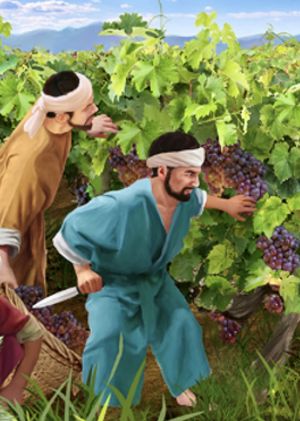
27th Sunday in Ordinary Time (year A) [4 October 2026]
First Reading from the Book of the Prophet Isaiah 5:1–7
This text begins as a song dedicated to the grape harvest: it recounts the vineyard-keeper’s patient care for his vineyard, from preparing the soil to selecting the best vine. In Israel, the vineyard was highly prized and required great care. For this reason, the song eventually came to be used as a wedding song too, urging the bridegroom to care for his wife with the same devotion as the vine-grower. The vineyard is also a symbol of the covenant with God. The prophet Isaiah draws on this image to speak of the relationship between God and Israel. The vineyard represents the house of Israel, whilst the beloved vine represents the people of Judah. The good fruits that God expects are righteousness and justice; the bad fruits, on the other hand, represent crime and cries of suffering. Above all, Isaiah denounces: greed and the hoarding of property, with the rich seeking to possess ever more land, and indifference towards the poor; the excessive pursuit of pleasure and drunkenness, whilst remaining indifferent to God’s work; above all, the loss of moral values and justice, to the point of regarding what is evil as good and what is good as evil. In summary: the vineyard is a metaphor for the people of Israel, loved and cared for by God. God expects this people to bear the fruits of justice, respect and solidarity, but Isaiah denounces selfishness, the accumulation of wealth, indifference towards the poor and moral corruption.
Responsorial Psalm (79/80)
The psalm takes up the theme of the vineyard from Isaiah: Israel is likened to a vineyard and God is the vine-grower. God has done for this vineyard everything a vine-grower can do: he has tended, protected and cared for it. He has prepared the soil, removed the stones, planted a choice vine, built a watchtower and set up a winepress. He expected good grapes, but the vineyard produced only bad grapes (Isaiah 5:1–2). Faced with this failure, the vineyard-keeper decides to abandon the vineyard: he will remove its protective hedge, turn it into a desolate wasteland, neither pruned nor cultivated, where thorns and brambles will grow, and he will even prevent the rain from falling on it (Isaiah 5:5–6). The metaphor of the vineyard was easily understood in the context of the Temple in Jerusalem, because the imagery of the vineyard describes the history and sufferings of Israel.
When the psalm says that God has opened the hedge and that passers-by are gathering the grapes, whilst wild boars and the beasts of the field are ravaging the vineyard, it is referring to foreign occupation: the wild beasts symbolically represent the enemies who are currently oppressing Israel. The vineyard is also described as destroyed and set ablaze, whilst the enemies and neighbouring peoples mock Israel. The people therefore turn to God, asking how long they must still endure his wrath, feeding on the ‘bread of tears’ and drinking tears in abundance. The text does not allow us to establish with certainty which particular invasion or occupation inspired this prayer. Wars and foreign occupations, in fact, produce similar situations of destruction and suffering. For this reason, it is not possible to establish with certainty the date of the psalm’s composition. One possibility is that it was written during the invasions of the Assyrian Empire, when the Northern Kingdom was threatened and Samaria was finally destroyed in 721 BC; this hypothesis would place the psalm between the 9th and 7th centuries BC, and therefore before the Babylonian exile. Another possibility is that it was composed later, after the conquest of Jerusalem by the Babylonians in the 6th century BC. The text does, however, acknowledge that other hypotheses also exist. Ultimately, the vineyard represents Israel, whilst God is the vine-grower who chose, tended and protected it. The failure to produce good fruit and the subsequent devastation of the vineyard represent the history of a people experiencing sin, suffering, invasions and foreign occupation. The psalm thus becomes a plea to God, in which Israel, wounded and persecuted, asks him to intervene and return to tend his vineyard.
Second Reading from the Letter of Saint Paul the Apostle to the Philippians (4:6–9)
‘Do not be anxious about anything,’ says Paul, and we might be tempted to reply that it is not always easy! But we must reread the verse that precedes this passage in Paul’s letter: ‘The Lord is near’. For Paul, this is the best – indeed, the only – reason to remain at peace, whatever may happen: ‘the Lord is near’. The Lord is near to us; we in Israel have known this for a long time, ever since the episode of the burning bush, and God is near to us because he loves us. The Lord is near because the time has been fulfilled, because the Kingdom of God has already begun and we are in the last days. Another phrase from Paul, ‘the time is short’, translates an expression taken from nautical vocabulary: ‘Time has lowered its sails’ (1 Cor 7:29); just as a boat about to enter harbour folds in its sails, so human history is very close to the harbour. To be a believer is to be drawn towards this fulfilment of history; not only has the Kingdom drawn near to us in Jesus Christ (for the Kingdom is Jesus Christ present in everyone), but, even more so, it draws us to itself like a magnet. The rest of the text follows on from this: since the Lord is near, let us not worry about anything. ‘Do not be anxious about anything’… since everything has already been given, all we need to do is draw upon it: we need do nothing but let ourselves be carried along by the torrent of grace. To pray, after all, is to immerse oneself in God’s gift. We then understand why, in prayer, supplication and thanksgiving are always linked; it is a characteristic of Jewish prayer, which always says simultaneously, ‘Blessed are You, Lord, who gives us… please, give us’ . It is logical, after all: if we pray to God, it is because we know that He can and does want our happiness. To ask Him for something is, at least implicitly, to give Him thanks. This is exactly what Paul says: ‘Brothers and sisters, do not be anxious about anything, but in every situation present your requests to God through prayer, supplication and thanksgiving’. But, as Jesus said, ‘Not everyone who says to me, “Lord, Lord”, will enter the Kingdom of Heaven, but only the one who does the will of my Father in heaven’ (Mt 7:21); Paul, too, makes the same recommendation: ‘Whatever is true, whatever is noble, whatever is just, whatever is pure… let these be the focus of your thoughts’. He certainly attaches great importance to this practice of living a righteous life, for he places it on exactly the same level as prayer. He begins by speaking of prayer and concludes, ‘the peace of God, which surpasses all understanding, will guard your hearts and your minds in Christ Jesus’. He then speaks of Christian conduct, ending with the phrase ‘the God of peace will be with you’. It seems to me that this parallelism, which is certainly intentional, means that, in Paul’s eyes, prayer goes hand in hand with community life. In this, moreover, he is simply echoing the preaching of the Old Testament prophets. For Saint Paul, peace lies at the end of the journey where a life of prayer and communal values go hand in hand: ‘Do not be anxious about anything… pray and make requests, giving thanks, so that God may know your needs… and the peace of God will guard your hearts and your minds’. If we take seriously the Scriptures’ insistence on the necessary link between prayer and brotherly love, we learn that not only do our anxieties make us forget that God loves us, but they also close our hearts… If we worried less about our daily bread, there would be bread today for many others.
From the Gospel according to Matthew (21:33–43)
This parable of Jesus echoes the prophet Isaiah’s song of the vineyard: A man owned a piece of land where he planted a vineyard; he fenced it in, dug a pit for the winepress and built a watchtower. The owner tends to his vineyard with the same care as Isaiah’s vineyard-keeper, but the similarities end there. In the Gospel, the parable takes a new turn and thus offers a new lesson. In Isaiah, the owner is also the vineyard-keeper; the vineyard represents the people of Israel, a vineyard surrounded by care, yet disappointing and yielding only bad fruit. In Jesus’ parable, the owner is not the vine-grower; he does not work his vineyard directly, but entrusts it to other vine-growers: ‘He let it out to some farmers and went away to a distant place.’ Is there a vineyard? Who are the vine-growers? As for knowing what the vineyard represents, and who the vine-growers are, it is not clear. There are two possibilities: the first hypothesis is that the vineyard represents Israel, as in Isaiah, and the vine-growers are the chief priests and the Pharisees. They were responsible for the vineyard—the people of Israel—and they mismanaged it because they mistreated all the prophets and, ultimately, were about to reject the Father’s Beloved Son. The second possibility is that the vineyard represents the Kingdom of God and the vine-growers are the entire people of Israel, who had been entrusted with it. This second possibility is probably the correct one, as Jesus concludes by saying: ‘The Kingdom of God will be taken away from you and given to a people who will produce its fruit’. This last statement by Jesus is terrible: ‘The kingdom of God will be taken away from you and given to a people who will produce its fruit’. Must we conclude, then, that the people of Israel would be rejected? This is a grave question that has poisoned dialogue between Jews and Christians for twenty centuries; and one with which Saint Paul, a Jew himself, was already painfully grappling in his Epistle to the Romans. His conclusion was that, in a mysterious yet certain way, Israel remains the chosen people in the service of the world because ‘God cannot deny himself’ . On the other hand, we must not forget that a parable is never a verdict, but a call to conversion; it is true that, from one parable to the next, in this final stage of Jesus’ life, the tone grows more urgent, but this is because the need to recognise the Messiah is becoming ever more pressing. We are on the eve of the Passion. We must never lose sight of the fact that Jesus’ constant desire is to save people, not to condemn them; and that, whilst he heals those born blind, he desires even more to heal his own people from their blindness. We therefore have here a final attempt by Jesus to warn the Pharisees; his words are stern, but they do not constitute a definitive judgement. This is by no means a final, irrevocable judgement on the Jewish people as a whole, nor even on their leaders; that would be contrary to the whole of the Gospel. Moreover, the most important message is not that the Kingdom is being taken away from them: what matters is that, despite the obstacles placed in its way by men, the Kingdom bears its fruit. It is not the vine-grower that matters, but the grapes. Above all, however, it is Jesus’ commentary that gives us the key to the parable: ‘Have you never read in the Scriptures: “The stone which the builders rejected has become the cornerstone. This was the Lord’s doing, and it is marvellous in our eyes!”’ God is accustomed to such reversals of fortune. Indeed, in the Book of Genesis, Jacob’s sons had said of their brother Joseph, ‘Here is the dreamer; let us kill him’… they could not have imagined that the one they wished to kill was the very one who would save them, and the whole people (Gen 37:20). In a sense, Jesus is here foretelling his Resurrection: he, the rejected stone, will become the keystone of the building; in other words, the new people will be all those who gather round him, whatever their background. And no one is excluded: all the vine-growers are included in Jesus’ words on the cross: ‘Father, forgive them, for they know not what they do’. This means that Jesus has indeed taken up the theme of the parable of the vineyard found in Isaiah, but has modified its symbolism – something quite common amongst biblical authors. One need only consider how biblical metaphors (such as that of the cornerstone, for example) evolve from one author to another. The judgement that Jeremiah had already passed on the people of Israel can shed light on this: ‘On the day I brought them (your forefathers) out of the land of Egypt… this is the command I gave them: “Listen to my voice: I will be your God and you shall be my people; you shall follow all the ways I prescribe for you, so that you may be happy.” But they did not listen; they paid no heed; they followed the evil inclinations of their hardened hearts; they turned their backs on me, not their faces. From the day your forefathers came out of the land of Egypt until today, I have sent all my servants, the prophets, to you without ceasing. But they did not listen to me, they paid no heed; they stiffened their necks and were worse than their fathers. You shall speak all these words to them, and they will not listen to you. You shall call out to them, and they will not answer you. Then you shall say to them: ‘This is the nation that has not listened to the voice of the Lord its God, nor accepted instruction! Truth is lost; it has vanished from their mouths.” (Jer 7:22–28). Matthew wrote his Gospel at the end of the first century, at a time when the Jews’ refusal to recognise the Messiah had facilitated the entry of pagans into the Church; it is therefore not surprising to find in texts from this period a hint of polemic against those who had led the Jewish people to reject Christ.
+Giovanni D’Ercole
Teach us to pray: the ‘Cross-inside’
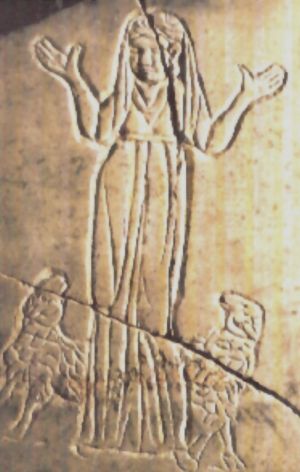
Gaze no longer positioned outside
Lk 11:1-13 (v.4c)
«When you pray, do not babble like the pagans, for they think they will be heard because of their wordiness» (Mt 6:7; cf. Lk 11:1).
The God of religions was named with an overabundance of high-sounding honorific epithets, as if he craved ever more numerous ranks of incensers.
The «Father» is not accompanied by prestigious titles. A child does not address the parent as a very high, eternal and omnipotent, but the a reliable family Person who transmits life to him.
And the son does not imagine that he has to offer external cries and acknowledgments: the Father looks at needs, not merits.
«Et ne nos inducas in tentationem»: ancient Prayer of the sons.
«Do not induce us [Lead us not into]» is (in the Latin and Greek sense: «until the end») an ancient Symbol of the ‘reborn in Christ’, in the experience of real life.
In religions there are clearly opposed demons and angels: disordered and dark powers, contrary to the bright and "right" ones.
But by dint of relegating the former, the worst continually resurface, until they win the game and spread.
In the lives of the saints we see these great women and men strangely always under temptation - because they disdain evil, therefore they do not know it.
Gradually, however, the little constant naggings becomes overwhelming crowds.
The persons of Faith do not act according to pre-established and superficial models, not even religious ones; they are aware that they are not heroes or paradigm phenomena.
That is why they rely on. They let intimate problems go by: understood its strength!
This is the meaning of the formula of the Our Father, in its original sense: «and lead us not into [the end of] temptation [trial] (because we know our weakness)».
If, on the other hand, our 'counterpart' becomes a protagonist, a one-sided pivot, a constant afterthought, and a block, we’re done for.
Pain, failures, sadness, frustrations, weaknesses, a thousand anxieties, too many falls, accustom us to experience transgressions as part of ourselves: Condition to be evaluated, not "guilt" to be cut horizontally.
In the process of true salvific transmutation, that signal speaks of us: within a deviation or the eccentricity there is a secret or a knowledge to be found, for a ‘new personal birth’.
Looking at the discomforts and oppositions, we realize that these critical sides of being become like a malleable magma, which approaches our healing more quickly. As if through a permanent, radical conversion… because it involves and belongs to us; not in peripheral mode, but basically, of Seed and Nature.
Absorbed patterns and beliefs do not allow us to understand that the passionate life is composed of opposing states, of competitive energies - which must not be disguised in order to be considered decent people.
Perceiving and integrating such depths, we lay down the idea and atmosphere of impending danger, devoid of further opportunity; only for death.
We become mature, without dissociation or hysterical states resulting from contrived identifications, nor disesteem for an important part of us.
In short, straits and "crosses" have something to tell us.
They shake the soul to the root, sweep away the absorbed masks, ignite the person, and save the life.
In this way, inconveniences and anxieties help us. They hide capabilities and possibilities that we do not yet see.
In the virtue of the shaky yet unique exceptionality for each person, here is the true journey opening up.
Path of the Father and of the heart, Way that wants to guide us to alternative trajectories, new dimensions of existence.
Difference between Faith and ancient religiosity [in the sense of the ‘Cross-within’]?
It lies in the realisation that only the sick, are healed; only the incomplete free from attachments, grow.
Only those who limp along and let go, become free; they find their voice again, and evolve.
So by falling, by losing themselves, by «feeling like nobody», they spring forward.
[Wednesday 27th wk. in O.T. October 7, 2026]
Teach us to pray: the Cross within
No longer looking outward
(Lk 11:1-4)
In the communities of Matthew and Luke, the "prayer" of the sons - the «Our Father» - does not arise as an oration, but as a formula of acceptance of the Beatitudes (in its sections: invocation to the Father, the human situation and the coming of the Kingdom, liberation).
In any case, the full difference between religious prayer and expression animated by Faith lies in the distinction between: Performance or Perception.
[As Pope Francis says: 'Praying is not talking to God like a parrot'. 'Our God does not need sacrifices to win his favour! He does not need anything'.
In religions, in fact, it is the praying subject who 'prays', expressing requests, exposing himself, praising, and so on.
Again in Thomism, the virtue of religion was considered an aspect of the cardinal virtue of Justice. In other words, the right position of man before God is that of one who recognises a duty of worship (worship that comes from him) towards the Creator; and man - the subject of prayer - fulfils this duty.
Conversely, the son of God in Christ is a 'listener' to the Logos: he is the one who listens, perceives, welcomes: in short, the authentic Subject who expresses himself is God himself.
He reveals himself through the Word, in the reality of events, in the folds of universal and personal history, in the particular Call he grants us, even in intimate images.
These become plastic expressions of Mystery (and personal Vocation) which, wave upon wave, even guide the soul.
"When you pray, do not babble like the pagans, for they think that they will be heard because of their many words" (Mt 6:7; cf. Lk 11:1).
In Faith, we participate in the authentic prayer of Jesus himself - Person in us - addressed to the Father, first of all in "listening" to His providential proposals: as if, united with our Friend and Brother, we were entering into this Dialogue - filled with even figurative suggestions.
But it is the Only Begotten Son who prays; we are not the great protagonists. Only in this sense can the act of prayer be defined as "of the children" or "Christian".
Our life of prayer is not an ascetic exercise - much less a duty or a shopping list - because God does not need to be informed about something He had not thought of before.
As the Master says, the Father knows what we need (Mt 6:8). Therefore, no effort is necessary to turn to Him [no agonising struggle to focus on ourselves and step outside ourselves...]. Nor does He oblige us to say too many (or the right) words.
Authentic prayer is not a repetition, nor a leap into the external darkness, but rather a searching and sifting, a gift. It is a plunge into our being, where the intimacy of the Agreement seeks to understand the Author's signature in the heart of events, even of emotions.
The prayer of the man of Faith does not aim to introduce God's will and the reality of situations into narrow horizons and already understandable judgements, as if pushing it into unnatural harmonies.
Prayer is a perceptive leap without repetitive identities, from one's own core - which eliminates mental toxins; and thus becomes an experience of fullness of being, in search of global and personal meaning.
The praying man is not even prey to some kind of excited (ridiculous or soporific) paroxysmal state: he is welcoming an Action - a Work of paradoxical suspension, on the path towards his own Beatitude.
Prayer is even an aesthetic gesture in Christ. Precisely because it tends to jolt our everyday imagination, so that it may be shaped according to the guiding vision that dwells within. It shifts and almost directs the eye of the soul, and the ecclesial experience.
A virtue-event that gradually chisels away at that very personal image that brings to awareness a goal or a communal reality of praise, or rather an innate narrative... A voice of unknown energies, for important changes.
Step by step, this perception and dialogue that emerges leads us to internalise hidden glimpses of the path that belongs to us: a missionary spirit that seeks harmony, the creation of a living environment, and so on. Even destabilising ones.
Only in this sense is prayer beneficial to us.
Nor can it be reduced to a group distinction, because while recognising themselves in certain knowledge, each person has their own language of the soul, a significant history and sensitivity, an unprecedented iconic world (also in terms of dreamed micro and macro relationships), as well as a unique task of salvation.
For this reason too – although in relation to the community of reference – the Symbol of those reborn in Christ who turn to the Father has come down to us in different versions: Matthew, Luke, Didache [‘Teaching’, perhaps contemporary with the last writings of the New Testament, a sort of early Catechism].
To introduce us to specific considerations, it is appropriate to ask ourselves: why does Jesus not frequent places of worship to recite traditional formulas, but rather to teach?And there is never any mention of the apostles praying with him: it seems that they only wanted a formula to distinguish themselves from other rabbinical schools (cf. Lk 11:1).
The Lord stands firm only on the mentality and lifestyle: he proceeds on fundamental options - and insists on a perception aimed at welcoming, rather than on our saying and organising (which are not deeply imbued with a well-founded eternity).
Father
The God of religions was named with an abundance of high-sounding honorific epithets, as if He craved ever larger crowds of flatterers.
The Father does not surround himself with prestigious titles. A child does not address his parent as someone who is very high, eternal or exalted, but as the one who gives him life.
And the son does not imagine that he must offer cries and external acknowledgements - otherwise the superior and master would be offended and might punish him: the Parent looks at needs, not merits.
The God of religions rules his subjects by issuing laws, as a sovereign does; the Father transmits his Spirit, his very Life, which elevates and perfects both the capacity for personal listening and awareness (e.g., of one's brothers and sisters).
The only request is to extend our missionary resources and to feed ourselves with the Bread-Person who remoulds us according to his own virtues, according to what we should be, and perhaps already could have been.
A reality within our reach is the cancellation of the material debts that our neighbour has incurred out of necessity.
There is no witness to God-Love that does not pass through a fraternal community, where the communion of goods is lived.
The assurance of being at peace with God lies in the joy of living together and sharing.
In religious belief, material blessings are often confused with divine blessings, which accentuates competition, artificial primacy and the hardships of real life.
Conversely, the spirit of the Beatitudes is evident in a people where distinctions between creditors and debtors are abolished.
«Lead us not»: ancient prayer of children, in real life
The essence of God is: Love that does not betray and does not abandon; it is useless, confusing and blasphemous to ask a Father: 'Do not abandon me' [cf. Greek text]. Even if it may be effective to the external ear.
The false mystics of the abandoned Jesus (even by the Father!) do not educate; they may fascinate, they certainly confuse - and they brainwash.
In prayer, only the Spirit is guaranteed: the clarity to understand the fruitfulness of the Cross, the gain in loss, life not in triumph but in death. And the strength to be faithful to one's calling, despite persecutions, even 'internal' ones.
The community and individual souls nevertheless ask not to be placed in extreme conditions of trial, knowing well their own limits, their personal invincible precariousness, even if redeemed.
This is the threshold that distinguishes religiosity from Faith: on the one hand, the 'safe' formula of the convinced and strong; on the other, a humble and expectant prayer: that of the unsteady, redeemed by love.
'Lead us not' is precisely (in the Latin and Greek sense: 'lead us to the end') an ancient symbol of those reborn in Christ, in the experience of real life.
In religions, there are clearly opposing demons and angels: disordered and dark powers, contrary to the luminous and 'right' ones.
But by dint of pushing back the former, the worst continually resurface, until they win the game and spread.
In the lives of the saints, we see these great men strangely always under temptation - because they despise evil, they do not know it. Gradually, however, the constant harassment becomes an uncontrollable crowd.
Women and men of faith do not act according to pre-established, superficial models, not even religious ones; they are aware that they are not heroes or paradigm phenomena.
That is why they entrust themselves. They let their intimate problems pass: they have understood their power!
This is the meaning of the Lord's Prayer in its original sense: 'do not bring us to trial, for we know our weakness'.
This attention arises so that sin itself - by dint of denying it, then masking it - does not paradoxically become the hidden protagonist of our journey. The focus of attention, which unfortunately clogs the mind, blocking the internal processes of spontaneous growth, perception of Grace and self-healing [in accordance with one's own unique Calling].
This would be the opposite of Redemption and Freedom, and therefore of Love: it is destroyed where there is a superior who dominates - even if it is God.
On the contrary, it is very beneficial to recover the energy that has brought us into contact with our deepest layers, opening up new horizons. We should take it on board and make it our own, in order to (only then) invest it in an unexpected and wise way.
If, on the other hand, our 'counterpart' becomes a constant afterthought and block, we are doomed.
Pain, failure, sadness, frustration, weakness, a thousand anxieties, too many falls, accustom us to experiencing evil as part of ourselves: a condition to be evaluated, not a 'fault' to be cut off horizontally.
In the process of true salvific transmutation, that signal speaks about us: within a deviation or eccentricity there is a secret or knowledge to be discovered, in order to be personally reborn.
By looking at discomfort and opposition, we realise that these critical aspects of being become like malleable magma, which more quickly brings about healing. It is like a permanent, radical conversion... because it involves us and belongs to us; it is not artificial or superficial, but fundamental, coming from our core, from our seed and nature.
Absorbed patterns and beliefs prevent us from understanding that a passionate life is made up of contrasting states, of competing energies - which we must not mask in order to be considered respectable people.
By perceiving and integrating these depths, we abandon the idea and atmosphere of impending danger, devoid of further opportunities, only for death.
We become mature, without dissociations or hysterical states resulting from artificial identifications, or contempt for an important part of ourselves.
In short, limitations and 'crosses' have something to tell us.
They shake the soul to its core, sweep away absorbed masks, ignite the person, and save lives.
In this way, inconveniences and anxieties help us. They hide abilities and possibilities that we cannot yet see.
In the virtue of the fragile yet unique exceptionality of each person, the true path opens up.
The path of the Father and of the heart, the Way that wants to guide us towards alternative trajectories, new dimensions of existence.
Difference between Faith and ancient religiosity [in the sense of the ‘Cross-within’]?
It lies in the realisation that only the sick, are healed; only the incomplete free from attachments, grow.
Only those who limp along and let go, become free; they find their voice again, and evolve.
So by falling, by losing themselves, by «feeling like nobody», they spring forward.
Cf. Jn 16:23-28: Prayer in the Name: daily commentary, Saturday of the 6th week of Easter
Cf. Mt 11:25-27: The only prayer Jesus ever taught Wednesday 15th
Faith in God opens before us the horizon of a sure hope, one which does not disappoint; it indicates a solid foundation on which to base one’s life without fear; it demands a faith-filled surrender into the hands of the Love which sustains the world (Pope Benedict)
La fede in Dio apre all’uomo l’orizzonte di una speranza certa che non delude; indica un solido fondamento sul quale poggiare, senza paura, la propria vita; richiede l’abbandono, pieno di fiducia, nelle mani dell’Amore che sostiene il mondo (Papa Benedetto)
The "new evangelization" faces this challenge. It must work to ensure that people recover the awareness that in Christ evil can be conquered with good (Pope John Paul II)
La “nuova evangelizzazione” affronta questa sfida. Essa deve impegnarsi perché tutti gli uomini recuperino la consapevolezza che in Cristo è possibile vincere il male con il bene (Papa Giovanni Paolo II)
Many saints experienced the night of faith and God’s silence — when we knock and God does not respond — and these saints were persevering (Pope Francis)
Tanti santi e sante hanno sperimentato la notte della fede e il silenzio di Dio – quando noi bussiamo e Dio non risponde – e questi santi sono stati perseveranti (Papa Francesco)
In some passages of Scripture it seems to be first and foremost Jesus’ prayer, his intimacy with the Father, that governs everything (Pope Francis)
In qualche pagina della Scrittura sembra essere anzitutto la preghiera di Gesù, la sua intimità con il Padre, a governare tutto (Papa Francesco)
It is necessary to know how to be silent, to create spaces of solitude or, better still, of meeting reserved for intimacy with the Lord. It is necessary to know how to contemplate. Today's man feels a great need not to limit himself to pure material concerns, and instead to supplement his technical culture with superior and detoxifying inputs from the world of the spirit [John Paul II]
Occorre saper fare silenzio, creare spazi di solitudine o, meglio, di incontro riservato ad un’intimità col Signore. Occorre saper contemplare. L’uomo d’oggi sente molto il bisogno di non limitarsi alle pure preoccupazioni materiali, e di integrare invece la propria cultura tecnica con superiori e disintossicanti apporti provenienti dal mondo dello spirito [Giovanni Paolo II]
This can only take place on the basis of an intimate encounter with God, an encounter which has become a communion of will, even affecting my feelings (Pope Benedict)
Questo può realizzarsi solo a partire dall'intimo incontro con Dio, un incontro che è diventato comunione di volontà arrivando fino a toccare il sentimento (Papa Benedetto)
He is “the very stone which the builders rejected” (cf. Mt 21:42), because they judged him to be hostile to the law and a danger to public order [Pope Benedict]
Egli è “la pietra che i costruttori hanno scartato” (cfr Mt 21,42), perché l’hanno giudicato nemico della legge e pericoloso per l’ordine pubblico [Papa Benedetto]
"His" in a very literal sense: the One whom only the Son knows as Father, and by whom alone He is mutually known. We are now on the same ground, from which the prologue of the Gospel of John will later arise (Pope John Paul II)
“Suo” in senso quanto mai letterale: Colui che solo il Figlio conosce come Padre, e dal quale soltanto è reciprocamente conosciuto. Ci troviamo ormai sullo stesso terreno, dal quale più tardi sorgerà il prologo del Vangelo di Giovanni (Papa Giovanni Paolo II)








duevie.art
don Giuseppe Nespeca
Tel. 333-1329741
Disclaimer
Questo blog non rappresenta una testata giornalistica in quanto viene aggiornato senza alcuna periodicità. Non può pertanto considerarsi un prodotto editoriale ai sensi della legge N°62 del 07/03/2001.
Le immagini sono tratte da internet, ma se il loro uso violasse diritti d'autore, lo si comunichi all'autore del blog che provvederà alla loro pronta rimozione.
L'autore dichiara di non essere responsabile dei commenti lasciati nei post. Eventuali commenti dei lettori, lesivi dell'immagine o dell'onorabilità di persone terze, il cui contenuto fosse ritenuto non idoneo alla pubblicazione verranno insindacabilmente rimossi.