


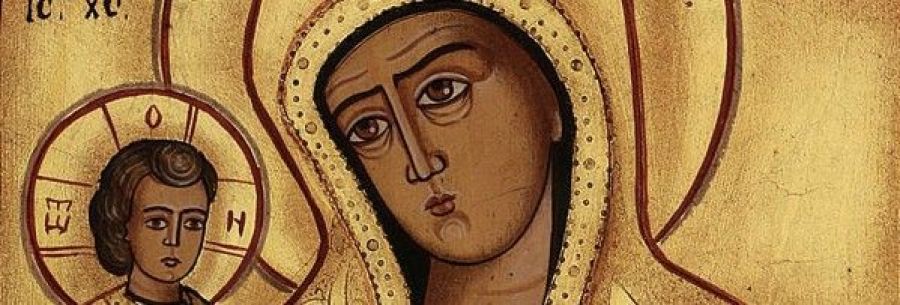
(Jn 6:30-35)
What the term "Bread" used by Jesus in this pericope alludes to is derived from the Hebrew term "Lechem", whose root [consonants "l-h-m"] evokes his "being ground" and "sifted" in the Passion of love; thus, it relates in filigree to the complete gift on the Cross.
According to a Jewish belief, the advent of the Messiah would be accompanied by a shower of Manna from heaven - called Manna of the Second Redeemer - to satisfy material appetites.
Bread that does not last.
There were also rabbinic speculations that reflected other claims, not of physical necessity; and they told of the "bread" descended from above in a sapiential figure (Deut 8:3: "man does not live by bread alone, but by what comes from the mouth of the Lord"; cf. Wis 16:26).
In order to satisfy existential needs and great questions of meaning, Jesus reveals and presents himself as the indestructible Bread of Life.
In the messianic hopes of a golden age and liberation lurked the same expectations that lurk in the folds of our going, even further than those fulfilled by Moses.
We seek eminent food.
For there are questions that we cannot answer: why the pain and humiliation, why there are fortunate people and others who blamelessly live unhappily; for what great task we were born, and why in spite of our comforts we still do not feel fulfilled.
Our experience is as if shrouded in the confusion of underlying questions... and often even the eye and warmth of a Witness is missing.
We then seek a Person who translates everything into Relation, and we long for his sapiential Food - a foundation, the humanising warmth, and a synthesis of all truth and all history.
Only Jesus and his story give meaning to the many happenings; even to limits, wounds, boundaries, precariousness: he is Dream, Meaning, Action and Voice of the Father. Key, Centre and Destination of each one and of humanity.
The only Nourishment for the 'hunger' and the only true Source for the 'thirst' of the woman and man subjected to trials and questions.
In Jesus' time, by widespread devotion Moses continued to be the great leader to believe and adhere to.
But according to the Lord, that of the Exodus of the "fathers" is configured as a proposal that has no future: it does not guarantee orientation, subsistence and a joyful, solid and full life.
It does not even remain as a stump of the now. It is only an archaic seed, a peculiar excrescence unravelled in favour of the mystical and renewed Wheat that moves us forward on the authentic Path.
The great ancient warlord had stopped at the religious dimension and its requisitions. What was missing was the leap of Faith ignited by the revelation of the Father's heart, in the teaching, the story, and the Person of Christ.
Accepting Jesus as the authentic motive and driving force, the support and nourishment that would really get hunger out of the way, is inseparable from accepting his proposal:
"Do you wish to unite your life with Mine? One Body, between us and Him - burning.
In such an approach, not even heaven had been able to satiate the doubts - a paradoxically growing hunger and a parchedness that forced one to return to draw, instead of being able to quench the thirst of the people.
The approach of simple religiosity plagued the lives of women and men, increasingly so.
Nervous, skittish and dissatisfied people. A wedding banquet devoid of festivity, due to cold, distant, impersonal, Spirit-resistant doctrine and discipline.
The pious, outdated custom - with all its travails - had not ensured, and neither does it guarantee today, the great change that sustains us on our journey and ceaselessly urges, kindling the heart of Friendship: access to the 'land of the free', hence of love.
The Gift from Heaven prepared and arranged another Birth, disrupting from the root the common religious relationship - light, tedious and insipid nourishment; whatever, and never thickening: 'good' for all seasons.
All this was coupled with a perspective of Happiness postponed to the afterlife, after death, and on the basis of external merits.
A swampy climate of compressed and stagnant energies, which did not vibrate with joy.
With Jesus, simple believing becomes Faith - no longer assent and demeaning repetition, which hurls and drags us beyond our 'centre' - but unique, unprecedented and creative action. First of all of God himself in us; for a complete realisation: as sons.
No reassuring recipe emerges, because the 'second' Genesis and growth in the Spirit has character, but does not happen once and for all.
Uniquely in this sense, the expression "I Am" (v.35) underlines the exclusivity of the "discourse of revelation".
Christ totally reinterprets, and overturns, the idea of transcendence of the divine condition in the human.The Most High is received and assimilated with a view to germination and likeness, no longer to external imitation and obedience.
"Too much" is only the Wisdom of his Revelation, which frees us from doubts because it makes them fruitful and propulsive; not at all humiliating in the same way as the ancient vacillations.
Even the wounds and uncertainties of life become a 'call' to feed on the Person of Christ. But reinterpreting it with new answers to new questions; to generate oneself again and grow in Him and of Him.
So we are in the episodes, yet outside of time; in the Love that is born, new.
Our identity - better: 'imprint' - is not that of pretenders [which does not quench the soul's thirst] but that of being loved.
Thus we no longer need to silence all normal demands.
We can experience the taste of living, instead of the condemnation of always feeling undermined.
For this spousal and ever-new union, the immense scope of His Person minced, ruminated and made one's own as one does with food, becomes Life itself of the Eternal (v.33).
An anointing that does not lapse, that calls together to concelebrate.
To internalise and live the message:
Does my soul hunger for pity offices on the body or for rebirth, for meaning, and for a path to freedom?








