


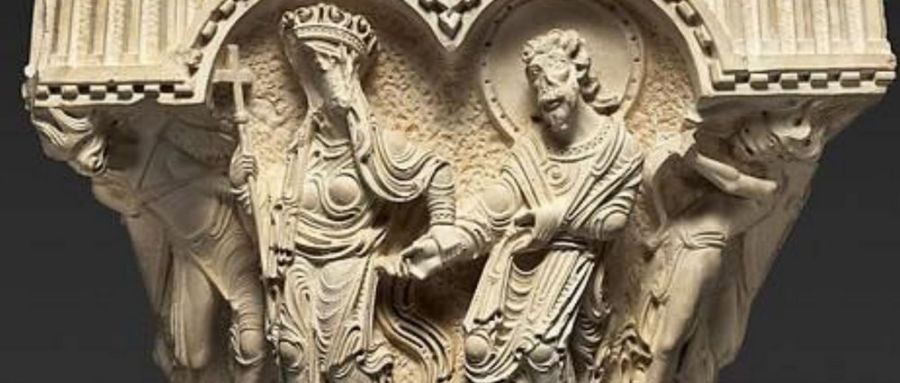
Unconventional Firmness
(Mt 7:6, 12-14)
Are we, too, after a beautiful Eucharistic liturgy, ready to trample, condemn, bite?
Do we lock ourselves in one-sided congregations that make us feel strong, turning the Gospel proclamation inside out?
It means that we live in fear of not being personally equal to the situation; thus we allow ourselves to be stepped on by someone or by the herd.
We need to change the register, starting from the soul and the innermost dynamics of approach.
The Glad Tidings is Pearl (v.6). Gem that should not be dispensed to those who would only use it as a tool.
Indeed, there are those who maintain the old competitive, pagan mentality - sometimes to the point of aiming to support their own conceptions of dominance, with fine manners [which sooner or later drop their masks].
Some perhaps under cover of the Word of God itself.
At the time of Jesus, for example, the same Law (written and oral) ended up being used not to favour the welcoming of the marginalised and needy, but to accentuate detachment and ghettoisation.
Situations that did not value personal gifts, and were even leading to the collapse of the least protected sections of the population.
In short, the alliance between throne and altar - instead of strengthening the sense of community - was being used to accentuate hierarchies. As a weapon that legitimised a whole mentality of exclusions, and confirmed the imperial logic of divide and rule.
Instead, Jesus wants to return to the Father's Dream: the ineliminable one of fraternity, the only seal to salvation history.
That is why his non-avoidable criterion is to link the Word of God to the life of the people and of each person; thus overcoming divisions.
The apostle must do what he must - not the façade "perfection" that conceals problems.
In this way, the disciple must be authentically motivated, not have a double life; nor be sent to dissipate energy.
For ourselves, too, it is imperative that we beware of the cheaters and patsies of the soul.
We must take the leap of Faith - which does not allow for the reversal of values.
There are many tricks that the opportunists of religion can pull to attract the eye and exploit the naivety of the little ones - then turn against them.
The simple ones always have their hearts in their hands, and spontaneously trust their neighbour.
In the face of old and new barkers, the children of God often take everything for granted - sometimes allowing themselves to be plagiarised and exploited, or entangled in clubs with shady public and private dealings.
Recently, even the Holy See has been forced to take very severe disciplinary measures against marauders of the 'spirit' who advocate a false mystical discipline to the weak.
We know the mechanisms of sects, which guarantee happiness by locking adherents in mental cages.
The Lord does not promise us new life ... only when we have finally dispelled our doubts, definitively resolved problems, realised dreams and ambitions.
Christ does not wish to deprive sensitive souls to the point of dispossessing them and not making them aware, involving them in useless battles.
Nor does he admit that someone among his intimates may 'for good' attempt to deceive the uninformed, charming them with platitudes passed off as solemn truths. Carefully avoiding that they understand the Gospels, life today and their own souls; that they study, compare, update - and delve deeper into the issues.
The Father wants each one to express his or her own creative capacities, the different characters that dwell within him or her - in which the deep personal nature of a son takes shape, all to be discovered. And which has its own meaning, in order to Salvation.
Some groups emotivize the proposals with a barrage of old-fashioned or sophisticated ideas [all partial] - peppered with afterthoughts or practical activities, which deplete consciences.
Circles that take over the global existence, work, hopes and goods of the simple - even the young, and various gullible.
Unfortunately, dangerous individuals and veritable agencies of manipulation emerge here and there, with the aim of alienating people.
They float around exploiting the gratuitousness of the innocent who seek God, as well as the resources of the common good.
It is right to trust in women, men and groups, but there is devious (even spiritual) evil, which is murderous.
We recognise it now: in those who presume of themselves and are so puffed up that they will never pass through a loophole (vv.13-14) - so they will never chart new paths.
And sadly, he will do everything to ensure that others do not explore them too, exorcising them with à la page narratives or made-up slogans; imposing models; feeling themselves to be a privileged group or club.
By floating on the ignorance of the arguments, some may be able to maintain their fake prestige and satrap lifestyle.
Sometimes, however, masks fall off.
This happens e.g. when in difficulties, the herd of envious careerist businessmen in sheep's clothing (v.15), who know that they can more easily condition those who fall into a state of bewilderment and weakness - do not recover or accompany, but enjoy the spectacle, waiting for the ruin reserving the right to intimidate the unaccountable, adding evil to evil without a crumb of human pity.
Evaluation must be constantly exercised, lest the fake saints [into whom we risk falling as inexperienced ones] succeed in profaning our person and Calling.
So - as Pope Francis pointed out - 'Lamb... with Christian cunning. Lamb, not fool".
It is not others who must decide for us.
There are opportunists of religion who are willing to fill others' healthy hearts with disorders, for ideology and self-interest.
The early Christians understood well that faith in the victory of life over death is incompatible with attachment to the ephemeral or to any influence.
In this regard, the indirect testimony of Lucian of Samosata (125-192), author of satires against superstitions and credulity, among which he includes 'Christianity', is significant.
With light-hearted language, the author describes in 'The Death of Peregrinus' [De morte Peregrini, 13] the impact that faith had on the lives of the simple people of his time:
"Their first lawgiver persuades them that they are all brothers among themselves, and as they are converted, denying the Greek gods, they worship that crucified wise man and live according to his laws. For something they despise all goods equally and believe them to be common and do not care when they have them. Therefore, if a shrewd impostor arose among them who knew how to handle them well, he would immediately become rich, mocking these gullible and foolish people".
The challenge is open, because the same comparison can be transferred to diriment aspects - unfortunately also lacerating - of the inner life, when it is made tormenting and unclear in an artificial way.
Therefore, the 'narrow door' is not a passage reserved for a few 'integrities' or those elected to life; not infrequently not very genuine and committed to influence, disrupting the transparency of souls and things.
As Pope Benedict said, 'the temptation to interpret religious practice as a source of privilege or security is always lurking'.
So, how do we detect those who intend to dehumanise us, locking us into obsessive comparisons - using us only for trivial interest - wherever they put themselves with seemingly lofty arguments?
On the basis of the 'past' or the 'future' [all their own], the false guides force us to make war on ourselves - and criticise ourselves - instead of multiplying our forces, and going on to explore other worlds.
To follow external models is to throw our Pearl before the 'swine' (v.6): to throw ourselves at the feet of those who - in order to steal our souls - disrespect, judge, scold and devalue us.
While the little ones live in the present. Unconventional Firmness.








