


The model of the satraps
(Mk 10:35-45)
Unofficially, Pius VII tried to lift the triregnum (neoclassical style, unusual) given to him by Napoleon, but his pages almost couldn't pull it up for the weight.
Let alone carry 8 kilos and 200 grams on his head! He tried, however, also to put it on, while of course someone also supported him from the side (imagine if he had fallen on the red slippers).
But it was also too narrow: impossible to stick your head in!
Out of spite, Bonaparte, the new emperor, had it made up so that no pope could ever wear it; and so it was, the ironic museum piece.
The imposition formula was: 'Receive the Tiara adorned with three crowns, and know that Thou art Father of Princes and Kings, Ruler of the world, Vicar on earth of Our Saviour Jesus Christ, to whom be honour and glory for ever and ever'. Amen.
While amidst symphonies and choirs someone was waiting for the very moment of the tiara to weep a little over the ancient glories, at the celebration of the reopening of the Council - after the coronation - Paul VI finally laid the triregnum on the papal altar.
He took it off with satisfaction, not because it was uncomfortable (he had a good four and a half kilos on his head): later he also made other gestures of unexpected renunciation with demands to be obeyed.
After him, no pope had the courage to adorn himself with it.
It was an opportunity not to be missed for those with vast experience in curial and diplomatic circles.
With the keys of Heaven, the reins of the earth and the command of Purgatory (the three crowns) in his fist, the pontiff decided to bring up several flames from underground - to overheat the strains of some careerist from the sidelines, accustomed to directing souls by standing on top of any trunk.
Mc wrote his Gospel in the year of the four Caesars (68-69).
Despite the fact that Nero's persecution had passed only a few years earlier, immediately the believers returned to squabbling among themselves to be 'big' and in first place.
Within the Roman community, the race to excel began again. Here is the cue for the evangelical call.
To be worshipped, hunger for prominence, better to be counted than to be counted?
The place of honour is last.
The alternative is: a religion that produces and reiterates distances, or the life of humility-communion marked by sympathy for the less entitled.
The person of Faith is recognised and characterised by human fulfilment, which resembles God.
In the Gospels, the "Son of Man" (vv. 33.45) is an icon of transmissible holiness, a living sanctuary from which divine compassion radiates.
Son of man is the one who, having reached the peak of human fullness, comes to reflect the divine condition and radiates it widely - not selectively as expected.
Successful son: the Person with the definitive step, who in us aspires to convivial expansion, to an indestructible carat within each one who approaches - and encounters - divine marks.
It is growth and humanisation of the people: the quiet, transparent and complete development of the divine plan on humanity.
The Son of Man is therefore not a religious, guarded, controlled and reserved title, but an opportunity for all those who adhere to the Lord's life proposal and reinterpret it in a personal creative way.
They transcend the firm, natural boundaries making room for the Gift; welcoming from Grace the fullness of being, in its new, unrepeatable tracks.
Feeling totally and undeservedly loved, we discover other facets... we change the way we are with ourselves, and we can grow, realise ourselves, flourish, radiate the wholeness we have received - with no more closures.
In the Gospels, the Son of Man - the true and full development of the divine plan on humanity - is not hindered by the frequenters of the bad places, but by the habitués of the sacred precincts.
Precisely. The Lord disdains the model of satraps.
Here then are the two opposing orientations of life.
On the one hand, the custom of prevailing-serving, perpetuating the old world; thus demanding, getting one's way, dominating, manipulating, acting with duplicity, demanding with harsh (but also mellifluous - in order to obtain for oneself) language...
Instead, a different humanising track is to support people in expanding their lives and esteeming themselves, discovering their own deepest states, their personal Calling - that which is conformable and beautiful to them - encouraging them to mature the Dream they cultivate.
In Jesus' proposal, heavenly glory is identified with what is a source of fulfilment for all, not with a pyramidal archetype of well-introduced (deaf in ambition).
For if the outer papier-mâché castles are ecstatic and still leave us open-mouthed, in the turn of history the presumptuous suddenly become chaff in the wind; they have no weight, they do not last.
It is the archetype of pyramidal authority and command, attentive to balance and strategic points.Such dynamics do not belong to the community of the Sons - marked by sharing the choice of the Chalice (v.39): anti-ambition.
In short, Jesus reaffirms that God's authentic enemy is not imperfection, nor limitation - or even the apparent ruin of one's prestige - but an internal demon.
The counterpart of the Lord is the desire to climb the board of life and be served by others, for the thrill of power.
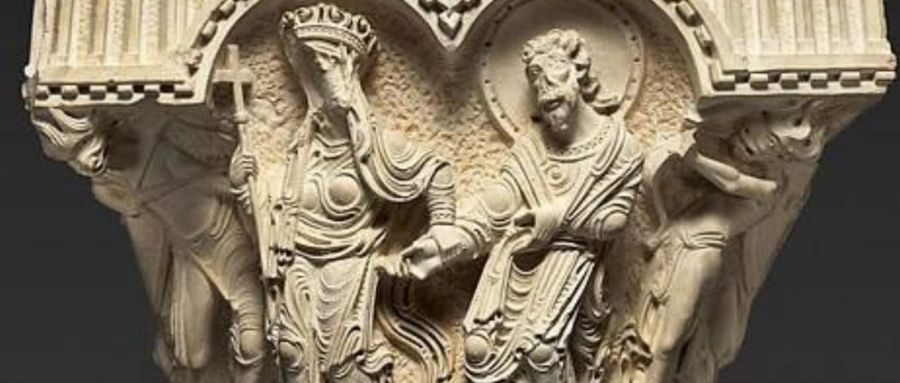
On a crusader capital preserved in the Nazareth Museum is a sculpture of an Apostle with a wavering pose and an uncertain gait, who is decisively dragged along by a crowned female figure: Faith.
It is Faith that clasps its hand on the wrist (where life pulses) of the character - awkward but endowed with a halo (from the features he definitely looks like Peter) undermined by the demons of having and power.
The disease of places of honour does not heal. The fever of being revered and seeming to be first in class does not subside, in fact it becomes sheer madness; and the head still does not change.
Always striving for the climb, the line of respect - and achieving space. Measure of a way of conceiving.
Here, then, is the Bishop of Rome still compelled to admonish his princes:
"These people play at being God"! "A successful life does not depend on success or on what others think". "Today there is a culture of subjugation of the other" - and so on.
In this way, the holders of titles of prestige are "deemed" (v.42) to be leaders.
In the parallel passage, Lk adds that these rulers - also in relation to the churches - moreover claim to be called 'benefactors' (a title of the great Hellenistic rulers).
And unfortunately here and there the malpractice continues.
It is the type of chained, position-conscious sovereignty; which is exercised and 'works' great, but it does not go.
To ape the worldly structures marked by logics of privilege, prevarication, plagiarism, and subjugation is less than noble and more than suspicious: far from being an example or a civil and moral engine of society!
Such dynamics do not belong to the community of the Sons; although they are occasionally evoked, enacted by individuals and factions oppressing the voiceless (even underhandedly) or at least regretted by ill-concealed nostalgics.
The same ones who - not having lost the vice of satisfying themselves by cloaking themselves in false prestige - continue to spoil the climate and drive away the best energies.
The Apostles were already sure that they had taken the Master hostage (v.35).
So in the still vain attempt to stir consciences and diroze them, the Lord continues to address men - as in the Gospel passage - cordially and from below, like a slave with his masters (v.36).
It is God who is the forced labourer at the service of the subordinates' desire for life; reflexively His own - if they manifest Him authentically, Greatly seriously.
To those who do not live a vital relationship with Christ but pretend to sequester him, Pope Francis reiterated the traits of the "disease of those who feel themselves masters. They believe themselves to be superior or indispensable and not of service. Sickness that comes from the pathology of power, narcissism, the complex of the elect'.
The 'designated' often imagine that they have already caged Jesus, so you always find them above and in front, never equal; let alone behind: rather, smeared with imperial dust that produces lacerations and schisms (v.41).
Other than giving themselves and sharing - we repeat - the choice of the Chalice (the anti-ambition)!
Here is the indicative element of the difference between religion and Faith:
The enemy of God is not sin, but power. The intoxication of being crowned with a tiara, that is, of being destined to continually allow oneself to be honoured, to be noticed and to command everywhere... even underground.








