


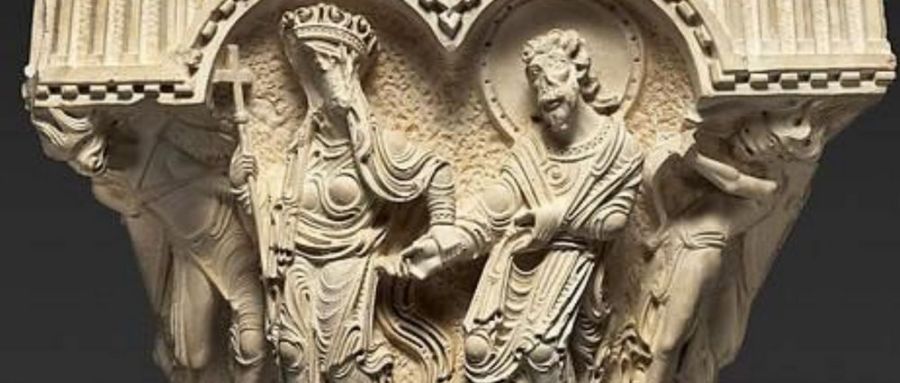
(Jn 3:1-8)
Jn introduces the Gospel passage with the very representative Jewish leader, insisting on the imperfection of believing in prodigies. They only grasp the outward side.
Indeed, he seems to emphasise that the religion-show so coveted by the religious leaders called Jews, because they were akin to the Judaizers of the first communities, arouses only deviant expectations and ambiguous hearts (2:18-25).
Nicodemus was a Pharisee, a prominent person, a leader among the early religious leaders, and even a member of the Sanhedrin [supreme court], which, however, recognises in Christ a messenger from God.
In the fourth Gospel, the notable represents precisely the Jews who were intrigued by the figure of Jesus. Some of them question and do not silence their questions, but remain perplexed - because they were educated to other messianic, peremptory and clamorous expectations.
Indeed, the authorities cultivated the whole issue concerning the 'Kingdom of God' (vv.3.5) in an approximate and conformist manner. [The expression so frequent in the Synoptics - 'kingdom of heaven' in Mt - is only found in this passage of the Fourth Gospel].
But it is only a point of support, because Jesus teaches that all speculations do not bring good results for life in the Spirit, which is not generated from what man devises or does for God, from his possibilities - as in religions.
We must rely on Grace, which enters the scene by overturning petty hopes - in this way, not relying on our own measures, skills and dexterity; nor on thoughts, which are as established as they are inadequate.
The new Rebbe makes it clear that to understand the Mystery we must shake off the outer book of the Law, and undertake an experience of ideal and practical transmutation, like a Birth - alongside a regenerating Agent.
Christ stimulates Nicodemus to make the leap from normal traditional religiosity, with its reasonable intentions and expectations, to the adventure of Faith that grasps, dreams and traces the future, surpassing the habitual chain of expectations.
One does not understand the Newness of God according to ancient knowledge, starting with the patriarchs - or by reading it in the watermark of a normative, albeit sharable, standard.
The new order of existence is superior to all capacities, all holdings and resiliences. That which is born from the flesh is in any case subject to too many boundaries.
Conversely, the path from above creates a new personality, by which we are enabled to correspond perfectly to the Calling by Name, which repeats itself wave after wave in increasing and dissimilar ways.
Recreated from the indestructible Life that Comes, we too are enabled to generate something like the same Nature that gives birth to us. As sparks that somehow conform to the divine: similis sibi similem parit.
Exactly: the too normal is unable to redefine the codes of a new look, and of the inconceivable space of unknown love.
It is not a question of changing banners, or 'cutting something' and mortifying oneself more. Rather, integrating and shining, changing beliefs.
What does not coincide with the inherited ideas is actually activating the new developments.
That which is contrary to established customs, or fashions, is preparing another world, a different person, a new calling (in the same personal vocation), another trail to follow.
It is no longer the God of religions, everything still and always to be achieved with arrangements, agility in the smallest details, and chiselled rhythms, accumulating merits according to clichés.
The Kingdom is not set up: it is welcomed - because it always bewilders us.
So it cannot be predetermined: it is impossible to set it up on the basis of our genius, muscles, virtues, perfections. We receive Him as a free gift and without 'due' prerequisites.
The God who comes without warning calls us to listen, to know what is unbelievable - to allow ourselves to be saved in an unthinkable way, then to be taken by surprise by the facts that Providence brings.
And there to stay, until the next news.
Jesus invites Nicodemus to scrutinise the reality of the soul and the events as a global sphere, of overall energies that draw together in paradoxical synergy, to recover the opposite sides - all of them useful.
Innate forces that are activated by attunements and reciprocal ways, making themselves infallible guides: cosmic outside and acutely divine within us.
The recoveries that Jesus makes through the quality of life of his own and of the communities generate in the one who is in the 'night' of doubt (v.2) an initial search and dedication, but they do not arouse active Faith.
In short, one does not understand God from arguments, but from the experience of involvement wave after wave; recreating, from the accepted Gift of one's own history, in the sign of the times.
We must lay aside the reassuring certainties of the normal religious catechism, and open heart and hand to the reality that comes like a tide - not to put us on the defensive, but to ride it.Throwing ourselves into the life of the Spirit retrieves us, but it supplants and overrides the organisation of the settled synagogues; it is not within the reach of complacent mechanisms or impersonal balances.
At most we understand its intrinsic course - the fullness of humanisation, in the creaturely plan - not its Origin and Goal.
Humanity, in its voluntarist plan and even in its good intentions, is unable to solve the real problems. It cannot give itself salvation; only manners - initiating at the same time processes of communion and individuation.
This is the new restlessness and the 'night' of questions that we, like Nicodemus, experience, practising teaching and works according to the norm - which do not convey a sense of fullness of being, indeed despite great promises seem to attract precisely sadness.
It is the Spirit of oneness that dominates the chaos, that shapes heaven and earth, and takes possession of the eminent characters of the First Testament, prompting them to perform actions in favour of the emancipation of the people - acting with contagious power.
But resting "as a dove" - a figure of a force no longer aggressive - on Jesus in Baptism (Jn 1:32), he initiates a new Creation, the reconciled Man, capable of fulfilling his vocation.
Of course, what characterises this Wind is freedom, not control.
It acts energetically on us, but we do not act on Him. We cannot affect it. Only set the sails according to its direction, and look at it with new eyes.
Even in difficulties, the Gift of the Spirit prepares us for another Birth. Then the Word of Jesus announces an upheaval that goes to the root of the common pious life.
The relationship with the God of religions usually comes up with static and reassuring recipes, but the experience of Faith in Christ convinces "by Way" that each stage must instead correspond to another genesis.
Indeed, thorny trials are all called to a leap of supra-nature; to germinate again.
Birth in the Spirit does not happen once and for all: only then will living not be a prize, nor perishing a punishment.
For we have become like a Wind.
To internalise and live the message:
Do you accept the surprise? Do you feel it as a revelation of the Spirit's action? How do you react to the novelties that the apostolate proposes? On what occasion have you perceived that you are born again?








