


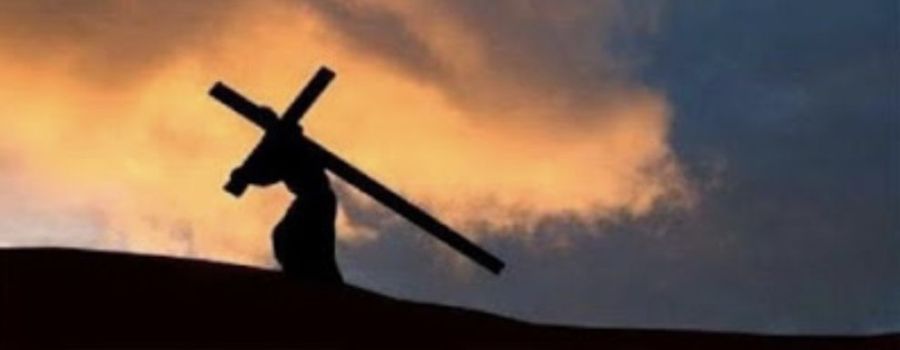
Real life in Jesus - the condemned for living against the tide
(Jn 17:11-19)
«Holy Father keep them in your Name which you have given me, that they may be One as we are» (Jn 17:11b).
At a time when intermediate social classes were coming to the fore, in a disenchanted environment such as capital Rome, Domitian also attributed himself divine titles in an attempt to stem the conspiracies of the envious senatorial aristocracy that had always been conservative, vain and scheming.
In the East - due to cultural issues - the deification of the emperor was taken more seriously, both by officials and the army ranks, as well as by the religious and social imagery of the crowds, who by mystery custom tended to identify power with sacred connubi.
For these reasons, fraternities of God's children were easily targeted in Asia Minor - harmless, yet considered a bombshell for that system, which did not want any alternative truth to enter its world.
Immersed in the death-resurrection of Christ, the communities of Faith lived as one big family, united in charity and mutual understanding - not according to already configured social obligations.
In the churches, the warmth of fraternal relationships was perceived: a nucleus of an alternative society to that of the empire, which on the horizon of its well-managed universe excluded the access of the humble and needy.
Faith played to the limit.
Thus Jesus asks the Father for an intimate custody of believers, consecrated in Him (vv.11-13.17.19)... not to remove them from tribulation, but for evangelisation.
Proceeding the path of exodus in his own and immersing himself in the situations, his Person, Word and affair prolonged the Jesuit act of consecrating the world according to Semitic categories.
Not a kind of protection of sisters and brothers, in the manner of a pagan deity, but to live the fullness of the Beatitudes.
All this, within the arc of profound discernment, and capacity for incisive action - induced by the fraternal climate and the sense of divine approval, with no more external diktats.
It was the 'power' of the 'Name' (vv.11-12): the reality of the new Face of the Most High, as revealed in the problematic story of the Son.
Primordial, intimate and empathic energy, which in the same terms - glorious and paradoxical - invested the disciples, those called to manifest the divine condition, becoming like Christ.
Even in the face of the hardships, mockeries and repulses of others, in the mutual love lived in community, in the conviviality of the differences of believers and churches, God's therapy and revival was manifested.
The Father was revealing unforeseeable love, precisely in the manifestation of this unity.
But even Jesus' presence failed to protect Judas from self-destruction.
His case is a special result, precisely because he did not trust in love and the Word of Life. Victim of influence and calculation of false external guides.
This explains the exclusion of the 'world' from Jesus' prayer (v.9).
In a closed environment, marked by the combination of 'power religion interest', one cannot be a humanising sign.
Without a life-wave, one cannot experience the sense of the Mystery in the vertigo of sharing, nor any teaching.
Sisters and brother friends must always have the grace to be freed from the world of conformist duties, which sometimes take over.
In this: "sanctified in truth" - for the mission rediscovers the density, internal rhythm and cascading effect of lived reciprocity.
In Jn, such a clear icon of the Lord is pressing in.
In his farewell, he does not demand that anyone kneel before him; rather, he dreams of a spirit of unity between disciples, and - indeed - churches.
It was the only attitude that could make it possible to resist the attacks, marginalisation and flattery of the Roman-Hellenistic world, in particular of Ephesus, the fourth city of the empire.
Jesus promises a counter joy: genuine happiness, of radical 'differences'.
Not the joy guaranteed by the opulent and dispersive environment (especially the port) of the cosmopolitan emporium of reference.
Christ did not wish to ensure the hilarious frenzy of a religiosity contaminated by ambivalences and turncoats.
In this regard, think of the great commerce guaranteed by the Artemision, and many other eminent, spectacular sacred sites, rooted in the urban layout and fabric of city life.
The ideal of the Risen One had to ferment in everyone's heart, even at that ambiguous and worldly point; not... escape into an unreachable tomorrow.
A bond that had its mirror in the intensity of the Father-Son relationship and in the dignity of the shaky and outcast who opened themselves to the Action of the Spirit.
As if to say: what was passed off as venerable had no human-divine foundation.The only sacred sphere had to be the Person and the respect for the profound, dissimilar Truth, proper to the intimate seed of the children; the one without any make-up.
"To 'keep in the Name' was thus to have access to the Father, in the Son. In Him - radiating his eccentricity, transparency and selflessness - build Unity.
Only in the awareness of this connection could the disciples dedicate their lives to witnessing other convictions - even in a climate of social intimidation.
Jesus turned his concern into prayer.
To internalise and live the message:
What do you think of a Jesus condemned for living against the tide? What is the soul and the foundation that you see reflected in the Son? How do you open yourself to the holiness of God? How do you launch yourself into the world? What do you pray for?








