Oct 16, 2026 Written by 

Bearing fruit simultaneously vs contemporary anti-vision

3. I spoke of fructification, and I am also helped in this by the Gospel, when it proposes - a reading we recently encountered in the sacred liturgy - the simile of the barren fig tree, which is threatened with uprooting (Lk 13:6-9). Man must bear fruit in time, that is, during his earthly life, and not only for himself, but also for others, for the society of which he is an integral part. However, this operation of his in time, precisely because he is "contained" in time, must neither make him forget nor neglect his other essential dimension, of being that is oriented toward eternity: man, therefore, must bear fruit simultaneously for eternity as well.

And if we take this perspective away from man, he will remain a barren fig tree.

On the one hand, he must "fill with himself" time creatively, because the otherworldly dimension certainly does not dispense him from the duty to work responsibly and originally, participating effectively and in collaboration with all other men in the building up of society according to the concrete needs of the historical moment, in which he finds himself living. It is, this, the Christian sense of the "historicity" of man. On the other hand, this commitment of faith immerses the young person in a contemporaneity, which carries within itself, in a certain sense, a vision contrary to Christianity.

This anti-view has these characteristics, which I recall in a manner, albeit briefly.

Man today often lacks a sense of the transcendent, of supernatural realities, of something that surpasses him. Man cannot live without some thing that goes further, that surpasses him. Man lives himself if he is aware of this, if he must always go beyond himself, transcend himself. This transcendence is deeply inscribed in the human constitution of the person.

Behold, in the anti-view, as I have said, contemporary, the meaning of man's existence therefore comes to be "determined" within the framework of a materialistic conception in order to the various problems, such as those of justice, work, etc.: hence arise those multiform contrasts between social categories or between national entities, in which the various collective egoisms manifest themselves. It is necessary, on the other hand, to overcome such a closed and, in the end, alienating conception, contrasting it with that broader horizon that right reason and even more so the Christian faith already let us glimpse. There, in fact, problems find a fuller solution; there justice takes on completeness and implementation in all its aspects; there human relationships, excluding all forms of selfishness, come to correspond to the dignity of man, as a person on whom the face of God shines.

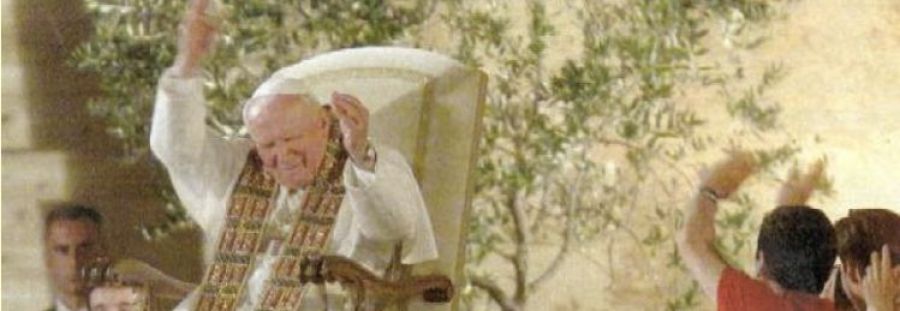
[Pope John Paul II, to the young people of Turin, April 13, 1980]

116 Last modified on Friday, 16 October 2026 03:23
don Giuseppe Nespeca

Giuseppe Nespeca è architetto e sacerdote. Cultore della Sacra scrittura è autore della raccolta "Due Fuochi due Vie - Religione e Fede, Vangeli e Tao"; coautore del libro "Dialogo e Solstizio".

Email This email address is being protected from spambots. You need JavaScript enabled to view it.
O Lord, let my faith be full, without reservations, and let penetrate into my thought, in my way of judging divine things and human things (Pope Paul VI)
O Signore, fa’ che la mia fede sia piena, senza riserve, e che essa penetri nel mio pensiero, nel mio modo di giudicare le cose divine e le cose umane (Papa Paolo VI)
The Judgment surprises and makes friends with the journey of each one who notices
Il Giudizio sorprende e fa amicizia con il viaggio di ciascuno che si accorge
This is where the challenge for your life lies! It is here that you can manifest your faith, your hope and your love! [John Paul II at the Tala Leprosarium, Manila]
È qui la sfida per la vostra vita! È qui che potete manifestare la vostra fede, la vostra speranza e il vostro amore! [Giovanni Paolo II al Lebbrosario di Tala, Manila]
The more we do for others, the more we understand and can appropriate the words of Christ: “We are useless servants” (Lk 17:10). We recognize that we are not acting on the basis of any superiority or greater personal efficiency, but because the Lord has graciously enabled us to do so [Pope Benedict, Deus Caritas est n.35]
Quanto più uno s'adopera per gli altri, tanto più capirà e farà sua la parola di Cristo: « Siamo servi inutili » (Lc 17, 10). Egli riconosce infatti di agire non in base ad una superiorità o maggior efficienza personale, ma perché il Signore gliene fa dono [Papa Benedetto, Deus Caritas est n.35]
Each time we celebrate the dedication of a church, an essential truth is recalled: the physical temple made of brick and mortar is a sign of the living Church serving in history (Pope Francis)
Ogni volta che celebriamo la dedicazione di una chiesa, ci viene richiamata una verità essenziale: il tempio materiale fatto di mattoni è segno della Chiesa viva e operante nella storia (Papa Francesco)
It is a happy image with which, however, Jesus teaches a truth that calls us into question […] If we remove God, we remove Christ and the world falls back into emptiness and darkness (Pope Benedict)
E’ un’immagine felice, con cui però Gesù insegna una verità che ci mette in discussione […] Se togliamo Dio, se togliamo Cristo, il mondo ripiomba nel vuoto e nel buio (Papa Benedetto)
We would also like to set an example ourself, even if the smallness of our means might prevent anyone from appreciating the practical and quantitative significance of it. We want to see our own charitable institutions undergo a new development in the struggle against hunger and toward meeting the main needs of the world. This is the way and the only way to build peace (Pope Paul VI)
Vorremmo anche Noi dare l'esempio, sebbene l'esiguità dei Nostri mezzi ci impedisca di farne apprezzare la rilevanza pratica e quantitativa: Noi vogliamo dare alle Nostre istituzioni caritative un nuovo sviluppo in favore della fame e dei bisogni del mondo: è in questo modo, e non altrimenti, che si costruisce la pace (Papa Paolo VI)
As St. Ambrose put it: You are not making a gift of what is yours to the poor man, but you are giving him back what is his (Pope Paul VI, Populorum Progressio n.23)
Non è del tuo avere, afferma sant’Ambrogio, che tu fai dono al povero; tu non fai che rendergli ciò che gli appartiene (Papa Paolo VI, Populorum Progressio n.23)
Here is the entire Gospel! Here! The whole Gospel, all of Christianity, is here! But make sure that it is not sentiment, it is not being a “do-gooder”! (Pope Francis)

Due Fuochi due Vie - Vol. 1 Due Fuochi due Vie - Vol. 2 Due Fuochi due Vie - Vol. 3 Due Fuochi due Vie - Vol. 4 Due Fuochi due Vie - Vol. 5 Dialogo e Solstizio I fiammiferi di Maria

duevie.art

don Giuseppe Nespeca

Tel. 333-1329741


Disclaimer

Questo blog non rappresenta una testata giornalistica in quanto viene aggiornato senza alcuna periodicità. Non può pertanto considerarsi un prodotto editoriale ai sensi della legge N°62 del 07/03/2001.
Le immagini sono tratte da internet, ma se il loro uso violasse diritti d'autore, lo si comunichi all'autore del blog che provvederà alla loro pronta rimozione.
L'autore dichiara di non essere responsabile dei commenti lasciati nei post. Eventuali commenti dei lettori, lesivi dell'immagine o dell'onorabilità di persone terze, il cui contenuto fosse ritenuto non idoneo alla pubblicazione verranno insindacabilmente rimossi.






