3. “Blessed are you!”, he says, “all you who are poor in spirit, gentle and merciful, you who mourn, who care for what is right, who are pure in heart, who make peace, you who are persecuted! Blessed are you!” But the words of Jesus may seem strange. It is strange that Jesus exalts those whom the world generally regards as weak. He says to them, “Blessed are you who seem to be losers, because you are the true winners: the kingdom of heaven is yours!” Spoken by him who is “gentle and humble in heart” (Mt 11:29), these words present a challenge which demands a deep and abiding metanoia of the spirit, a great change of heart.
You young people will understand why this change of heart is necessary! Because you are aware of another voice within you and all around you, a contradictory voice. It is a voice which says, “Blessed are the proud and violent, those who prosper at any cost, who are unscrupulous, pitiless, devious, who make war not peace, and persecute those who stand in their way”. And this voice seems to make sense in a world where the violent often triumph and the devious seem to succeed. “Yes”, says the voice of evil, “they are the ones who win. Happy are they!”
4. Jesus offers a very different message. Not far from this very place Jesus called his first disciples, as he calls you now. His call has always demanded a choice between the two voices competing for your hearts even now on this hill, the choice between good and evil, between life and death. Which voice will the young people of the twenty-first century choose to follow? To put your faith in Jesus means choosing to believe what he says, no matter how strange it may seem, and choosing to reject the claims of evil, no matter how sensible or attractive they may seem.
In the end, Jesus does not merely speak the Beatitudes. He lives the Beatitudes. He is the Beatitudes. Looking at him you will see what it means to be poor in spirit, gentle and merciful, to mourn, to care for what is right, to be pure in heart, to make peace, to be persecuted. This is why he has the right to say, “Come, follow me!” He does not say simply, “Do what I say”. He says, “Come, follow me!”
You hear his voice on this hill, and you believe what he says. But like the first disciples at the Sea of Galilee, you must leave your boats and nets behind, and that is never easy – especially when you face an uncertain future and are tempted to lose faith in your Christian heritage. To be good Christians may seem beyond your strength in today’s world. But Jesus does not stand by and leave you alone to face the challenge. He is always with you to transform your weakness into strength. Trust him when he says: “My grace is enough for you, for my power is made perfect in weakness” (2 Cor 12:9)!
5. The disciples spent time with the Lord. They came to know and love him deeply. They discovered the meaning of what the Apostle Peter once said to Jesus: “Lord, to whom shall we go? You have the words of eternal life” (Jn 6:68). They discovered that the words of eternal life are the words of Sinai and the words of the Beatitudes. And this is the message which they spread everywhere.
At the moment of his Ascension Jesus gave his disciples a mission and this reassurance: “All power in heaven and on earth has been given to me. Go, therefore, and make disciples of all nations . . . and behold I am with you always, until the end of the age” (Mt 28:18-20). For two thousand years Christ’s followers have carried out this mission. Now, at the dawn of the Third Millennium, it is your turn. It is your turn to go out into the world to preach the message of the Ten Commandments and the Beatitudes. When God speaks, he speaks of things which have the greatest importance for each person, for the people of the twenty-first century no less than those of the first century. The Ten Commandments and the Beatitudes speak of truth and goodness, of grace and freedom: of all that is necessary to enter into Christ’s Kingdom. Now it is your turn to be courageous apostles of that Kingdom!
Young people of the Holy Land, Young people of the world: answer the Lord with a heart that is willing and open! Willing and open, like the heart of the greatest daughter of Galilee, Mary, the Mother of Jesus. How did she respond? She said: “I am the servant of the Lord, let it be done to me according to your word” (Lk 1:38).
O Lord Jesus Christ, in this place that you knew and loved so well, listen to these generous young hearts! Continue to teach these young people the truth of the Commandments and the Beatitudes! Make them joyful witnesses to your truth and convinced apostles of your Kingdom! Be with them always, especially when following you and the Gospel becomes difficult and demanding! You will be their strength; you will be their victory!
O Lord Jesus, you have made these young people your friends: keep them for ever close to you! Amen.
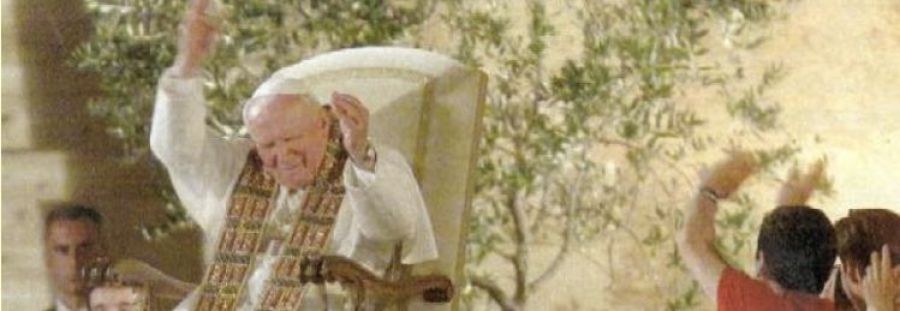
[Pope John Paul II, homily to young people, Mount of the Beatitudes 24 March 2000]