Aug 29, 2026 Written by 

In the Eucharist, or even outside the familiar congregation

4. «Come and see». You will meet Jesus where men and women are suffering and hoping: in the little villages, scattered across the continents and seemingly on the fringe of history, as Nazareth was when God sent his Angel to Mary; in the huge metropolises, where millions of human beings live often as strangers. In reality, every human being is a «fellow citizen» of Christ.

Jesus is living next to you, in the brothers and sisters with whom you share your daily existence. His visage is that of the poorest, of the marginalized who, not infrequently, are victims of an unjust model of development, in which profit is given first place and the human being is made a means rather than an end. Jesus' dwelling is wherever a human person is suffering because rights are denied, hopes betrayed, anxieties ignored. There, in the midst of humankind, is the dwelling of Christ, who asks you to dry every tear in his name, and to remind whoever feels lonely that no one whose hope is placed in Him is ever alone (cf. Mt 25:31-46).

5. Jesus dwells among those who call on Him without having known Him; among those who, after beginning to know Him, have lost Him through no fault of their own; among those who seek Him in sincerity of heart, while coming from different cultural and religious contexts (cf. Lumen Gentium, 16). As disciples and friends of Jesus, become agents of dialogue and collaboration with those who believe in a God who rules the universe with infinite love; be ambassadors of the Messiah you have found and known in his «dwelling», the Church, so that many more young people of your age may be able to follow in his footsteps; their way lighted by your fraternal charity and by the joy in your eyes that have contemplated Christ.

Jesus dwells among the men and women «honoured with the name of Christian» (cf. Lumen Gentium, 15 ). All are able to meet Him in the Scriptures, in prayer and in service of their neighbours. On the eve of the third millennium, it is becoming every day a more urgent duty to repair the scandal of the division among Christians, strengthening unity through dialogue, prayer in common and witness. It is not a matter of ignoring differences and problems in the detachment of a lukewarm relativism; that would be like covering the wound without healing it, with the risk of interrupting the journey before reaching the goal of full communion. On the contrary, it is a matter of working – under the guidance of the Holy Spirit – with a view to effective reconciliation, trusting in the efficacy of Jesus' prayer on the eve of his passion : «Father, that they may be one even as we are one» (cf. Jn 17:22). The more you cling to Jesus the more capable you will become of being close to one another; and insofar as you make concrete gestures of reconciliation you will enter into the intimacy of his love.

Jesus dwells especially in your parishes, in the communities in which you live, in the associations and ecclesial movements to which you belong, as well as in many contemporary forms of grouping and apostolate at the service of the new evangelization. This rich variety of charisms is a benefit for the whole Church, and an encouragement for every believer to place his or her capacities at the service of the one Lord, fount of salvation for all humankind.

7. Jesus lives among us in the Eucharist, the supreme fulfilment of his real presence, a presence that is contemporary with the history of humankind. Amidst the uncertainties and distractions of daily life, imitate the disciples on their way to Emmaus; like them, say to the Risen One, revealed in the act of breaking the bread: «Stay with us, for it is toward evening and the day is now far spent» (Lk 24:29). Call out to Jesus to remain with you always along the many roads to Emmaus of our time. May He be your strength, your point of reference, your enduring hope. May the Eucharistic Bread, dear young people, never be lacking on the tables of your existence. And may you draw from this Bread the strength to bear witness to the faith!

Around the Eucharistic table the harmonious unity of the Church is realized and made manifest; the mystery of missionary communion, in which all feel that they are children, sisters and brothers, without any exclusion or difference from race, language, age, social situation or culture. Dear young people, make your generous and responsible contribution to the constant building up of the Church as a family, a place of dialogue and mutual acceptance, a space of peace, mercy and pardon.

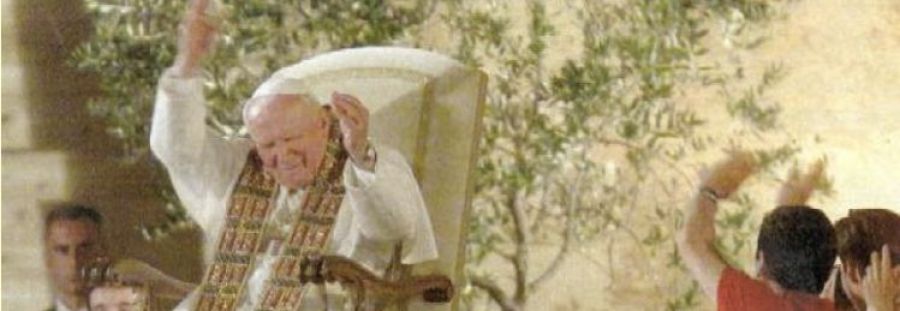
[Pope John Paul II, Message on the occasion of the 12th World Youth Day, from Castel Gandolfo, 15 August 1996]


116 Last modified on Saturday, 29 August 2026 04:32
don Giuseppe Nespeca

Giuseppe Nespeca è architetto e sacerdote. Cultore della Sacra scrittura è autore della raccolta "Due Fuochi due Vie - Religione e Fede, Vangeli e Tao"; coautore del libro "Dialogo e Solstizio".

Email This email address is being protected from spambots. You need JavaScript enabled to view it.
The question makes apparent the concern, present in ancient Jewish tradition, over finding a unifying principle in the various formulations of God's will […] Emphasis is placed on the totality of this dedication to God, listing the three faculties that define man in his deep psychological structures: heart, soul and mind. The word mind, diánoia, contains the rational element (Pope Benedict)
La domanda lascia trasparire la preoccupazione, presente nell’antica tradizione giudaica, di trovare un principio unificatore delle varie formulazioni della volontà di Dio […] L’accento è posto sulla totalità di questa dedizione a Dio, elencando le tre facoltà che definiscono l’uomo nelle sue strutture psicologiche profonde: cuore, anima e mente. Il termine mente, diánoia, contiene l’elemento razionale (Papa Benedetto)
A “year” of grace: the period of Christ’s ministry, the time of the Church before his glorious return, an interval of our life (Pope Francis)
Un “anno” di grazia: il tempo del ministero di Cristo, il tempo della Chiesa prima del suo ritorno glorioso, il tempo della nostra vita (Papa Francesco)
The Church, having before her eyes the picture of the generation to which we belong, shares the uneasiness of so many of the people of our time (Dives in Misericordia n.12)
Avendo davanti agli occhi l'immagine della generazione a cui apparteniamo, la Chiesa condivide l'inquietudine di tanti uomini contemporanei (Dives in Misericordia n.12)
Addressing this state of mind, the Church testifies to her hope, based on the conviction that evil, the mysterium iniquitatis, does not have the final word in human affairs (Pope John Paul II)
Di fronte a questi stati d'animo la Chiesa desidera testimoniare la sua speranza, basata sulla convinzione che il male, il mysterium iniquitatis, non ha l'ultima parola nelle vicende umane (Papa Giovanni Paolo II)
Jesus reminds us today that the expectation of the eternal beatitude does not relieve us of the duty to render the world more just and more liveable (Pope Francis)
Gesù oggi ci ricorda che l’attesa della beatitudine eterna non ci dispensa dall’impegno di rendere più giusto e più abitabile il mondo (Papa Francesco)
Those who open to Him will be blessed, because they will have a great reward: indeed, the Lord will make himself a servant to his servants — it is a beautiful reward — in the great banquet of his Kingdom He himself will serve them [Pope Francis]
E sarà beato chi gli aprirà, perché avrà una grande ricompensa: infatti il Signore stesso si farà servo dei suoi servi - è una bella ricompensa - nel grande banchetto del suo Regno passerà Lui stesso a servirli [Papa Francesco]
The fool in the Bible, the one who does not want to learn from the experience of visible things, that nothing lasts for ever but that all things pass away, youth and physical strength, amenities and important roles. Making one's life depend on such an ephemeral reality is therefore foolishness (Pope Benedict)
L’uomo stolto nella Bibbia è colui che non vuole rendersi conto, dall’esperienza delle cose visibili, che nulla dura per sempre, ma tutto passa: la giovinezza come la forza fisica, le comodità come i ruoli di potere. Far dipendere la propria vita da realtà così passeggere è, dunque, stoltezza (Papa Benedetto)
As sometimes happens in the Gospel, faced with the trap set by his enemies, Jesus, with his response, rises above the contingent controversy and goes far beyond the particular and mutually divergent positions (Pope John Paul II)

Due Fuochi due Vie - Vol. 1 Due Fuochi due Vie - Vol. 2 Due Fuochi due Vie - Vol. 3 Due Fuochi due Vie - Vol. 4 Due Fuochi due Vie - Vol. 5 Dialogo e Solstizio I fiammiferi di Maria

duevie.art

don Giuseppe Nespeca

Tel. 333-1329741


Disclaimer

Questo blog non rappresenta una testata giornalistica in quanto viene aggiornato senza alcuna periodicità. Non può pertanto considerarsi un prodotto editoriale ai sensi della legge N°62 del 07/03/2001.
Le immagini sono tratte da internet, ma se il loro uso violasse diritti d'autore, lo si comunichi all'autore del blog che provvederà alla loro pronta rimozione.
L'autore dichiara di non essere responsabile dei commenti lasciati nei post. Eventuali commenti dei lettori, lesivi dell'immagine o dell'onorabilità di persone terze, il cui contenuto fosse ritenuto non idoneo alla pubblicazione verranno insindacabilmente rimossi.





