Jul 11, 2026 Written by 

It is not a figure of speech

5. As the cross can be reduced to being an ornament, “to carry the cross” can become just a manner of speaking. In the teaching of Jesus, however, it does not imply the pre-eminence of mortification and denial. It does not refer primarily to the need to endure patiently  the great and small tribulations of life, or, even less, to the exaltation of pain as a means of pleasing God. It is not suffering for its own sake that a Christian seeks, but love. When the cross is embraced it becomes a sign of love and of total self-giving. To carry it behind Christ means to be united with him in offering the greatest proof of love.

We cannot speak about the cross without considering God’s love for us, the fact that God wishes to shower us with good things. With his invitation “follow me”, Jesus not only says again to his disciples: take me as your model, but also: share my life and my choices, and stake your life for love of God and for neighbour together with me. This is how Jesus opens up before us the “way of life”. Unfortunately, this is constantly being threatened by the “way of death”. Sin is this way that separates a person from God and neighbour and brings about division and undermines  society from within.

The “way of life” continues and renews the mind of Christ in us  and becomes the way of faith and conversion. It is indeed the way of the cross. It is the way that leads one to trust in him and his plan of salvation, and to believe that He died in order to show God’s love for each one. It is the way to salvation in a society often divided, confused and contradictory. It is the way to the happiness found in following Christ right to the end, in the sometimes dramatic circumstances of daily life.  It is the way that does not fear  failure, difficulties, isolation, loneliness, because it fills our hearts with the presence of Jesus. It is the path of peace, self-control and a joyful heart.

6. My dear young people, do not think it strange that, at the beginning of the third millennium, the Pope once again directs you towards the Cross of Christ as the path of life and true happiness. The Church has always believed and proclaimed that only in the Cross of Christ  is there salvation.

There is a widespread culture of the ephemeral that only attaches value to whatever is pleasing or beautiful, and it would like us to believe that it is necessary to remove the cross in order to be happy. The ideal presented is one of instant success, a fast career, sexuality separated from any sense of responsibility, and ultimately, an existence centred on self affirmation, often bereft of respect for others.

Open your eyes and observe well, my dear young people: this is not the road that leads to true life, but it is the path that sinks into death. Jesus said: “Whoever wishes to save his life will lose it, but whoever loses his life for my sake will save it.” Jesus leaves us under no illusions: “What profit is there for one to gain the whole world yet lose or forfeit himself?” (Lk 9:24-25). With the truth of his words that sound hard but  fill the heart with peace, Jesus reveals the secret of how to live a true life (cf. Talk to the young people of Rome, 2 April 1998).

Therefore, do not be afraid to walk the way first trodden by the Lord. With your youthfulness, put your mark of hope and enthusiasm, so typical of your age, on the third millennium that is just beginning. If you allow the grace of God to work in you, and earnestly fulfill this commitment daily, you will make this new century a better time for everyone.

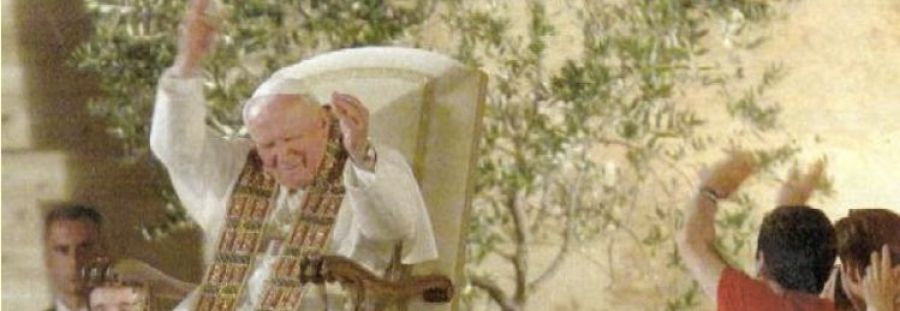
[Pope John Paul II, Message for the 16th World Youth Day, 14 February 2001]

15 Last modified on Saturday, 11 July 2026 15:52
don Giuseppe Nespeca

Giuseppe Nespeca è architetto e sacerdote. Cultore della Sacra scrittura è autore della raccolta "Due Fuochi due Vie - Religione e Fede, Vangeli e Tao"; coautore del libro "Dialogo e Solstizio".

Email This email address is being protected from spambots. You need JavaScript enabled to view it.
This Parable of the Sower is somewhat the ‘mother’ of all parables […] Such is the heart of God! Each one of us is ground on which the seed of the Word falls; no one is excluded! [Pope Francis]
Questa del seminatore è un po’ la “madre” di tutte le parabole […] Così è il cuore di Dio! Ognuno di noi è un terreno su cui cade il seme della Parola, nessuno è escluso [Papa Francesco]
Are we not perhaps all afraid in some way? If we let Christ enter fully into our lives, if we open ourselves totally to him, are we not afraid that He might take something away from us? Are we not perhaps afraid to give up something significant, something unique, something that makes life so beautiful? Do we not then risk ending up diminished and deprived of our freedom? (Pope Benedict)
Non abbiamo forse tutti in qualche modo paura - se lasciamo entrare Cristo totalmente dentro di noi, se ci apriamo totalmente a lui – paura che Egli possa portar via qualcosa della nostra vita? Non abbiamo forse paura di rinunciare a qualcosa di grande, di unico, che rende la vita così bella? Non rischiamo di trovarci poi nell’angustia e privati della libertà? (Papa Benedetto)
«Is there an attitude for those who want to follow Jesus» so that «they do not end badly, that they do not end up eaten alive - as my mother used to say: "Eat raw" - by others»? (Pope Francis)
«Esiste un atteggiamento per quelli che vogliono seguire Gesù» in modo che «non finiscano male, che non finiscano mangiati vivi — come diceva mia mamma: “Mangiati crudi” — dagli altri»? (Papa Francesco)
For Christians, volunteer work is not merely an expression of good will. It is based on a personal experience of Christ (Pope Benedict)
Per i cristiani, il volontariato non è soltanto espressione di buona volontà. È basato sull’esperienza personale di Cristo (Papa Benedetto)
Christ reveals his identity of Messiah, Israel's bridegroom, who came for the betrothal with his people. Those who recognize and welcome him are celebrating. However, he will have to be rejected and killed precisely by his own; at that moment, during his Passion and death, the hour of mourning and fasting will come (Pope Benedict)
Cristo rivela la sua identità di Messia, Sposo d'Israele, venuto per le nozze con il suo popolo. Quelli che lo riconoscono e lo accolgono con fede sono in festa. Egli però dovrà essere rifiutato e ucciso proprio dai suoi: in quel momento, durante la sua passione e la sua morte, verrà l'ora del lutto e del digiuno (Papa Benedetto)
For the prodigious and instantaneous healing of the paralytic, the apostle St. Matthew is more sober than the other synoptics, St. Mark and St. Luke. These add broader details, including that of the opening of the roof in the environment where Jesus was, to lower the sick man with his lettuce, given the huge crowd that crowded at the entrance. Evident is the hope of the pitiful companions: they almost want to force Jesus to take care of the unexpected guest and to begin a dialogue with him (Pope Paul VI)
As the cross can be reduced to being an ornament, “to carry the cross” can become just a manner of speaking (John Paul II)
Come la croce può ridursi ad oggetto ornamentale, così "portare la croce" può diventare un modo di dire (Giovanni Paolo II)

Due Fuochi due Vie - Vol. 1 Due Fuochi due Vie - Vol. 2 Due Fuochi due Vie - Vol. 3 Due Fuochi due Vie - Vol. 4 Due Fuochi due Vie - Vol. 5 Dialogo e Solstizio I fiammiferi di Maria

duevie.art

don Giuseppe Nespeca

Tel. 333-1329741


Disclaimer

Questo blog non rappresenta una testata giornalistica in quanto viene aggiornato senza alcuna periodicità. Non può pertanto considerarsi un prodotto editoriale ai sensi della legge N°62 del 07/03/2001.
Le immagini sono tratte da internet, ma se il loro uso violasse diritti d'autore, lo si comunichi all'autore del blog che provvederà alla loro pronta rimozione.
L'autore dichiara di non essere responsabile dei commenti lasciati nei post. Eventuali commenti dei lettori, lesivi dell'immagine o dell'onorabilità di persone terze, il cui contenuto fosse ritenuto non idoneo alla pubblicazione verranno insindacabilmente rimossi.






