

1. As we said in the previous catechesis, it is not possible to understand the origins of the Church without taking into account everything that Jesus preached and did (cf. Acts 1:1). It is precisely on this subject that he addressed his disciples and left us all a fundamental teaching in the parables concerning the Kingdom of God. Among these, those which set out and help us to discover the nature of the historical and spiritual development that is proper to the Church, in accordance with the plan of her Founder himself, are of particular importance.
2. Jesus says: “The Kingdom of God is like a man who scatters seed on the ground: whether he sleeps or wakes, night or day, the seed sprouts and grows; how, he himself does not know. For the earth brings forth of its own accord, first the stalk, then the ear, then the full grain in the ear. When the crop is ready, the sickle is immediately put to work, for the harvest has come’ (Mk 4:26–29). Thus, the Kingdom of God grows here on earth, within human history, by virtue of an initial sowing—that is, a foundation—which comes from God, and of a mysterious working of God himself, who continues to nurture the Church throughout the centuries. God’s action concerning the Kingdom also involves the sickle of sacrifice: the Kingdom cannot develop without suffering. This is the meaning of the parable recorded in the Gospel of Mark.
3. We find the same concept in other parables too, especially those collected in the Gospel of Matthew (Mt 13:3–50).
‘The Kingdom of Heaven,’ we read in this Gospel, ‘may be compared to a mustard seed, which a man takes and sows in his field. It is the smallest of all seeds, but once it has grown, it is larger than the other vegetables and becomes a tree, so that the birds of the air nest among its branches’ (Mt 13:31). This is the growth of the Kingdom in an ‘extensive’ sense.
Another parable, however, illustrates its growth in an ‘intensive’ or qualitative sense, comparing it to yeast, which a woman took and mixed into three measures of flour so that the whole batch might rise’ (Mt 13:32).
4. In the parable of the sower and the sowing, the growth of the Kingdom of God certainly appears as the fruit of the sower’s labour, but it is in relation to the soil and the climatic conditions that the sowing produces a harvest: “in one place a hundredfold, in another sixtyfold, in another thirtyfold” (Mt 13:8). The soil signifies people’s inner receptiveness. Therefore, according to Jesus, the growth of the Kingdom of God is also conditioned by human beings. Human free will is responsible for this growth. This is why Jesus urges everyone to pray: “Thy kingdom come” (cf. Mt 6:10; Lk 11:2): it is one of the first petitions of the Lord’s Prayer.
5. One of the parables told by Jesus concerning the growth of the Kingdom of God on earth reveals to us, in a very realistic way, the struggle inherent in the Kingdom, due to the presence and action of an ‘enemy’ who ‘sows tares (or weeds) amongst the wheat’. Jesus says that, when ‘the crop had grown and borne fruit, then the tares also appeared’. The servants of the owner of the field would like to pull it up, but the owner does not allow them to do so, ‘lest . . . you uproot the wheat as well. Let both grow together until the harvest; and at harvest time I will tell the reapers: First gather the weeds and bind them in bundles to be burnt; but gather the wheat into my barn’ (Mt 13:24–30). This parable explains the coexistence and often the intertwining of good and evil in the world, in our lives, and in the very history of the Church. Jesus teaches us to view things with Christian realism and to deal with every problem with clarity of principle, but also with prudence and patience. This presupposes a transcendent view of history, in which we know that everything belongs to God and every final outcome is the work of his Providence. Yet the final fate – of an eschatological nature – of the good and the wicked is not hidden: it is symbolised by the gathering of the wheat into the storehouse and the burning of the weeds.
6. Jesus himself explains the parable of the sower at the disciples’ request (cf. Mt 13:36–43). His words reveal both the temporal and eschatological dimensions of the Kingdom of God.
He says to his disciples: “To you has been entrusted the mystery of the Kingdom of God” (Mk 4:11). He instructs them on this mystery and, at the same time, through his word and his work, “prepares a kingdom for them, just as the Father has prepared it for him (the Son)” (cf. Lk 22:29). This preparation is also taken up again after his Resurrection: indeed, we read in the Acts of the Apostles that ‘he appeared to them over a period of forty days and spoke about the Kingdom of God’ (cf. Acts 1:3) until the day when ‘he was taken up into heaven and sat at the right hand of God’ (Mark 16:19). These were the final instructions and directives to the Apostles on what they were to do after the Ascension and Pentecost to bring about the concrete beginning of the Kingdom of God at the founding of the Church.
7. The words addressed to Peter at Caesarea Philippi also form part of his preaching on the Kingdom. He says to him, in fact: “I will give you the keys of the Kingdom of Heaven” (Mt 16:19), immediately after calling him the rock upon which he would build his Church, which would be invincible against “the gates of Hades” (cf. Mt 16:18). This promise was expressed at the time using the future tense: ‘I will build’, because the definitive establishment of the Kingdom of God in this world was yet to be accomplished through the sacrifice of the Cross and the victory of the Resurrection. After that, Peter, together with the other Apostles, would have a living awareness of their calling to ‘proclaim the marvellous deeds of him who has called them out of darkness into his marvellous light’ (cf. 1 Pet 2:9). At the same time, they would all also be aware of the truth that emerges from the parable of the sower, namely that ‘neither the one who plants nor the one who waters is anything, but God who makes things grow’, as Saint Paul would write (1 Cor 3:7).
8. The author of the Book of Revelation expresses this same awareness of the kingdom when he recounts the song addressed to the Lamb: ‘You were slain, and with your blood you have ransomed for God people from every tribe, language, people and nation, and you have made them a kingdom of priests for our God’ (Rev 5:9–10). The Apostle Peter specifies that they have been made such “to offer spiritual sacrifices acceptable to God through Jesus Christ” (cf. 1 Pet 2:5). These are all expressions of the truths taught by Jesus who, in the parables of the sower and the sowing, of the growth of the wheat and the weeds, and of the mustard seed which is sown and then grows into a large plant, spoke of the Kingdom of God which, under the action of the Holy Spirit, grows within souls thanks to the life-giving power derived from his death and resurrection: a kingdom that grows until the time appointed by God himself.
9. “Then comes the end,” St Paul proclaims, “when he (Christ) will hand over the kingdom to God the Father, after he has put every rule and every authority and power to nothing” (1 Cor 15:24). For when “everything has been brought under his authority, then the Son himself will also be subject to the One who has put all things under his authority, so that God may be all in all” (1 Cor 15:28).
The existence of the Church, from the beginning to the end, is inscribed within this marvellous eschatological vision of the Kingdom of God, and its history unfolds from the first day to the last.
[John Paul II, General Audience, 25 September 1991]
-
font size
decrease font size
 increase font size
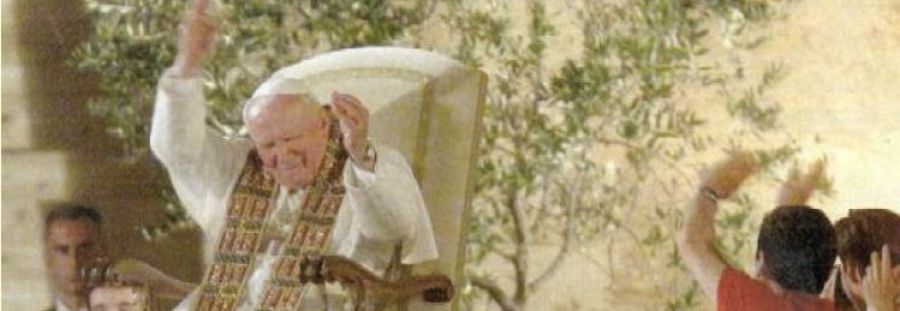
Like a man who sows a seed

don Giuseppe Nespeca
Giuseppe Nespeca è architetto e sacerdote. Cultore della Sacra scrittura è autore della raccolta "Due Fuochi due Vie - Religione e Fede, Vangeli e Tao"; coautore del libro "Dialogo e Solstizio".
Email This email address is being protected from spambots. You need JavaScript enabled to view it.And this is the problem: when the People put down roots in the land and are the depository of the Law, they are tempted to place their security and joy in something that is no longer the Word of God (Pope Benedict)
Ed ecco il problema: quando il popolo si stabilisce nella terra, ed è depositario della Legge, è tentato di riporre la sua sicurezza e la sua gioia in qualcosa che non è più la Parola del Signore (Papa Benedetto)
Despite the scarcity of information about him, St Bartholomew stands before us to tell us that attachment to Jesus can also be lived and witnessed to without performing sensational deeds. Jesus himself, to whom each one of us is called to dedicate his or her own life and death, is and remains extraordinary (Pope Benedict)
La figura di san Bartolomeo, pur nella scarsità delle informazioni che lo riguardano, resta comunque davanti a noi per dirci che l'adesione a Gesù può essere vissuta e testimoniata anche senza il compimento di opere sensazionali. Straordinario è e resta Gesù stesso, a cui ciascuno di noi è chiamato a consacrare la propria vita e la propria morte (Papa Benedetto)
Faith is more than just empirical or historical facts; it is an ability to grasp the mystery of Christ’s person in all its depth [Pope Benedict]
La fede va al di là dei semplici dati empirici o storici, ed è capace di cogliere il mistero della persona di Cristo nella sua profondità [Papa Benedetto]
More than 600 precepts are mentioned in the Law of Moses. How should the great commandment be distinguished among these? (Pope Francis)
Nella Legge di Mosè sono menzionati oltre seicento precetti. Come distinguere, tra tutti questi, il grande comandamento? (Papa Francesco)
The invitation has three characteristics: freely offered, breadth and universality. Many people were invited, but something surprising happened: none of the intended guests came to take part in the feast, saying they had other things to do; indeed, some were even indifferent, impertinent, even annoyed (Pope Francis)
L’invito ha tre caratteristiche: la gratuità, la larghezza, l’universalità. Gli invitati sono tanti, ma avviene qualcosa di sorprendente: nessuno dei prescelti accetta di prendere parte alla festa, dicono che hanno altro da fare; anzi alcuni mostrano indifferenza, estraneità, perfino fastidio (Papa Francesco)
Those who are considered the "last", if they accept, become the "first", whereas the "first" can risk becoming the "last" (Pope Benedict)
Proprio quelli che sono considerati "ultimi", se lo accettano, diventano "primi", mentre i "primi" possono rischiare di finire "ultimi" (Papa Benedetto)
The dialogue of Jesus with the rich young man, related in the nineteenth chapter of Saint Matthew's Gospel, can serve as a useful guide for listening once more in a lively and direct way to his moral teaching [Veritatis Splendor n.6]
Il dialogo di Gesù con il giovane ricco, riferito nel capitolo 19 del Vangelo di san Matteo, può costituire un'utile traccia per riascoltare in modo vivo e incisivo il suo insegnamento morale [Veritatis Splendor n.6]
St Augustine rightly commented: “Christ showed himself indifferent to her, not in order to refuse her his mercy but rather to inflame her desire for it” (Sermo 77, 1: PL 38, 483) [Pope Benedict]
These words are full of the disarming power of truth that pulls down the wall of hypocrisy and opens consciences [Pope Benedict]
Queste parole sono piene della forza disarmante della verità, che abbatte il muro dell’ipocrisia e apre le coscienze [Papa Benedetto]








duevie.art
don Giuseppe Nespeca
Tel. 333-1329741
Disclaimer
Questo blog non rappresenta una testata giornalistica in quanto viene aggiornato senza alcuna periodicità. Non può pertanto considerarsi un prodotto editoriale ai sensi della legge N°62 del 07/03/2001.
Le immagini sono tratte da internet, ma se il loro uso violasse diritti d'autore, lo si comunichi all'autore del blog che provvederà alla loro pronta rimozione.
L'autore dichiara di non essere responsabile dei commenti lasciati nei post. Eventuali commenti dei lettori, lesivi dell'immagine o dell'onorabilità di persone terze, il cui contenuto fosse ritenuto non idoneo alla pubblicazione verranno insindacabilmente rimossi.