May 25, 2026 Written by 

Imbue everything with the Gospel spirit

1. Jesus' incisive statement: 'Render unto Caesar the things that are Caesar's, and unto God the things that are God's' (Matthew 22:21), answers a problem that was much discussed in his day and is still very much felt today. What attitude should believers have towards civil authority and the laws of the state? What commitment should they make as citizens with regard to their duties in the social and political spheres?

The occasion is offered to Jesus by a question that was much debated at the time concerning the lawfulness or otherwise of paying tribute to the emperor of Rome. The positions, in fact, were diversified and the reasons given to support the lawfulness or unlawfulness of the taxes imposed by the Romans were also different.

In this context, the question put to Jesus by the Pharisees: "Is it lawful or not to pay tribute to Caesar?" constituted an insidious challenge to the Master, considered by all as the one who taught the way of God according to truth.

As sometimes happens in the Gospel, faced with the trap set by his enemies, Jesus, with his answer, rises above the contingent controversy and goes far beyond the particular and mutually divergent positions.

On the one hand, by commanding them to return to Caesar what belongs to him, he declares that paying the tax is not an act of idolatry, but a duty of honest citizens; on the other hand, by recalling the primacy of God in human life and history, he asks them to return to him what is due to him as the one and only true 'Lord'.

2. With this statement, Jesus makes a clear distinction between the duties required of believers, as citizens and as children of God. Without, however, placing them in conflict. Thus, from a particular issue, such as the tribute to be given to Caesar, new horizons emerge for the mission of Christians in society.

By reason of faith, each one (of you) is called to transform history, to permeate all human and social reality with the spirit of the Gospel. No one can or should alienate himself from the required tasks of working to ensure a more just and fraternal civil coexistence. This duty must be done, however, in full fidelity to the Gospel message, in docile submission to the Spirit, without ever shirking what is required by the laws of the state that aim to do so. It must be done above all by giving primacy to what is in the first place: God, his plan of salvation, his law, spiritual and transcendent values.

The profession of faith in Christ, belonging to the kingdom of God and the lifestyle that flows from it are to be lived not "outside", but "inside" history as a "service" to be rendered to the city of men and therefore to the common good and the integral promotion of each person.

Faith, integrally lived, impels you to assume strong and precise responsibilities in that immense human endeavour to promote and safeguard fundamental human rights for a peaceful and fraternal coexistence among all.

3. It is therefore a commitment connected with an authentic and hard-working faith, which demands adequate training, deep convictions, consistent witness. And so it also takes on the characteristics of a true service of charity towards all men.

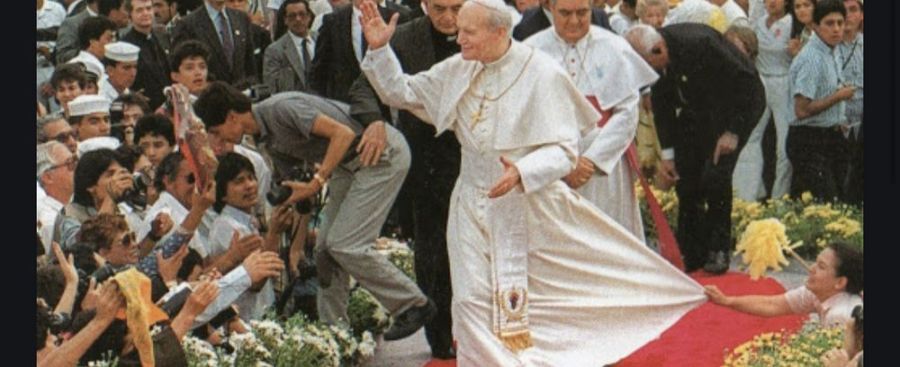
[Pope John Paul II, homily 21 October 1990]

24 Last modified on Monday, 25 May 2026 05:22
don Giuseppe Nespeca

Giuseppe Nespeca è architetto e sacerdote. Cultore della Sacra scrittura è autore della raccolta "Due Fuochi due Vie - Religione e Fede, Vangeli e Tao"; coautore del libro "Dialogo e Solstizio".

Email This email address is being protected from spambots. You need JavaScript enabled to view it.
As sometimes happens in the Gospel, faced with the trap set for him by his enemies, Jesus, with his response, rises above the contingent controversy and goes far beyond the particular and mutually divergent positions (John Paul II)
Come talora accade nel Vangelo, di fronte al tranello mossogli dai suoi nemici, Gesù, con la sua risposta, s’innalza al di sopra della polemica contingente e va ben oltre le posizioni particolari e tra loro divergenti (Giovanni Paolo II)
This Name clearly expresses that the God of the Bible is not some kind of monad closed in on itself and satisfied with his own self-sufficiency but he is life that wants to communicate itself, openness, relationship [Pope Benedict]
Questo nome esprime dunque chiaramente che il Dio della Bibbia non è una sorta di monade chiusa in se stessa e soddisfatta della propria autosufficienza, ma è vita che vuole comunicarsi, è apertura, relazione [Papa Benedetto]
There, however, in the place that should have been taken up by the encounter between God and man, he found livestock merchants and money-changers who occupied this place of prayer with their commerce […] In the temple's purification, however, it was a matter of more than fighting abuses. A new time in history was foretold (Pope Benedict)
Ma là dove doveva esservi lo spazio dell’incontro tra Dio e l’uomo, Egli trova commercianti di bestiame e cambiavalute che occupano con i loro affari il luogo di preghiera […] Nella purificazione del tempio, però, si tratta di più che della lotta agli abusi. È preconizzata una nuova ora della storia (Papa Benedetto)
«Ask Jesus for the grace to follow him closely», so as not to leave him alone, thus overcoming the temptations of looking at ourselves to «share the cake» of personal interests [Pope Francis]
«Chiedere a Gesù la grazia di seguirlo da vicino», per non lasciarlo solo, superando così le tentazioni di guardare noi stessi per «spartirsi la torta» degli interessi personali [Papa Francesco]
First, in Nazareth, he makes him grow, raises him, educates him, but then follows him: "Your mother is there" (Pope Francis)
Prima, a Nazareth, lo fa crescere, lo alleva, lo educa, ma poi lo segue: “La tua madre è lì” (Papa Francesco)
Unity is not made with glue [...] The great prayer of Jesus is to «resemble» the Father (Pope Francis)
L’Unità non si fa con la colla […] La grande preghiera di Gesù» è quella di «assomigliare» al Padre (Papa Francesco)
Divisions among Christians, while they wound the Church, wound Christ; and divided, we cause a wound to Christ: the Church is indeed the body of which Christ is the Head (Pope Francis)
Le divisioni tra i cristiani, mentre feriscono la Chiesa, feriscono Cristo, e noi divisi provochiamo una ferita a Cristo: la Chiesa infatti è il corpo di cui Cristo è capo (Papa Francesco)
The glorification that Jesus asks for himself as High Priest, is the entry into full obedience to the Father, an obedience that leads to his fullest filial condition [Pope Benedict]
La glorificazione che Gesù chiede per se stesso, quale Sommo Sacerdote, è l'ingresso nella piena obbedienza al Padre, un'obbedienza che lo conduce alla sua più piena condizione filiale [Papa Benedetto]

Due Fuochi due Vie - Vol. 1 Due Fuochi due Vie - Vol. 2 Due Fuochi due Vie - Vol. 3 Due Fuochi due Vie - Vol. 4 Due Fuochi due Vie - Vol. 5 Dialogo e Solstizio I fiammiferi di Maria

duevie.art

don Giuseppe Nespeca

Tel. 333-1329741


Disclaimer

Questo blog non rappresenta una testata giornalistica in quanto viene aggiornato senza alcuna periodicità. Non può pertanto considerarsi un prodotto editoriale ai sensi della legge N°62 del 07/03/2001.
Le immagini sono tratte da internet, ma se il loro uso violasse diritti d'autore, lo si comunichi all'autore del blog che provvederà alla loro pronta rimozione.
L'autore dichiara di non essere responsabile dei commenti lasciati nei post. Eventuali commenti dei lettori, lesivi dell'immagine o dell'onorabilità di persone terze, il cui contenuto fosse ritenuto non idoneo alla pubblicazione verranno insindacabilmente rimossi.






