May 6, 2026 Written by 

The fate of Christians

To the disciples Jesus addresses the invitation to rejoice, to overcome the temptation of sadness for the departure of the Master, because this departure is a condition laid down in the divine plan for the coming of the Holy Spirit: "It is good for you that I go away, because if I do not go away the Paraclete will not come to you; but when I have gone away, I will send him to you" (Jn 16:7). It will be the gift of the Spirit that will bring the disciples great joy, indeed the fullness of joy, according to the intention expressed by Jesus. After inviting the disciples to remain in his love, the Saviour said: "This I have spoken to you that my joy may be in you and that your joy may be full" (Jn 15:11; cf. Jn 17:13). It is the Holy Spirit who puts into the hearts of the disciples the same joy as Jesus, the joy of faithfulness to the love that comes from the Father.

St Luke records that the disciples, who at the time of the Ascension had received the promise of the gift of the Holy Spirit, "returned to Jerusalem with great joy and were always in the temple praising God" (Lk 24:52-53). In the Acts of the Apostles it appears that, after Pentecost, a climate of profound joy was created in the Apostles, which was communicated to the community in the form of exultation and enthusiasm in embracing the faith, receiving baptism, and living together, as evidenced by "taking meals with gladness and simplicity of heart, praising God and enjoying the sympathy of all the people" (Acts 2:46-47). The book of Acts notes: "The disciples were filled with joy and with the Holy Spirit" (Acts 13, 52).

6. Soon would come the tribulations and persecutions foretold by Jesus in announcing the coming of the Paraclete-Consoler (cf. Jn 16:1ff). But according to Acts, joy endures even in trial: we read that the Apostles, when they were brought before the Sanhedrin, flogged, admonished and sent home, returned "rejoicing that they had been outraged for the sake of the name of Jesus. And every day, in the temple and at home, they did not cease to teach and to bring the good news that Jesus is the Christ" (Acts 5:41-42).

This, after all, is the condition and lot of Christians, as St Paul reminds the Thessalonians: "You have become imitators of us and of the Lord, having received the word with the joy of the Holy Spirit even in the midst of great tribulation" (1 Thess 1:6). Christians, according to Paul, repeat in themselves the paschal mystery of Christ, which has the Cross as its pivot. But its crowning glory is the "joy of the Holy Spirit" for those who persevere in trials. This is the joy of the beatitudes, and more particularly the beatitude of the afflicted, and of the persecuted (cf. Mt 5:4, 10-12). Did not the Apostle Paul say: 'I rejoice in the sufferings I endure for you . . ." (Col 1:24)? And Peter, for his part, exhorted: "Inasmuch as you share in the sufferings of Christ, rejoice, that in the revelation of his glory you may also rejoice and exult" (1 Pet 4:13).

Let us pray to the Holy Spirit to kindle in us more and more the desire for heavenly goods and make us one day enjoy their fullness: "Give virtue and reward, give holy death, give eternal joy.

Amen.

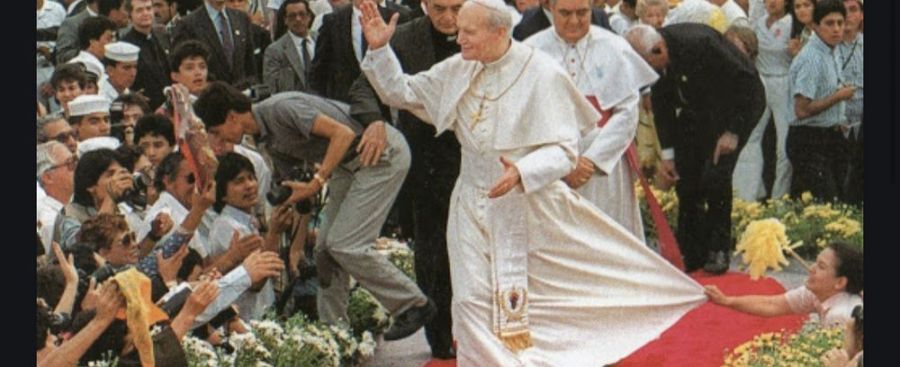
[Pope John Paul II, General Audience, 19 June 1991]

1 Last modified on Wednesday, 06 May 2026 03:48
don Giuseppe Nespeca

Giuseppe Nespeca è architetto e sacerdote. Cultore della Sacra scrittura è autore della raccolta "Due Fuochi due Vie - Religione e Fede, Vangeli e Tao"; coautore del libro "Dialogo e Solstizio".

Email This email address is being protected from spambots. You need JavaScript enabled to view it.
«When the servant of God is troubled, as it happens, by something, he must get up immediately to pray, and persevere before the Supreme Father until he restores to him the joy of his salvation. Because if it remains in sadness, that Babylonian evil will grow and, in the end, will generate in the heart an indelible rust, if it is not removed with tears» (St Francis of Assisi, FS 709)
«Il servo di Dio quando è turbato, come capita, da qualcosa, deve alzarsi subito per pregare, e perseverare davanti al Padre Sommo sino a che gli restituisca la gioia della sua salvezza. Perché se permane nella tristezza, crescerà quel male babilonese e, alla fine, genererà nel cuore una ruggine indelebile, se non verrà tolta con le lacrime» (san Francesco d’Assisi, FF 709)
Wherever people want to set themselves up as God they cannot but set themselves against each other. Instead, wherever they place themselves in the Lord’s truth they are open to the action of his Spirit who sustains and unites them (Pope Benedict
Dove gli uomini vogliono farsi Dio, possono solo mettersi l’uno contro l’altro. Dove invece si pongono nella verità del Signore, si aprono all’azione del suo Spirito che li sostiene e li unisce (Papa Benedetto)
But our understanding is limited: thus, the Spirit's mission is to introduce the Church, in an ever new way from generation to generation, into the greatness of Christ's mystery. The Spirit places nothing different or new beside Christ; no pneumatic revelation comes with the revelation of Christ - as some say -, no second level of Revelation (Pope Benedict)
Ma la nostra capacità di comprendere è limitata; perciò la missione dello Spirito è di introdurre la Chiesa in modo sempre nuovo, di generazione in generazione, nella grandezza del mistero di Cristo. Lo Spirito non pone nulla di diverso e di nuovo accanto a Cristo; non c’è nessuna rivelazione pneumatica accanto a quella di Cristo - come alcuni credono - nessun secondo livello di Rivelazione (Papa Benedetto)
Who touched Lydia's heart? The answer is: «the Holy Spirit». It’s He who made this woman feel that Jesus was Lord; He made this woman feel that salvation was in Paul's words; He made this woman feel a testimony (Pope Francis)
Chi ha toccato il cuore di Lidia? La risposta è: «lo Spirito Santo». È lui che ha fatto sentire a questa donna che Gesù era il Signore; ha fatto sentire a questa donna che la salvezza era nelle parole di Paolo; ha fatto sentire a questa donna una testimonianza (Papa Francesco)
But what does it mean to love Christ?  It means trusting him even in times of trial, following him faithfully even on the Via Crucis, in the hope that soon the morning of the Resurrection will come.  Entrusting ourselves to Christ, we lose nothing, we gain everything.  In his hands our life acquires its true meaning.  Love for Christ expresses itself in the will to harmonize our own life with the thoughts and sentiments of his Heart.  This is achieved through interior union [Pope Benedict]
Ma che vuol dire amare Cristo? Vuol dire fidarsi di Lui anche nell'ora della prova, seguirLo fedelmente anche sulla Via Crucis, nella speranza che presto verrà il mattino della risurrezione. Affidandoci a Cristo non perdiamo niente, ma acquistiamo tutto. Nelle sue mani la nostra vita acquista il suo vero senso. L'amore per Cristo si esprime nella volontà di sintonizzare la propria vita con i pensieri e i sentimenti del suo Cuore. Questo si realizza mediante l'unione interiore [Papa Benedetto]
The New Law is not another commandment more difficult than the others: the New Law is a gift, the New Law is the presence of the Holy Spirit [Pope Benedict]

Due Fuochi due Vie - Vol. 1 Due Fuochi due Vie - Vol. 2 Due Fuochi due Vie - Vol. 3 Due Fuochi due Vie - Vol. 4 Due Fuochi due Vie - Vol. 5 Dialogo e Solstizio I fiammiferi di Maria

duevie.art

don Giuseppe Nespeca

Tel. 333-1329741


Disclaimer

Questo blog non rappresenta una testata giornalistica in quanto viene aggiornato senza alcuna periodicità. Non può pertanto considerarsi un prodotto editoriale ai sensi della legge N°62 del 07/03/2001.
Le immagini sono tratte da internet, ma se il loro uso violasse diritti d'autore, lo si comunichi all'autore del blog che provvederà alla loro pronta rimozione.
L'autore dichiara di non essere responsabile dei commenti lasciati nei post. Eventuali commenti dei lettori, lesivi dell'immagine o dell'onorabilità di persone terze, il cui contenuto fosse ritenuto non idoneo alla pubblicazione verranno insindacabilmente rimossi.






