Apr 30, 2026 Written by 

From Trinitarian Communion

Men, eternally elected by the Father in the Beloved Son, find in Christ the Way to their end as adopted children. To Him they unite themselves by becoming His Body. Through Him they ascend to the Father as one "whole" with the things of earth and heaven.

This divine plan finds its historical fulfilment when Jesus establishes the Church, which he first announces and then founds with the sacrifice of his blood and the mandate given to the Apostles to shepherd his flock. It is a historical fact and at the same time a mystery of communion in Christ. For the realisation of this communion of men in Christ eternally willed by God, the commandment that Jesus himself calls 'my commandment' is of essential importance. He calls it 'a new commandment': 'I give you a new commandment: that you love one another. As I have loved you, so also love one another'. "This is my commandment: that you love one another, as I have loved you".

The commandment to love God above all things, and one's neighbour as oneself, has its roots in the Old Testament. But Jesus summarises it, formulates it in sculptural words, gives it a new meaning, as a sign of his followers' belonging to him. "By this all will know that you are my disciples: if you have love for one another". Christ himself is the living model and measure of that love of which he speaks in his commandment: 'As I have loved you,' he says. And indeed he presents himself as the source of that love, as 'the vine', which bears fruit with that love in his disciples, who are 'the branches' of it: 'I am the vine, you are the branches. He who abides in me, and I in him, bears much fruit, for without me you can do nothing'. Hence the exhortation: 'Abide in my love'. The community of disciples, rooted in that love with which Christ himself loved them, is the Church, the Body of Christ, the one vine of which we are the branches. It is the Church-communion, the Church-community of love, the Church-mystery of love. The members of this community love Christ and, in Him, love one another. But it is a love that, deriving from the love with which Jesus himself loved them, is linked back to the source of the love of Christ Man-God, namely the Trinitarian communion. From it it draws its entire nature, its supernatural qualification, and tends to it as to its own definitive fulfilment.

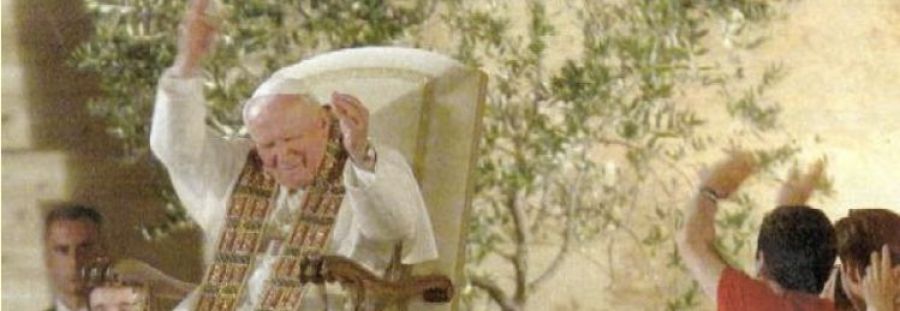
[Pope John Paul II, General Audience, 15 January 1992]

83 Last modified on Thursday, 30 April 2026 04:14
don Giuseppe Nespeca

Giuseppe Nespeca è architetto e sacerdote. Cultore della Sacra scrittura è autore della raccolta "Due Fuochi due Vie - Religione e Fede, Vangeli e Tao"; coautore del libro "Dialogo e Solstizio".

Email This email address is being protected from spambots. You need JavaScript enabled to view it.
As sometimes happens in the Gospel, faced with the trap set for him by his enemies, Jesus, with his response, rises above the contingent controversy and goes far beyond the particular and mutually divergent positions (John Paul II)
Come talora accade nel Vangelo, di fronte al tranello mossogli dai suoi nemici, Gesù, con la sua risposta, s’innalza al di sopra della polemica contingente e va ben oltre le posizioni particolari e tra loro divergenti (Giovanni Paolo II)
This Name clearly expresses that the God of the Bible is not some kind of monad closed in on itself and satisfied with his own self-sufficiency but he is life that wants to communicate itself, openness, relationship [Pope Benedict]
Questo nome esprime dunque chiaramente che il Dio della Bibbia non è una sorta di monade chiusa in se stessa e soddisfatta della propria autosufficienza, ma è vita che vuole comunicarsi, è apertura, relazione [Papa Benedetto]
There, however, in the place that should have been taken up by the encounter between God and man, he found livestock merchants and money-changers who occupied this place of prayer with their commerce […] In the temple's purification, however, it was a matter of more than fighting abuses. A new time in history was foretold (Pope Benedict)
Ma là dove doveva esservi lo spazio dell’incontro tra Dio e l’uomo, Egli trova commercianti di bestiame e cambiavalute che occupano con i loro affari il luogo di preghiera […] Nella purificazione del tempio, però, si tratta di più che della lotta agli abusi. È preconizzata una nuova ora della storia (Papa Benedetto)
«Ask Jesus for the grace to follow him closely», so as not to leave him alone, thus overcoming the temptations of looking at ourselves to «share the cake» of personal interests [Pope Francis]
«Chiedere a Gesù la grazia di seguirlo da vicino», per non lasciarlo solo, superando così le tentazioni di guardare noi stessi per «spartirsi la torta» degli interessi personali [Papa Francesco]
First, in Nazareth, he makes him grow, raises him, educates him, but then follows him: "Your mother is there" (Pope Francis)
Prima, a Nazareth, lo fa crescere, lo alleva, lo educa, ma poi lo segue: “La tua madre è lì” (Papa Francesco)
Unity is not made with glue [...] The great prayer of Jesus is to «resemble» the Father (Pope Francis)
L’Unità non si fa con la colla […] La grande preghiera di Gesù» è quella di «assomigliare» al Padre (Papa Francesco)
Divisions among Christians, while they wound the Church, wound Christ; and divided, we cause a wound to Christ: the Church is indeed the body of which Christ is the Head (Pope Francis)
Le divisioni tra i cristiani, mentre feriscono la Chiesa, feriscono Cristo, e noi divisi provochiamo una ferita a Cristo: la Chiesa infatti è il corpo di cui Cristo è capo (Papa Francesco)
The glorification that Jesus asks for himself as High Priest, is the entry into full obedience to the Father, an obedience that leads to his fullest filial condition [Pope Benedict]
La glorificazione che Gesù chiede per se stesso, quale Sommo Sacerdote, è l'ingresso nella piena obbedienza al Padre, un'obbedienza che lo conduce alla sua più piena condizione filiale [Papa Benedetto]

Due Fuochi due Vie - Vol. 1 Due Fuochi due Vie - Vol. 2 Due Fuochi due Vie - Vol. 3 Due Fuochi due Vie - Vol. 4 Due Fuochi due Vie - Vol. 5 Dialogo e Solstizio I fiammiferi di Maria

duevie.art

don Giuseppe Nespeca

Tel. 333-1329741


Disclaimer

Questo blog non rappresenta una testata giornalistica in quanto viene aggiornato senza alcuna periodicità. Non può pertanto considerarsi un prodotto editoriale ai sensi della legge N°62 del 07/03/2001.
Le immagini sono tratte da internet, ma se il loro uso violasse diritti d'autore, lo si comunichi all'autore del blog che provvederà alla loro pronta rimozione.
L'autore dichiara di non essere responsabile dei commenti lasciati nei post. Eventuali commenti dei lettori, lesivi dell'immagine o dell'onorabilità di persone terze, il cui contenuto fosse ritenuto non idoneo alla pubblicazione verranno insindacabilmente rimossi.






