


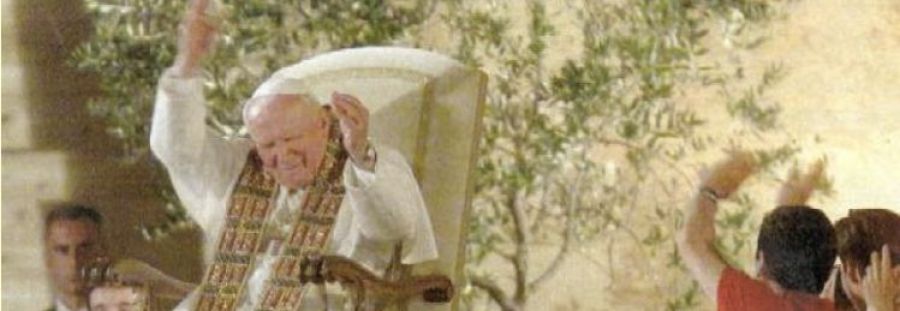
As a pilgrim to the 46th International Eucharistic Congress, I turn my steps first to the ancient Cathedral of Wrocław in order to kneel with faith before the Blessed Sacrament — the "Bread of Life". I do so with deep emotion and heartfelt gratitude to Divine Providence for the gift of this Congress and the fact that it is taking place here, in Wrocław, in Poland — in my homeland.
After the miraculous multiplication of the loaves, Christ says to the crowds who were seeking him: "Truly, truly I say to you, you seek me, not because you saw signs, but because you ate your fill of the loaves. Do not labour for the food which perishes, but for the food which endures to eternal life, which the Son of man will give to you" (Jn 6:26-27). How difficult it was for Jesus' hearers to make this passage from the sign to the mystery indicated by that sign, from daily bread to the bread "which endures to eternal life"! Nor is it easy for us, the people of the twentieth century. Eucharistic Congresses are celebrated precisely for this reason, to remind the whole world of this truth: "Do not labour for the food which perishes, but for the food which endures to eternal life".
Jesus' hearers, continuing the dialogue, rightly ask, "What must we do, to be doing the works of God?" (Jn 6:28). And Christ answers: "This is the work of God, that you believe in him whom he has sent" (Jn 6:29). It is an exhortation to have faith in the Son of man, in the Giver of the food which does not perish. Without faith in him whom the Father has sent, it is not possible to recognize and accept this Gift which does not pass away. This is the very reason why we are here — here in Wrocław, at the 46th International Eucharistic Congress. We are here in order to profess, together with the whole Church, our faith in Christ the Eucharist, in Christ — the living bread and the bread of life. With Saint Peter we say: "You are the Christ, the Son of the living God" (Mt 16:16) and again: "Lord, to whom shall we go? You have the words of eternal life" (Jn 6:68).
2. "Lord, give us this bread always" (Jn 6:34).
The miraculous multiplication of the loaves had not evoked the expected response of faith in those who had been eyewitnesses of that event. They wanted a new sign: "Then what sign do you do, that we may see, and believe? What work do you perform? Our fathers ate the manna in the wilderness; as it is written: He gave them bread from heaven to eat'" (Jn 6:30-31). The disciples gathered around Jesus thus expect a sign like the manna which their ancestors had eaten in the desert. But Jesus exhorts them to expect something more than a mere repetition of the miracle of the manna, to expect a different kind of food. Christ says: "It was not Moses who gave you the bread from heaven; my Father gives you the true bread from heaven. For the bread of God is that which comes down from heaven and gives life to the world" (Jn 6:32-33).
Along with physical hunger man has within him another hunger, a more basic hunger, which cannot be satisfied by ordinary food. It is a hunger for life, a hunger for eternity. The sign of the manna was the proclamation of the coming of Christ who was to satisfy man's hunger for eternity by himself becoming the "living bread" which "gives life to the world". And see: those who heard Jesus ask him to fulfil what had been proclaimed by the sign of the manna, perhaps without being conscious of how far their request would go: "Lord, give us this bread always" (Jn 6:34). How eloquent is this request! How generous and how amazing is its fulfilment. "I am the bread of life; he who comes to me shall not hunger, and he who believes in me shall never thirst... For my flesh is food indeed, and my blood is drink indeed. He who eats my flesh and drinks my blood abides in me, and I in him" (Jn 6:35,55-56). "He who eats my flesh and drinks my blood has eternal life, and I will raise him up at the last day' (Jn 6:54).
What a great dignity has been bestowed on us! The Son of God gives himself to us in the Most Holy Sacrament of his Body and Blood. How infinitely great is God's generosity! He responds to our deepest desires, which are not only desires for earthly bread, but extend to the horizons of life eternal. This is the great mystery of faith!
3. "Rabbi, when did you come here?" (Jn 6:54).
This was the question put to Jesus by those who sought him after the miraculous multiplication of the loaves. We too ask this same question today, in Wroclaw. It is the question asked by everyone taking part in the International Eucharistic Congress. And Christ answers us: I came when your ancestors received Baptism, at the time of Mieszko I and of Boleslas the Brave, when Bishops and priests began to celebrate in this land the "mystery of faith" which brought together all those who hungered for the bread which gives eternal life.
This was how Christ came to Wrocław over a thousand years ago, when the Church was born here and Wrocław became an episcopal see, one of the first in the territories of the Piast. In the course of the centuries Christ came to all the places on the earth from which those taking part in this Eucharistic Congress have come. And from that time on he has continued to be present in the Eucharist, always equally silent, humble and generous. Truly, "having loved those who were his own in the world, he loved them to the end" (Jn 13:1).
Now, on the threshold of the Third Millennium, we wish to give a particular expression to our gratitude. This Eucharistic Congress in Wroclaw has an international dimension. Taking part in it are not only the faithful of Poland, but faithful from throughout the world. Together we all want to express our deep faith in the Eucharist and our fervent gratitude for the Eucharistic food which for almost two thousand years has nourished whole generations of believers in Christ. How inexhaustible and available to all is the treasury of God's love! How enormous is our debt to Christ the Eucharist! We realize this and we cry out with Saint Thomas Aquinas: "Quantum potes, tantum aude: quia maior omni laude, nec laudare sufficis", "Dare all thou canst, thou hast no song, worthy his praises to prolong, so far surpassing powers like thine" (Lauda Sion).
These words express very well the attitude of all taking part in this Eucharistic Congress. In these days we seek to give the Lord Jesus in the Eucharist the honour and glory which he deserves. Let us strive to thank him for his presence, because for nearly two thousand years he has remained in our midst.
"We give you thanks, our Father...
You have graciously given us
spiritual food and drink
and life eternal
through Jesus your servant.
To you be glory for ever!" (cf. Didache).
[John Paul II, homily in Wroclaw 31 May 1997]








